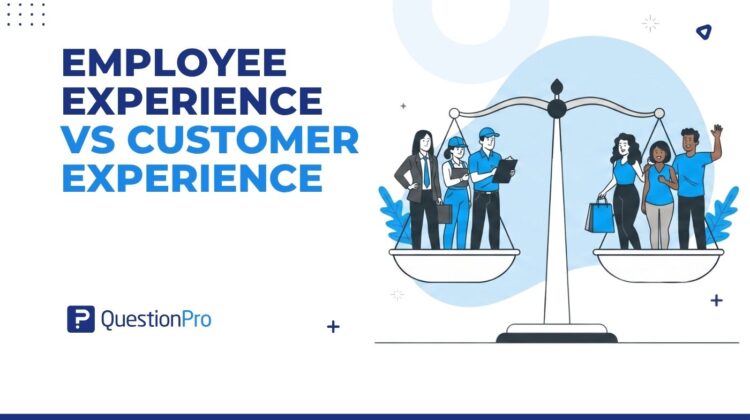
Employee experience vs customer experience is one of the oldest debates in business strategy. For decades, the answer seemed obvious: customers come first, because revenue depends on their loyalty. Every process, hire, and campaign lined up behind that single idea.
That thinking is shifting. Newer workforce data shows employee experience often drives customer outcomes more directly than the reverse. Companies that ignore this link risk investing in the wrong side of the equation.
In this article, we’ll explain what each experience actually means and what the data says about which one moves the needle. Then we’ll cover how to build a strategy that strengthens both.
What are employee experience and customer experience?
Employee experience (EX) is the sum of what an employee sees, feels, and encounters at every stage of working for an organization, from recruitment through exit. Customer experience (CX) is the sum of every interaction a customer has with a brand, from first contact through post-purchase support. Both are measured and managed through dedicated programs, but they serve different audiences and different business goals.
| Attribute | Employee experience (EX) | Customer experience (CX) |
|---|---|---|
| Definition | The journey an employee takes with an organization | Sum of interactions a customer has with a brand |
| Focus | Culture, engagement, growth | Satisfaction, loyalty, retention |
| Primary metric | Employee Net Promoter Score (eNPS) | Net Promoter Score (NPS) |
| Journey stage | Hire to exit | Awareness to advocacy |
EX is often confused with employee engagement, which measures motivation at a single point in time. Employee experience is broader. It covers the entire journey, not just how engaged someone feels this quarter. CX is similarly distinct from user experience (UX), which focuses narrowly on product or website usability rather than the full customer relationship.
Why the “customers first” mindset is being challenged
For years, corporate strategy assumed customer experience alone justified the investment. Recent research complicates that assumption.
Forrester’s 2025 Global Customer Experience Index found that a quarter of US brands saw their CX scores fall for a second straight year, while only 7% improved. The report noted that the gap between the experience brands promise and what customers actually receive keeps growing.
Employee engagement is falling at the same time. Gallup’s 2026 State of the Global Workplace report, cited on gallup.com, found worldwide engagement dropped to 20%, a second consecutive annual decline. Forrester’s newer Total Experience research puts a number on the connection between the two. Organizations that align brand, customer, and employee experience together see revenue gains as high as 5.1 times in assets per customer, according to Forrester’s 2026 Total Experience Score report. The same research found that 37% of US brands now have a negative employee experience impact on their overall customer results.
Customer experience rarely improves in isolation. It tends to improve when the people delivering it feel supported.
How employee experience impacts customer experience: what the data shows
QuestionPro’s analysis of more than 700,000 employee experience benchmarks points to a similar conclusion. The research looked at what actually moves Employee Net Promoter Score (eNPS), a single-question metric scored 0 to 10 that gauges how likely employees are to recommend their employer.
The factors with the biggest positive impact on eNPS were:
- Supportive teams and strong collaboration
- A clear sense of purpose and meaningful work
- Investment in inclusion and belonging
- Open, two-way communication
The factors that dragged eNPS down included clunky internal processes, weak knowledge-sharing across teams, and centralized decision-making that shuts out the people closest to the problem. One more factor stood out: an over-focus on customer loyalty without a balanced, employee-first mindset. Chasing customer scores while ignoring the workforce behind them tends to backfire on both fronts.
Employee experience vs customer experience: who should come first?
The honest answer is neither wins outright. Treating employee experience and customer experience as competing priorities creates the same trap the old either/or debate always created.
A more useful question is where to start. Service-heavy businesses, where employees interact with customers directly, tend to see faster returns from investing in employee experience first. Retail, hospitality, call centers, and healthcare fall into this category, since frontline morale shows up immediately in service quality.
Product-led businesses, where customers rarely interact with staff, may get more immediate value from customer experience investment. A software company with a highly automated purchase flow has fewer employee touchpoints shaping the customer’s perception.
Three questions help decide where to focus first:
| Question to ask | What it signals |
|---|---|
| How much direct contact do employees have with customers? | Service-heavy roles usually see faster returns from EX investment |
| Which score, eNPS or NPS, has declined more recently? | The lagging score often points to where to intervene first |
| Where is turnover or churn creating the bigger financial risk? | The costlier problem usually deserves budget first |
Company size matters too. A 20-person startup can usually run informal check-ins for both employees and customers without dedicated software. A 2,000-person enterprise needs structured surveys and a shared reporting cadence, or the two experiences drift apart without anyone noticing until scores fall.
Whichever team starts, the goal should be closing the gap between EX and CX investment within one planning cycle, not letting one experience run years ahead of the other.
Real-world examples of aligning employee and customer experience
Southwest Airlines built its brand on affordable, enjoyable air travel for customers. Internally, founder Herb Kelleher was known for prioritizing employees first, on the belief that a well-treated team delivers better service without being told to. The airline still limits certain customer requests, such as assigned seating, when honoring them would add cost or friction for staff.
Intuit takes a different approach. Rather than ranking customers, employees, and stakeholders against each other, the company designs decisions to create a win for all three groups at once. That balance has helped Intuit turn a category as unglamorous as tax software into both a respected employer brand and a customer favorite.
The pattern across both examples is the same. Neither company treats EX and CX as a zero-sum choice. They treat the two as connected systems that succeed or fail together.
Smaller organizations show the same pattern on a different scale. A regional healthcare provider that raises pay and staffing on its busiest units usually sees patient satisfaction scores move within a quarter or two. Patients notice when nurses are less rushed and less burned out.
Step-by-step guide to measuring and aligning EX and CX
Aligning employee and customer experience starts with measurement, not opinion. Here is a practical sequence most organizations can follow.
- Track eNPS and NPS side by side, not in separate reports, so leadership sees both trends together
- Segment eNPS by team, tenure, and location to catch problems before they surface in customer data
- Map moments where employee experience directly shapes a customer touchpoint, such as onboarding calls or support tickets
- Set a shared review cadence so HR and CX teams look at both scores in the same meeting
- Close the loop on both sides, since an unresolved employee complaint and an unresolved customer complaint carry the same weight
Platforms such as the QuestionPro Employee Experience platform make this easier, since eNPS and NPS data can sit on shared dashboards for HR and CX teams to review together, using the same underlying Net Promoter Score framework.
Common mistakes when prioritizing one experience over the other
Even well-intentioned strategies break down in predictable ways. These mistakes show up most often when one experience gets all the budget and attention.
| Mistake | Why it backfires |
|---|---|
| Measuring customer satisfaction quarterly while employee sentiment goes unmeasured for a year or more | Problems surface in service quality before anyone has data to explain them |
| Rewarding frontline managers for customer scores alone | Removes accountability for the team turnover driving those scores down |
| Treating employee experience surveys as a compliance exercise | Turns a planning input into paperwork nobody acts on |
| Assuming a strong eNPS automatically means customers are happy | Two scores can move independently without a shared review process |
| Cutting employee experience budgets first during a downturn | Customer experience scores often slip months later, once the cause is harder to trace |
Avoiding these mistakes takes less effort than fixing the fallout. Most of them come down to reviewing one score without ever looking at the other.
None of these mistakes require a large budget to fix. They require a habit change: put eNPS and NPS on the same page, reviewed by the same people, on the same schedule. Organizations that make that one change tend to catch problems on either side months earlier than organizations that keep the two scores in separate reports.
The real advantage comes from treating both as one system
Businesses that keep asking whether customers or employees come first are solving the wrong problem. The data increasingly points to a different question: how connected are the two experiences inside your organization today?
Every customer interaction is shaped, directly or indirectly, by someone’s employee experience that day. Every employee’s sense of purpose is shaped, at least in part, by how customers treat them in return.
Organizations that look at real employee experience examples tend to find the same lesson: treating EX and CX as one connected system, measured and reviewed together, outperforms treating them as a competition. That broader approach is sometimes called Total Experience, and it is becoming the standard way analysts now score brand performance.
Frequently Asked Questions (FAQs)
Neither experience outranks the other on its own. Forrester’s research on US brands shows that employee experience now directly affects customer scores, since frontline morale carries into service quality, retention, and how consistently a brand delivers on its promises.
Employee experience is typically owned by HR and tracked through eNPS, engagement, and exit data. Customer experience is usually owned by CX or marketing teams and tracked through NPS, CSAT, and retention. The two rarely share a dashboard.
Yes, and it doesn’t require separate software budgets. A short quarterly eNPS pulse survey paired with an ongoing NPS survey covers both sides for most small and mid-sized US companies, as long as someone reviews both scores together instead of filing them separately.
High employee turnover forces customer-facing teams to rely on newer, less experienced staff, which tends to lower CSAT and NPS scores during the transition. Tracking eNPS alongside turnover data can flag a coming customer experience dip before it shows up in survey results.
Total experience (TX) is a management approach that combines employee experience, customer experience, and user experience into one connected strategy instead of three separate ones. Forrester’s Total Experience Score tracks this alignment across brands and links it directly to revenue growth.