An eNPS survey tool turns one simple question into a clear read on how employees really feel about working for you. Global employee engagement sits at just 20 percent, according to Gallup’s 2026 State of the Global Workplace report, and that gap costs the world economy an estimated 10 trillion dollars a year in lost productivity. A reliable eNPS platform helps you catch disengagement early, before it turns into turnover.
Picking the right tool matters as much as asking the right question. Some platforms build eNPS into a full employee engagement program, while others bolt it onto a general survey builder.
In this guide, we’ll compare 12 of the best eNPS survey tools for 2026, walk through how to run a survey step by step, and cover the mistakes that quietly wreck response rates.
What is an eNPS survey tool?
An eNPS survey tool is software that measures employee loyalty by asking a single question and automatically calculating a score between -100 and +100.
Employee Net Promoter Score, or eNPS, is a workplace metric adapted from the customer-focused Net Promoter Score (NPS). Both measure how likely someone is to recommend something to others, though eNPS focuses on employees recommending their workplace rather than customers recommending a brand.
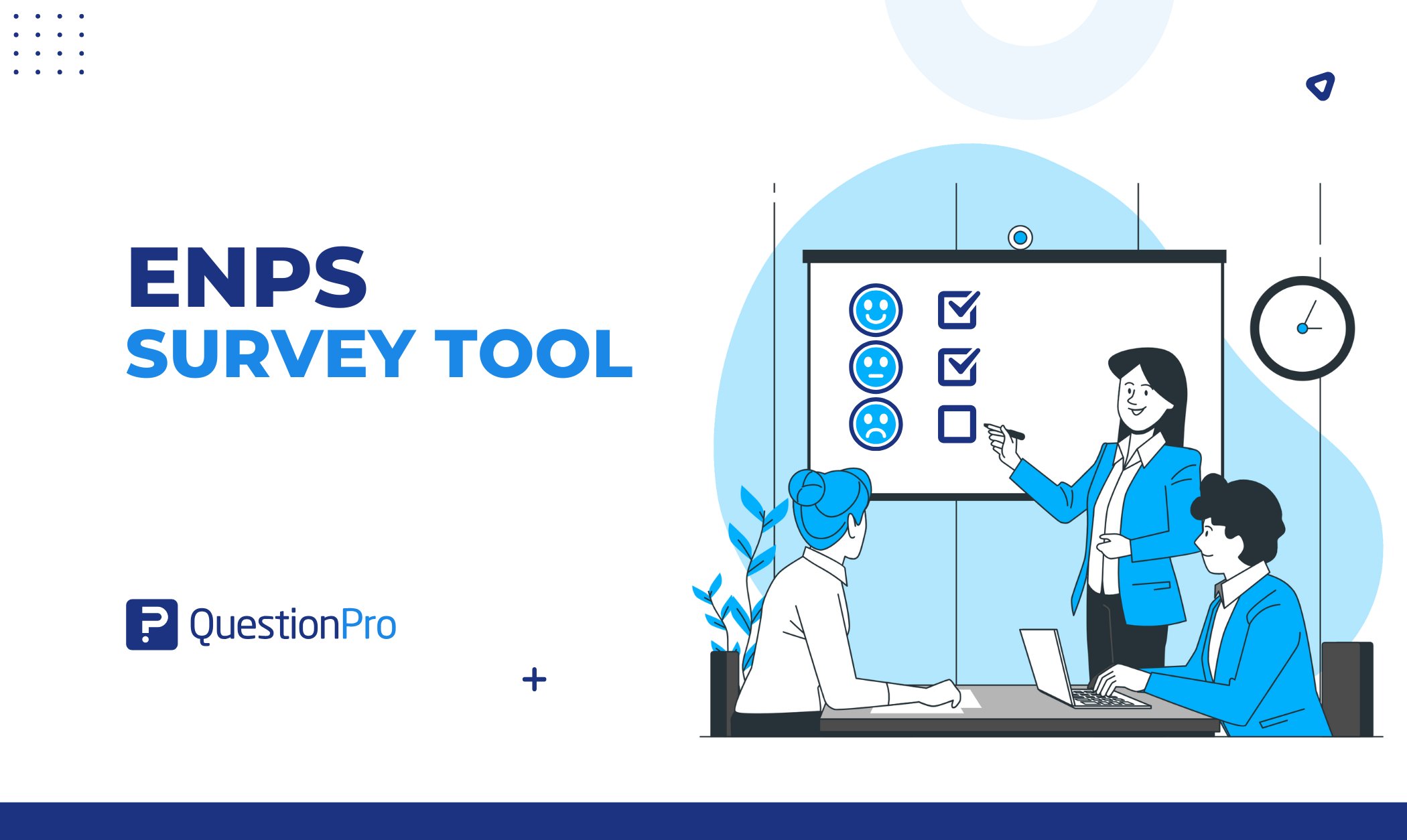
The standard eNPS question reads: “On a scale of 0 to 10, how likely are you to recommend this company as a place to work?” Based on their answer, employees fall into one of three groups.
- Promoters (9-10): Loyal employees who actively recommend the company
- Passives (7-8): Satisfied employees who are unlikely to promote or criticize
- Detractors (0-6): Unhappy employees who may discourage others from joining
To calculate the score, subtract the percentage of detractors from the percentage of promoters.
Here’s a quick example. A 200-person company surveys its staff and gets 60 percent promoters, 25 percent passives, and 15 percent detractors. The eNPS would be 60 minus 15, or +45, a strong result that suggests most employees would recommend the company as a workplace.
eNPS vs. NPS: What’s the difference?
eNPS and NPS share the same 0-to-10 scale and scoring formula, but they measure loyalty from two different audiences.
NPS asks customers whether they would recommend a product or service. eNPS asks employees whether they would recommend their employer. The distinction matters because a company can score well on one and poorly on the other, and each points to a different set of fixes.
| Aspect | NPS | eNPS |
|---|---|---|
| Who answers | Customers | Employees |
| What it measures | Likelihood to recommend a product or service | Likelihood to recommend the workplace |
| Typical frequency | Ongoing or transactional | Quarterly or twice a year |
| Who acts on results | Sales, marketing, and CX teams | HR and people leaders |
| Common companion metric | Customer satisfaction score | Employee engagement score |
Many organizations track both scores side by side. A rising eNPS alongside a falling NPS often signals that internal culture problems are starting to show up in customer-facing work.
What to look for in an eNPS survey tool
The best eNPS survey tool fits how your team actually works, not just what looks good in a demo. A handful of features separate the platforms that get used every cycle from the ones that get abandoned after one survey.
- Anonymity controls: Configurable group-size thresholds that protect individual identities while still showing team-level trends
- Real-time dashboards: Live results instead of static reports, so managers can spot problems as they emerge
- Benchmarking: Built-in comparisons against industry or company-size averages for context
- Automation: Scheduled, recurring surveys that don’t need manual setup every quarter
- Open-text follow-ups: A prompt asking why, since the number alone rarely explains the story behind it
- Integrations: Connections to Slack, Microsoft Teams, or your HRIS so surveys reach people where they already work
Not every organization needs all six. A 15-person startup running its first eNPS survey can get by with a free tool and a simple spreadsheet for tracking trends. A 2,000-person enterprise with multiple locations usually needs benchmarking and role-based dashboards from day one, since a single company-wide average hides which offices or teams actually need attention. Match the feature list to your current size, not the size you hope to reach in three years.
12 Best eNPS survey tools for HR teams in 2026
Here are 12 eNPS survey tools worth evaluating in 2026, ranging from dedicated employee experience platforms to general-purpose survey builders that support eNPS. The list mixes categories on purpose: a startup comparing free options and an enterprise HR team comparing platforms with benchmarking will land in different places, and it helps to see both ends before narrowing down.
1. QuestionPro Employee Experience
QuestionPro Employee Experience is a full people-experience platform built to measure engagement, loyalty, and satisfaction through eNPS and related surveys.
Key features:
- Ready-to-use eNPS survey templates
- 360-degree feedback
- Anonymous response collection
- Real-time dashboards and segmentation
- Integrations with HR tools and Slack
Best for: Teams that want eNPS tied into a broader employee experience program rather than a standalone survey.
2. SurveySparrow
SurveySparrow uses a conversational, chat-like format that feels less like a form and more like a quick exchange.
Key features:
- Customizable eNPS templates
- Chat-style survey flow
- Automated recurring surveys
- Mobile-friendly, multi-language support
Best for: Organizations that want higher completion rates through a more engaging survey format.
3. Typeform
Typeform is known for a clean, one-question-at-a-time design that keeps surveys short and visually simple.
Key features:
- Logic jumps for follow-up questions
- Integrations with Slack and Google Sheets
- Works well across desktop and mobile
Best for: Teams that care about survey design and want a polished respondent experience.
4. Qualtrics EmployeeXM
Qualtrics EmployeeXM is an enterprise employee experience platform that covers the full employee lifecycle, with eNPS as one part of a larger system.
Key features:
- Advanced eNPS and engagement tracking
- Role-based dashboards
- AI-powered text analysis
- Enterprise-level data security
Best for: Large organizations that need predictive analytics and deep lifecycle data alongside eNPS.
5. Google Forms
Google Forms is a free tool that can run a basic eNPS survey without any setup cost.
Key features:
- Simple, no-cost survey creation
- Responses tracked automatically in Google Sheets
- Easy sharing by link or email
Best for: Small teams or startups that want a no-frills way to test eNPS before investing in dedicated software.
6. TinyPulse
TinyPulse focuses on frequent, lightweight pulse surveys, with eNPS built in as a core metric.
Key features:
- Built-in eNPS tracking
- Weekly anonymous pulse surveys
- Peer recognition tools
- Slack and Microsoft Teams integration
Best for: Companies that want frequent, bite-sized feedback rather than a single annual survey.
7. SurveyMonkey
SurveyMonkey offers pre-built eNPS templates inside a broad, general-purpose survey builder.
Key features:
- Pre-built eNPS questions
- Automated scheduling
- Custom branding
- Integrations with Salesforce and Slack
Best for: Small to mid-sized teams that want an easy, familiar tool without a steep learning curve.
8. Workleap
Workleap combines eNPS with broader engagement tracking, manager reporting, and culture tools.
Key features:
- Automated eNPS surveys
- Anonymous feedback system
- Trend tracking and manager dashboards
Best for: HR leaders who want eNPS alongside ongoing culture and engagement insights.
9. Zonka Feedback
Zonka Feedback supports eNPS across multiple channels, including email, web, mobile, and kiosk.
Key features:
- Ready-to-use eNPS templates
- Multi-channel survey distribution
- Real-time response alerts
- Filterable analytics
Best for: Organizations that need feedback from both desk-based and frontline employees.
10. Lattice
Lattice is a people-success platform that pairs eNPS with performance and growth tools.
Key features:
- eNPS and engagement surveys
- Automated workflows
- Integrations with existing HR systems
Best for: Teams that want eNPS connected to performance reviews and career development.
11. Culture Amp
Culture Amp is a research-backed employee experience platform known for its engagement benchmarking.
Key features:
- eNPS with industry benchmark comparisons
- Structured engagement survey library
- Manager-level reporting
Best for: Organizations that want to compare their eNPS against a large benchmark dataset.
12. Leapsome
Leapsome connects eNPS to performance management and continuous listening in one platform.
Key features:
- Continuous listening surveys
- AI-assisted engagement trend analysis
- Goal and performance tracking integration
Best for: Teams that want eNPS data feeding directly into performance and development conversations.
Quick comparison of eNPS survey tools
The table below summarizes what each tool is best for, along with approximate starting pricing. Figures are publicly listed and may change, so confirm current pricing directly with each vendor.
| Tool | Best for | Key eNPS feature | Starting price |
|---|---|---|---|
| QuestionPro Employee Experience | Full employee experience programs | 360-degree feedback plus eNPS templates | From $99/month |
| SurveySparrow | Engaging, chat-style surveys | Conversational eNPS flow | From $19/month |
| Typeform | Clean survey design | Logic-based follow-ups | From $29/month |
| Qualtrics EmployeeXM | Enterprise lifecycle data | AI text analysis | Custom pricing |
| Google Forms | Free, basic surveys | No-cost eNPS forms | Free |
| TinyPulse | Frequent pulse surveys | Weekly anonymous pulses | Custom pricing |
| SurveyMonkey | Familiar, general-purpose builder | Pre-built eNPS templates | From $39/month |
| Workleap | Culture and engagement tracking | Manager dashboards | From $3.50/user/month |
| Zonka Feedback | Multi-channel feedback | Offline and kiosk support | From $24/month |
| Lattice | Performance-linked eNPS | Automated workflows | From $4/user/month |
| Culture Amp | Benchmark-heavy reporting | Industry benchmarking | Custom pricing |
| Leapsome | Performance plus continuous listening | AI trend analysis | Custom pricing |
How to run an eNPS survey step by step
Running an eNPS survey well takes more than sending out a single question. These six steps cover the process from planning to follow-up.
- Set a clear objective.
Decide whether you’re measuring overall sentiment, testing a specific team, or tracking change after a policy shift. A vague goal usually leads to a survey nobody acts on afterward. - Choose your eNPS survey tool.
Pick a platform that matches your team size, budget, and need for anonymity or integrations, using the feature checklist above as a starting point. Many general-purpose platforms, including QuestionPro Survey Software, support a single eNPS question without needing a dedicated employee experience suite. - Write the question clearly.
Stick close to the standard wording so your results stay comparable over time, and avoid adding extra context that could bias the answer. - Guarantee anonymity.
Tell employees explicitly how their responses will and won’t be used before you send the survey, and repeat that message in the survey invitation itself. - Send and follow up.
Distribute through email, Slack, or your HRIS, and send one reminder roughly three days later to lift response rates without becoming a nuisance. - Analyze and act.
Calculate the score, read the open-text comments for patterns, and share at least one concrete action with employees within a few weeks of closing the survey.
Common eNPS survey mistakes to avoid
A low response rate or a confusing score usually traces back to one of a few avoidable mistakes.
- Skipping the follow-up question.
The score alone doesn’t explain why employees answered the way they did, so the open-text comment is often the most useful part of the survey. - Running surveys too often.
Monthly eNPS surveys can create fatigue and lower response quality; quarterly or twice a year usually works better for most organizations. - Promising anonymity you can’t deliver.
Small team sizes can make individual responses identifiable, which erodes trust fast once someone figures out who said what. - Never sharing results.
Employees who never hear what happened to their feedback stop bothering to give it, and response rates drop with every cycle that goes unacknowledged. - Comparing scores against unrelated benchmarks.
An eNPS of +20 might be strong in one industry and weak in another, so context always matters more than the raw number.
How QuestionPro works as an eNPS survey tool
QuestionPro fits into an eNPS program at the point where most teams get stuck: turning a single score into an ongoing feedback habit.
Surveys go out through email, SMS, or an internal portal, with unique anonymous links so remote and in-office employees respond the same way. Results land in real-time dashboards that break scores down by team, tenure, or location, which makes it easier to see where loyalty is highest, not just what the company-wide average looks like.
Because anonymity is handled at the platform level, HR teams don’t have to build their own workarounds to protect respondent identity. The goal isn’t the score itself. It’s catching a downward trend early enough to protect employee retention before a dip turns into resignations.
Teams that outgrow a single annual eNPS check can layer in shorter pulse surveys between cycles without switching tools, which keeps the data comparable over time instead of starting over on a new platform every year or two.
Turning eNPS scores into a better workplace
A high eNPS score feels good, but it only matters if it changes what happens next. The number tells you where employees stand today. What you do with the open-text comments and the trend over time is what actually shapes workplace culture.
Pick a tool that fits your team’s size and habits, ask the question consistently, and treat every survey cycle as the start of a conversation rather than the end of one.
Frequently Asked Questions (FAQs)
A score above 0 is generally considered acceptable, above 30 is strong, and above 50 is excellent. Context matters more than the raw number, since industry, company size, and survey timing all shift what counts as a healthy benchmark.
Most US organizations run eNPS quarterly or twice a year. High-growth teams sometimes go monthly during major change, such as a merger or a return-to-office policy, then scale back once things stabilize.
Yes. Free options like Google Forms work for teams under 20 people, though anonymity becomes harder to guarantee at that size. Paid tools with configurable group thresholds are safer once a team grows past roughly 30 employees.
Yes, as long as the distribution channel reaches everyone equally. Email and SMS-based tools tend to work better than in-office kiosks for hybrid teams, since remote employees need the same access as those on-site.
Not immediately, but persistent low scores correlate with higher turnover risk over time. A single low reading is a signal to investigate, not a guaranteed predictor of resignations on its own.