Market research for startups is the process of testing demand, understanding customers, studying competitors, and reducing risk before you build or launch. It does not have to be expensive. Public data, customer interviews, short surveys, online communities, and small demand tests can tell a founder more than a costly report ever could.
Many startups fail because they build for the wrong audience or solve a problem people will not pay to fix. Good research helps you catch that early. You do not need a research budget. You need clear questions, honest feedback, and a process that separates real demand from polite interest.
In this article, we’ll explore actionable, low-cost method steps and tools to validate your idea, run effective customer interviews, measure real purchase intent, and avoid the most common validation pitfalls founders face before spending money on development.
What is market research for startups?
Market research for startups is the process of collecting and analyzing information about customers, competitors, demand, pricing, and market conditions before building or scaling a business.
For a founder, it answers practical questions:
- Who has the problem?
- How painful is the problem?
- What are people using now instead?
- What would make them switch?
- How much would they pay?
- Which customer segment should you start with?
- Is the market large enough to support the business?
The goal is not to prove your idea is perfect. The goal is to find the truth early enough to change course cheaply.
Why do startups need market research before launching?
Startups need market research before launching because assumptions are expensive once they turn out wrong. A founder might assume customers want a certain feature, price, or message, when in fact customers see the problem differently or already have a workaround they are happy with.
In the US, where startup competition is high and customer acquisition costs can climb fast, early research prevents wasted spend. It helps founders focus on the right audience, offer, and go-to-market approach before a single ad dollar goes out. The U.S. Small Business Administration notes that market research helps a business find customers, while competitive analysis helps that business become unique. Combining both is what creates a real competitive edge.
Market research helps startups test ideas before launch, identify the right target customers, understand competitor gaps, estimate demand, learn what people will actually pay, and avoid building features nobody asked for.
What are the main types of startup market research?
Startup market research usually combines four approaches, and most founders end up using all four at different stages.
Secondary research uses existing information, such as government data, industry reports, trade associations, and competitor websites. It is the best starting point because it is fast and low-cost, and it helps you understand market size and trends before you ever talk to a customer.
Primary research is information you collect directly from your target audience through surveys, interviews, or prototype tests. It is useful because it ties feedback directly to your specific idea and offer, rather than the market in general.
Qualitative research explores motivations and pain points in people’s own words, usually through interviews or open-ended survey questions. It explains why people care, or do not care, about a problem.
Quantitative research collects measurable data from a larger group through surveys, polls, or pricing tests. It shows how common a need or preference is across your target audience, which qualitative interviews alone cannot do.
How do you do market research for a startup step by step?
A startup can do market research by writing down assumptions, checking public data, talking to real customers, testing demand, and using the findings to sharpen the idea.
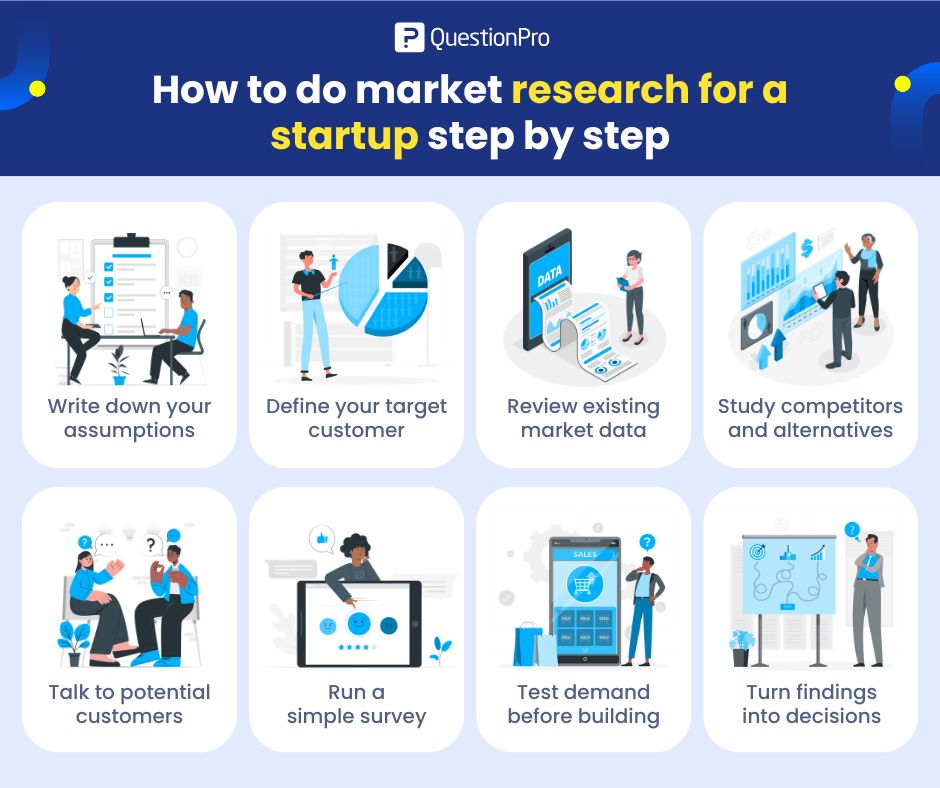
- Write down your assumptions.
List what you believe to be true about your customer, their problem, and what they would pay. These assumptions become your research questions.
- Define your target customer.
Avoid “everyone” as an audience. Use specifics like role, industry, company size, location, and buying trigger, for example, “US-based service businesses with 5 to 25 employees that manage appointments manually.”
- Review existing market data.
Use the U.S. Census Bureau, SBA resources, industry reports, and competitor review sites to see whether the market is real before you invest in primary research.
- Study competitors and substitutes.
Look beyond direct competitors to alternatives like spreadsheets, manual workarounds, or free tools, and note pricing, positioning, and complaints.
- Talk to potential customers.
Ask about current behavior, not opinions about your idea. Behavior shows whether a problem is worth solving; opinions are easy to give and easy to ignore.
- Run a simple survey.
Keep it short. Ask about the problem, current behavior, decision criteria, budget, and purchase intent, and avoid leading questions that nudge people toward your preferred answer.
- Test demand before building.
Use landing pages, waitlists, pre-orders, or paid ad tests to see whether people take a real action, not just say something sounds interesting.
- Turn findings into decisions.
Research only matters if it changes your audience, offer, pricing, or launch plan. The strongest founders adjust quickly instead of defending the first idea.
What low-cost market research methods work for startups?
Low-cost methods can teach a startup more than a full research agency engagement, especially in the earliest stage. Useful options include:
- Reading competitor reviews on G2 or Capterra
- Searching Reddit, LinkedIn groups, and niche communities
- Reviewing Google Trends for category momentum
- Running short online surveys with 5 to 10 questions
- Interviewing 10 to 15 target customers
- Testing a simple landing page
- Running a small ad test with a fixed budget
- Reviewing free public data from the SBA and Census Bureau
- Asking sales or support teams about recurring customer questions
The strongest approach combines methods. Public data shows the market exists. Interviews explain the problem. Surveys measure how common it is. Demand tests show whether people will actually act.
What market research tools can startups use?
Market research tools should help founders learn about customers, competitors, and demand without adding cost or complexity they do not need yet. Useful categories include:
- Survey tools to collect structured feedback from target customers
- Interview and call-recording tools to organize customer conversations
- Trend tools like Google Trends to track search interest
- Competitor research tools to review pricing, positioning, and reviews
- Analytics tools to understand website behavior and traffic sources
- Landing page tools to test messaging and sign-ups
- Ad platforms to run small demand tests
- Public data tools for demographics and business trends
QuestionPro’s Market Research Software gives founders a way to build and distribute surveys, then analyze the responses without needing a data team.
What questions should startups ask potential customers?
Startups should ask questions that reveal behavior, pain, urgency, budget, and decision-making, not just whether someone likes an idea.
Strong customer research questions include: What problem are you trying to solve? How do you solve it today? What frustrates you about your current option? How much time or money does this problem cost you? What would make you switch? Who else is involved in the decision? What price would feel reasonable? How likely are you to buy in the next 30 days?
Avoid asking only whether people “like” the idea. Likes do not reliably become sales, and a founder who only collects likes will walk away with false confidence.
How is purchase intent different from general interest?
Purchase intent measures whether someone will take a real action, such as paying or signing up, while interest only measures whether an idea sounds appealing.
The distinction matters because interest is easy to give. A weak demand question like “Would you be interested in this product?” almost always gets a polite yes. A stronger question, such as “how likely are you to buy this solution in the next 30 days if it solves this problem,” forces a more honest answer. Customer validation means testing for the second kind of signal, through actions like landing page sign-ups, pre-orders, demo requests, or a completed pilot, not just verbal encouragement.
What does startup market research look like in practice?
A US-based founder building scheduling software for independent hair stylists assumed her core buyer was the stylist herself. Ten customer interviews told a different story: many stylists rent a chair inside a salon, and the salon owner, not the stylist, controls software purchases.
That single insight changed her target customer, her pricing model, and her onboarding flow before she wrote a line of code. A short survey to 40 salon owners confirmed the shift, showing stronger purchase intent from owners than from individual stylists. This is what good research is for. It does not just confirm an idea. It corrects it early, when the fix is still cheap.
How much does market research for startups cost?
Market research for startups can cost almost nothing at the start if founders use free public data, interviews, communities, and simple surveys. A low-cost research plan typically includes free secondary research from the SBA and Census, low-cost or free survey tools, customer interviews over video calls, competitor review analysis, and small ad or landing page tests.
The real cost is usually the founder’s time, and that time is worth spending if it prevents months of building the wrong product. Paid research makes more sense once a startup needs a larger sample, a hard-to-reach audience, or investor-ready evidence.
What mistakes should startups avoid in market research?
The most damaging mistake is using research to confirm what you already believe instead of challenging it. Other common mistakes include asking only friends and family, targeting too broad an audience, confusing interest with intent, and treating a small sample as final proof.
Startups also tend to ignore substitutes and competitors, use outdated market data, and change nothing after collecting feedback. If your team plans to run surveys, learning how to avoid survey bias can help you write cleaner questions and collect more reliable answers from the start.
How can QuestionPro help with market research for startups?
QuestionPro can help startups collect customer feedback, run surveys, test ideas, and analyze responses before launch. A founder can measure pain points, feature priorities, willingness to pay, and purchase intent, ideally after a handful of interviews have already clarified the core problem.
When a startup needs respondents beyond its own network, QuestionPro Audience can help reach a larger panel for customer validation and market testing. QuestionPro should not replace direct conversations with customers. It works best paired with interviews, secondary research, and small demand tests, and it fits naturally alongside a broader product-market fit survey once you have enough signal to test at scale.
Building for a real audience
Market research for startups is not about producing a polished report. It is about reducing risk before you spend months of time, money, and energy on the wrong idea.
Start with what you can learn for free, talk to real customers, test demand before you build, and let the results change your plan when they need to.
Frequently Asked Questions (FAQs)
Most founders start seeing repeated patterns after 10 to 15 interviews with people who match the target customer profile. Fewer than that risks drawing conclusions from a handful of outlier opinions rather than a real trend.
Yes, within limits. Free secondary research, customer interviews over video calls, community listening, and no-cost survey tiers can validate a problem and rough demand. A budget becomes useful later for larger samples or paid ad tests.
Market research explores who the customer is, what they need, and what the competitive landscape looks like. Market validation goes a step further and tests whether people will actually take action, like paying or signing up, for your specific solution.
Early-stage startups usually do research in-house to move fast and stay close to customers. A firm makes more sense later, when a decision carries high stakes, such as entering a new market, or when investors expect independent, third-party evidence.
Treat it as ongoing rather than a one-time project. Revisit assumptions after major product changes, new competitor entries, or every six to twelve months as the market and customer behavior shift.