A transactional survey captures feedback immediately after a specific interaction, such as a purchase, support call, or delivery. Unlike broad customer surveys, it focuses on a single moment. This makes transactional survey data easier to interpret and faster to act on, especially for teams in the USA managing high customer volume and tight service expectations.
This article explains what a transactional survey is, how it works, which metrics matter, when to use it, and how to apply best practices so results lead to real improvements.
What is a transactional survey?
A transactional survey is a short survey sent right after a customer completes a specific action. The goal is to measure how that single interaction felt, not how the customer feels about the brand overall.
Typical triggers include:
- Completing an online purchase
- Contacting customer support
- Receiving a product delivery
- Finishing onboarding or setup
- Attending a service appointment
Because the feedback is collected immediately, responses are based on fresh memory rather than general impressions.
Learn more: Online purchasing survey questions and aample questionnaire template
How does a transactional survey work
Transactional surveys are event-based. A survey is triggered automatically when a defined interaction ends.
For example:
- A CSAT survey is sent after a support ticket is closed
- A transactional NPS survey is sent after delivery
- A CES survey appears after a self-service task is completed
This timing is what makes the data useful. The response reflects that exact moment, not a mix of past experiences.
Why transactional surveys are important
Transactional surveys help you understand what happens at critical customer touchpoints.
They matter because they:
- Reveal friction at specific steps in the journey
- Show where expectations are not being met
- Allow fast fixes before issues affect loyalty
- Provide clear ownership for improvements
In US markets where switching costs are low and alternatives are easy to find, even one poor interaction can change customer behavior.
Which metrics are used in a transactional survey
Transactional surveys rely on standardized metrics so results can be tracked and compared over time.
1. Customer Satisfaction Score (CSAT)
CSAT measures how satisfied a customer was with a specific interaction.
You can typically ask:
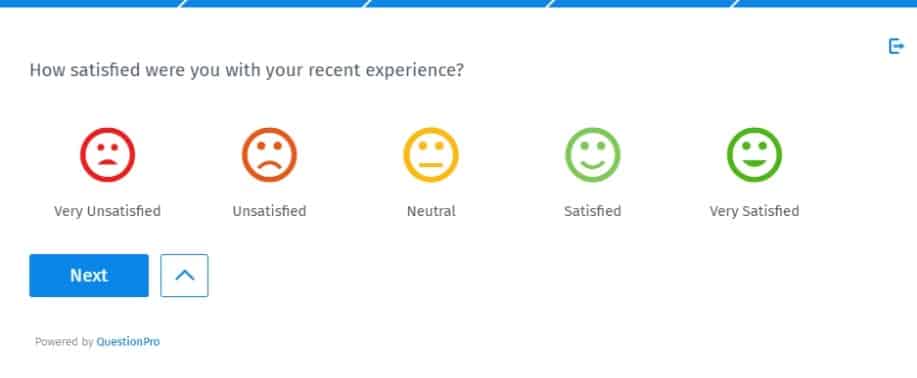
Responses are usually captured on a 1 to 5 or 1 to 10 scale. Usually, you can use CSAT after purchases, deliveries, or support interactions.
2. Customer Effort Score (CES)
CES measures how easy or difficult it was for a customer to complete a task or resolve an issue.
A common question is:
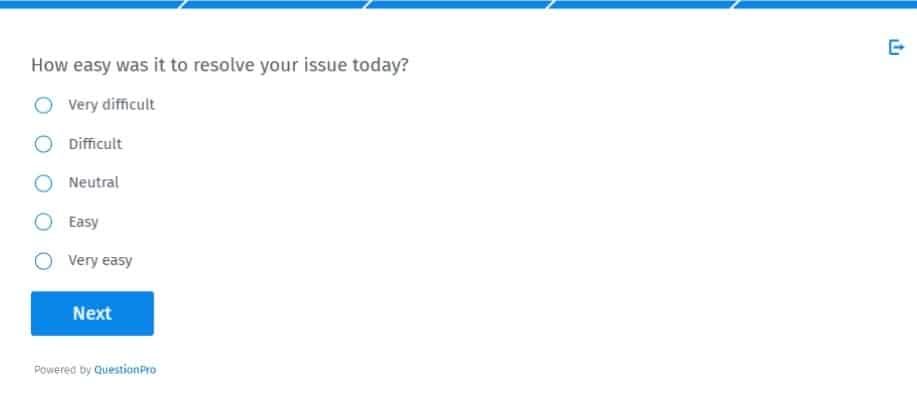
CES is especially useful in support, onboarding, and self-service environments where effort has a strong impact on retention.
3. Transactional Net Promoter Score (tNPS)
Transactional NPS measures recommendation intent based on a single interaction, not the overall relationship.
The question is:
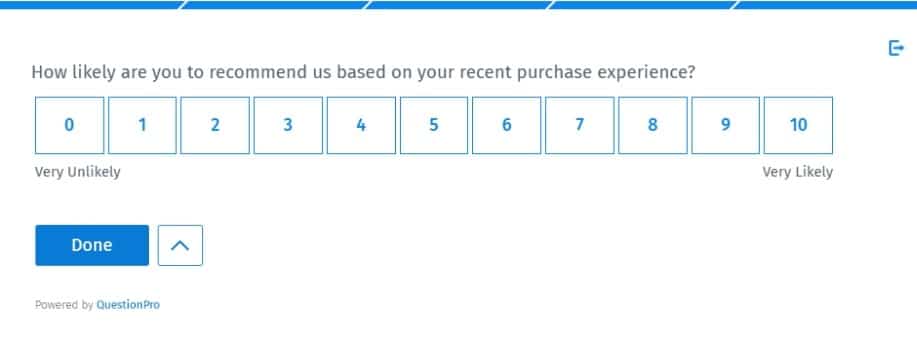
It uses a 0 to 10 scale and helps you understand which touchpoints influence loyalty most.
Recommended to read: Types of surveys with examples
What supporting metrics add context to transactional surveys
Beyond core scores, you often track operational indicators to explain results.
Common examples include:
- First Contact Resolution to confirm if an issue was resolved on the first attempt
- Time to Resolution to measure how long the interaction took
- Response Rate to assess data reliability
- Feedback Volume to validate sample size
These metrics help connect experience feedback with process performance.
When should businesses use transactional surveys
Transactional surveys are most effective when sent immediately after the interaction ends.
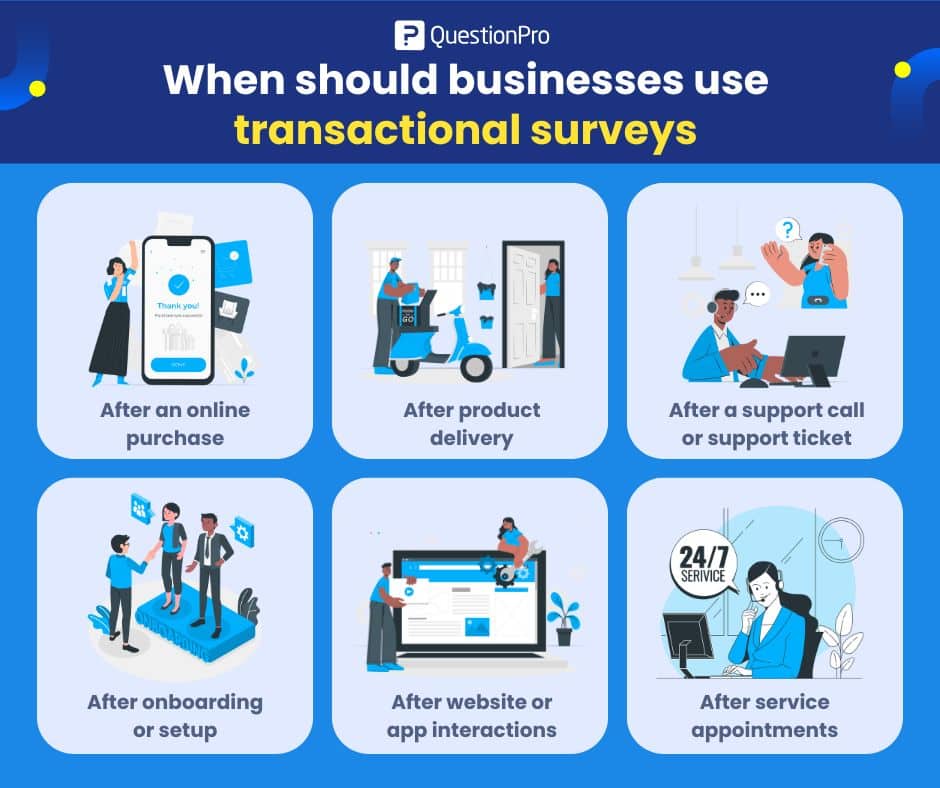
Common use cases include:
- After an online purchase
Measures checkout clarity, payment flow, and purchase confidence.
- After product delivery
Captures feedback on delivery speed, condition, and expectations.
- After a support call or ticket
Evaluates issue handling, clarity, and resolution quality.
- After onboarding or setup
Identifies early friction that affects adoption.
- After website or app tasks
Measures usability and task completion at a specific point.
Sending surveys at these moments makes feedback precise and actionable.
Also check: What the purchase journey is, stages, challenges & solutions
How are transactional surveys different from relationship surveys
Transactional surveys and relationship surveys both collect customer feedback, but they serve different purposes.
| Transactional Surveys | Relationship Surveys |
| Focus on one interaction | Measure overall sentiment |
| Are sent immediately | Are sent periodically |
| Support tactical improvements | Support long-term strategy |
Most mature programs use both to understand moments and trends.
Learn about: Differences between transactional and relational nps
What are the best practices for a transactional survey
Transactional surveys work only if they respect the customer’s time and attention.
Key practices include:
- Send the survey as soon as the interaction ends
- Focus on one touchpoint per survey
- Keep surveys to 2 to 5 questions
- Use clear, simple wording
- Include one open-ended question for context
- Limit frequency to avoid fatigue
- Close the loop by acting on feedback
Following these principles improves response quality and trust.
How QuestionPro support transactional surveys
Survey platforms typically support transactional surveys by automating triggers, managing distribution, and centralizing analysis. An effective survey platform should have some key capabilities.
Capabilities usually include:
- Event-based survey delivery
- Support for CSAT, CES, and transactional NPS
- Template libraries for common use cases
- Dashboards for tracking scores by touchpoint
- Multi-channel distribution, such as email, links, or QR codes
For example, tools like QuestionPro can help you to organize transactional feedback in one place and compare performance across interactions.
Key features of QuestionPro:
- QuestionPro AI can build surveys faster based on your goals.
- Types of surveys, such as NPS, CSAT, and CES, to measure specific touchpoints.
- Ready-to-use templates to launch transactional surveys quickly.
- Dashboard to view and manage all responses in one place.
- Multi-channel feedback collection to collect feedback at the right moment.
What should you do with transactional survey results
Transactional survey data creates value only when it leads to action.
You should:
- Track the same questions consistently
- Compare results across touchpoints
- Review open-ended responses regularly
- Identify repeat issues, not one-off comments
- Assign ownership for fixes
Treat transactional surveys as an ongoing feedback system, not a one-time exercise.
Frequently Asked Questions(FAQs)
Answer: Yes. Retail, SaaS, healthcare, finance, and hospitality teams across the USA use transactional surveys at points of frequent customer interaction.
Answer: Most effective transactional surveys include between 2 and 5 questions to keep completion rates high.
Answer: No. Transactional surveys measure moments. Relationship surveys measure the overall relationship. They answer different questions.
Answer: Yes. One open-ended question helps explain scores and reveals issues that metrics alone cannot show.
Answer: Only customers who completed the interaction being measured. This keeps feedback relevant and reliable.