A voice of customer program is a structured way to collect, analyze, and act on what customers say about a brand. It turns scattered opinions into decisions that product, support, and marketing teams can actually use.
Most businesses already collect some customer feedback. Far fewer turn that feedback into a real program, with clear ownership and a habit of closing the loop. That gap usually separates a company that listens from one that improves.
In this guide, we’ll cover what a voice of customer program includes and how to build one. We’ll also cover how to strengthen a program that already exists but isn’t driving results yet.
What is a voice of customer program?
A voice of customer (VoC) program is a systematic process for collecting and analyzing customer feedback. The goal is to understand customer preferences, needs, and expectations, then use those insights to improve products, services, and interactions.
A complete VoC program includes five parts working together.
- Feedback collection: Gathering input through surveys, interviews, social media, and reviews.
- Data analysis: Identifying trends and pain points inside the feedback.
- Action planning: Turning insights into specific, owned fixes.
- Implementation and monitoring: Closing the loop so feedback actually changes something.
- Reporting and communication: Sharing results with internal teams and customers.
A program that only collects feedback, without the other four parts, is not really a VoC program. It is a survey habit.
Voice of customer program vs. a single customer feedback survey: What’s the difference?
A single feedback survey captures one moment in time. A voice of customer program is an ongoing system that collects feedback continuously and assigns ownership for acting on it.
| Aspect | One-off survey | VoC program |
|---|---|---|
| Timeframe | Single snapshot | Continuous and recurring |
| Ownership | Usually one team | Cross-functional, with named owners |
| Output | A report | Action plans tied to metrics |
| Channels | Typically one | Multiple, unified into one view |
Running occasional surveys is a reasonable start. It is not the same thing as a program. A survey tells you what customers said. A program tells you what the business did about it.
Why does a voice of customer program matter?
A voice of customer program matters because it replaces guesswork with evidence. Teams get real data when deciding what to fix, build, or communicate next.
The benefits show up in a few consistent ways:
- Customer-centric decisions: Changes get matched to what customers actually expect, not internal assumptions.
- Faster problem detection: Ongoing feedback surfaces friction before it shows up in churn numbers.
- Stronger retention: Customers who see their feedback acted on tend to stay and renew.
- A competitive edge: Reacting to customer needs faster than competitors wins more close calls.
Forrester has modeled how modest customer experience improvements can produce measurable revenue gains. The gains come through three channels: retention, increased spend from existing customers, and referral-driven growth. A VoC program is a direct way to act on that kind of finding, since it is built to surface what drives those loyalty shifts.
Is your business ready to build a dedicated VoC program?
A business is ready for a dedicated VoC program when three things are true. There is a clear objective for the feedback, a team ready to act on it, and leadership support to follow through.
| Signs you’re ready | Signs to wait |
|---|---|
| Leadership wants a specific, measurable outcome (retention, NPS, churn) | Feedback is wanted “just to see what customers think,” with no target metric |
| At least one team is ready to own action plans | No team has bandwidth to act on findings |
| Feedback currently lives in scattered spreadsheets or inboxes | Feedback is already centralized and acted on consistently |
| The customer base is large enough that patterns aren’t obvious from memory | The customer base is small enough that direct conversations already surface most issues |
A program without a defined objective tends to produce dashboards nobody checks. Start with one clear goal, such as reducing onboarding churn. That makes the investment easier to justify and the program’s value easier to prove early.
How to build a voice of customer program
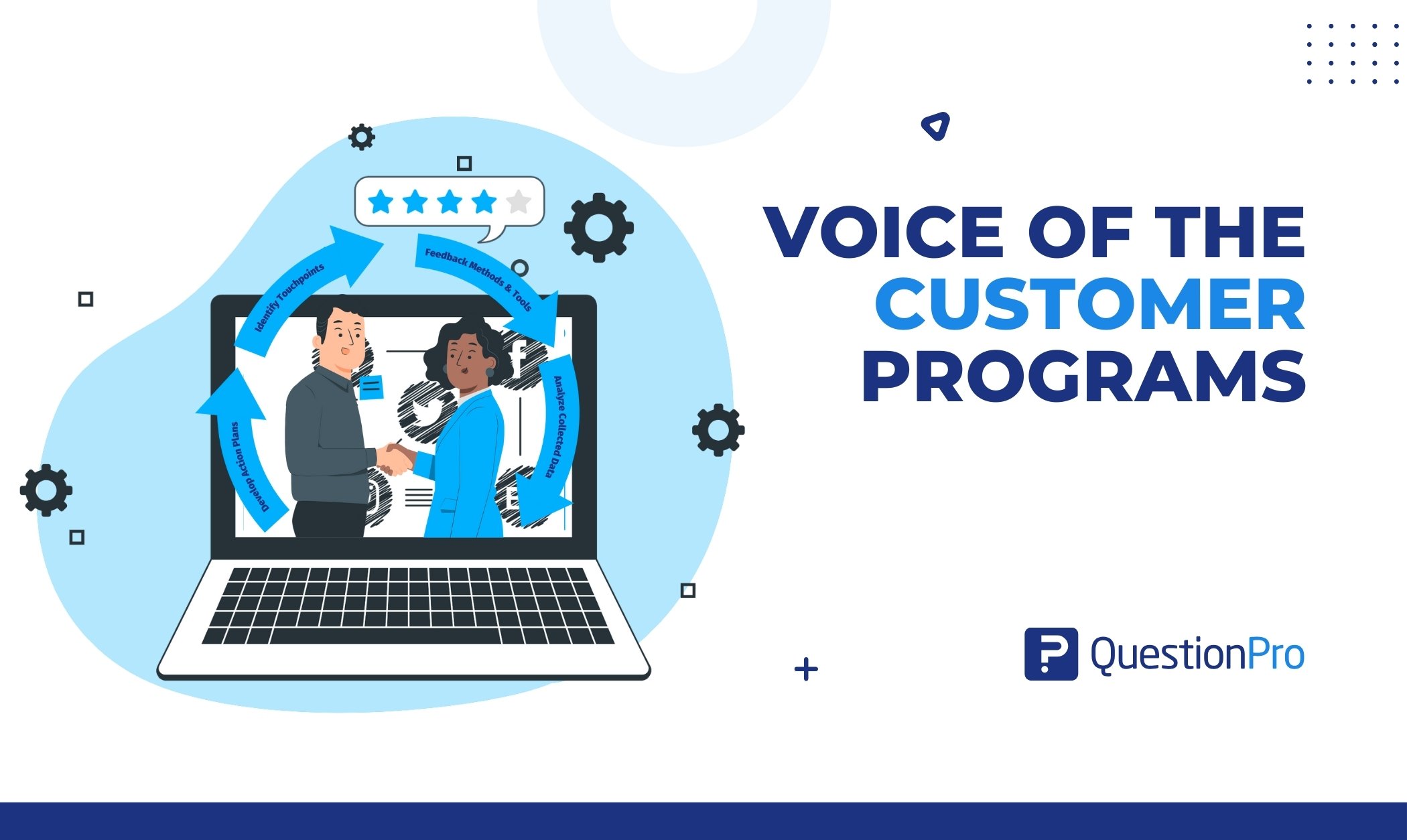
Building a voice of customer program follows six steps. Each step feeds directly into the next.
Step 1: Define your objectives.
Decide what the program needs to accomplish before collecting any data. Common objectives include:
- Reducing churn at a specific stage
- Improving onboarding completion
- Lifting a specific satisfaction score
Step 2: Identify your key touchpoints.
Map where customers interact with the brand, including the website, support channels, and social media. Feedback collected at the wrong touchpoint answers the wrong question.
Step 3: Choose your feedback methods and tools.
Select how feedback gets collected based on the objective and audience. Surveys work well for repeatable data. Interviews add context surveys cannot capture, and social listening catches feedback customers never submit directly.
Step 4: Analyze the collected data.
Look for recurring themes rather than isolated complaints. Sentiment analysis can speed this up significantly on open-ended responses.
Step 5: Develop action plans.
Translate findings into specific, owned fixes. Strong plans follow the SMART standard:
- Specific and measurable
- Achievable and relevant
- Time-bound, so progress can be checked later
Step 6: Implement changes and communicate results.
Put the plan into motion and track its impact against the original objective. Share what changed with internal teams and customers. This last step is the one most programs skip, and the one that proves the program was worth running.
A voice of customer program in practice
A mid-sized software company was seeing steady signups but a rising cancellation rate in the first 90 days.
Its VoC program connected three previously separate feedback sources: onboarding surveys, support tickets, and in-app exit surveys. The pattern was clear. New users understood the main feature but never discovered a secondary feature that drove long-term retention.
The fix was specific. During week two of onboarding, the product team added a short prompt introducing the secondary feature. Support agents also flagged any customer confused about setup for a quick follow-up call.
Results over the next quarter showed real movement:
- Onboarding-related cancellations dropped
- Average Customer Effort Score for new users improved
- Support spent less time on repeat setup questions
None of this required new feedback. It required connecting feedback that already existed, then assigning someone to act on it.
Best practices to strengthen a voice of customer program
A program that is already running can still underperform. Feedback stays siloed, teams aren’t aligned, or results never reach the people who could act on them.
Connect feedback across every channel
Many organizations still rely on a single channel to measure customer interactions. This limits the depth and accuracy of the insights. A VoC software platform that integrates with existing systems helps break down these silos, including:
- Customer relationship management (CRM) platforms
- Marketing automation tools
- Existing analytics dashboards
Build a cross-functional action plan with clear ownership
A VoC program loses momentum fast when only one department is involved. Every action plan needs a named owner and a start and end date. Responsibilities should be divided across every team involved, with visibility that lets leadership check progress without chasing updates.
Include the voice of the employee
A customer feedback program that ignores frontline employees misses half the picture. Those teams can surface the real blockers behind recurring complaints.
- Workload pressure that causes rushed or inconsistent service
- Missing tools or access that slow down resolution
- Unclear escalation paths that leave issues unresolved too long
Sharing VoC data broadly keeps every department aligned on how customers perceive the brand. This includes teams that never interact with customers directly. A dashboard built for each department’s specific role gets used far more than one generic view for everyone.
Track the right metrics and prove ROI
Measuring return on investment turns a VoC program from a reporting exercise into a budget line leadership keeps funding. A rising Net Promoter Score, as detractors and passives shift into promoters, is one of the clearest signs a program is working.
- A growing share of promoters relative to detractors
- A measurable drop in churn tied to a specific fix
- Higher renewal rates in the segment that received follow-up
Benchmark and keep iterating
A VoC program is never finished. Review competitor feedback trends on a regular cadence. Refine the program’s questions, channels, and metrics as customer expectations shift.
How do you measure a voice of customer program?
A voice of customer program is measured through a small set of metrics. Together, they track sentiment, effort, and loyalty rather than one single number.
| Metric | What it measures |
|---|---|
| Net Promoter Score | How likely customers are to recommend the brand, from detractors to promoters |
| Customer Satisfaction Score (CSAT) | Satisfaction with one specific interaction or touchpoint |
| Customer Effort Score | How much effort it took a customer to get an issue resolved |
| Churn rate | The percentage of customers lost over a given period |
| Renewal or repeat purchase rate | How many customers return after a feedback-driven change |
No single metric tells the whole story. NPS and CSAT describe sentiment. Customer Effort Score describes friction. Churn and renewal rates describe whether any of it actually changed customer behavior.
What are the biggest challenges and mistakes in a VoC program?
Most VoC programs struggle with the same handful of problems, regardless of company size.
- Data overload: Collecting more feedback than any team can realistically analyze, which buries the churn-relevant insights that matter most.
- Weak system integration: Running VoC software that doesn’t connect to the CRM or support platform, forcing manual data stitching.
- Feedback fatigue: Asking for input too often without showing customers anything changed.
- Unclear data privacy practices: Collecting feedback without a clear policy on storage and use.
- Insights that never turn into action: The most common failure, where good data sits in a dashboard nobody reviews.
The fix for nearly all of these is the same. Fewer channels run well beats more channels run poorly, and every piece of feedback needs an owner.
How does QuestionPro Customer Experience support a voice of customer program?
QuestionPro Customer Experience gives teams one place to collect feedback across online surveys, email, website pop-ups, and in-app prompts. That removes the need to stitch together a separate tool for each channel.
Built-in templates map to specific stages of the customer journey, from onboarding through post-support. Real-time dashboards and segmentation let teams filter results by customer type, product, or journey stage. Text and sentiment analysis surfaces themes in open-ended comments that would otherwise take hours to read by hand. Net Promoter Score, CSAT, and Customer Effort Score tracking come built in, so the core metrics are ready without building separate reports.
A VoC program is only as strong as its follow-through
Every part of a voice of customer program, from the channels chosen to the dashboards built, exists to support one outcome. Customers need to see that their feedback changed something.
Programs that stall usually aren’t failing at collection. They fail at the handoff between insight and action, where a finding sits in a report instead of reaching the team that could fix it. The businesses that get this right share a few habits:
- They assign a named owner to every significant finding, not just the program overall.
- They close the loop publicly, showing customers and employees what changed.
- They review the program itself on a schedule, not only the feedback it collects.
Frequently Asked Questions (FAQs)
Start with the channel where the most customers already interact with the brand, such as support tickets or post-purchase surveys, rather than adding a new channel first. Expand once the first channel has a clear owner and action process.
Early signals, like response themes and quick wins, often appear within four to six weeks. Measurable shifts in metrics such as churn or NPS usually take one to two full quarters, since customers need time to experience the changes.
A CX or customer experience team typically owns the program’s structure and metrics, but action plans need shared ownership across product, support, and sales. A program owned by one team in isolation rarely drives cross-functional change.
Yes. A small business can start with a single survey tool, a shared spreadsheet for tracking themes, and a monthly review meeting. Dedicated software becomes more valuable as feedback volume and channel count grow.
A quarterly review is a reasonable default for most businesses, checking whether tracked metrics still match current objectives and whether any channel has stopped producing useful feedback. Fast-growing companies may benefit from a monthly check instead.