The Burger King customer experience includes every interaction a customer has with the brand before, during, and after ordering. It covers ads, menu discovery, app use, drive-thru service, in-store ordering, delivery, loyalty rewards, food quality, order accuracy, feedback, and post-purchase engagement.
For a fast-food brand, customer experience is not only about taste. It is also about speed, consistency, convenience, price perception, digital access, and whether the order is right the first time.
Burger King is a useful CX example because its experience depends on both emotional brand recognition and everyday operational details. A customer may enjoy a campaign, download the app, place a mobile order, use Royal Perks, visit a drive-thru, and share feedback after the meal. Every one of those moments affects how the customer sees the brand.
What is the Burger King customer experience?
The Burger King customer experience is the full journey a customer goes through when discovering, ordering, receiving, eating, and responding to Burger King products and services. It includes digital, physical, and emotional touchpoints.
A customer experience touchpoint is any moment where a person interacts with a brand. For Burger King, touchpoints include TV and digital ads, search results, the Burger King app, the restaurant, drive-thru lanes, delivery platforms, employee service, packaging, food quality, loyalty rewards, and feedback channels.
A good Burger King experience usually depends on a few practical factors:
- The customer can find the menu easily.
- The ordering process is fast and clear.
- The restaurant or app experience works smoothly.
- The food matches expectations.
- The order is accurate.
- The price feels fair.
- Rewards or offers are easy to use.
- Problems are handled quickly.
That mix is why restaurant customer experience is hard to manage. A campaign may create interest, but the real test happens at the order counter, app checkout, drive-thru window, or delivery handoff.
Why is Burger King a useful customer experience example?
Burger King is a useful customer experience example because it operates in a high-frequency, high-expectation industry. Fast-food customers expect speed, consistency, convenience, and value with very little patience for friction.
The quick-service restaurant industry is also highly competitive in the US. Customers can compare Burger King with McDonald’s, Wendy’s, Taco Bell, Chick-fil-A, local restaurants, grocery meals, and delivery options within seconds.
That makes the Burger King customer journey useful for studying questions like:
- How does a brand turn awareness into an order?
- How does digital ordering affect customer convenience?
- Where can app, drive-thru, and in-store experiences break down?
- How do loyalty rewards support repeat visits?
- Which operational issues hurt customer satisfaction?
- How can feedback improve the experience across locations?
Burger King also gives CX teams a clear reminder: brand recognition gets attention, but consistent execution earns repeat visits.
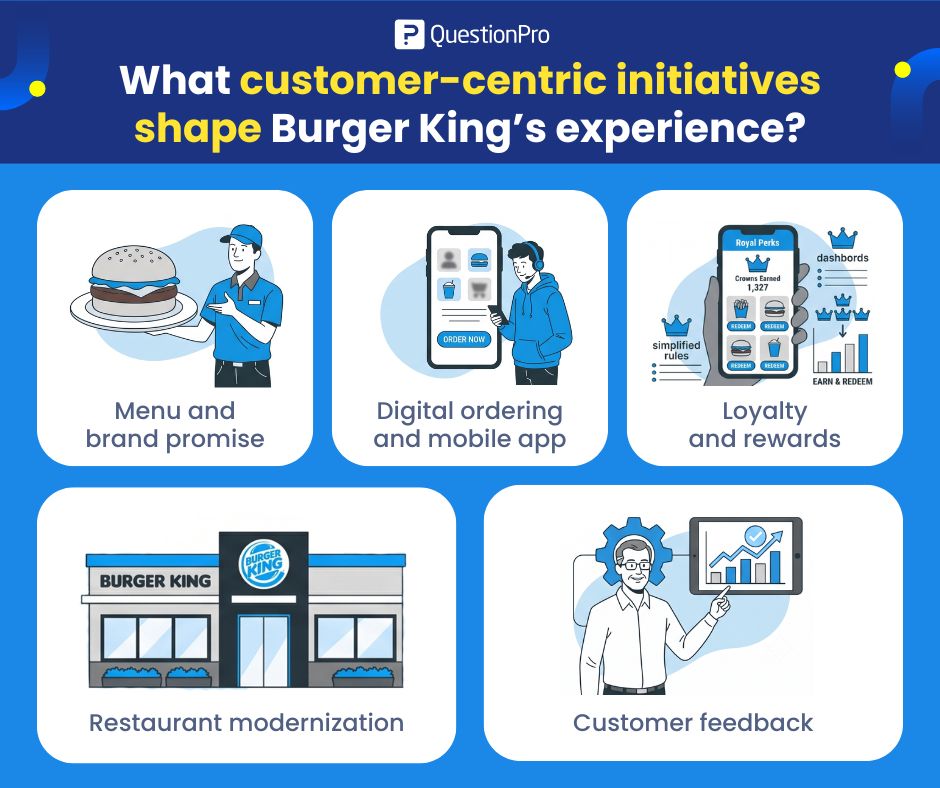
What customer-centric initiatives shape Burger King’s experience?
Burger King’s customer experience is shaped by menu choices, digital ordering, loyalty rewards, restaurant modernization, and customer feedback. These initiatives affect how customers discover, order, receive, and evaluate the experience.
Menu and brand promise
Burger King’s brand promise has long been connected to flame-grilled burgers, customization, and familiar fast-food value. The menu is a major part of the experience because customers often judge the brand by taste, portion, price, and consistency.
Menu experience is not only about what is available. It also includes:
- How easy the menu is to understand
- Whether promotions feel clear
- Whether limited-time offers create interest
- Whether customization works correctly
- Whether food quality is consistent across locations
When menu expectations and actual experience do not match, customer satisfaction drops quickly.
Digital ordering and mobile app
Digital ordering is now a core part of fast food customer experience. The Burger King app and website can help customers browse offers, customize orders, place orders ahead, and access loyalty rewards.
Digital convenience can improve the experience when it reduces wait time and makes ordering easier. But it can also create friction if the app is slow, offers do not apply correctly, menu items are unavailable, or the order is not ready when expected.
For Burger King and other QSR brands, digital CX depends on both the app and restaurant operations. A smooth checkout does not matter if the store cannot fulfill the order accurately.
Loyalty and rewards
Burger King’s Royal Perks program gives members rewards and offers through a loyalty structure. According to Burger King’s official Royal Perks page, members earn 10 Crowns for every $1 spent on eligible transactions at participating US Burger King restaurants and can redeem Crowns for eligible menu items.
A loyalty program can improve customer retention when it is easy to understand and easy to use. It can also create a stronger feedback loop because members interact with the brand more often through digital channels.
The CX risk is complexity. If customers do not understand how to earn or redeem rewards, the loyalty program becomes another source of frustration.
Restaurant modernization
Burger King’s US customer experience also includes restaurant design and operations. Through its Reclaim the Flame plan, Burger King announced investments in advertising, digital, restaurant technology, kitchen equipment, building improvements, remodels, and relocations.
Restaurant Brands International later announced an additional investment to help modernize US Burger King restaurants, with a goal of reaching a modern image across 85% to 90% of US restaurants by 2028.
This matters because physical experience still matters in fast food. Clean restaurants, clear layouts, updated drive-thru lanes, modern equipment, and better kitchen workflows can affect speed, accuracy, comfort, and customer trust.
Customer feedback
Customer feedback helps Burger King and franchise operators understand what customers experience across restaurants and channels. In fast food, feedback can reveal issues that may not show up in sales alone.
Useful feedback topics include:
- Order accuracy
- Food temperature
- Wait time
- Staff friendliness
- App issues
- Drive-thru speed
- Cleanliness
- Value for money
- Loyalty reward confusion
- Delivery problems
Feedback is only useful when it leads to action. A customer who reports the same issue repeatedly and sees no improvement is less likely to stay loyal.
What does the Burger King customer journey look like?
The Burger King customer journey usually moves through six stages: awareness, consideration, ordering, fulfillment, loyalty, and advocacy. Each stage has its own customer goal, touchpoints, pain points, and improvement opportunities.
A customer may not move through these stages in a straight line. Someone may see an ad, open the app, compare offers, visit the drive-thru, redeem rewards, and later leave a review. Another customer may only search for the nearest location and order in-store.
The key is to understand what the customer is trying to do at each stage and where friction can appear.
Importance of the Customer Journey from Burger King
Understanding the customer journey is pivotal for Burger King, as it is for any business aiming for long-term success. Burger King recognizes that each customer interaction, whether at a physical restaurant or through their app, contributes to the overall perception of the brand. By meticulously mapping out this journey, Burger King can identify pain points, moments of delight, and areas for improvement.
Here’s why the customer journey matters at Burger King:
1. Enhanced Customer Satisfaction: By analyzing the entire journey, Burger King can identify areas where customers might face frustration or inconvenience. Addressing these pain points leads to increased satisfaction and loyalty.
2. Personalized Experiences: The customer journey informs how Burger King tailors its offerings and promotions to individual preferences. Personalization is key to keeping customers engaged and coming back for more.
3. Competitive Edge: Understanding the journey enables Burger King to stay ahead of competitors. By continuously optimizing touchpoints and experiences, they can differentiate themselves in a crowded market.
4. Long-Term Loyalty: A seamless customer journey fosters loyalty. Customers who have positive interactions throughout their journey are more likely to become regular patrons and brand advocates.
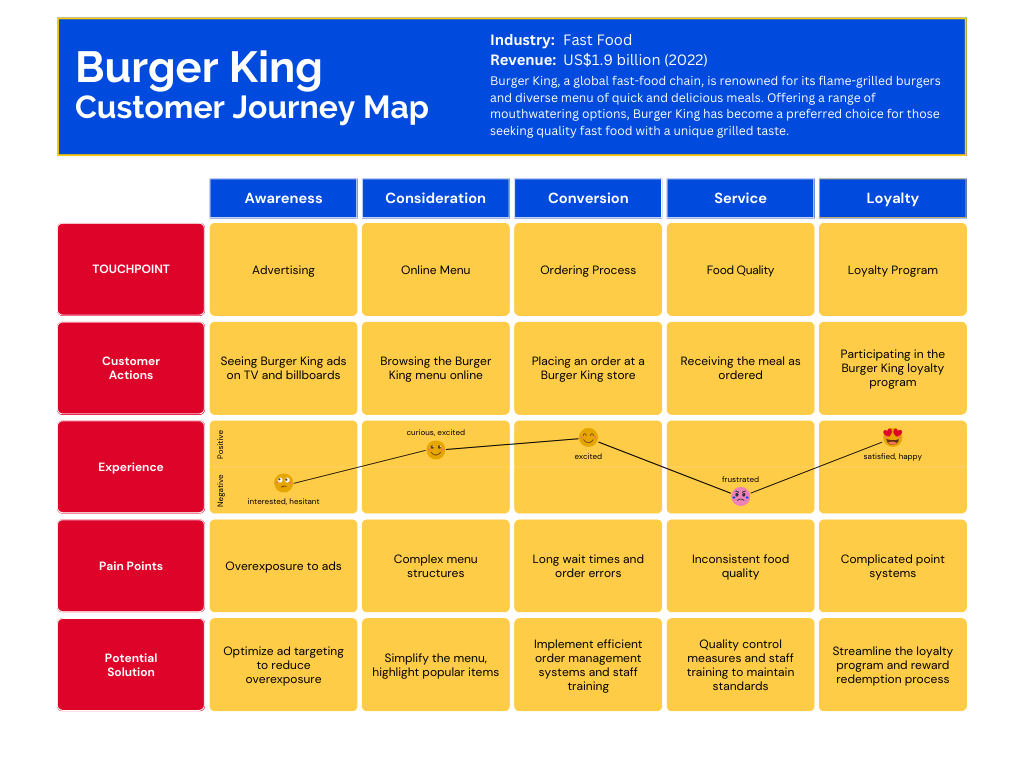
Burger King customer journey map
A Burger King customer journey map shows how customers move from discovering the brand to ordering, receiving food, returning, and sharing their experience. It helps teams identify where the experience works and where customers may face friction.
| Journey stage | Customer goal | Main touchpoints | Possible pain points | CX improvement opportunities |
|---|---|---|---|---|
| Awareness | Notice Burger King and feel interested | Ads, social media, search, word of mouth, store signage | Unclear offer, weak local visibility, low relevance | Improve local messaging, connect campaigns to real menu value, track awareness by region |
| Consideration | Decide whether Burger King is worth choosing | Menu, app, website, reviews, coupons, delivery apps | Confusing offers, missing prices, poor reviews, limited menu visibility | Make menu and offers easier to compare, highlight value, monitor sentiment |
| Ordering and purchase | Place an order quickly and accurately | App, website, kiosk, counter, drive-thru, delivery platforms | App errors, long lines, unclear customization, payment issues | Test ordering paths, reduce checkout steps, improve app and drive-thru instructions |
| Fulfillment and service | Receive the correct order on time | Kitchen, pickup counter, drive-thru window, delivery handoff | Long wait time, wrong items, cold food, poor service | Track order accuracy, wait time, staff training, fulfillment issues |
| Loyalty | Return and use rewards or offers | Royal Perks, email, app notifications, coupons, receipts | Hard-to-use rewards, unclear redemption rules, irrelevant offers | Simplify rewards, personalize offers carefully, ask members for feedback |
| Advocacy | Share the experience with others | Reviews, social media, surveys, word of mouth | Unresolved complaints, inconsistent experience, no follow-up | Close the feedback loop, respond to issues, identify promoters and detractors |
A journey map is useful because it connects customer behavior to operational action. It shows that improving Burger King customer experience is not one project. It requires work across marketing, digital, store operations, loyalty, and feedback.
How does awareness work for Burger King?
Awareness is where potential customers first encounter the brand, often through advertising, word of mouth, or simply passing a restaurant location.
Common awareness touchpoints include:
- Television and digital advertising campaigns
- Social media presence and viral marketing moments
- Physical restaurant visibility and signage
The main challenge at this stage is standing out in a fast-food category with heavy advertising spend from every major competitor. Awareness alone rarely drives a purchase decision, but it sets up everything that follows in the customer journey, since a customer cannot consider a brand they’ve never noticed.
For a brand with thousands of locations, awareness also works differently by market. A customer in a city with a dozen nearby Burger King locations experiences a very different level of brand presence than someone in an area with only one.
What happens during the consideration stage?
Consideration is when a customer compares Burger King against other fast-food options before deciding where to eat. This stage is where menu clarity, pricing, and social proof do most of the work in shaping a decision.
| Touchpoint | Customer action | Common pain point |
| Mobile app browsing | Reviews menu and current promotions | Menu navigation can feel cluttered |
| Online reviews | Reads recent customer feedback | Inconsistent experiences across locations |
| Price comparison | Weighs value against competitors | Value perception varies by market |
Addressing inconsistency across franchise locations is one of the harder parts of this stage, since experience quality is not always uniform. This is exactly where an omnichannel customer journey approach helps, since it forces a brand to look at the app, website, and in-store experience as one connected journey rather than three separate systems.
A customer comparing two fast-food chains on their phone rarely separates the digital experience from the in-restaurant one. If the app promises a deal the restaurant does not honor, the entire brand takes the credibility hit, not just that one location.
How does the conversion stage work?
Conversion is the actual purchase, whether that happens in person, through drive-thru, or through the app.
- Order accuracy and speed directly affect satisfaction at this stage
- App-based ordering reduces wait time compared to counter service
- Payment friction, like unsupported payment methods, can stall a sale
A smooth conversion experience depends heavily on operational execution at the individual restaurant level, not just the ordering technology itself. A well-designed app cannot compensate for a slow kitchen or an order that arrives wrong, which is why conversion problems often trace back to operations rather than the digital experience.
This is also the stage where a single bad interaction can undo everything built up during awareness and consideration. A customer who waited too long or received the wrong order rarely blames the specific location. They tend to generalize the frustration to the whole brand.
How does Burger King build loyalty?
Burger King’s loyalty program, Royal Perks, is where the brand’s customer experience strategy is most concretely measurable.
Members earn 10 Crowns for every $1 spent, redeemable for menu items, with bonus Crowns during a member’s birthday month. In Burger King’s own announcement expanding the program nationwide, the company reported that more than 80 percent of Royal Perks members said they were likely to recommend the program to others.
That figure matters because it’s a real, published number, not an assumption about how a loyalty program is performing. It gives other businesses a concrete benchmark for what a well-received loyalty program can look like, and it shows why monitoring a customer journey with real data beats relying on internal guesses about satisfaction.
Simplicity appears to be a major driver of that recommendation rate. Earning a flat 10 Crowns per dollar is easy to understand compared to loyalty programs with multiple tiers, expiring point categories, or complicated redemption rules. Customers tend to disengage from programs they cannot explain in one sentence.
What does advocacy look like at this stage?
Advocacy is the point where satisfied customers actively recommend the brand to others, whether through reviews, social media, or word of mouth.
A few signals typically mark strong advocacy at this stage:
- Unprompted positive mentions on social media
- Reviews that specifically mention the loyalty program or rewards
- Referrals from existing customers, not just paid advertising
Encouraging satisfied Royal Perks members to leave reviews or share their experience is a natural extension of a loyalty program with genuinely high recommendation rates. A brand does not need to manufacture advocacy if the underlying experience already earns it.
The lesson here extends beyond Burger King. A recommendation rate above 80 percent is a strong result for any loyalty program, and it suggests advocacy at this brand is earned through the reward structure itself, not through separate marketing campaigns asking customers to talk about the brand.
What CX metrics matter in the Burger King customer journey?
The most useful CX metrics for the Burger King customer journey are the ones that connect customer perception with operational performance. Fast-food experience depends on both how customers feel and what actually happened during the visit.
Important metrics include:
- Customer satisfaction score: Measures how satisfied customers are after an interaction.
- Net Promoter Score: Measures how likely customers are to recommend the brand.
- Customer effort score: Measures how easy it was to complete an action, such as ordering or resolving an issue.
- Order accuracy: Tracks whether customers received what they ordered.
- Wait time: Measures speed at the counter, drive-thru, pickup, or delivery.
- App conversion rate: Shows how many app users complete an order.
- Loyalty enrollment: Tracks how many customers join Royal Perks or similar programs.
- Reward redemption rate: Shows whether loyalty benefits are being used.
- Repeat purchase rate: Measures whether customers come back.
- Complaint resolution time: Tracks how quickly issues are handled.
- Review ratings: Measures public customer sentiment by location.
- Sentiment analysis: Identifies patterns in open-text feedback.
- Delivery issue rate: Tracks missing items, late deliveries, or poor food condition.
These metrics should not be viewed in isolation. For example, a high app conversion rate is less valuable if order accuracy is poor. A strong loyalty program is less useful if members complain about confusing rewards.
What can businesses learn from Burger King’s approach to customer experience?
A few practical lessons carry over well beyond fast food.
- Loyalty programs perform better when rewards are simple and transparent, not layered with confusing tiers
- Customization builds preference over time, even in a category built on speed and convenience
- Publishing real performance data, like recommendation rates, builds more trust than vague claims of customer satisfaction
- Consistency across every location matters as much as the strategy itself
The common thread across all four lessons is that customer experience strategy only works when it’s backed by something measurable, not just a stated intention. Businesses that personalize the customer journey using real survey and behavioral data tend to see the same kind of measurable results Burger King reports for its loyalty program, rather than relying on assumptions about what customers want.
A regional coffee chain, for example, could apply the same pattern by keeping its own loyalty rewards simple, tracking recommendation rates the way Burger King does, and being willing to publish that number once it’s strong enough to serve as proof rather than a marketing claim.
How can QuestionPro Customer Experience help map and improve customer journeys?
QuestionPro Customer Experience can help businesses map, measure, and improve customer journeys by collecting feedback across touchpoints and turning it into clear action areas.
For a restaurant, retail, or service brand, QuestionPro Customer Experience can support:
- Customer journey feedback
- Touchpoint surveys
- Customer satisfaction surveys
- Net Promoter Score surveys
- Customer effort score surveys
- Sentiment analysis
- Location-level reporting
- Closed-loop feedback
- Dashboards for CX teams
- Voice of Customer programs
For example, a QSR brand could use post-visit surveys to measure order accuracy, wait time, staff friendliness, food quality, and loyalty program experience. It could then segment results by location, channel, visit type, or customer group.
This approach helps teams move from general feedback to specific improvement areas. Instead of only knowing that satisfaction dropped, teams can see whether the issue came from mobile ordering, drive-thru wait time, staff service, food quality, or rewards confusion.
Getting customer journey mapping right
Mapping a journey like this works best when it’s grounded in real data at each stage, not assumptions about how customers behave.
A customer journey map is most useful when a business can point to actual numbers, like Burger King’s published Royal Perks recommendation rate, rather than guessing at how customers feel at each touchpoint. Tools like QuestionPro’s journey mapping platform can help teams collect that kind of data directly from customers rather than relying on internal assumptions.
The stages covered here, awareness through advocacy, apply well outside fast food. Any business selling a repeat-purchase product or service can map the same five stages and look for the same kind of measurable signal Burger King uses for its loyalty program, rather than settling for a general sense that customers seem happy.
The specific numbers will differ by industry, but the underlying discipline stays the same. Pick one measurable signal per stage, track it consistently, and be willing to publish it once it’s strong enough to serve as real proof rather than an internal talking point.