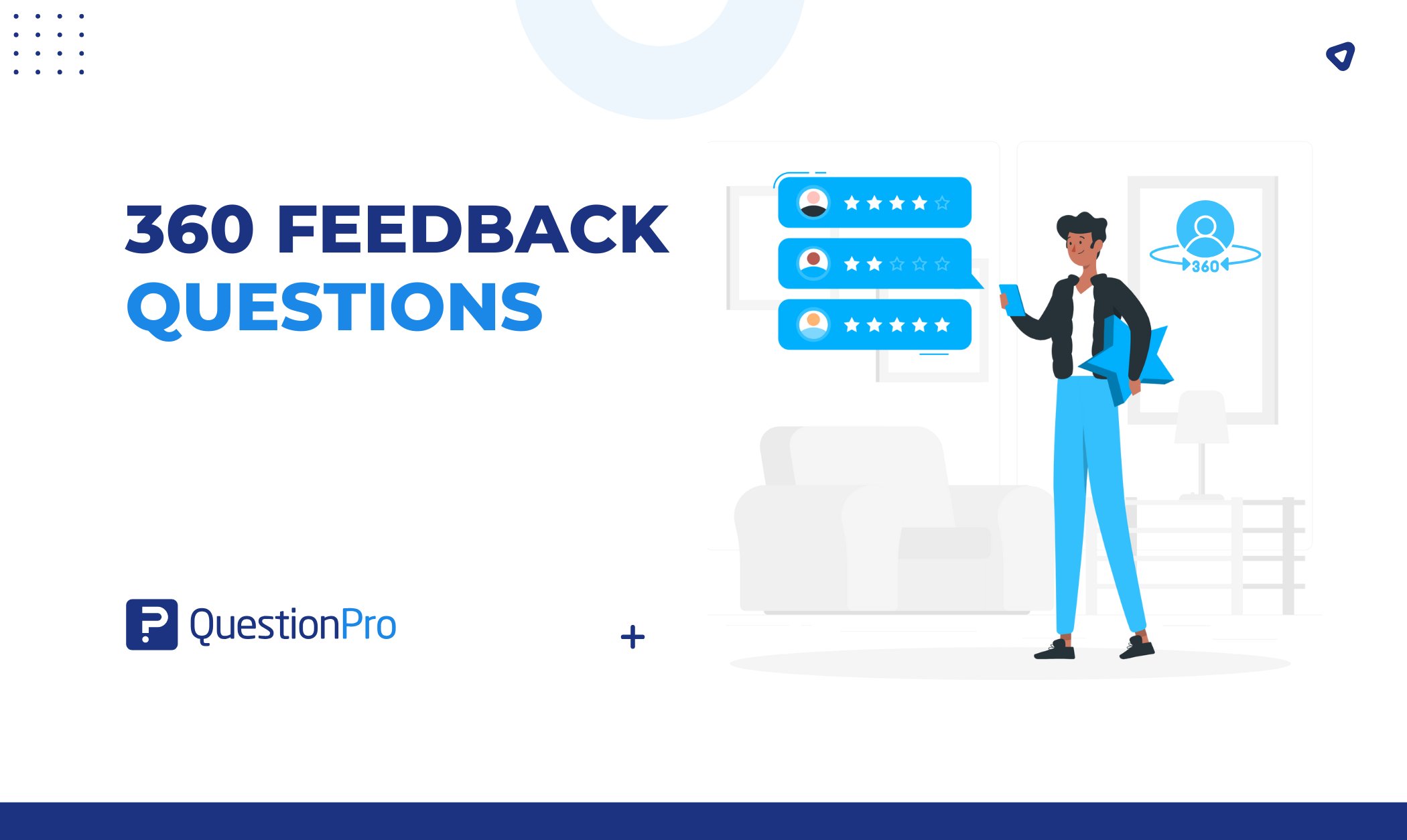
360 feedback questions are the survey prompts that ask peers, direct reports, managers, and the person under review how someone works. Good ones surface specific behaviors. Weak ones produce polite scores that nobody can act on.
The right wording depends on who answers. Peers see collaboration. A direct report sees leadership. Managers see results.
In this blog, we’ll share 60+ examples by rater group, competency, and question type. Then we’ll cover how to choose, run, and measure them.
What are 360 feedback questions?
360 feedback questions are survey items that collect observations about one person from several rater groups. Together, the answers form a multi-rater picture of strengths, blind spots, and development priorities. A blind spot is a behavior others see clearly but the person does not.
A full survey usually covers these groups:
- Peers who work beside the person
- Direct reports who experience their leadership
- Managers who judge results and goals
- The person themselves, through self-assessment
- Optional external partners, such as customers or vendors
Most surveys mix two formats. Rating items give you scores to compare across groups. Open-ended items give you the stories behind the scores. For the full process, see this guide to 360-degree feedback.
360 feedback questions vs. 360 review questions and similar terms
360 feedback questions, 360 review questions, and 360-degree feedback questions all describe the same practice. Neighboring terms differ in who answers and how you use the results.
| Term | Who answers | Main purpose |
|---|---|---|
| 360 feedback questions | Peers, direct reports, managers, self | Development from several viewpoints |
| Peer feedback questions | Colleagues only | Collaboration and teamwork |
| Upward feedback questions | Direct reports only | How a manager leads |
| Performance review questions | Manager, sometimes self | Goals, ratings, and pay decisions |
| Leadership assessment questions | Mixed, tied to a leadership model | Comparing leaders with a framework |
Peer-only surveys are one slice of the full process. For ready-to-use wording, see these peer feedback questions.
What makes a good 360 feedback question?
A good 360 feedback question asks about one observable behavior, uses plain words, and lets the rater answer from experience. It avoids personality labels and never hints at the right answer. Use these rules when you write or edit items:
- Ask about behavior, not traits: Replace “Is Maya friendly?” with “How does Maya build working relationships with other teams?”
- Ask one thing at a time: “Does Sam communicate clearly and manage time well?” hides two questions. Split it.
- Stay neutral: Replace “Don’t you agree Lee is a strong leader?” with “How would you describe Lee’s leadership?”
- Match the rater’s view: Peers cannot judge budget calls. Direct reports can describe coaching.
- Pair ratings with a chance to explain: Add “Please share an example” after key items.
- Balance strengths and growth: Ask what to keep doing and what to change.
- Pilot first: Test the survey with five to eight people and fix any confusing item.
360 feedback questions for peers, direct reports, and managers
The same person looks different from each angle, so each rater group needs its own questions. Use the sets below as a starting point. Cut any item a group cannot observe.
Peer questions
Peers see day-to-day collaboration, so focus on communication, reliability, and teamwork.
- When you work with this person on a project, what makes collaboration easier or harder?
- How well does this person share information others need to do their jobs?
- When priorities change mid-project, how does this person respond?
- How reliably does this person follow through on commitments? (1 = rarely, 5 = always)
- Describe a time this person helped you or the team solve a problem.
- How does this person handle disagreement in meetings?
- How openly does this person ask for and use feedback?
- What is one thing this person should keep doing, and one thing they should change?
Direct report questions (upward feedback)
Upward feedback shows how a manager leads. Ask about clarity, coaching, fairness, and safety.
- How clearly does your manager explain priorities and what success looks like?
- How often does your manager give you feedback you can use right away? (Never to Always)
- How safe do you feel raising a concern or admitting a mistake to your manager?
- How fairly does your manager share interesting work and recognition?
- How well does your manager delegate while staying available?
- What has your manager done recently that helped you grow?
- How does your manager respond when you disagree with a decision?
- What is one change that would make your manager more effective for you?
Manager questions
Managers judge outcomes and goal progress. These items work for the person’s direct supervisor.
- How consistently does this person meet agreed goals and deadlines?
- How well does this person prioritize when workloads compete?
- Which core competencies does this person show most strongly?
- How well does this person act on feedback you shared before?
- What skill, if developed, would most expand this person’s impact?
- How ready is this person for a larger scope in the next 12 months?
Self-assessment questions
Self-assessment gives you a baseline to compare with everyone else’s view. The gaps matter more than the scores.
- Which of your strengths do others rely on most?
- How would you rate your own communication in meetings? (1 to 5)
- Where would your team say you need to improve?
- What feedback have you received recently that was hard to hear, and what did you do with it?
- How well do you manage stress and pressure?
- Which one behavior do you most want to change over the next six months?
Senior leader questions
Senior leaders affect strategy and culture. Their questions should cover vision, decisions, and trust. For a longer treatment, read this 360 leadership assessment guide.
- How clearly does this leader connect daily work to company strategy?
- How well does this leader decide on time with incomplete information?
- How effectively does this leader build trust across functions?
- How consistently do this leader’s actions match the stated company values?
- How well does this leader develop other leaders?
- How openly does this leader accept challenge from people at every level?
360-degree feedback questions by competency
A competency is a skill or behavior pattern tied to success in a role, such as communication or adaptability. Pair one rating item with one open-ended follow-up per competency. Every score then arrives with context.
| Competency | Rating question (1 to 5) | Open-ended follow-up |
|---|---|---|
| Communication | How clearly does this person explain complex ideas? | Describe a time their communication helped or hurt a project. |
| Teamwork | How well does this person support teammates’ goals? | What does this person do that helps the team succeed? |
| Problem solving | How effectively does this person break down unfamiliar problems? | Share an example of a solution this person created. |
| Adaptability | How well does this person adjust when plans change? | What helps or blocks them during change? |
| Initiative | How often does this person act before being asked? | Where have they taken on work beyond their role? |
| Accountability | How consistently does this person own mistakes and fix them? | Describe how they handled a recent setback. |
| Inclusion | How well does this person welcome different perspectives? | What could they do to make meetings more inclusive? |
| Customer focus | How well does this person prioritize customer or stakeholder needs? | Share an example of how they handled a difficult request. |
Swap in fresh wording each cycle. Raters who see identical items every year start answering on autopilot.
360 feedback questions by question type
Rating, open-ended, behavioral, yes or no, and comparative questions each serve a different need. Most strong surveys lean on rating and open-ended items and use the rest sparingly.
Rating scale questions
A rating scale question asks the rater to score a behavior on a labeled scale, usually 1 to 5. Labels keep scores consistent across raters. Rating items let you compare groups and track change over time.
- How well does this person explain priorities during meetings? (1 = not well, 5 = very well)
- How effectively does this person handle conflict on the team?
- How approachable is this person when someone needs help?
Open-ended questions
An open-ended question lets raters answer in their own words. These items supply the examples behind the scores. Keep them to one per competency so raters do not tire.
- What is the biggest strength this person brings to the team?
- Describe a time this person went above and beyond.
- What should this person start, stop, and continue doing?
Behavioral frequency questions
A behavioral frequency question asks how often someone shows a specific action. Raters recall frequency more reliably than they judge character. Use the same answer options on every item:
- Never
- Rarely
- Sometimes
- Often
- Always
Sample items: How often does this person take the lead on new projects? How often does this person recognize the efforts of others?
Yes or no and comparative questions
Yes or no (dichotomous) questions give fast, clear signals but hide nuance. Use them for simple checks and follow with a comment box. Comparative questions rank someone against peers or a standard. They invite bias, so define the comparison group clearly.
- Does this person actively listen during discussions? (Yes/No)
- Compared with others at the same level, how innovative is this person?
Example scenarios: How teams match questions to goals
These composite scenarios show how to pick question sets for a goal. They are planning illustrations, not client stories.
A first-time manager gets a development baseline
A 40-person software company wants to support a newly promoted team lead. HR invites five direct reports and four peers. The upward questions focus on clarity, feedback, and safety. One start, stop, continue item stands out.
- Direct reports say the lead assigns tasks but keeps every decision.
- Peers praise the lead’s quick responses.
- The lead sets one goal: hand off decisions on small projects within the quarter.
Two teams fix a handoff problem
A regional retail chain has repeated handoff problems between store managers and the distribution team. The survey asks distribution peers about information sharing and responsiveness. It asks store managers the same items about themselves.
The gap is clear. Store managers rate their own updates highly. Distribution peers report late order changes. Both groups agree on a shared update cutoff and a single channel for changes.
Vice presidents compare how they lead up, down, and across
A US financial services firm gives its vice presidents the senior leader set. Peers rate trust across functions lower than direct reports do.
- The gap shows leaders manage down better than they manage across.
- Each vice president picks one cross-functional habit to change.
- A pulse survey to the same raters checks progress after 90 days.
Step-by-step guide to choosing your 360 feedback questions
Choose questions by working backward from your goal, your rater groups, and the time raters can give. A tight survey beats a long one. Follow these steps:
- Set the purpose.
Decide whether results will guide development or feed pay and promotion. Development-only surveys draw more candid answers because raters do not fear changing someone’s pay. - Pick four to six competencies.
Tie them to the role or your leadership model. - Choose rater groups.
Invite at least three raters in each group so no single answer points to one person. - Write one rating and one open-ended item per competency.
A practical target is 20 to 30 items, which most raters finish in 10 to 15 minutes. - Start from a template.
Adapt the free 360-degree review survey template, which includes 20+ questions across direct report, supervisor, and colleague sections. - Pilot, then launch.
Test with a small group, fix confusing items, and deliver the survey through employee experience software that enforces anonymity and sends reminders.
Common mistakes that weaken 360 feedback questions
Most failed 360 programs trace back to a few repeat mistakes in design and follow-up. Avoid these seven:
- Tying results to pay: Raters inflate scores to protect colleagues or punish rivals.
- Running long surveys: Fatigue turns thoughtful answers into straight-line ratings.
- Writing double-barreled items: One question cannot judge two behaviors.
- Asking raters about things they cannot see: A peer cannot rate budget planning.
- Using vague trait labels: “Is this person a team player?” gets vague answers.
- Showing results from tiny groups: Two responses reveal who wrote what.
- Skipping the debrief: Harvard Business Review’s 2026 article “For Your 360-Degree Feedback to Be Effective, You Need to Discuss It” by Brenda Steinberg calls follow-up conversations the strongest predictor of better leadership effectiveness.
How to measure whether your 360 feedback questions work
You can judge a 360 survey with six simple checks on response, spread, and follow-through. The targets below are working benchmarks. Adjust them to your team size and culture.
| Metric | How to check | Warning sign |
|---|---|---|
| Response rate by group | Completed surveys divided by invited raters | Under 80% in any group |
| Responses per group | Count completed responses before reporting | Fewer than 3, so hide the group |
| Rating spread | Review the score distribution per item | Over 90% of ratings in the top two boxes |
| Open-text completion | Share of raters who wrote at least one comment | Under 50% of raters |
| Self vs. rater gap | Compare self-score with the average rater score per competency | A gap of 1 point or more on a 5-point scale |
| Action follow-through | Check for a development goal within two weeks and progress at 90 days | No goal on record |
A large self-versus-rater gap is not a failure. It marks the best place to start the debrief conversation.
How QuestionPro Employee Experience supports 360 feedback surveys
QuestionPro Employee Experience runs 360 feedback surveys with configurable assessments, anonymity controls, and automated rater tracking. These capabilities cover the setup work that surrounds the questions.
- Configurable assessment.
Start with the out-of-the-box assessment, which measures competencies such as inclusive leadership, resilience, and team capacity management. Then adjust it to your own leadership model. - Respondent portal.
Track who has answered, add participants, and send automated reminders to raters. - Anonymity protection.
The platform includes Respondent Anonymity Assurance (RAA) to protect rater identity. - Flexible distribution.
Send surveys by email, SMS, or portal. Connect your employee directory through FTP (file transfer) or API (software connection) to load subjects and evaluators. - Generative AI for comments.
AI helps people make sense of open-ended comments, which can feel emotional to read. - Branded reports.
Reports show leaders their strengths and performance gaps.
Explore QuestionPro’s 360 feedback software for the full setup. Teams that only need a one-off survey can build it in Survey Software.
Better questions turn feedback into a conversation
The best 360 feedback questions do one job. They make it easy for a rater to describe what they saw and for the person to hear it. Wording matters, but follow-up matters more.
Start small and keep three habits:
- Ask about behaviors the rater can observe.
- Pair every rating with a chance to explain.
- Book the debrief before you send the survey.
Frequently Asked Questions (FAQs)
Aim for 20 to 30 items per rater, which most people finish in 10 to 15 minutes. Use one rating and one open-ended question for each of four to six competencies, then cut any item a rater group cannot observe.
Yes, for peers and direct reports. Anonymity works only when results stay hidden until enough people in a group respond. Small teams often cannot reach that bar, so combine groups or use named feedback with trained raters.
Most programs avoid it. When ratings affect pay, raters tend to inflate scores or settle scores, and candor drops. If you must use results for decisions, tell raters in advance and treat the data as one input among several.
Once a year suits most organizations. Between cycles, send a short pulse to the same raters on the one or two goals the person chose. Running full surveys more often tends to cause rater fatigue.
Written comments can become part of an employment record. Train raters to describe observable work behavior and avoid remarks about protected characteristics such as race, age, sex, or disability, which the U.S. EEOC enforces. Ask legal counsel to review your process.