Trust is the product an insurer actually sells. Allstate built decades of brand recognition on that promise, yet its loyalty numbers now tell a harder story. Allstate NPS sits at 13, well under the insurance industry average, a signal that many policyholders feel more tolerated than valued.
In this blog, we break down Allstate’s net promoter score, unpack the promoter and detractor split behind it, compare it to rivals like USAA and GEICO, and explain what is dragging customer loyalty down. You will also see how any insurer can measure and lift its own score.
What is a net promoter score?
Net Promoter Score (NPS) is a single-question metric that measures how likely customers are to recommend a brand to others. It captures loyalty and predicted word of mouth in one number.
Customers answer one question on a 0 to 10 scale: how likely are you to recommend us to a friend or colleague? Their ratings sort them into three groups.
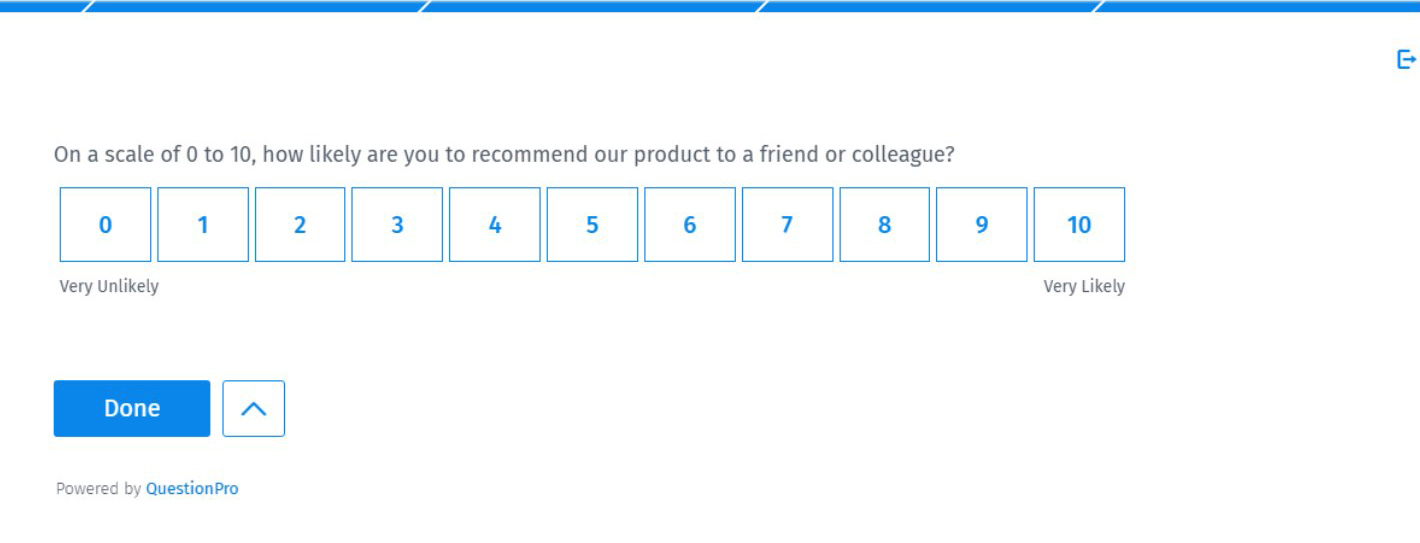
- Promoters (9-10): loyal fans who repurchase and refer others.
- Passives (7-8): satisfied but unattached, and easy for a rival to poach.
- Detractors (0-6): unhappy customers who may spread negative word of mouth.
The Net Promoter Score formula subtracts the share of detractors from the share of promoters. Scores run from -100 to +100. Above 0 is positive, 50 or higher is excellent, and 70 or above is world-class.
What is the difference between NPS and CSAT?
NPS and CSAT both measure customer sentiment, but they answer different questions. Confusing the two leads to the wrong fix.
| Metric | What It Measures | Question Asked | Typical Scale |
|---|---|---|---|
| NPS | Loyalty and referral likelihood | Would you recommend us? | -100 to +100 |
| CSAT | Satisfaction with one interaction | How satisfied were you? | 1 to 5, or a percentage |
NPS predicts long-term loyalty. CSAT (Customer Satisfaction Score) captures how a single touchpoint felt, such as one phone call or one claim. Allstate’s benchmark report tracks both, but the figure of 13 refers specifically to NPS.
What is Allstate’s NPS score in 2025?
Allstate’s NPS score is 13, based on QuestionPro’s Q1 2025 NPS and CSAT benchmark report. That places the brand below the insurance industry average of 23 and behind several direct competitors.
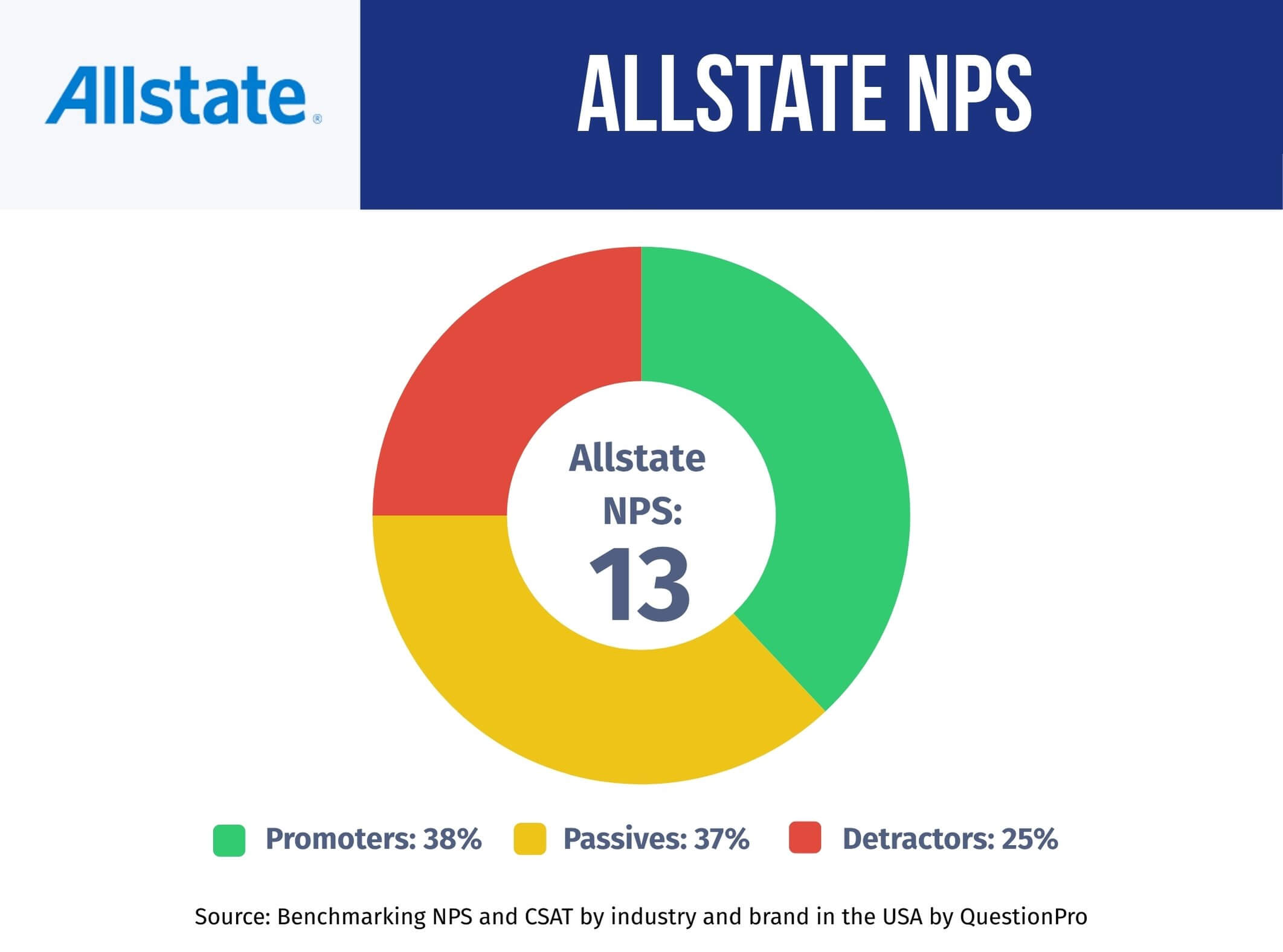
The report surveyed 1,000 U.S. customers and split Allstate’s respondents into 38% promoters, 37% passives, and 25% detractors. Subtracting the 25% detractors from the 38% promoters produces the score of 13.
Two numbers stand out. A quarter of Allstate customers actively discourage others from choosing the brand. Another 37% sit in the passive middle, content enough to stay for now but ready to leave for a better rate or a smoother claim. That combination leaves Allstate with a thin base of genuine advocates.
These insights are drawn from feedback provided by 1,000 participants in QuestionPro’s Q1 2025 report, offering a snapshot of how major insurance brands are perceived in the eyes of their customers.
How does Allstate’s NPS compare to competitors and the industry average?
Allstate’s score of 13 trails both the insurance benchmark and its best-known rivals. The gap is widest against membership-driven insurers that treat service as their main product.
The table below compares Allstate with three national competitors and the overall insurance NPS benchmark from the same Q1 2025 dataset.
| Insurer | NPS Score | Standing vs. Industry Average (23) |
|---|---|---|
| USAA | 54 | 31 points above |
| Insurance average | 23 | Benchmark |
| GEICO | 20 | 3 points below |
| Progressive | 15 | 8 points below |
| Allstate | 13 | 10 points below |
USAA’s stronger score reflects a service model where roughly seven in ten customers actively recommend the brand. Allstate sits in the same lagging tier as GEICO and Progressive, which points to shared industry pressures rather than a single-company failure.
What is driving Allstate’s low NPS?
Allstate’s low score comes down to five recurring complaints that surface again and again in customer feedback. Each one erodes loyalty at the exact moment trust matters most.
- A slow, confusing claims process. Policyholders report long delays, spotty updates, and disputes over what their policy actually covers, often right after an accident or storm.
- Hard-to-reach customer service. Customers describe long hold times, unreturned calls, and agents who pass them between departments without resolving anything.
- Unexpected premium increases. Many say low introductory rates or promised discounts quietly disappeared, with little explanation on the bill.
- Friction managing a policy. Routine tasks like adding a vehicle or correcting a detail turn into multi-call ordeals with no clear owner.
- Little reward for loyalty. Long-tenured customers feel taken for granted during claims and disputes, and some switch after decades.
Together these issues turn otherwise neutral passives into detractors. Fixing them is where the largest NPS gains sit.
What do national studies reveal about insurance loyalty?
Allstate’s struggles mirror an industry-wide loyalty problem documented well beyond one survey. National auto studies show the same pressure points dragging scores down across carriers.
In the J.D. Power 2025 U.S. Auto Claims Satisfaction Study, overall claims satisfaction landed at 700 on a 1,000-point scale, barely moving year over year. Price shocks did much of the damage. Around 44% of claimants saw a rate increase in the prior 12 months, and those customers rated satisfaction 104 points lower than customers whose rates held steady.
The same study found that 7% of customers now avoid filing a claim at all, fearing a rate hike, which quietly starves insurers of the service moments that build advocacy.
Policy confusion compounds the problem. The J.D. Power 2026 U.S. Auto Insurance Study found that only 58% of customers fully understand what their policy covers, and an insurer-initiated premium hike cut price satisfaction by 155 points. Erie Insurance, far from a national mega-brand, topped the 2025 claims ranking at 743, proof that service beats scale on loyalty.
For Allstate, the takeaway is direct. Clear communication and predictable pricing move NPS more than advertising ever will.
How can Allstate rebuild customer loyalty?
Allstate can lift its NPS by repairing the drivers that create detractors, in priority order. The highest-return moves target claims and communication first, because those shape the moments customers remember.
- Speed up and clarify claims, with proactive status updates at every stage.
- Cut hold times and give each case a single owner so customers stop repeating themselves.
- Make pricing changes transparent, explaining any increase before it reaches the bill.
- Recognize tenure with real perks, not just renewal notices.
- Close the loop on every detractor, following up personally to recover the relationship.
Sequence matters here. A faster claim with honest pricing rebuilds trust well before a new discount or ad campaign ever could.
How to measure and improve your NPS
Measuring NPS well takes more than firing off one question. A repeatable program turns raw scores into fixes customers can feel. Here is a simple way to run one.
- Launch a focused survey. Ask the 0-to-10 recommendation question, then one open-ended follow-up: what is the main reason for your score? A ready-made NPS survey template speeds this up.
- Reach people where they are. Send it by email, SMS, QR code, or a direct link so response rates hold up.
- Read results in real time. Sort responses into promoters, passives, and detractors automatically, and watch trends by segment.
- Act on the comments. Route detractor feedback to the team that can fix it, and reply while the issue is still fresh.
- Track it over time. Re-measure each quarter and benchmark against your industry to confirm changes are working.
QuestionPro Customer Experience supports this loop with detractor recovery workflows that send unhappy responses straight to the right owner for follow-up.
Where Allstate’s NPS goes from here
Allstate’s NPS of 13 is not a verdict, but it is a warning. The brand still holds more promoters than detractors, so the base for recovery exists. Those passives are the real prize, because converting even part of that 37% would move the score quickly.
The path forward is unglamorous and clear.
- Fix the claim and the phone call before touching the ad budget.
- Treat long-time customers like the advocates Allstate needs them to become.
Loyalty in insurance is rebuilt one resolved claim at a time. Allstate’s next benchmark result will show whether it listened.
Explore the Q1 2025 NPS Benchmark Report to see how leading brands are turning feedback into business growth.