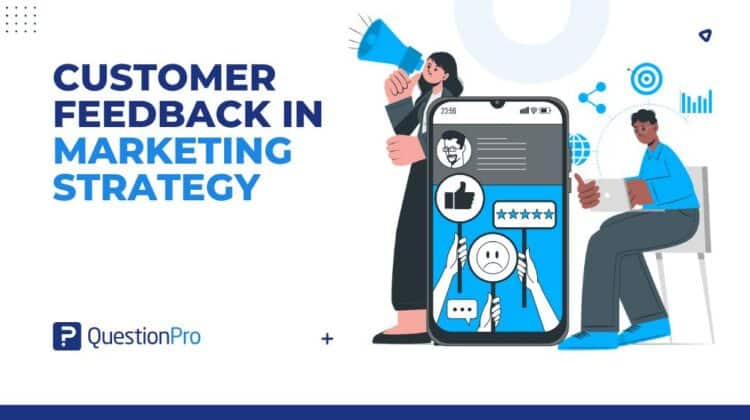
Customer feedback in marketing strategy is the practice of using what customers say, rate, and review. It guides who you target, what you promise, and where you show up. Most teams collect plenty of feedback. Few connect it to campaign decisions.
When that link is missing, marketing runs on assumptions. Messages miss, channels underperform, and budgets drift toward guesses. Feedback replaces those guesses with evidence from the people you want to reach.
In this guide, we’ll break down what feedback-driven marketing looks like, seven ways to apply it, and how to prioritize, measure, and protect it.
What is customer feedback in a marketing strategy?
Customer feedback in a marketing strategy is structured input from customers, such as survey answers, reviews, and interview comments, that marketers use to choose audiences, messages, and channels.
A marketing strategy answers three questions. Who are your customers? What do they need? How do you reach them? Feedback tests each answer against real opinion and behavior.
Take a skincare brand that plans before-and-after posts on Instagram. Survey comments might show that buyers care more about ingredient safety than visible results. The brand can fix the message before it spends more on the wrong one.
Feedback arrives in two forms, and strong programs use both:
- Solicited feedback comes from surveys and interviews you request.
- Unsolicited feedback appears in reviews, social comments, and support chats.
How is customer feedback different from market research and voice of customer?
Customer feedback, market research, and voice of customer overlap, but they answer different questions. Mixing them up leads to the wrong method for the job. The table separates four terms that marketers often confuse.
| Term | What it means | Main sources | Best marketing use |
|---|---|---|---|
| Customer feedback | What existing customers say about their experience with your brand | Surveys, reviews, support chats | Refine messaging, campaigns, and retention |
| Market research | A structured study of a whole market, including people who do not buy from you | Panels, focus groups, competitor analysis | Size new segments and test positioning |
| Voice of customer (VoC) | An ongoing program that collects and analyzes feedback across every touchpoint | Surveys, calls, social, reviews, behavior data | Connect feedback to company-wide decisions |
| Customer reviews | Public ratings and comments posted on third-party sites | Google, Amazon, G2, Yelp | Social proof and reputation |
A voice of customer program is a system that keeps feedback flowing. A single survey is just one input. Use feedback to improve what you already sell, and use market research to decide where to grow next.
Why does customer feedback matter for marketing?
Feedback matters because buyers expect brands to know them and prove their claims. Four sourced findings show how much that expectation shapes results.
- Personalization is the baseline.
McKinsey found that 71% of consumers expect companies to deliver personalized interactions, and 76% feel frustrated when that does not happen.
- Reviews move sales.
Researchers found that the purchase likelihood for a product with five reviews is 270% greater than for a product with none.
- Trust is harder to earn.
In BrightLocal’s 2025 survey of 1,026 US adults, only 42% trusted online reviews as much as personal recommendations, down from 79% in 2020.
- Replies are expected.
The same survey found that just 7% of consumers do not expect a business to respond to reviews.
Each finding points to the same need. Marketers need first-party evidence of what their own customers want and say.
What are the best ways to collect customer feedback for marketing?
The best collection method depends on the decision you need to make. Use surveys for measurable patterns and interviews for the reasons behind them. The table compares seven common sources.
| Method | Best for | Watch out for |
|---|---|---|
| Surveys | Measuring satisfaction, preferences, and message appeal at scale | Long forms that lower completion |
| Customer interviews | Learning the reasons and language behind choices | Small samples and interviewer bias |
| Social media monitoring | Spotting unprompted opinions and trends | A vocal minority skewing the picture |
| Online reviews and testimonials | Finding praise, complaints, and proof to reuse | Bias toward extreme experiences |
| Customer meetings and advisory panels | Testing ideas with engaged customers | Panels that no longer reflect new buyers |
| Website and in-app feedback widgets | Catching friction at the moment it happens | Low response unless prompts are short |
| Support tickets and sales call notes | Hearing objections and recurring questions | Notes that are inconsistent or untagged |
Start with one quantitative source and one qualitative source. A short survey plus five interviews beats either one alone.
How to use customer feedback in your marketing strategy
You can use customer feedback in marketing in seven practical ways. Each one ties a type of feedback to a specific marketing decision.
1. Understand your audience and its pain points
Feedback shows who your buyers are, what frustrates them, and what they expect from you. Look for three patterns first:
- Recurring complaints and unmet needs
- Reasons customers bought, and reasons others did not
- The places where buyers first heard about you
Then ask one pointed question: “What almost stopped you from buying?” The answers surface objections that your ad copy can address directly.
2. Create content that answers real questions
Customers tell you what to write about. Repeated questions in support chats, reviews, and survey comments make strong topics for blog posts, how-to videos, and FAQ pages.
Content built this way matches real demand, because the questions came from buyers. List the questions by how often they appear, and publish the top five first. Then check whether those pages convert better than your older content.
3. Write messaging in your customers’ own words
Customers often describe your product better than your marketing team does. Their wording also matches how they search. Follow these steps:
- Pull 50 to 100 open-text comments and reviews.
- Highlight phrases that repeat, such as “saves me an hour” or “easy to set up.”
- Test those phrases against your current headline in an A/B test.
Keep the exact phrasing, but remove names and personal details.
4. Refine campaigns and channels
Feedback shows which campaigns land and which confuse. It also shows where customers first heard of you. Use the table to turn common signals into actions.
| Feedback signal | Marketing action |
|---|---|
| Customers say a campaign was unclear | Rewrite the headline and offer, then retest |
| Most buyers say they found you on Instagram | Shift budget toward that channel |
| Buyers did not know a feature existed | Add it to onboarding emails and landing pages |
| Lapsed customers cite price | Test a value message or a smaller entry plan |
5. Personalize communication for each customer group
Because most buyers now expect personalization, generic messages cost you attention. Group customers by what feedback reveals about their needs, behavior, and preferences.
Customer segmentation turns scattered comments into groups you can address. Subscribers who want depth get detailed emails. Younger audiences may prefer short, interactive posts. High-value accounts may deserve one-to-one outreach.
Save the preferences customers state in surveys. That way you stop guessing later.
6. Turn positive feedback into proof
Happy customers supply the proof that ads cannot. Reviews, testimonials, and case studies work best where buyers make decisions.
- Place star ratings and short quotes beside calls to action on landing pages.
- Turn a detailed success story into a one-page case study.
- Add reviews to product pages and marketing emails.
- Ask permission before you name a customer or use a photo.
Keep it honest. The FTC’s 2024 final rule bans fake reviews and testimonials, review buying, and review suppression.
7. Respond to negative feedback in public
Complaints are the most useful feedback and the most visible. A fast, calm reply protects your brand and shows prospects how you treat people. Use this sequence:
- Reply quickly and name the problem in the customer’s words.
- Take responsibility without excuses.
- Offer a specific fix, or a clear path to one.
- Follow up after the fix and ask if the issue is resolved.
What do real examples of feedback-driven marketing look like?
These three scenarios show the pattern. They are illustrative composites of common situations, not results from named clients.
- A meal kit brand.
Open-text survey answers keep repeating “too much prep.” The team stops promoting recipe variety and rewrites its headline around “dinner in 20 minutes.” It then runs the new headline against the old one.
- A local dental clinic.
Reviews praise short waits, while complaints mention confusing bills. The clinic puts “seen on time” in its Google Business profile and ads. It also adds a plain-language billing page.
- A B2B software company.
Post-purchase interviews show that buyers chose the product for one-click reporting, not the feature the team advertised. The team rebuilds its demo page and case study around reporting.
In each case, feedback changed one specific marketing asset. The team then measured the result against a baseline.
How do you decide which feedback to act on?
Act first on feedback that is frequent, tied to revenue, and cheap to address. Not every comment deserves a campaign. Score each theme on four factors:
- Frequency: How many customers mention it? A theme in 30% of comments outranks one raised by 1.5%.
- Revenue link: Does it affect conversion, retention, or order value?
- Effort: Can marketing fix it with copy, targeting, or content, or does it need product work?
- Brand fit: Does acting on it support the promise you want to be known for?
Rate each factor from 1 to 5 and rank the totals. Send product issues to the product team and keep messaging issues for marketing. When segments disagree, favor the one that drives the most revenue, then test the change with the other.
Step-by-step guide to building a feedback-driven marketing process
A repeatable process beats a one-time survey. This six-step cycle fits a single campaign or a full quarter.
- Pick one marketing decision to improve, such as homepage messaging or channel mix.
- Choose two feedback sources that speak to that decision.
- Collect responses and tag each comment with a theme.
- Rank the themes using the scoring above.
- Change one asset and test it against the old version.
- Close the customer feedback loop by telling customers what changed.
Repeat the cycle every quarter. Small cycles beat one large annual survey.
Which survey questions give the best marketing insights?
The best marketing survey questions are short, specific, and tied to a decision. Each question below maps to one marketing job.
- Discovery: How did you first hear about us?
- Motivation: What was the main reason you chose us?
- Objection: What almost stopped you from buying?
- Alternatives: What other options did you consider?
- Value: Which benefit matters most to you?
- Loyalty: How likely are you to recommend us, and why?
- Language: How would you describe us to a friend?
- Gaps: What is one thing we could do better?
Mix rating scales with open-ended questions. Scores show how many customers feel a certain way. Comments show why. Keep each survey under 10 questions and ask one idea at a time.
How do you measure the impact of feedback-driven marketing?
Measure impact by comparing marketing results before and after you act on feedback. Pair satisfaction metrics with business metrics, so you see both sentiment and sales.
| Metric | What it shows | How to read it |
|---|---|---|
| Net Promoter Score (NPS) | How likely customers are to recommend you, on a 0 to 10 scale | Track the trend by segment, not one number |
| Customer satisfaction score (CSAT) | Satisfaction with a specific purchase or interaction | Survey right after campaigns and purchases |
| Customer effort score (CES) | How easy it was to buy or get help | Rising effort flags friction to fix |
| Conversion rate | Share of visitors who take the target action | Compare the new message against the old one |
| Review volume and rating | Reputation and strength of proof | Watch monthly growth and reply rate |
| Repeat purchase rate | Loyalty after the campaign | Compare customers who saw the change with those who did not |
Set a baseline for 30 to 90 days before the change. Then run the new version against the old one in an A/B test, or compare matched time periods.
Aim for at least 100 responses per segment. At that size, a survey percentage carries a margin of error near plus or minus 10 points at 95% confidence. Treat small gaps with care.
Common mistakes when using customer feedback in marketing
Most feedback programs fail from habit, not from lack of data. Watch for these six mistakes:
- Surveying only happy customers: Include lapsed and churned buyers too.
- Following the loudest voice: One angry post is not a trend.
- Collecting without acting: Customers stop answering when nothing changes.
- Quoting without permission: Get consent before using names, photos, or full comments.
- Rewarding favorable reviews: Reward participation, never a positive rating.
- Treating stated intent as behavior: Compare what customers say with what they buy.
How QuestionPro supports feedback-driven marketing
QuestionPro Customer Experience focuses on the step most teams skip: capturing the reason behind every score. Three capabilities matter most for marketers.
- AskWhy pairs a rating with a follow-up on the reason and an open comment in a single question. Customers can also vote on other customers’ comments, which shows which themes matter most.
- Text analytics reads open-ended answers, scores sentiment, and groups comments into themes. Marketers no longer tag hundreds of comments by hand.
- Closed-loop workflows turn detractor responses into tickets routed to an owner, so unhappy customers get a reply.
Those theme and sentiment results feed directly into the messaging tests described above.
Customers already hold your best marketing brief
Every review, survey comment, and support chat is a note from the people you want to reach. Teams that read those notes write sharper messages, choose better channels, and spend less on guesses.
You do not need a large program to start. Pick one decision, gather feedback on it, change one asset, and measure the result. Then do it again.
Frequently Asked Questions (FAQs)
Collect feedback continuously at key moments, such as after a purchase or support contact. Run a broader relationship survey once or twice a year. Review themes monthly so campaign changes reflect current opinion, not last year’s survey.
Yes, with care. Get permission before naming customers or using photos, disclose any material connection or incentive, and never publish fake or edited reviews. The FTC’s 2024 rule on reviews and testimonials covers fake reviews, review buying, and suppression.
Small rewards such as a discount entry or loyalty points can raise response rates. Reward the act of answering, never a positive rating. The FTC rule prohibits compensation conditioned on favorable sentiment, so keep incentives neutral and disclose them when relevant.
Send a one-question email after each purchase, ask for a Google review at checkout, and talk to five customers each month. A free survey tool and a simple spreadsheet are enough to tag themes and track three core metrics.
Segment the responses before deciding. Weigh each group by revenue and growth potential, then test the change with the group that disagrees. Often the best answer is two messages, one for each segment, rather than a single compromise.