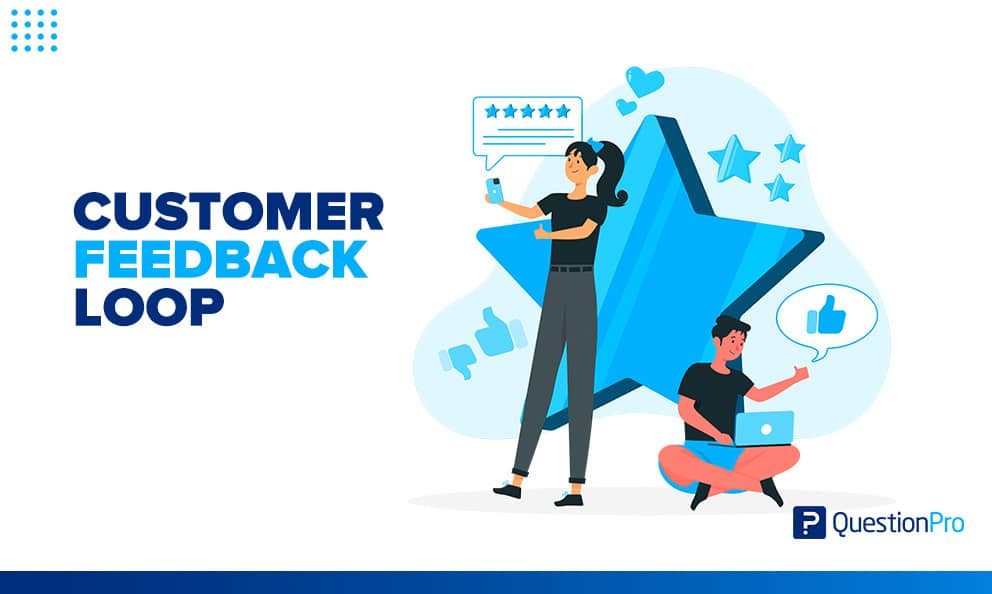
A customer feedback loop is the system that turns customer opinions into real product and service changes. Instead of filing survey responses away, a business studies the input, acts on it, and tells the customer what changed. That last step is what separates a company that listens from one that only asks.
Most companies collect feedback. Few actually close the loop. Retention is the reward for getting this right, and the financial case is hard to ignore once you see the numbers.
In this guide, we’ll cover what a customer feedback loop is, how the four-stage process works, and how to close it in a way that keeps customers loyal.
What is a customer feedback loop?
A customer feedback loop is a repeatable process where a business collects customer input, studies it for patterns, acts on what it learns, and reports back to the customer about what changed. It only counts as a true loop once that last step happens. Skip it, and the process becomes a one-way channel instead of a loop.
Businesses gather customer feedback from many sources at once. Sales calls, support tickets, review sites, and surveys such as Net Promoter Score (NPS), which measures how likely a customer is to recommend a brand, all feed the same loop.
Collecting that input was never the hard part. Connecting it to action, and telling the person who gave it what happened next, is where most programs break down.
Customer feedback loop vs closed-loop feedback: What’s the difference?
The terms customer feedback loop and closed-loop feedback get used interchangeably, but they describe different scopes of the same idea. Confusing them is one reason feedback programs stall.
| Term | What it means | Scope |
|---|---|---|
| Customer feedback loop | The full, ongoing cycle of collecting, analyzing, acting on, and reporting back on feedback | Company-wide process |
| Closed-loop feedback | The specific act of following up with one customer after they submit feedback | A single customer interaction |
| Voice of the customer (VoC) program | The broader strategy and toolset a company uses to listen across every channel | Organization-wide strategy |
A customer feedback loop is the system. Closed-loop feedback is what happens inside it, one conversation at a time. A VoC program is the umbrella that both sit under, covering channels, ownership, and reporting across the whole business.
The customer feedback loop process: 4 stages that close the loop
Every working customer feedback loop follows the same four stages, no matter the industry or company size. Skipping any one of them breaks the cycle.
1. Collect feedback
Pull input from every channel where customers already talk, including support tickets, in-app prompts, review sites, and NPS software alongside CSAT (Customer Satisfaction Score, which measures satisfaction with a single interaction). The goal is coverage, not volume for its own sake. A single channel, like a post-purchase survey, only shows one slice of the relationship, so pairing structured survey data with unstructured comments from support and reviews gives a fuller picture.
2. Analyze for patterns
Raw comments are not insights until someone groups them by theme and root cause. Look for the issues that show up across many customers, not the loudest single complaint. Tagging feedback by category, such as pricing, onboarding, or product bugs, makes it easier to spot which theme is growing month over month instead of reacting to whichever comment came in most recently.
3. Act on what you learn
Route findings to the team that can actually fix the problem, whether that’s product, support, or operations. A pattern that never reaches a decision-maker dies at this stage. Assigning a clear owner for each theme, with a deadline for a response, keeps insights from sitting in a shared spreadsheet indefinitely.
4. Close the loop with the customer
Tell the customer what changed and why, even in a short message. This step is what makes the process a loop instead of a funnel that only moves in one direction. A brief note that references the customer’s original comment, rather than a generic update, is what makes the follow-up feel personal instead of automated.
Customer feedback loop examples in action
These stages look different depending on the business, but the pattern holds. Three examples show what a working loop looks like in practice.
- SaaS product teams: A support team notices repeated requests for a missing feature. Product ships it, and support personally messages the customers who asked, pointing them to the update instead of a generic release note.
- Insurance and financial services: A customer flags friction during a claims process in a post-interaction survey. The company adjusts the workflow and follows up with everyone who reported the issue once the fix ships.
- Retail and e-commerce: A customer complains about a delivery delay. The brand resolves the individual case, then uses the pattern across many similar complaints to renegotiate terms with a shipping partner.
In each case, something structural got fixed internally, and the customer who raised it was told their input mattered.
Inner loop vs outer loop: Two types of customer feedback loops
Feedback loops operate at two levels, and mixing them up is where a lot of companies lose momentum. Bain & Company’s Net Promoter System popularized this split, and it still holds up.
The inner loop is internal. It moves feedback between departments, so support, sales, marketing, and product all work from the same picture of the customer journey instead of isolated notes.
The outer loop is customer-facing. It’s the direct reply a customer gets after leaving feedback, confirming their input was heard and, ideally, acted on.
If you’re building a feedback program from scratch, start with the outer loop. A fast, honest reply to individual customers builds trust immediately and buys time to fix the inner loop’s cross-team routing later. Programs running both loops in parallel see the biggest retention gains, but sequencing matters when resources are limited.
Why the customer feedback loop matters for retention
The main reason customers leave a brand is feeling unheard, not price. A working feedback loop fixes that by proving the company is listening and changing course as a result.
Retention has a direct line to profit. Research published in the Harvard Business Review found that raising customer retention rates by just 5% can increase profits by 25% to 95%. A feedback loop is one of the more direct ways to move that number, since it catches frustrated customers before they churn quietly.
Feedback also compounds. Customers who see their input lead to a real change tend to give more detailed feedback the next time they’re asked. A loop that never closes trains people to stop responding at all, which shrinks your data and skews it toward extreme opinions.
Common customer feedback loop mistakes to avoid
Most broken feedback loops fail in a handful of predictable ways.
- Treating the loop as a one-time project.
A launch-and-forget survey program stops producing useful signal within a few months, once the initial novelty wears off. - Letting a single department own all the feedback.
Support hears different complaints than sales does, and neither sees the full picture without a shared process for routing input across teams. - Confirming receipt without explaining what changed.
A “thanks for your feedback” auto-reply is not the same as closing the loop, and customers can tell the difference. - Ignoring recurring themes because the fix is hard.
Expensive or politically difficult problems don’t disappear just because no one wants to own them. - Measuring collection volume instead of closure.
A growing number of responses means nothing if the percentage that actually gets resolved and followed up on stays flat.
Any one of these turns a feedback loop into a feedback funnel that only moves in one direction. Fixing even one of them tends to lift the closure rate noticeably within a quarter.
How to measure a customer feedback loop’s success
A feedback loop is only as good as its closure rate, and data collection habits determine whether you can even calculate it accurately. Track this formula: (feedback items resolved and followed up on ÷ total feedback items collected) × 100. A team resolving 425 of 500 items with a customer follow-up is running an 85% closure rate.
Pair that number with three others for a fuller picture:
- Average response time, from feedback received to first acknowledgment
- NPS or CSAT movement among customers who received a follow-up, compared to those who didn’t
- Retention rate by cohort, tracking whether customers who got a closed loop stay longer than those who didn’t
None of these numbers matter in isolation. A high closure rate with slow response times still frustrates customers, so track speed and completion together.
How QuestionPro helps you close the customer feedback loop
Closing the feedback loop at scale is hard to do by hand once feedback volume grows past a handful of channels. QuestionPro Customer Experience helps teams route feedback to the right owner, track closure status per case, and trigger automatic follow-ups so no customer response goes unanswered. Dashboards surface the closure-rate and response-time metrics covered above, so teams can see where the loop is breaking without pulling data manually.
Case management workflows also let teams assign a single feedback item to the person best placed to fix it, then track that item until it’s marked resolved and the customer has been notified. That end-to-end visibility is often the missing piece for teams that collect plenty of feedback but struggle to prove any of it led somewhere.
Turning feedback into your next competitive advantage
Collecting feedback is easy. Acting on it consistently, and telling customers what happened as a result, is the part that actually moves retention. Companies that treat the loop as core infrastructure, not a side project, tend to build the kind of trust that competitors struggle to copy.
The businesses that close the loop well aren’t necessarily the ones with the most feedback. They’re the ones who respond to it like it matters every time, on every case, whether the fix takes a day or a quarter.
That consistency is what customers remember. A single great recovery story gets forgotten quickly, but a pattern of visible follow-through becomes a reason people stay, refer others, and keep giving you the honest input you need to keep improving.
Frequently Asked Questions (FAQs)
There’s no universal deadline, but faster is almost always better. Many teams aim to acknowledge feedback within a day or two and deliver a substantive update within a few weeks, depending on whether the fix requires a quick reply or a product change.
No. A VoC program is the broader strategy covering every listening channel and team involved. The customer feedback loop is one operational process inside that strategy, focused specifically on collecting, acting on, and reporting back on individual pieces of feedback.
Most teams combine survey platforms for collection, text and sentiment analysis for pattern-finding, and a case management or ticketing layer for routing and follow-up. Smaller teams sometimes run all three functions inside one CX platform instead of stitching tools together.
It works at any size, though the process looks lighter for smaller teams. A five-person company can close loops manually through email and still see retention benefits, while larger organizations usually need automated routing to keep pace with volume.
AI mainly speeds up the analysis stage, clustering open-ended comments into themes in minutes instead of days. It doesn’t replace the human judgment needed to decide what to fix or the personal touch required to close the loop with a customer well.