Bring your Excel/PPT & Static Maps into a journey-based operating platform.
Most organizations are not short on journey maps.
They are short on journey management.
Over the last decade, companies across industries have invested heavily in mapping customer experiences. Teams gathered insights, documented touchpoints, and aligned stakeholders around what the customer goes through. The output was often thoughtful, detailed, and visually compelling.
Yet, months later, many of those same maps are no longer referenced.
Not because they were wrong, but because they were never operationalized.
The challenge today isn’t creating journey maps, it’s transforming them into systems that guide decisions, measure performance, and drive accountability.
That’s the shift from Journey Mapping to Journey Management.
The Difference Between Mapping a Journey and Managing One
Journey Mapping is an exercise, while Journey Management is an operating model.
Mapping helps you understand experiences at a moment in time.
Managing ensures those experiences continuously improve over time.
| Journey Mapping | Journey Management |
| Visualizes customer experience | Operationalizes customer experience |
| Delivered as a project | Sustained as a discipline |
| Static documentation | Dynamic, data-connected system |
| Insight-driven | Action-driven |
| Periodic updates | Continuous optimization |
Many organizations stop at the first column not by choice, but because their journey maps live in tools that cannot support the second.
Why Static Formats Prevent Operational CX
Let’s look at where most journey maps actually live today:
- Excel files with process-level detail
- PowerPoint decks used in workshops and reviews
- PDFs shared with leadership
- Documentation stored across shared drives
These formats are excellent for collaboration and storytelling. But they create three major roadblocks when organizations try to act on them.
1. No Connection to Real-Time Customer Data
Static maps cannot reflect what customers are saying right now. They don’t ingest feedback, track satisfaction, or highlight emerging friction points.
2. No Ownership or Accountability Structure
When a journey exists only in a file, no team truly “runs” it. Responsibility becomes diffuse, and improvements become ad hoc.
3. No Mechanism for Continuous Improvement
Updating a static map requires manual effort, which means updates rarely happen. The map quickly drifts away from reality.
In other words, the organization understands the journey but cannot manage it.
The Need for a Journey-Based Operating Platform
To move beyond static mapping, organizations need to embed journeys into the way they operate.
A journey-based operating platform allows teams to:
- Anchor metrics to specific journey stages
- Assign ownership across functions
- Monitor experience health continuously
- Identify root causes tied to real touchpoints
- Prioritize improvements based on impact
- Align operations, product, and CX around a shared structure
This is where static files fall short and where modern CX platforms step in.
Solutions like QuestionPro enable organizations to import their existing journey artifacts and transform them into connected, measurable frameworks.
You Don’t Need New Maps; You Need to Activate the Ones You Have
A common misconception is that moving to journey management requires starting over.
It doesn’t.
- Your Excel sheets already define workflows.
- Your PPT maps already show experience stages.
- Your PDFs already capture insights.
What’s missing is not knowledge; it’s connectivity.
By bringing these existing assets into a centralized platform, organizations can translate static thinking into operational structure without recreating months of work.
What Changes When Journeys Become Operational?
Once journeys live inside a management environment instead of documents, they start behaving differently.
They Become Measurable
Instead of asking:
“Do we think onboarding is working?”
You can ask:
“How is onboarding performing across satisfaction, effort, and completion rates this quarter?”
Metrics align directly to stages, giving leaders visibility that static maps never could.
They Become Owned
Each stage or touchpoint can be tied to responsible teams.
This shifts journeys from conceptual diagrams to shared accountability models, ensuring improvements are coordinated rather than siloed.
They Become Dynamic
Journeys evolve alongside customer behavior.
New touchpoints can be added. Friction can be tracked. Improvements can be validated against actual outcomes.
The journey becomes a living system not a finished deliverable.
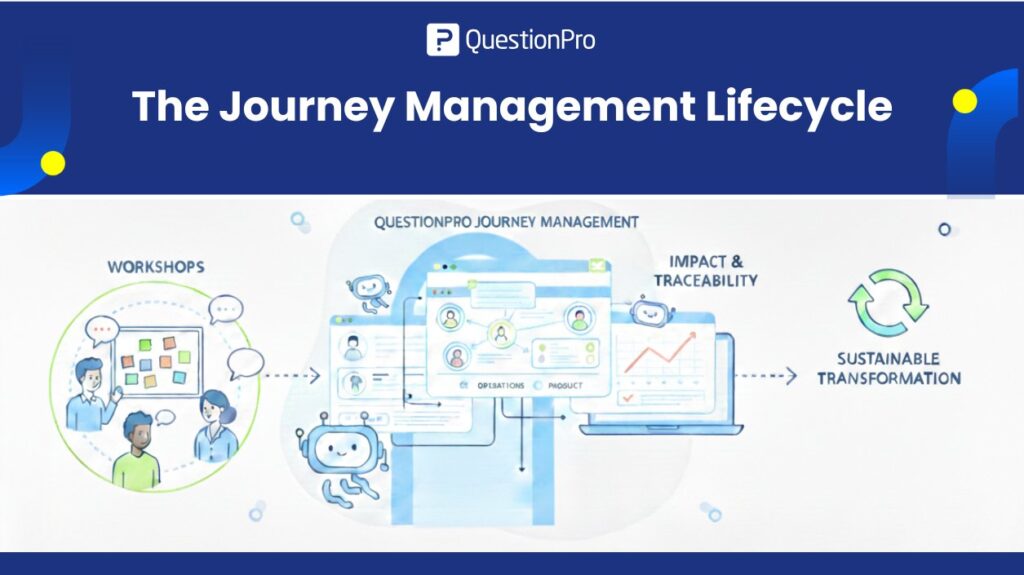
From Workshops to Workflows
Traditional journey mapping often peaks during workshops. Energy is high, collaboration is strong, and insights are rich.
But without an operational layer, that momentum fades as teams return to daily responsibilities.
A journey-based platform ensures workshop insights translate into workflows by:
- Embedding journeys into decision-making
- Connecting feedback loops automatically
- Enabling cross-functional visibility
- Supporting continuous iteration
This turns journey mapping into something far more powerful: a management framework.
Bridging CX, Operations, and Product Teams
One of the biggest advantages of operationalizing journeys is alignment.
Static maps are often “owned” by CX teams but rarely used by operations or products because they aren’t embedded into execution systems.
When journeys become part of an operating platform:
- CX teams monitor sentiment and feedback
- Operations teams track delivery performance
- Product teams prioritize enhancements based on journey pain points
Everyone works from the same structure, reducing fragmentation and accelerating change.
Making Experience Improvements Traceable
Organizations often implement changes but struggle to answer a simple question:
Did that actually improve the customer experience?
Journey management provides traceability.
Because metrics and feedback are tied to specific journey stages, teams can measure whether interventions moved the needle- turning CX from intuition-driven to evidence-driven.
A More Sustainable Model for Experience Transformation
Journey mapping alone cannot sustain CX transformation. It creates awareness but lacks durability.
Journey management creates sustainability by embedding experience thinking into everyday operations rather than periodic initiatives.
This shift enables organizations to move from:
- Listening occasionally to Listening continuously
- Reacting to problems to Anticipating them
- Running projects to Running programs
The Evolution Organizations Are Undergoing Right Now
We’re seeing a clear progression across industries:
Phase 1: Discover journeys through workshops
Phase 2: Document journeys in static formats
Phase 3: Struggle to maintain relevance
Phase 4: Transition to journey-based management platforms
Many organizations are currently between Phases 2 and 3, rich in insight but lacking activation.
The move to Phase 4 doesn’t require reinvention. It requires integration.
The Real Value of Moving Beyond Static Maps
When journeys become operational, they start influencing outcomes that matter:
- Reduced friction across critical touchpoints
- Faster identification of experience breakdowns
- Better cross-functional prioritization
- Stronger alignment between brand promise and delivery
- Measurable ROI from CX initiatives
This is when journey thinking shifts from a design activity to a business capability.
Your Journey Maps Are the Foundation- Not the Finish Line
The maps you’ve already created are not outdated. They’re unfinished.
They contain the structure, insights, and alignment needed to manage experiences, they just need the right environment to function.
By bringing Excel, PPT, and other static artifacts into a journey-based operating platform, organizations can unlock the next stage of CX maturity without discarding past work.
From Understanding Experiences to Running Them
Journey Mapping helped organizations understand what customers go through.
Journey Management enables organizations to run experiences intentionally, consistently, and measurably.
And that is the difference between knowing the journey and leading it.