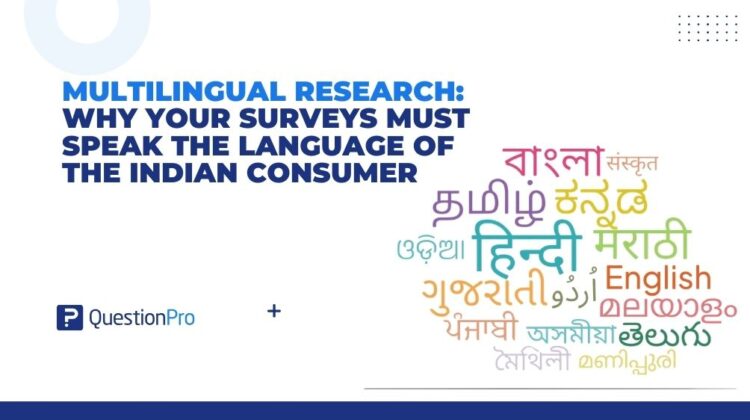
India is not a single market. It is 28 states and 8 union territories, each with distinct linguistic identities, cultural contexts, and consumer behaviors. The country has 22 officially recognized languages, hundreds of dialects, and a linguistic map of staggering diversity.
Yet the overwhelming majority of market research and customer experience surveys deployed in India are delivered only in English or, at best, English and Hindi, effectively excluding or significantly disadvantageing the majority of Indian consumers from contributing accurate feedback.
The consequences are commercial, not academic. Brands making pricing decisions, product development investments, distribution choices, and customer experience improvements based on English-only survey data are making those decisions on a dataset that structurally represents only the English-fluent 10 to 15 percent of India’s population.
In a country where the most dynamic consumer growth is happening in regional language markets – Tamil Nadu, Andhra Pradesh, Karnataka, West Bengal, Maharashtra, and Gujarat – this is a systematic blind spot that costs brands real money and real market share.
The Language Reality of Indian Consumers
Hindi is spoken as a first language by approximately 44 per cent of India’s population, meaning more than half of Indians have a different mother tongue. Tamil Nadu, Karnataka, Andhra Pradesh, and Telangana together hold approximately 250 million people, the vast majority more comfortable in Tamil, Kannada, or Telugu. West Bengal’s 100-million-plus population is predominantly Bengali-speaking.
Maharashtra’s 120 million include Marathi and Konkani speakers. Gujarat’s 65 million are predominantly Gujarati-speaking. Research consistently shows that consumer decision-making, emotional expression, and complaint articulation are most accurate in a person’s native language.
Asking a Tamil-speaking consumer from Chennai to express their satisfaction with a financial product in English produces measurably less accurate data than asking in Tamil.
How Language Bias Systematically Distorts Indian Research
Sampling Bias
English-only surveys automatically skew samples toward urban, educated, higher-income respondents. Any decision made on that data is biased toward the preferences of a segment that may not reflect your actual or target customer base in the markets that matter most to your growth.
Comprehension Errors
Respondents completing surveys in a non-fluent language make systematic comprehension errors. They misinterpret Likert scale directions, skip nuanced questions, or select safe middle options. These errors do not appear as ‘wrong’ in the data; they look like valid responses but are noise masquerading as signal.
Sentiment Inaccuracy
Emotional expression is most authentic in a person’s native language. For customer satisfaction surveys and NPS instruments, forcing non-native language completion produces flatter, less differentiated responses, systematically underestimating the variance in customer sentiment that the research is trying to measure.
Completion and Dropout Bias
English-only surveys delivered to populations with mixed English proficiency produce dramatically lower completion rates among non-English-dominant respondents. Your completed dataset represents specifically those members of your target population who are comfortable in English, a non-representative minority in most Indian consumer markets.
How QuestionPro Solves the Multilingual Research Problem
QuestionPro’s multilingual survey platform is built specifically for the linguistic complexity of markets like India. The platform supports 30+ languages, including Hindi, Tamil, Telugu, Kannada, Marathi, Bengali, Gujarati, Malayalam, Punjabi, and Odia, covering the primary linguistic groups of over 95 per cent of India’s population.
Every QuestionPro survey can be configured with multiple simultaneous language versions, with dynamic language selection at the start of the survey based on respondent preference. Response data from all language versions flow into a single unified dataset with consistent question coding, enabling cross-language analysis without manual data harmonisation.
Devanagari, Tamil, Telugu, Kannada, Bengali, and other scripts all render correctly on all supported devices, including entry-level Android handsets. The survey builder allows researchers to build all language versions from a single interface with side-by-side translation management that simplifies professional translation workflows.
Translation Quality: The Difference Between Data and Noise
The most common mistake in multilingual survey design is using machine translation for survey questionnaires. Machine translation is dangerously unreliable for research instruments. A translation error that changes the direction of a scale or the interpretation of a concept produces worthless data. Cultural nuance is lost, and dialect variation within languages is not handled at all.
Professional translation with back-translation validation is the gold standard. QuestionPro’s platform integrates with professional translation workflows and includes translation management tools that simplify the back-translation validation process. For high-stakes research, QuestionPro’s survey design team can support questionnaire localisation as part of the research design process.
Distributing Multilingual Surveys: Channel Matters as Much as Language
WhatsApp surveys are the most effective delivery channel for regional language respondents in India. QuestionPro’s WhatsApp Business API integration allows language-matched survey delivery based on respondent profile or device language settings. SMS in regional scripts is effective for post-transaction CSAT collection. In-app surveys with device language detection are highly effective for consumer apps with large regional user bases.
Email remains primarily an urban, English-medium channel; deploying multilingual surveys via email still misses the regional language audience you are trying to reach.
Analyzing Multilingual Survey Data With QuestionPro
For closed-ended questions, cross-language analysis is straightforward when QuestionPro’s consistent response coding is maintained across language versions. For open-ended responses, QuestionPro’s text analytics engine processes feedback in Hindi, Tamil, Telugu, Kannada, and other Indian languages, identifying sentiment polarity, thematic clusters, and urgent issues in vernacular text without requiring manual translation.
Language itself should be treated as a segmentation variable in analysis. Significant differences in satisfaction scores between Hindi and Tamil respondents, for example, often reflect genuine regional variation in product experience or service quality, and QuestionPro’s dashboards allow researchers to break out all KPIs by response language, surfacing these regional insights automatically.
Frequently Asked Questions
India’s linguistic diversity means English-only surveys structurally exclude or disadvantage the majority of consumers. Multilingual surveys generate more accurate, representative, and actionable insights and reach markets that English-only instruments simply cannot access. QuestionPro’s 30+ language support makes this accessible without complex custom development.
For national coverage, include Hindi, English, Tamil, Telugu, Kannada, Marathi, Bengali, Gujarati, and Malayalam. These nine languages cover over 95% of India’s population. QuestionPro’s platform supports all of these plus Punjabi, Odia, Assamese, and additional regional languages.
No. Machine translation produces errors in survey questions that can fundamentally alter their meaning. Professional translation with back-translation validation is the recommended minimum standard. QuestionPro’s platform supports professional translation management workflows.
QuestionPro supports 30+ languages, including all major Indian regional languages, with correct script rendering, dynamic language selection for respondents, unified data structures for cross-language analysis, and text analytics in Indian languages for processing open-ended responses.
WhatsApp is the most effective channel for regional language survey distribution in India, followed by SMS. QuestionPro’s WhatsApp Business API integration allows language-matched survey delivery. Email is primarily effective for urban, English-dominant audiences.
Use a platform with multilingual NLP capabilities trained on Indian language data. QuestionPro’s text analytics engine supports sentiment analysis and topic extraction in Hindi, Tamil, Telugu, and Kannada, processing regional feedback in a unified analysis interface alongside English responses.
India’s regional language consumers are your fastest-growing market. Do not let a language barrier stand between you and their insights.
Related Reading: Mobile-First Survey Optimization | WhatsApp Survey Guide | Customer Satisfaction Survey Design