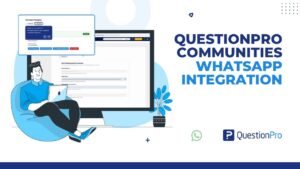
WhatsApp surveys in India deliver questions directly inside a WhatsApp chat thread, letting respondents answer one question at a time without switching to an app or browser. For a country where WhatsApp is the primary digital communication channel for hundreds of millions of people, this single design choice changes response rates dramatically compared to email.
India presents a unique research challenge: over 500 million WhatsApp users span urban and rural areas, dozens of languages, and every income bracket, while email survey open rates in India typically run between 15 and 25 percent. Statista data confirms India has consistently ranked as WhatsApp’s largest single-country market, ahead of Brazil and Indonesia. WhatsApp closes the response gap by meeting respondents where they already spend their time.
In this guide, we’ll explore why WhatsApp outperforms other channels for Indian market research, how regional language support works, and what compliance considerations matter under India’s data protection law.
Why do WhatsApp surveys work so well in India?
WhatsApp surveys succeed in India because the platform has effectively become the country’s default communication infrastructure, not just a messaging app among several options. With over 500 million active Indian users checking the app multiple times daily, a survey delivered through WhatsApp reaches people who may never open a market research email at all.
The response rate gap is significant. WhatsApp messages in India see open rates above 95 percent, compared to 15 to 25 percent for email. Response initiation rates, the percentage of people who actually begin the survey, run three to five times higher on WhatsApp than on equivalent email campaigns.
How WhatsApp reaches audiences other channels miss
WhatsApp penetration in India cuts across demographics that email and traditional online panels struggle to reach. Rural consumers, older age groups, lower-income segments, and speakers of regional languages are all far more likely to be reachable on WhatsApp than through an English-language email inbox.
This matters because India’s research landscape is not one homogenous audience. A consumer in a metro city and a consumer in a smaller town often have different linguistic preferences, different levels of comfort with English-language forms, and very different email habits.
WhatsApp’s conversational format works consistently across all of these groups in a way email cannot.
Regional language support for WhatsApp surveys
India has 22 official languages and hundreds of dialects, which makes language matching a core requirement for any national research program, not an optional add-on. A multilingual survey delivered through WhatsApp can match language to respondent profile or device settings, so a respondent in Chennai sees Tamil while a respondent in Lucknow sees Hindi.
Text analytics for open-ended responses adds another layer of value here. Processing feedback in Hindi, Tamil, Telugu, Kannada, and other Indian languages without requiring manual translation lets researchers identify sentiment and themes at scale, something that would take significantly longer with manual translation workflows.
Best practices for running WhatsApp surveys in India
A few practices consistently improve results for WhatsApp-based research programs in the Indian market.
- Keep the conversational format short.
WhatsApp’s strength is its chat-like feel, so a survey that reads like a long form defeats the purpose of the channel. - Match language to the respondent, not the brand’s default.
Language-matched delivery based on profile or device settings measurably improves both response rates and data quality. - Time distribution around peak engagement windows.
Late morning to early afternoon windows tend to see stronger response rates than early morning or late evening sends. - Offer instant, locally relevant incentives.
UPI-linked cashbacks and mobile top-ups resonate more strongly with Indian respondents than generic gift card offers common in Western markets. - Build in fraud and quality checks.
GPS inconsistency detection and pattern recognition for professional survey-takers help maintain data quality at scale.
Pros and cons of WhatsApp surveys in India
Pros
- Reaches rural, older, and regional-language audiences email cannot
- Achieves dramatically higher open and response initiation rates than email
- Feels like a direct brand conversation rather than an automated inbox message
- Supports real-time, conversational data collection without app downloads
Cons
- Requires WhatsApp Business API access, which involves setup and approval steps
- Shorter conversational format is not ideal for very long or complex questionnaires
- Language-matching and text analytics in vernacular languages need proper configuration
- Data protection compliance requires deliberate attention given India’s regulatory environment
Data protection and compliance considerations
Any WhatsApp survey program in India needs to account for the Digital Personal Data Protection Act, which governs how personal data is collected, stored, and processed. Platforms offering local Indian data residency make compliance considerably more straightforward than those routing Indian respondent data through servers outside the country.
Researchers should also confirm consent mechanisms are clear before collecting any personal data through WhatsApp, since the conversational format can make consent feel more casual than it should be treated from a compliance standpoint. Platforms built specifically for Indian market research agencies typically bake DPDP compliance and local data residency into the core product rather than treating it as an afterthought.
Common mistakes when running WhatsApp surveys in India
The most common mistake is treating a WhatsApp survey like a shortened email survey rather than designing for the conversational format from the start. A form-like sequence of dense questions loses the natural feel that makes WhatsApp effective in the first place.
A second mistake is defaulting to English or Hindi only, missing the reach advantage that regional language support provides. A campaign targeting a national audience without language-matched delivery leaves significant response rate improvement on the table.
The third mistake is underestimating incentive expectations. In a price-sensitive market, offering no incentive or an incentive that feels disconnected from local payment habits, rather than UPI-based options, measurably reduces completion.
How QuestionPro supports WhatsApp research in India
QuestionPro’s WhatsApp survey integration provides the infrastructure to run WhatsApp-based research at scale, including Business API support for language-matched delivery and compliance features aligned with the DPDP Act. Pairing this with proven strategies to increase survey response rates in India, like localized incentives and peak-window timing, compounds the reach advantage WhatsApp already provides.
Combined with QuestionPro’s broader Market Research Software, teams can run WhatsApp, SMS, and traditional online surveys from a single platform rather than stitching together separate tools for each channel.
A closing thought on reaching Indian audiences where they are
The math on channel choice for Indian market research is not subtle. A channel with 95 percent-plus open rates and reach into rural, regional-language audiences will consistently outperform a channel most people barely open.
WhatsApp surveys are not a novelty distribution method in India. They are quickly becoming the default for any research program serious about representative national reach.
Frequently Asked Questions (FAQs)
WhatsApp messages in India typically see open rates above 95 percent, compared to 15 to 25 percent for email. Response initiation rates run three to five times higher on WhatsApp than equivalent email campaigns.
Yes, and this is one of WhatsApp’s biggest advantages. Rural consumers, older age groups, and regional-language speakers are far more reachable on WhatsApp than through English-dominant email or web survey channels.
It can be, provided the platform supports DPDP Act requirements, including clear consent mechanisms and, ideally, local Indian data residency. Compliance depends on how the survey program is configured, not on WhatsApp being the default channel.
UPI-linked cashbacks, mobile top-ups, and Indian e-commerce vouchers tend to outperform generic gift card incentives common in Western markets. Instant, locally relevant rewards align better with respondent expectations.
Yes. Language-matched delivery based on respondent profile or device settings allows a single campaign to reach respondents in Hindi, Tamil, Telugu, Bengali, and other regional languages without running separate campaigns for each.