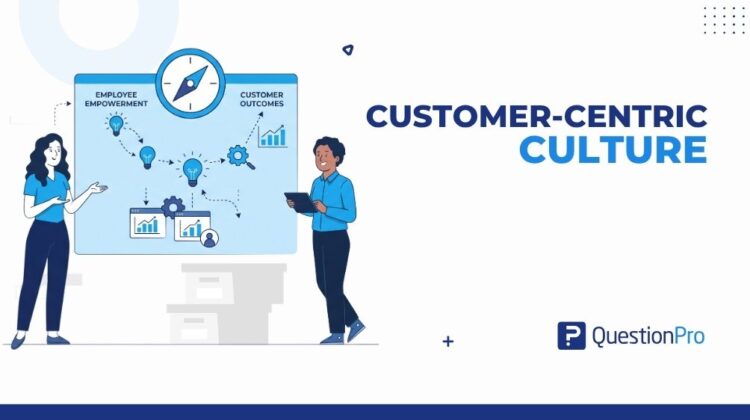
A customer-centric culture is what separates companies that talk about customer experience from companies that actually deliver it. It shows up in daily decisions, not mission statements on a wall.
Most companies believe they already have one. Few actually do. What they have instead is an operations-focused company with a customer service department bolted on, and the two are not the same thing.
In this article, we will break down what a customer-centric culture actually means, how it differs from an operations-focused mindset, and the steps you can take to build one in your own organization.
What is a customer-centric culture?
A customer-centric culture is an organizational mindset where every decision, policy, and job role is built around what benefits the customer, not just what is easiest or cheapest to operate.
It is different from customer service. Customer service is a function. A customer-centric culture is a company-wide operating model. A business can have a well-trained support team and still run an operations-focused company underneath it, because the culture that shapes hiring, leadership, and daily decisions never actually changed.
It also gets confused with “customer-focused,” a term often used loosely as a synonym. In practice, customer-focused usually describes intent, a stated priority to care about customers. A customer-centric culture describes structure, meaning that intent is actually built into hiring, training, incentives, and escalation paths. Intent without structure rarely survives a budget cut.
The stakes are real. Deloitte research has found that customer-centric companies are significantly more profitable than companies that are not focused on the customer. That gap does not come from a nicer greeting at checkout. It comes from structural differences in how the company is built, which is exactly what separates a customer-centric company from an operations-focused one. Understanding the broader idea of customer experience is the starting point, since a customer-centric culture is really the internal engine that produces it.
Customer-focused vs. operations-focused companies: what actually differs
Both types of companies can claim to care about customers. The difference shows up in daily decisions, not in a values statement.
A survey software platform can help you gather that data directly from employees and customers, since each group will describe very different daily experiences depending on which side of this table your company falls on.
| Area | Customer-focused company | Operations-focused company |
|---|---|---|
| Empowerment | Employees can make judgment calls to help a customer, within legal and ethical limits | Employees need manager approval for anything outside written policy |
| Hiring | Candidates are hired for values and personality fit, then trained on skills | Candidates are hired almost entirely for technical skill and experience |
| Training | Time and budget go toward relationship building and soft skills | Time and budget go almost entirely toward product knowledge and process |
| Leadership | Leaders visibly model the behavior they expect from the team | Leaders set a vision but do not consistently practice it themselves |
| Employee experience | Employee wellbeing is treated as a driver of customer outcomes | Employee experience is secondary to systems, procedures, and cost control |
| Ownership of service | Every employee treats customer service as part of their job | Customer service is treated as one department’s responsibility |
Neither model is entirely wrong. Operational discipline still matters. The difference is which one wins when the two are in tension, and a customer-centric company consistently chooses the customer’s outcome over the easier internal process.
A quick test: picture an employee facing an unusual request outside written policy. If the honest answer is “they would need manager approval first,” the culture is still operations-focused.
Real-world examples of a customer-centric culture
Seeing the model in action makes it easier to apply than reading a definition alone.
- Zappos built its reputation by giving frontline employees wide authority to resolve customer issues without escalation, including well-documented cases where reps went far outside a typical script to help a customer.
- Amazon is known for keeping the customer’s perspective present in leadership meetings, using customer data across every department, from search results to delivery logistics, to shape decisions rather than treating it as a marketing input.
- Southwest Airlines has long trained gate and cabin staff to use judgment during irregular operations, such as flight delays, rather than following a rigid script, which is a direct example of the empowerment gap described in the comparison table above.
- Community-driven brands increasingly gather ongoing feedback through an online research community instead of relying only on annual surveys, which lets them catch shifts in customer expectations while there is still time to act on them.
The common thread across all four examples is the same. Customer input shapes real decisions, not just marketing copy, and that input reaches the people who can actually act on it. None of these companies eliminated process entirely. They simply built enough room inside the process for a human to make a judgment call.
How to build a customer-centric culture in your organization
Building this culture takes structural changes, not a new slogan. Each of the steps below targets one of the specific gaps shown in the comparison table, since fixing the culture means changing the mechanics behind it, not just the language around it.
- Hire for values first. Screen for alignment with your customer philosophy before you screen for technical skill, since skill is easier to teach than judgment.
- Set guidelines, not rigid rules. Give employees a clear boundary of what is off-limits, then trust their judgment inside it.
- Train leaders to model the behavior. Employees copy what leadership does, not what leadership says in a town hall.
- Close the loop with employees. Use 360 feedback software so employees hear how their behavior actually affects customers and coworkers, not just their manager’s opinion of them.
- Reward customer outcomes, not just speed. If your metrics only reward how fast a ticket closes, you are quietly building an operations-focused company no matter what your values statement says.
- Give managers a coaching role, not just an approval role. When a manager’s main job shifts from approving exceptions to coaching judgment, employees stop routing every decision upward by default.
SHRM research shows that turnover tied to a poor culture fit can cost a company 50 to 60 percent of that employee’s annual salary, which makes hiring for values a financial decision, not just a cultural one.
How to measure a customer-centric culture
You cannot manage what you do not measure, and culture is no exception.
Track a mix of customer and employee signals together, since the two move in tandem in a genuinely customer-centric company. Customer satisfaction (CSAT), Net Promoter Score, and first-contact resolution show the customer side. Employee engagement scores and voluntary turnover show whether the culture behind those numbers is actually holding up.
Treat customer metrics as lagging indicators and employee metrics as leading ones. A dip in employee engagement this quarter tends to show up as a dip in customer satisfaction next quarter, which means the employee data is often the earlier warning sign, not the customer data.
A customer experience platform can bring both sides into one view, so a drop in employee engagement gets flagged before it shows up in customer complaints three months later. Pairing a scored question with an AskWhy follow-up question also reveals the reason behind a low score, not just the number itself, which matters more than the score alone when you are deciding what to fix first.
Common mistakes to avoid
Most companies do not fail at this on purpose. They drift into it through small, reasonable-sounding decisions.
- Understaffing frontline roles.
Recent Gallup data found only 23 percent of employees believe their organization consistently delivers on its promises to customers, and staffing shortages are the top cited barrier.
- Measuring speed instead of outcomes.
A fast resolution that does not actually solve the problem is not a win, even if it looks good on a dashboard.
- Treating culture as a training module.
A single onboarding session does not change how people behave under pressure six months later.
- Letting policy exceptions require too many approvals.
If every judgment call needs three signatures, employees stop making them at all.
- Keeping customer feedback siloed by department.
If support, product, and leadership each see a different slice of feedback, nobody has the full picture needed to fix the actual cause.
Any one of these mistakes on its own is manageable. Left unaddressed together, they quietly rebuild the same operations-focused company you were trying to move away from.
Culture is the harder thing to copy
Pricing gets matched. Features get copied within a quarter. A culture built around genuine customer judgment is much harder for a competitor to replicate quickly, because it lives in hundreds of small daily decisions rather than in a single product feature.
That is also why it holds up better under pressure. When a company is squeezed on cost or time, an operations-focused company defaults to the rulebook, while a customer-centric one still has employees empowered to do the right thing. That resilience is the real return on the effort it takes to build this culture in the first place.
Frequently Asked Questions (FAQs)
Most organizations see early behavior changes within six to twelve months, but a full culture shift typically takes two to three years. Hiring and leadership modeling drive the pace more than any single training program does.
Yes. Empowerment guidelines, hiring for values, and leaders modeling the right behavior cost little to nothing. Budget affects the tools you use to measure it, not whether you can build the culture itself.
No. It means employees can use judgment within clear ethical and financial limits. A customer-centric culture still says no when a request is unreasonable or against company policy for good reason.
At-will employment in most US states gives companies flexibility to define empowerment guidelines without extensive union negotiation, but written policies should still stay within wage, safety, and anti-discrimination law regardless of how much discretion employees are given.
Technology cannot create the culture, but it can measure whether it is real. Feedback platforms and analytics dashboards show whether empowered decisions are actually improving customer outcomes over time.