Dichotomous questions are survey questions with exactly two possible answers, most often Yes or No. They show up everywhere, from customer feedback forms to healthcare intake surveys, because they are quick to answer and even quicker to analyze.
Are dichotomous questions useful? The honest answer is yes and no. They simplify the respondent’s experience, but that same simplicity limits what you can learn from the data later.
In this article, we’ll learn what dichotomous questions are, when they help, when they backfire, and how to write ones that don’t lead respondents toward a particular answer.
What is a dichotomous question?
A dichotomous question is a closed-ended survey question that offers respondents only two mutually exclusive answer choices. There is no middle ground and no room for nuance.
The word comes from “dichotomy,” meaning a division into two parts. In survey design, that division usually looks like:
- Yes / No
- True / False
- Agree / Disagree
- Fair / Unfair
- Pass / Fail
- Member / Non-member
This format works best when the underlying reality is genuinely binary. Someone either bought a product or they didn’t. A form was either submitted or it wasn’t. When the answer can only go one of two ways, a dichotomous question captures it cleanly.
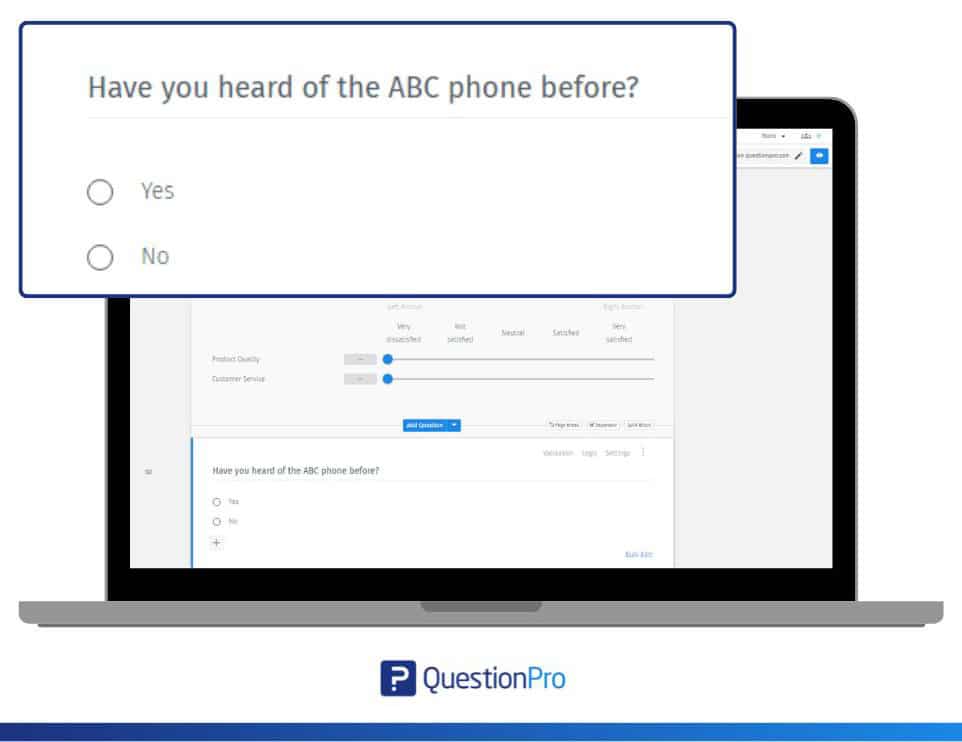
A good dichotomous question has a factual, verifiable answer, such as “Are you taller than six feet?” A weak one asks about a matter of degree, such as “Do you like the songs on this album?” A respondent might love one track and dislike the rest, and Yes/No has no way to capture that.
Common types of dichotomous questions
Most dichotomous questions fall into a handful of recurring formats. The table below shows the most common types along with a sample question for each.
| Type | Example question | Best used for |
|---|---|---|
| Yes/No | Have you used our app in the last 30 days? | Screening, eligibility, usage tracking |
| True/False | This product met my expectations. (True/False) | Fact-based statements |
| Agree/Disagree | I would recommend this service to a colleague. | Simple sentiment checks |
| Fair/Unfair | Was the pricing for this service fair? | Policy or fairness perception checks |
| Pass/Fail | Did the candidate meet the certification standard? | Scoring and evaluation |
| Present/Absent | Did the patient report any symptoms? | Healthcare intake, screening |
Each of these formats is a variation on the same idea: two options, one selection, no in-between.
Dichotomous questions are also a common building block inside a structured questionnaire, where every question follows a predetermined wording and sequence.
When are dichotomous questions useful?
Dichotomous questions earn their place when a survey needs a fast, unambiguous split between two groups. A few situations where they consistently work well:
- Screening and eligibility: Filtering respondents before routing them to the right follow-up questions. Asking “Have you ever purchased a product or service from our website?” lets you opt out respondents who have never bought from you, so the rest of the survey only reaches actual customers.
- Behavioral confirmation: Confirming whether an action happened, such as a purchase or a login.
- Exit interviews: Getting a clear signal, like whether a departing employee would consider returning.
- Healthcare intake: Recording clear-cut clinical facts where there is no room for ambiguity.
- Surveys aimed at children: Younger respondents often engage better with two simple choices than with a longer scale.
Outside of these cases, it helps to look at the wider set of types of survey questions before deciding whether a binary format actually fits the question you’re asking.
Pros and cons of dichotomous questions
Weighing the benefits against the drawbacks is the fastest way to decide whether a dichotomous question fits your survey.
Pros:
- Fast for respondents to answer, which supports higher completion rates
- Simple to code and analyze, since there are only two response categories
- Reduces ambiguity for factual, yes-or-no situations
- Works well as a screening or routing question
Cons:
- Collapses nuance, so you cannot measure intensity or degree of opinion
- Cannot be expanded later. Once you collect a Yes/No answer, you cannot recover the detail a scaled question would have captured
- More prone to acquiescence bias, where respondents default to the more agreeable option
- Provides only two analysis groups, which limits statistical depth
Dichotomous questions vs. other closed-ended question types
Dichotomous questions are one member of a larger family called closed-ended questions, and it helps to know where the boundaries sit.
A dichotomous question offers exactly two options. A multiple-choice question offers three or more, and a Likert or rating scale question measures degree, such as strongly disagree to strongly agree. All three are closed-ended, but only one of them is dichotomous.
| Question type | Number of options | What it measures |
|---|---|---|
| Dichotomous | 2 | A binary fact or choice |
| Multiple choice | 3 or more | A single selection from several categories |
| Likert/rating scale | 5 to 10, typically | Intensity or degree of agreement |
According to the Nielsen Norman Group, surveys with many open-ended questions usually see lower completion rates than surveys built around closed question formats like dichotomous questions, since respondents can answer with a single click.
How to avoid bias in dichotomous questions
The two-option format makes dichotomous questions easy to answer, but it also makes them easy to write badly. A poorly worded dichotomous question can quietly lead the respondent.
Compare these two ways of asking about a menu change at a restaurant:
- “Do you think our new menu additions have improved the dining experience?” Yes/No
- “In your opinion, how have the menu changes impacted your dining experience?” with options from Much Worse to Much Improved
The first question is leading. It primes the respondent to focus on improvement before they’ve even formed an opinion. Respondents also tend to agree with a stated premise, a pattern known as acquiescence bias, which inflates positive results without reflecting how people actually feel.
The second question is neutral. It measures both direction and intensity, and it gives respondents who noticed no change somewhere to go. For more ways to catch this kind of wording problem before it reaches your respondents, see this guide on how to avoid survey bias.
How to measure and analyze dichotomous question data
A dichotomous scale, in statistics, refers to a scoring method with exactly two outcomes, such as correct or incorrect on a test item. That same either/or logic applies to survey data analysis.
Analysts can always collapse detailed data into two groups after the fact. A five-point usage scale can be reduced to “user” versus “non-user” whenever that split is useful. The reverse is not true. Once a question is asked as Yes/No, there is no way to recover the missing detail during analysis.
That asymmetry is the main argument for asking a richer question upfront and simplifying later, rather than starting with a dichotomous question and hoping it was enough.
Common mistakes to avoid with dichotomous questions
A few recurring errors show up across dichotomous survey questions, and most of them are easy to fix once you know what to look for.
- Forcing a nuanced topic, like satisfaction or preference, into a binary choice when a scale would capture more useful data
- Asking about feelings or emotions with a Yes/No format. This is neutral territory where respondents often want to answer “maybe” or “occasionally,” and a strict binary choice pushes them toward an answer that doesn’t reflect how they feel
- Wording the question so it primes an “agreeable” answer, increasing the risk of acquiescence bias
- Skipping a neutral or “not applicable” option when some respondents genuinely have no strong view
- Using outdated or exclusionary binary categories for demographic questions where more than two answers may apply
- Treating a dichotomous question as a substitute for open-ended feedback when the goal is understanding “why,” not just “what”
For subjective, feelings-based measurements like task difficulty, a scaled instrument such as the Single Ease Question captures far more useful detail than a Yes/No version ever could.
Real-world example: Turning a Yes/No question into richer data
Consider a company that wants to understand product usage. A dichotomous version might ask: “Have you used our product in the last six months?” Yes/No. That question produces exactly two analysis groups.
A richer alternative asks: “How many times in the last six months have you used our product? If you have not used the product, write zero.” This open-ended numerical version lets analysts calculate average usage, then collapse the data into “user” and “non-user” groups whenever a binary view is useful.
Researchers who need that kind of open-ended follow-up alongside a quick binary screener can build both into one flow with QuestionPro’s AskWhy question type, part of its broader survey software, using skip logic to route respondents without forcing every question into a single format.
Choosing the right question format for the job
Dichotomous questions are not inherently good or bad. They are a tool suited to a specific job: capturing a clean, binary fact quickly and reliably.
The mistake is reaching for them by default. Before writing a Yes/No question, ask whether the underlying answer is actually binary, or whether it has a shape the two-option format would flatten.
When in doubt, ask the more detailed question first. You can always collapse rich data into two categories during analysis. You can never go the other way. Teams running larger studies can explore this further with market research software built to combine question formats in a single project.
Frequently Asked Questions (FAQs)
Neither on their own. They work well for screening, eligibility, and simple factual checks, but they perform poorly when the topic requires measuring degree, preference, or nuance. The right choice depends entirely on what the question needs to capture.
Technically no, since adding a third option makes it a multiple-choice question rather than a true dichotomy. If some respondents genuinely won’t know the answer, a three-option format is usually the better, more honest choice.
A dichotomous scale scores responses into exactly two categories, such as correct/incorrect or present/absent. It’s common in testing and clinical research, where outcomes are naturally binary rather than a matter of degree.
There’s no fixed number. Use them where a screening or factual split is genuinely needed, and switch to scaled or open-ended questions wherever you need to understand intensity, preference, or reasoning behind a response.
Yes/No is the most common dichotomous format, but the category is broader than that one pair. True/False, Agree/Disagree, and Pass/Fail are all dichotomous questions too, since each offers exactly two mutually exclusive answers.