A respondent clicks “Agree” not because they actually agree, but because it’s the easiest button to press. That’s acquiescence bias, and it’s one of the most common ways survey data quietly stops reflecting what people actually think.
In this guide, we’ll learn what acquiescence bias is and why it happens. We’ll also cover how it differs from other response biases and practical ways to prevent it.
What is acquiescence bias?
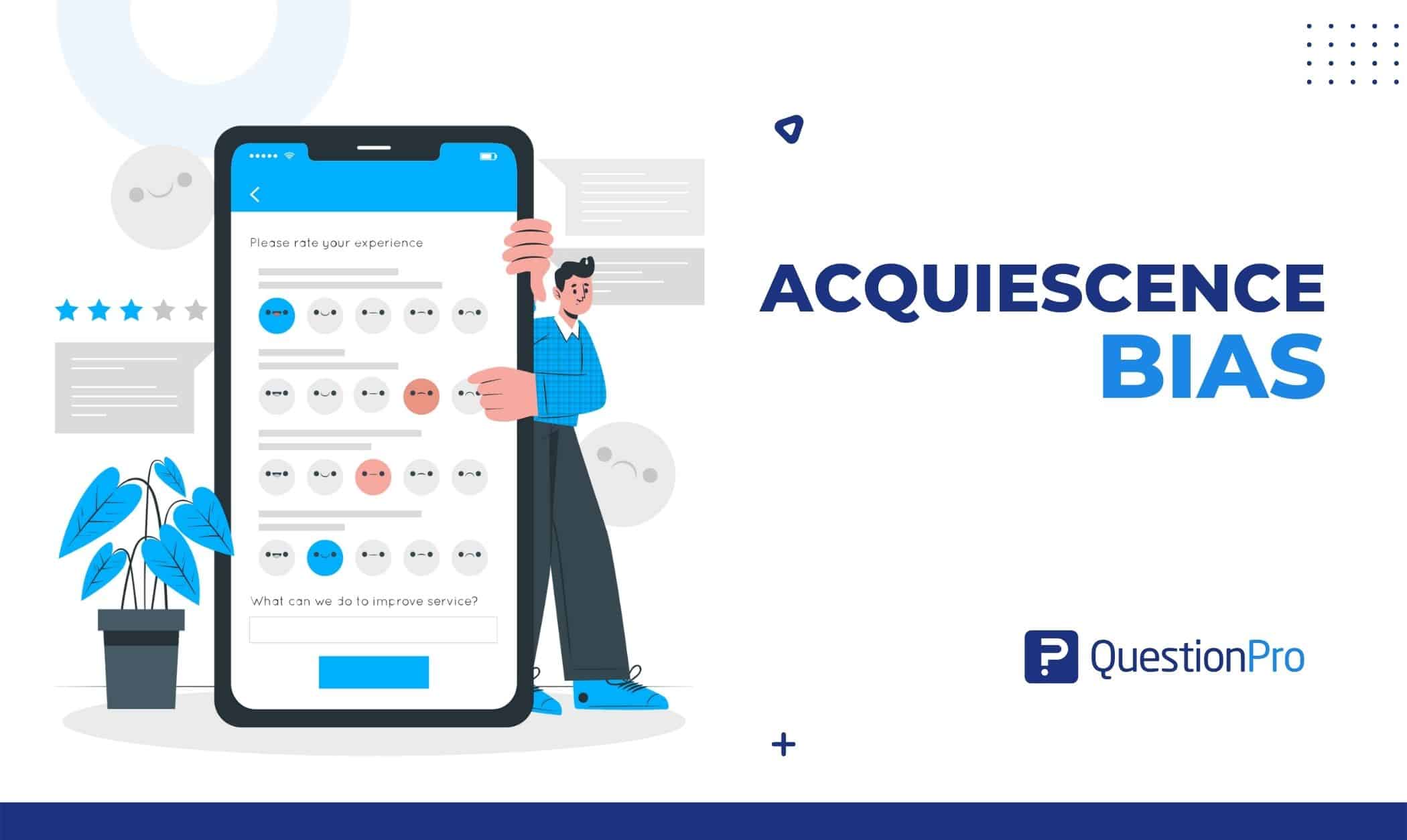
Acquiescence bias, also called agreement bias or yea-saying, is the tendency for survey respondents to agree with a statement regardless of their actual opinion.
It shows up most in questions built around opposite pairs:
- Agree / Disagree
- True / False
- Yes / No
A respondent might select “Very satisfied” not because they genuinely feel that way, but because it’s the answer that requires the least thought or feels the most agreeable to give. The result is data that looks more positive than reality, which can quietly mislead every decision built on top of it.
Why does acquiescence bias happen?
A few consistent factors explain why respondents default to agreement instead of giving their honest view.
- Survey fatigue: A long or repetitive survey wears respondents down. Once they’re tired, agreeing with whatever’s in front of them is faster than actually evaluating each statement.
- Desire to please: Some respondents agree because they assume that’s the answer the researcher wants, especially when the survey comes from an employer or a brand they already like.
- Cultural factors: Research on cross-cultural survey response consistently finds that acquiescence is more pronounced in collectivist cultures, where social harmony and deference carry more weight, than in individualist cultures. This matters directly for any research spanning multiple countries or regions.
- Ambiguous questions: When a question is unclear, agreeing feels like the safer default than admitting confusion or picking a side.
Acquiescence bias vs. Other response biases
Acquiescence bias is one of several response biases that distort survey data in different ways. It’s easy to confuse with its neighbors.
| Bias | What it looks like |
|---|---|
| Acquiescence bias | Agreeing with a statement regardless of actual opinion |
| Social desirability bias | Answering in a way that looks good to others, not necessarily agreeing more |
| Extreme response bias | Consistently picking the highest or lowest point on a scale |
Social desirability bias overlaps with acquiescence bias but isn’t identical. A respondent might disagree with a statement specifically because disagreeing is the more socially acceptable answer. That’s the opposite behavior from yea-saying.
Extreme response bias is a different pattern entirely. It’s about gravitating toward the ends of a scale, not about defaulting to agreement.
How to prevent acquiescence bias
A handful of practical changes to how a survey is designed and run meaningfully reduce how much acquiescence bias affects the results.
- Keep the survey short.
Fatigue is one of the biggest drivers of yea-saying. A shorter, more focused survey keeps respondents engaged long enough to give real answers.
- Use balanced or reverse-coded items.
Mixing in statements phrased in the opposite direction breaks the pattern of clicking the same answer repeatedly, since a respondent on autopilot will start contradicting themselves.
- Favor specific scales over agree/disagree.
A question like “How satisfied are you with our support team?” on a 5-point scale gives more signal than “Do you agree our support team is helpful?” which invites a reflexive yes.
- Ensure anonymity.
Respondents are more willing to give an honest, even negative, answer when they’re confident it won’t be traced back to them.
- Watch for straightlining.
If a respondent selects the same answer across an entire matrix of questions, that’s a signal the data may not be reliable, regardless of what the answer was.
- Pilot test the survey.
Running the survey with a small group first catches confusing wording before it affects your full dataset.
How QuestionPro helps reduce acquiescence bias
QuestionPro Survey Software supports several of these fixes directly in the survey builder:
- Balanced and reverse-coded question sets, built using standard question types
- Built-in anonymity settings, so responses aren’t tied to a respondent’s identity
- Real-time analytics that surface straightlining patterns while a survey is still in the field
That last point matters most in practice, since it means catching a data-quality problem while it’s still fixable, rather than discovering it after data collection ends.
Getting more honest data
Acquiescence bias never fully disappears, but it doesn’t have to quietly distort every survey either. Shorter surveys, balanced question wording, and genuine anonymity all chip away at the pressure respondents feel to just agree and move on. The goal isn’t a perfect survey. It’s one where saying no is exactly as easy as saying yes.
Frequently Asked Questions (FAQs)
Survey fatigue, a desire to please the researcher, cultural factors, and ambiguous question wording are the main drivers. Long or repetitive surveys make it worse, since tired respondents default to agreement rather than carefully evaluating each question.
Acquiescence bias is about defaulting to agreement regardless of content. Social desirability bias is about giving the answer that looks best to others, which sometimes means disagreeing instead. The two often overlap but aren’t the same mechanism.
No. Some level of yea-saying is present in nearly all survey research. The goal is reducing its impact through balanced question design, shorter surveys, and anonymity, not eliminating it entirely.
No. It’s most common in agree/disagree, true/false, and yes/no formats. Questions that ask for a specific rating or an open-ended response are less vulnerable. There’s no simple default answer to fall back on.