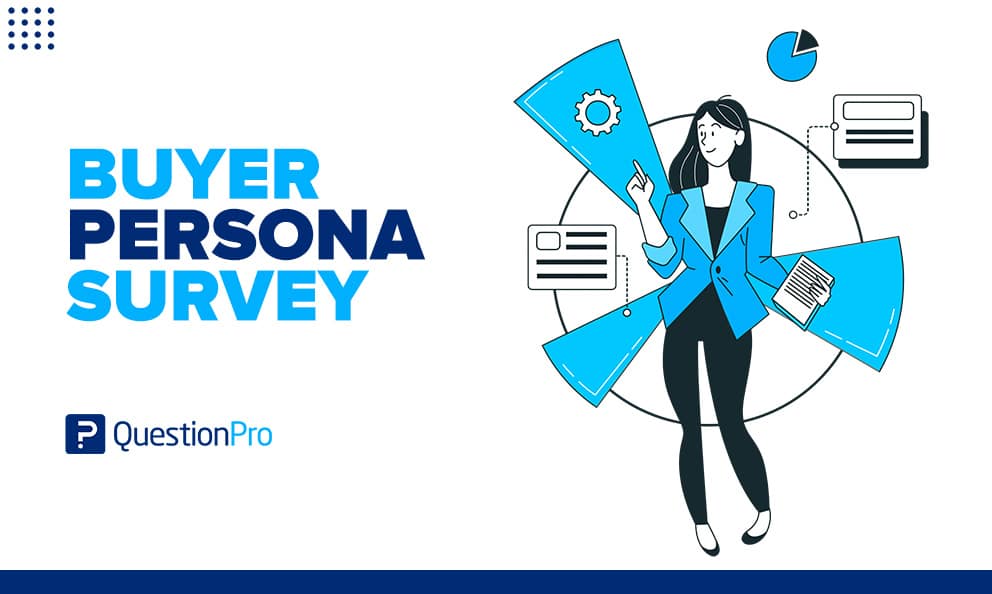
A buyer persona survey is a structured questionnaire that identifies the preferences, behaviors, and decision-making patterns of the people most likely to buy from you. It turns assumptions about your audience into evidence you can actually build a strategy around.
Even a genuinely good product can fail if it gets pitched to the wrong audience. Startups, SMEs, and enterprises alike run into this problem when marketing and sales teams operate on guesswork about who the customer actually is, rather than direct research.
This guide covers what a buyer persona survey measures, sample questions to include, a free template structure, and the step-by-step process for running one well using QuestionPro’s survey software.
What is a buyer persona survey?
A buyer persona survey is a questionnaire that identifies the preferences, opinions, and behavior a respondent is likely to exhibit as a customer. It groups respondents into categories based on their answers and reveals how they make purchasing decisions.
This differs from a basic demographic survey. A demographic survey tells you who someone is. A buyer persona survey tells you how that person thinks about a purchase, what problems they are trying to solve, and what would make them choose one option over another a distinction HubSpot’s persona research has linked to measurably stronger marketing performance.
Buyer persona surveys help marketing and sales teams focus resources on people who are actually likely to buy, which lowers acquisition cost and strengthens brand loyalty over time. A sales representative who knows a prospect’s budget constraints, for example, can pitch a monthly plan instead of an annual one and avoid losing the deal entirely.
Why do businesses need buyer persona research?
Businesses need buyer persona research because marketing and sales teams often make very different decisions with the same customer data, and both need it framed correctly to act on it.
Marketing teams use persona data to filter which messaging and channels reach the right audience segment. Sales teams use the same data to understand what a prospect actually needs before recommending a specific plan or product tier. Without shared, research-backed personas, both teams end up working from separate, often conflicting assumptions about the same customer base.
What questions should a buyer persona survey include?
A buyer persona survey should combine screening questions that filter your audience with deeper questions that reveal motivation and buying behavior.
Demographic and firmographic screening questions
- Age, gender, location, household income, marital status, and education level
- Professional details: industry, department, role, and title
- For B2B personas: company size, revenue, employee count, and location
Behavioral and motivation questions
- Are you buying this product for yourself or for someone else?
- What challenges do you face while using a product like this?
- What are the top three features you wish this type of product had?
- How much do you currently spend on this type of product, and how much would you be willing to spend?
- Do you research a purchase online before buying, and do you check reviews or ask friends first?
Keep the screening questions early in the survey and the motivation questions later, once you already know whether the respondent fits your target audience.
How do you build a free buyer persona survey template?
Start with a clear structure: screening questions first, behavioral questions second, and an open comment field last for anything the earlier questions missed.
QuestionPro’s free survey templates library includes buyer persona and customer profiling templates you can customize with your own branding, logo, and question logic rather than building the structure from scratch. Adding branching logic to a persona survey means respondents only see questions relevant to their previous answers, which keeps completion rates high even with a longer question set.
How do you conduct a buyer persona survey?
Running a buyer persona survey well comes down to three stages: identifying your sample audience, distributing the survey correctly, and analyzing the results against the categories you defined upfront.
Step 1: Identify your sample audience
Picture two very different buyers for the same smartphone launch. A college freshman wants a high-performance device for gaming and social apps, with 25 apps installed and a budget around $1,500 to $2,000. A working professional in their 40s wants strong data security, camera quality for personal use, and a similar budget.
Both share a budget range, but their needs diverge completely. That distinction is exactly what a buyer persona survey is built to surface before a product team locks in feature priorities.
Step 2: Distribute the survey
Choose from more than 40 question types, ranging from multiple choice to rating scales, and send the survey by email, SMS, QR code, or a direct link. If you need respondents beyond your existing contact list, QuestionPro Audience can fill that gap with targeted panel respondents. Randomizing question and answer order helps avoid order bias, and allowing anonymous responses tends to improve honesty on sensitive spending questions.
Step 3: Analyze the results
Monitor completion rate, dropout rate, and average time in a real-time dashboard. Then, break the data down by your defined persona categories. Integrating results with CRM or marketing automation tools reveals long-term customer behavior. This shows how personas actually act after the survey, not just what they said.
What mistakes should you avoid when building buyer personas?
A handful of avoidable mistakes weaken buyer persona research more than any single wrong question.
- Building personas from internal opinion instead of survey data.
Assumptions from a sales team meeting are not a substitute for direct respondent research.
- Making personas too broad.
A persona meant to represent “all customers” gives sales and marketing nothing specific to act on.
- Skipping the update cycle.
Buyer personas drift as markets change, and a persona built two years ago may no longer reflect who is actually buying.
- Ignoring the “why” behind a behavior.
A persona that lists only what customers do, without the motivation behind it, is hard to design messaging around.
Turn Survey Insights into Revenue Drivers
Knowing your real buyers turns strategy from guesswork into predictable revenue. A buyer persona survey eliminates assumptions and aligns your sales and marketing teams. It also guides product teams to solve verified customer pain points.
Use targeted screening questions and clear distribution to refine your ideal customer profile. Launch your survey today to anchor every business decision in real customer feedback.
Frequently Asked Questions (FAQs)
Most businesses do well with two to five personas, enough to capture meaningfully different buying behaviors without overcomplicating marketing and sales strategy. More than five personas usually means the segments are too narrow to act on separately.
Reviewing personas annually is a reasonable baseline for most businesses, though faster-moving markets or products with frequent feature changes may need updates every six months. A sudden shift in customer complaints or buying patterns is also a signal to revisit personas sooner.
Yes. B2B buyer persona surveys typically add firmographic questions, like company size, industry, and department, alongside individual role and decision-making authority within the buying process.
A target audience is typically a broad demographic description, like “adults aged 25 to 40.” A buyer persona is a detailed profile within that audience that includes goals, challenges, and buying behavior, built from actual survey data rather than assumptions.
Anonymity often improves honesty on sensitive questions like spending habits or product dissatisfaction. If you need to follow up individually, consider making the identifying fields optional rather than required.