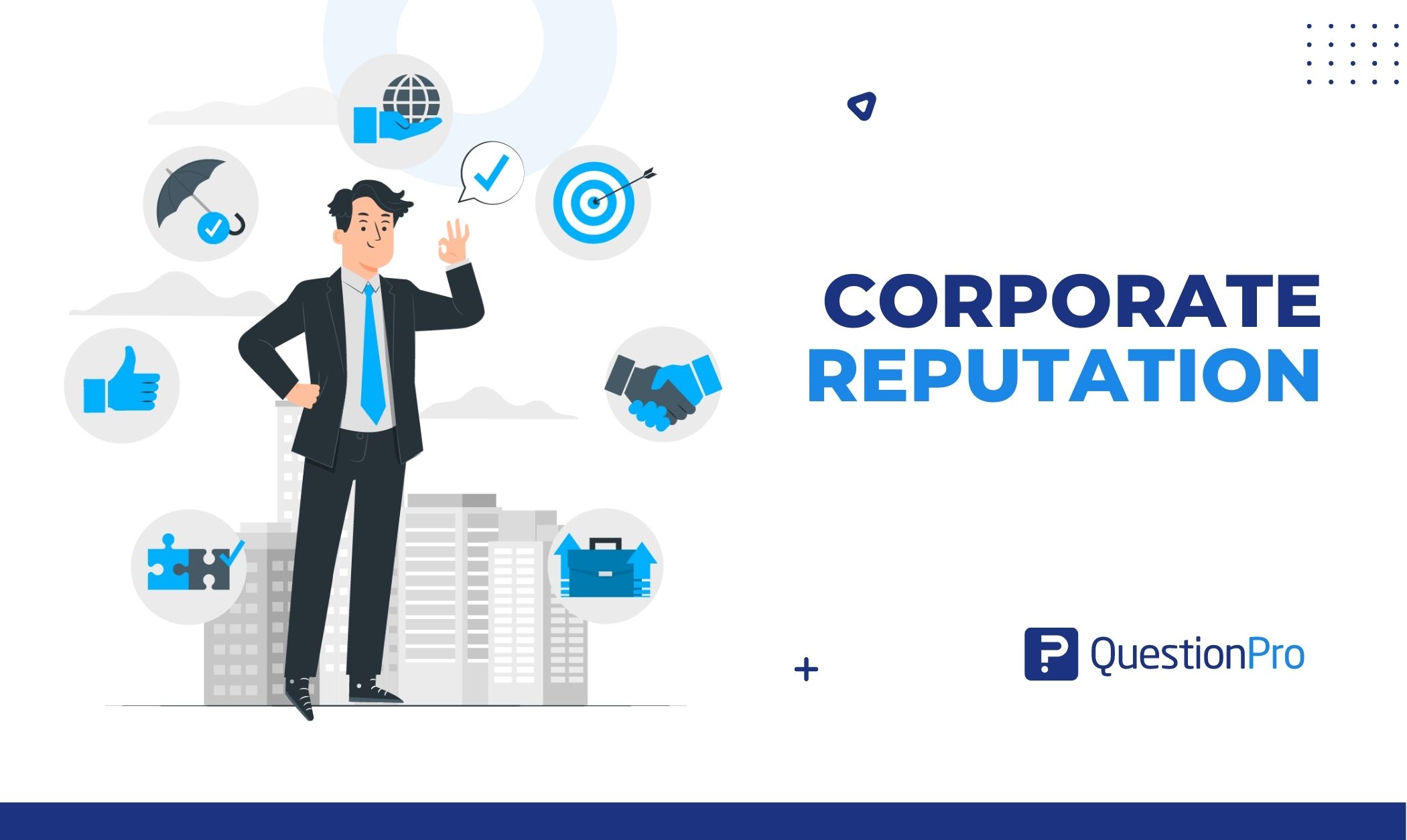
Corporate reputation is the overall view that customers, employees, investors and regulators hold of a company. It builds slowly through what a company does, not what it says. It can also fall in a single news cycle.
Reputation now carries real financial weight. Intangible assets, which include brand and trust, made up about 92% of S&P 500 market value at the end of 2025. Few teams track it with the same rigor as revenue.
In this guide, we’ll define corporate reputation, show what drives it, and explain how to measure and improve it with survey data.
What is corporate reputation?
Corporate reputation is the collective judgment stakeholders form about a company based on its past actions, current behavior and future prospects. Stakeholders are the groups with a stake in the business: customers, employees, investors, partners, regulators and the public.
Reputation differs by group. A customer judges service and product quality. An employee judges culture and pay. An investor judges governance and results. One company can rank high with one group and low with another.
Three forces shape it:
- What the company does: Products, pricing, treatment of staff and handling of mistakes.
- What the company says: Advertising, press releases and leadership statements.
- What others say: Media coverage, reviews and social posts.
Because reputation lives in other people’s minds, you cannot set it. You can only earn it and measure it. The risk that damage to this standing hurts the business has its own name: reputational risk.
How is corporate reputation different from brand reputation, brand image and identity?
Corporate reputation covers the whole company, while brand reputation covers a name or product line. The terms overlap, so teams often mix them up. This table separates them.
| Term | What it describes | Who judges it | Example |
|---|---|---|---|
| Corporate reputation | Overall judgment of the company, including conduct, workplace and finances | All stakeholders | An investor trusts a bank’s governance |
| Brand reputation | Standing of a brand or product line | Mostly customers | Shoppers rate a shoe line as durable |
| Brand image | The picture in people’s minds at one moment | Customers and prospects | An ad campaign makes a brand feel youthful |
| Corporate identity | What the company says it is: name, logo, values | The company itself | A mission statement |
| Online reputation | What search results, reviews and social posts show | Anyone who searches | A 3.8 star average across review sites |
Identity is the input. Reputation is the result. If your concern is mainly reviews and search results, read the guide to reputation management.
What drives corporate reputation?
Seven drivers shape most corporate reputation scores. Each driver also gives you a ready-made survey topic.
- Products and services: The perceived quality and value of what you sell, including support.
- Innovation: How new, adaptable and first to market you appear.
- Workplace: How well you treat, pay and develop employees.
- Leadership: The strength of your vision and the quality of your managers.
- Conduct: How ethical, fair and transparent your business practices look.
- Citizenship: Your environmental record and positive impact on society.
- Performance: Profitability and growth prospects.
Weak scores on conduct or leadership tend to hurt the most, because they raise doubts about everything else.
Why does corporate reputation matter?
A strong reputation protects revenue, eases hiring and cushions a company when something goes wrong. Four effects stand out.
Trust
Trust is the base layer. The 2026 Edelman Trust Barometer surveyed nearly 34,000 people in 28 countries.
- 64% trust business.
- 78% trust employers.
- 53% trust government.
- 42% are unwilling to invest in companies that do not share their values.
Financial value
Most of a modern company’s value sits in things a balance sheet cannot count. With intangibles near 92% of S&P 500 value, a damaged reputation can erase worth that no ledger records. Investors, lenders and partners weigh reputation when they price risk, so a weak score makes growth more expensive.
Talent and employees
Employees are often the most believable voice about a company. The Edelman figure above shows people trust their employer more than business in general. A good reputation widens your applicant pool and keeps current staff proud to advocate for you.
- Strong reputations draw better candidates.
- Weak ones raise turnover and recruiting costs.
- Employees who believe in the company defend it online.
Customer loyalty
Customers stay with companies they trust. A solid reputation supports customer loyalty and lowers churn. Buyers give trusted companies the benefit of the doubt after a mistake.
- Loyal customers buy again and refer others.
- Lower churn keeps acquisition costs down.
What does corporate reputation look like in practice?
Two cases show the range, from a costly collapse to a measured ranking of who Americans trust.
Wells Fargo and the cost of a trust failure
Wells Fargo shows how long damage can last. After the unauthorized-accounts scandal, the Federal Reserve capped the bank’s assets at $2 trillion in 2018. The cap stayed for about seven years and ended in June 2025.
The lesson is plain. Reputation damage can turn into regulatory limits on growth.
- The penalty targeted governance and risk management.
- Recovery came from fixing those practices, not from messaging.
How the Axios Harris Poll 100 tracks reputation
The Axios Harris Poll 100 is a US ranking built from large surveys.
- 6,226 Americans first named the companies with the best and worst reputations.
- 18,523 Americans then rated companies they knew on reputation dimensions.
- Each of the 100 companies drew about 325 raters.
- The strongest reputations went to companies Americans felt helped them get ahead.
How to measure corporate reputation
You measure corporate reputation by surveying each stakeholder group on the same drivers, then tracking scores over time and against peers. One number is never enough.
Step-by-step guide to measuring corporate reputation
- Pick your stakeholder groups, for example customers, employees, investors and partners.
- Choose the drivers that matter, using the seven listed above as a starting list.
- Write one question per driver on a 5-point agree-disagree scale.
- Add two outcome questions: how likely they are to recommend you, and how much they trust you.
- Set a minimum response count for each group, so every group’s score is stable on its own.
- Field the survey, then compare scores against your last wave and against two or three peers.
Which metrics should you track?
Pick a small set and keep the definitions fixed from wave to wave.
| Metric | What it tells you | How to calculate it |
|---|---|---|
| Net Promoter Score (NPS) | Willingness to recommend | % promoters (scores 9 to 10) minus % detractors (0 to 6). For example, 60% minus 15% gives 45 |
| Net Trust Score | Confidence in the organization | Same formula, applied to a 0 to 10 trust question |
| Driver score | Which of the seven drivers is strongest or weakest | Average rating per driver on the 5-point scale |
| Sentiment share | Tone of public conversation | Positive mentions divided by total mentions |
| Review rating and volume | Customer verdict at scale | Average star rating plus count per month |
| Employee NPS (eNPS) | Staff willingness to recommend you as an employer | Same NPS formula, asked of employees |
Pulse tracking between surveys
A full survey once or twice a year shows the big picture. Weekly monitoring of reviews and mentions catches problems early. Your online reputation score can serve as the weekly pulse, while the survey explains the why.
- Weekly: Reviews, social mentions and news sentiment.
- Once or twice a year: The full stakeholder survey.
How to improve corporate reputation
Improve corporate reputation by fixing your weakest driver first, then listening continuously and acting on what you hear. These six moves work together.
Start with the biggest driver gap
Your survey shows which driver trails the others. If conduct scores low, no ad campaign will fix it.
- Assign an owner to the weakest driver.
- Set a target for the next wave.
- Report progress to leadership.
Ask for feedback and act on it
- Invite satisfied customers to leave reviews.
- Reply to negative feedback quickly and politely.
- Tell people what changed because of their input.
Monitor mentions in real time
Reputation moves faster than annual surveys. Track reviews, social posts and news daily. Set alerts for sudden jumps in negative mentions so the right team sees a problem within hours, not weeks.
Treat employees as a core audience
Employees shape reputation every day, in customer calls, in hiring and on social media. Treat them as an internal audience, much as you treat customers.
- Share company news with staff before the press.
- Survey them on the workplace driver.
- Give them simple ways to refer friends and recommend the company.
Earn credibility through useful content
Publish original research, clear explainers and honest answers to hard questions. Thought leadership works when it helps readers, not when it promotes you. Over time, it makes your company the source people quote.
Map the customer journey to find friction
Pain points often hide between touchpoints. A customer journey map shows where buyers get frustrated, so you can fix the moments that create bad reviews.
- Long waits at checkout or support.
- Hand-offs where nobody owns the problem.
What does a bad corporate reputation cost?
A bad corporate reputation costs trust first, then sales, talent and the freedom to grow. The damage spreads across stakeholder groups, as the table shows.
| Impact area | What happens | Early warning signal |
|---|---|---|
| Customers | Buyers switch to rivals and stop recommending you | Falling NPS, rising churn |
| Revenue | Sales and renewals decline | Weaker conversion, more discounting |
| Talent | Good candidates decline offers, staff leave | Lower eNPS, more rejected offers |
| Investors | Confidence and valuation drop | Analyst downgrades, falling share price |
| Regulators | Closer scrutiny, fines or limits on growth | New inquiries, as in the Wells Fargo case |
| Partners and suppliers | Tighter terms, fewer deals | Slower contract approvals |
| Activists and buyers | Boycotts and public campaigns | Negative social spikes |
Recovery is slow. Trust takes years to rebuild, and rivals gain ground while you repair.
What are the most common corporate reputation mistakes?
Most reputation failures come from measuring too little, too rarely or in the wrong place. Watch for these six.
- Surveying only customers: Employees, investors and regulators judge you differently.
- Trusting media sentiment alone: Coverage tracks news, not conviction.
- Running a one-off study: A single wave shows no trend.
- Skipping benchmarks: A score of 70 means little without peer scores.
- Treating reputation as a PR task: Conduct and product quality drive it more than press releases.
- Chasing reviews over fixes: Asking for more five-star ratings will not repair a broken process.
Who owns corporate reputation inside a company?
The CEO owns corporate reputation in the end, but no single team controls every driver. Communications usually reports the score. Customer experience owns the customer view, human resources owns the employee view, and investor relations owns the financial audience.
Name one accountable owner for the overall score. Then give each driver a named lead and review the numbers in a regular leadership meeting. Shared ownership with a single scorekeeper prevents gaps.
How can QuestionPro help you measure and monitor corporate reputation?
QuestionPro helps by combining stakeholder surveys with live monitoring of public reviews, so the why and the what sit in one place. QuestionPro Customer Experience covers the survey side, including NPS and trust questions you can repeat each wave.
The CX Reputation module covers the public side.
- It gathers third-party ratings, reviews and mentions in one location.
- You can reply directly, filter reviews and turn on notifications.
- A dashboard tracks engagement, ratings and locations.
- AI sentiment analysis tags feedback across sentiment categories, with export and filtering.
Pair the two views to see whether a drop in public sentiment matches a drop in a specific driver score.
Corporate reputation is an asset you can measure
Corporate reputation is the sum of what stakeholders believe about your conduct, your products and your people. It looks soft, yet it shows up in sales, hiring, regulation and valuation. The Wells Fargo case shows how long a lost reputation can hold a company back.
The practical path is short:
- Measure each stakeholder group on the same drivers.
- Fix the weakest driver first.
- Track progress every wave.
Companies that treat reputation as a number with an owner usually spot trouble first.
Frequently Asked Questions (FAQs)
Run a full stakeholder survey once or twice a year, and monitor reviews and mentions weekly. Add a one-off pulse survey after a major event, such as a product recall, leadership change or viral controversy, to measure the immediate impact.
No universal benchmark exists, because scales and questions differ. A positive NPS means more promoters than detractors, but the useful test is your trend and your gap against direct peers measured with identical questions in the same period.
Yes. Every business has one, built by local customers, staff, suppliers and lenders. Small firms can measure it cheaply with a short survey, a review tracker and quarterly check-ins with a few key partners.
The Axios Harris Poll 100 ranks companies by US public opinion each year. RepTrak scores reputation across seven drivers. Both rely on large surveys, so they offer benchmarks you can compare against your own stakeholder results.
It depends on the severity and the cause. Minor service issues can recover in months. Deep trust failures take years, as Wells Fargo’s roughly seven-year asset cap showed. Visible fixes to governance and conduct speed recovery more than messaging does.