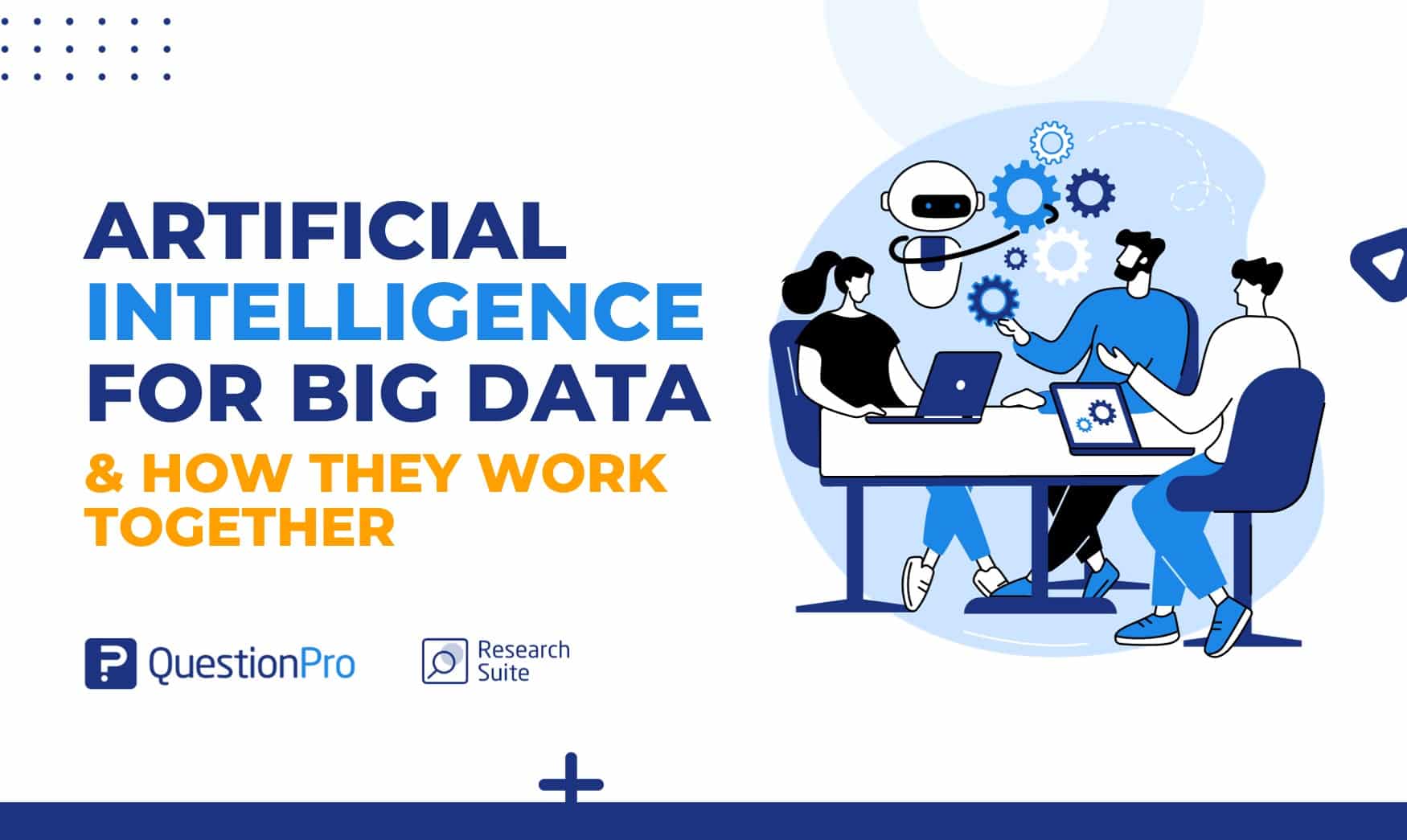
Artificial intelligence for big data is the use of machine learning and related AI methods to find patterns, predictions, and anomalies in datasets too large or varied for manual analysis. Big data supplies the volume. AI supplies the reasoning that turns that volume into decisions.
Adoption is no longer the hard part. Research found that 88 percent of organizations use AI in at least one business function, yet only 7 percent said AI was fully scaled across their organization. The gap usually traces back to data, not algorithms.
In this guide, we’ll break down how the two work together, which AI technique fits which job, and how to measure results.
What is artificial intelligence for big data?
Artificial intelligence for big data is the practice of training AI models on very large, fast, or mixed-format datasets so they can detect patterns, forecast outcomes, and automate analysis at a scale people cannot match. Teams also call it AI in big data or AI for data analytics.
Three terms make that definition work. Big data means datasets too large or complex for traditional tools to store and process. Artificial intelligence means software that performs tasks that normally need human judgment, such as classifying, predicting, or reading language. Machine learning, the most common AI method here, learns patterns from examples instead of following hand-written rules.
Together they power big data analytics, the process of examining large datasets to uncover trends and correlations. Without AI, analysts sample the data and build static reports. With AI, models read every record and flag what matters.
In short: Big data is the fuel, AI is the engine, and the output is a decision. If you need a primer on how businesses store and manage large data sets before AI touches them, start there.
What are the five Vs of big data?
Five traits, called the five Vs, define big data. They explain why ordinary databases and manual analysis stop working at scale.
- Volume: The sheer amount of data, often measured in terabytes or petabytes.
- Velocity: The speed at which new data arrives and needs processing, such as live sensor or transaction streams.
- Variety: The mix of formats, from structured tables to unstructured text, images, audio, and video.
- Veracity: How accurate and trustworthy the data is, which tends to drop as sources multiply.
- Value: The business worth you can extract once the data is processed and analyzed.
AI helps most with velocity and variety, because models can read text and images that tables cannot hold. It helps least with veracity. A model trained on unreliable data learns unreliable patterns.
Big data vs AI: What is the difference?
Big data is the material, and AI is the method that works on it. The terms often blur with machine learning, data science, and business intelligence, so a side-by-side view helps.
| Term | What it is | Role next to the others | Example |
|---|---|---|---|
| Big data | Datasets too large, fast, or varied for traditional tools | The raw material | Years of card transactions across all channels |
| Artificial intelligence | Software that performs tasks needing human-like judgment | The method that reads the material | A fraud-scoring system |
| Machine learning | A branch of AI that learns patterns from data | The most common way AI learns from big data | A model trained on past fraud labels |
| Data science | The discipline that combines statistics, coding, and domain knowledge | The practice that builds and tests the models | A team that designs the fraud model |
| Business intelligence | Dashboards and reports on what already happened | The reporting layer, often fed by AI output | A weekly fraud-loss dashboard |
Two myths follow from this table. You can have big data without AI, such as a warehouse that only feeds static dashboards. You can also run AI on small, clean datasets. Big data mainly improves accuracy on complex problems with many variables.
An AI model is the trained system that comes out of the learning step. It is the thing you deploy, monitor, and retrain.
How do big data and AI work together?
Big data and AI work together in a loop. Big data feeds the models, and the models turn that data into decisions that create new data. The loop runs through six steps.
- Collect.
Gather structured and unstructured data from sensors, apps, transactions, surveys, and social channels. - Store and process.
A data lake holds raw files in their original format. A data warehouse holds cleaned tables built for queries. A lakehouse combines both. Frameworks such as Apache Hadoop and Spark, an engine that processes data in memory across many machines, handle the heavy lifting. - Prepare.
Clean errors, remove duplicates, flag gaps, and reshape the data into a format models can read. - Train.
Algorithms study historical data to learn patterns. Supervised learning predicts known outcomes. Unsupervised learning finds groups and anomalies without labels. - Generate insight.
The trained model scores new data, a step called inference. The output is a forecast, a flag, a segment, or a recommendation. - Monitor and retrain.
Track accuracy over time. Retrain when real-world data drifts away from what the model learned.
What is the best AI for big data?
There is no single best AI for big data. The right choice depends on the type of data you have and the question you need answered. This table matches common techniques to common jobs.
| Technique | Best for | Typical big data source | Example |
|---|---|---|---|
| Supervised machine learning, which learns from labeled examples | Predicting known outcomes | Customer and transaction history | Churn prediction |
| Unsupervised machine learning, which finds structure without labels | Segments and anomalies | Server logs, clickstreams | Spotting unusual network traffic |
| Deep learning, which uses neural networks with many layers | Complex patterns in images, audio, and language | Images, speech, long text | Reading medical scans |
| Natural language processing (NLP), which reads human language | Text at scale | Reviews, tickets, open-ended survey answers | Sentiment analysis of customer comments |
| Computer vision, which interprets images and video | Visual inspection | Camera and video feeds | Detecting defects on a production line |
| Reinforcement learning, which learns by trial and reward | Sequential decisions | Simulations and live systems | Warehouse routing |
| Generative AI, which creates text, code, or images | Summaries, drafting, plain-language queries | Documents and knowledge bases | Asking questions of a dataset in plain English |
Most production systems combine several of these. A fraud platform, for example, might pair supervised models for known fraud with unsupervised models for new patterns.
How are generative AI and AI agents changing big data analytics?
Generative AI and AI agents let people question big data in plain language and automate follow-up work. They only stay reliable when grounded in trusted data.
Generative AI creates new content, such as text, code, or summaries, from patterns learned in training. A large language model (LLM) is the type that reads and writes text. An LLM cannot hold billions of rows in memory, so it connects to your data in two main ways:
- Retrieval-augmented generation (RAG): The system retrieves the relevant records or documents at question time and hands them to the model as context.
- Generated queries: The model writes SQL, the standard database query language, and the warehouse runs it.
An AI agent is a system that plans and carries out multi-step tasks using models and tools. For example, an agent can watch a sales feed for anomalies, check the likely cause, and open a ticket.
Keep a person in the loop for high-stakes actions, limit data access by role, and log every query. For a wider view of the tool landscape, see this roundup of AI tools for business.
How do you choose the right AI approach for a big data project?
Choose by working backward from the decision you need to make, then match speed, data, and technique to it. Five checks settle most choices.
- Name the decision and its deadline.
If acting an hour later keeps most of the value, use batch processing, which analyzes data in scheduled groups. If seconds matter, as with fraud at checkout, use stream processing, which analyzes data as it arrives. - Check for labeled outcomes.
If past records already carry the answer, such as churned or stayed, use supervised learning. If they do not, start with clustering or anomaly detection. - Match the technique to the data type.
Text points to NLP, images to computer vision, and tables to classic machine learning. - Prove data readiness first.
Audit completeness, ownership, and access before you buy tools. - Pilot one use case.
Pick a dataset you can reach, a KPI you can measure, and a named business owner. Scale only after the pilot beats its baseline.
Skip any use case where no one owns the decision. A model nobody acts on produces cost without value.
Examples of artificial intelligence for big data
AI for big data shows up wherever organizations produce more records than people can read. Five areas show the pattern most clearly.
Financial services fraud detection
Banks score each transaction as it happens.
- Data: Years of transaction history, device signals, and location.
- Model: Supervised models for known fraud and unsupervised models for new patterns.
- Outcome: Suspicious payments get flagged or held before money moves.
Retail and e-commerce
Recommendation engines at companies such as Netflix and Amazon study what millions of people watched or bought, then suggest what each person may want next. Retailers also feed sales history, weather, and promotions into forecasting models to set inventory levels. The same data reveals customer behavior patterns that guide pricing and campaigns.
Manufacturing and predictive maintenance
Machines stream sensor data around the clock.
- Data: Vibration, temperature, and pressure readings.
- Model: Learns what normal looks like and flags drift toward failure.
- Outcome: Crews fix equipment before it breaks, while cameras with computer vision catch defects on the line.
Healthcare
Hospitals combine electronic health records, imaging, and lab results to flag patients at risk of readmission and to support diagnosis. Clinicians review the output and make the final call. In the US, teams must also follow HIPAA, the federal health privacy law, when they use patient data to train models.
Customer and market research
Open-ended survey comments, reviews, and support tickets are unstructured big data. Say a US retailer collects 20,000 comments after the holiday season.
- NLP groups the comments into themes, such as shipping delays and return policy.
- Sentiment scoring labels each comment positive, negative, or neutral.
- Analysts filter the themes by region to see where complaints cluster.
- A researcher reviews and edits the themes before the team acts.
How do you measure AI for big data success?
Measure at three layers: the data pipeline, the model, and the business outcome. A model with strong accuracy still fails if the data arrives late or nobody acts on the output.
| Layer | Metric | What it tells you | Example target |
|---|---|---|---|
| Data | Completeness | Share of records with no missing values in the fields the model uses | At least 95 percent |
| Data | Freshness | Time between an event and its availability to the model | Inside your decision deadline |
| Model | Precision | Share of flagged cases that were truly positive | Set from the cost of a false alarm |
| Model | Recall | Share of true cases the model caught | Catch 90 percent of known cases in backtesting |
| Model | Drift | Drop in accuracy since launch | Retrain if accuracy falls more than 5 points |
| Business | Time to insight | Days from question to answer | Cut from five days to one |
| Business | Decision impact | KPI change versus a holdout group | Measurable lift over the baseline |
These targets are examples, not industry standards. Set yours from a baseline measured before launch.
What are the common mistakes and risks of using AI on big data?
Most failures trace back to data and process, not the algorithm. A survey found that 63 percent of organizations either lack the data management practices AI needs or are unsure they have them. Gartner predicts that organizations will abandon 60 percent of AI projects without AI-ready data through 2026.
- Dirty or biased training data: The model repeats whatever errors and skews the data holds.
- Data leakage: Information from outside the training set, such as future outcomes, slips in. The model looks excellent in testing and fails in production.
- Class imbalance: The event you want to catch is rare, so a model can score high accuracy by always predicting “no.”
- Model drift: Accuracy decays as customer behavior and data sources change.
- Volume over relevance: More data does not help if it does not match the question.
- Weak governance and privacy: Unclear data ownership and consent put you at odds with laws such as the California Consumer Privacy Act (CCPA).
- Black-box decisions: Regulated settings often require you to explain why a model decided.
The voluntary NIST AI Risk Management Framework gives US teams a structure for governing these risks.
How QuestionPro applies AI to survey and open-ended data
Survey data is a small but valuable slice of big data, because it explains the why behind behavioral numbers. QuestionPro TextAI, a module inside QuestionPro BI, applies AI to open-ended responses at that scale.
QuestionPro AI can generate a codebook from your actual response data. A codebook is the set of themes and sub-themes used to classify responses. You can also upload a code frame you already use, or reuse one from an earlier wave so a tracker stays consistent. In theme configuration, you can merge sub-themes, tag responses by hand, and recode. The AI does the first pass, and a researcher keeps the judgment.
Because themes sit on the same dashboard as closed-ended data, you can filter by region or customer tier and run stat testing to check whether a gap is significant. This overview of text analysis in QuestionPro BI walks through the setup. Teams running wider studies can explore the full toolkit in QuestionPro’s market research software.
The real question behind AI for big data
The useful question is not whether to adopt AI for big data. It is whether your data is ready for the decision in front of you. Models are now easy to rent. Clean, governed, well-labeled data is not.
Teams that treat data readiness as the main project, and the model as the easier part, are the ones whose pilots tend to reach production. Before you start, answer three questions:
- Which decision will this improve, and who owns it?
- Can you reach the data for that decision today, with the right permissions?
- What baseline will you compare against after launch?
Frequently Asked Questions (FAQs)
Yes. Cloud warehouses and analytics platforms now ship built-in AI features, such as natural language queries and automated theme detection. Start with one use case, rely on managed services, and add specialists only when a pilot proves its value.
The CCPA gives California residents rights to know what personal information businesses collect, request its deletion, and opt out of its sale or sharing. Teams training models on customer data should minimize collection, de-identify records where possible, and document each dataset’s origin.
AI analytics means using AI to analyze data of any size. AI for big data stresses scale, meaning the storage, processing, and streaming infrastructure needed when data is too large or fast for one machine. Our guide to AI analytics covers the broader view.
Four roles cover most projects: a data engineer who builds pipelines, a machine learning engineer who trains and deploys models, an analyst who interprets results, and a business owner accountable for the decision. Small teams often combine the first two roles.
Retrain when monitoring shows accuracy falling, not on a fixed calendar. Fast-changing areas such as fraud or demand forecasting often need frequent checks, while stable classification tasks can run longer. Always retrain after a major change in data sources or customer behavior.