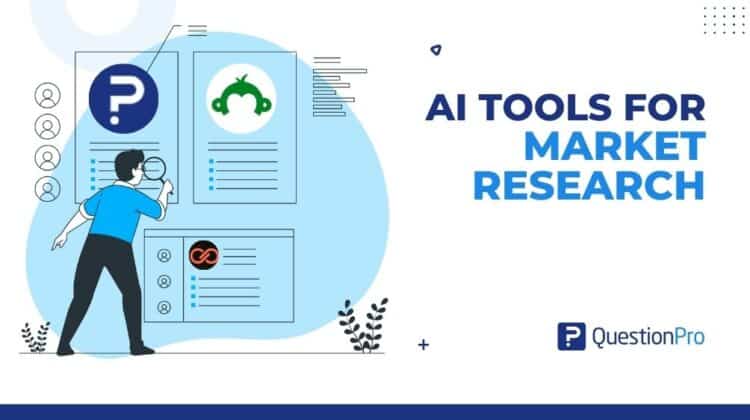
AI tools for market research are software platforms that use machine learning and natural language processing to design studies, analyze responses, and track markets faster than manual methods. Work that once took weeks can now finish in days.
The category is crowded, though. Survey platforms, social listening tools, interview bots, and general chatbots all claim the label, and each solves a different problem.
In this guide, we’ll compare 12 tools, show you how to choose one, and walk through a workflow that keeps the results trustworthy.
What are AI tools for market research?
AI tools for market research are software products that apply machine learning, natural language processing (NLP, which lets software read human language), and predictive models to research tasks. They draft surveys, probe respondents, code open-ended answers, scan social conversations, and summarize findings.
Most tools follow the same loop. They take in data from surveys, interviews, reviews, or the web. They find patterns such as themes, sentiment, or segments. Then they present the results as dashboards, summaries, or alerts for a researcher to check.
Adoption is moving fast. Gartner expects spending on generative AI models to grow 80.8% in 2026, inside a software market above $1.4 trillion. Research teams feel that pressure to add AI to every workflow.
AI market research tools vs similar terms
Several terms blur together in vendor marketing. This table separates them by what the product does and who runs the work.
| Term | What it means | Example | Who does the research |
|---|---|---|---|
| Survey software with AI | A survey platform that adds AI for drafting, quality checks, market research, or analysis | QuestionPro, Qualtrics | Your team |
| Research tool with AI | Software where AI is central to a research task | Quantilope, Speak | Your team, with AI help |
| General-purpose AI assistant | A chatbot trained on broad text, not built for research workflows | ChatGPT, Perplexity | You, with manual checks |
| AI-based research service | A vendor runs the study using AI plus human review | Managed AI studies | The vendor |
| Synthetic respondent platform | Simulated participants generated by models | Synthetic Users, digital twins | The model, not people |
| Social listening tool | Software that monitors public posts and reviews | Brandwatch | Your team |
What can AI market research tools do at each stage?
AI market research tools can support every stage of a study, from drafting the questionnaire to sharing results. The biggest gains show up where the work is repetitive or text-heavy.
- Design: Turn a brief into a draft survey or interview guide, then rewrite weak questions.
- Collect: Flag bots, speeders, and gibberish answers as they arrive. Run AI-moderated interviews that ask follow-ups.
- Analyze: Code thousands of open-ended answers into themes and sentiment. Transcribe and summarize audio or video.
- Predict and simulate: Forecast demand or churn from historical data. Test concepts on synthetic respondents before fieldwork.
- Monitor: Track competitor moves, social conversations, and search trends in near real time.
- Report and store: Draft executive summaries and build dashboards. Search past studies in a repository such as InsightsHub instead of repeating them.
Each stage still needs a person to set the question and sign off on the answer.
12 Best AI tools for market research in 2026
The 12 tools below cover six research jobs: survey and quantitative research, qualitative interviews, qualitative analysis, listening and trends, competitive intelligence, and desk research. Each earned a place because AI is core to the product and it covers a distinct job. Pricing models appear instead of prices, because most vendors quote by plan and change rates often. Confirm current pricing with each vendor.
1. QuestionPro
QuestionPro builds AI into a full market research software suite. QuestionPro AI drafts surveys from a plain-language brief, and Data Quality AI screens out bots, AI-written answers, and gibberish. Text AI, VideoAI, and ListenAI handle open-ended, video, and interview data. A free Essentials plan exists, and the Advanced plan costs $99 per user per month billed annually. Research Suite pricing is custom.
- Best for: teams that want survey design, qualitative AI, and dashboards in one platform.
- Watch for: Research Suite features need a sales conversation, so budget time to scope them.
2. Qualtrics
Qualtrics is an enterprise experience platform that runs research alongside customer and employee programs. Its AI supports survey optimization, data quality checks, and predictive analysis. It suits large organizations that want one contract across research and experience management. Setup is heavier than lighter tools, and pricing is quote-based. Teams weighing options can read this Qualtrics alternative comparison.
3. Quantilope
Quantilope automates advanced quantitative methods. These include conjoint (feature trade-off testing), MaxDiff (best-worst ranking), and TURF (reach optimization). Its AI research partner, quinn, drafts survey inputs and writes dashboard summaries. Category Twins, its synthetic consumers, are built from a brand’s own tracking data. Pricing is subscription-based with tiers.
- Best for: brand tracking and advanced methods in consumer insights teams.
- Watch for: it is lighter on qualitative depth than interview-first tools.
4. Perspective AI
Perspective AI runs AI-moderated interviews by voice or chat. The AI asks follow-up questions when an answer is thin, so teams get interview-style depth without scheduling every session. Pricing is usage or subscription based. It suits discovery work, win-loss studies, and concept reactions. It does not replace a representative survey, because interviews show the why, not the how many.
5. Speak
Speak turns audio and video into transcripts, themes, and answers to your questions. It imports files in bulk and connects with Zoom, YouTube, and Vimeo. A freemium tier exists.
- Best for: teams sitting on interview recordings, focus groups, or podcasts.
- Watch for: it analyzes content you already have. It does not recruit or field studies.
6. Dovetail
Dovetail is a research repository, meaning a searchable library of past studies and interview notes. Its AI tags, clusters, and summarizes qualitative data so patterns are easier to spot. A free tier is available, with paid plans per editor. It suits UX and product research teams that run many small studies.
7. Brandwatch
Brandwatch is a social listening platform that tracks brand and category conversations across public sources. Its AI analyst surfaces trends, and image analysis reads logos and scenes in posts. Pricing is enterprise and quote-based.
- Best for: brand health tracking and reputation monitoring.
- Watch for: social posts over-represent vocal users, so treat them as signals, not samples.
8. Glimpse
Glimpse is a trend detection tool. It scans search data, social conversations, reviews, and e-commerce signals to spot rising topics before they peak. Sentiment and demographic filters add context. Pricing is subscription-based. Use it to form hypotheses. It shows what is rising, not why people care.
9. Crayon
Crayon is a competitive intelligence platform. It monitors competitor websites, pricing pages, reviews, and publications. It then sends alerts and feeds battlecards into tools such as Salesforce and Slack.
- Best for: B2B product marketing and sales enablement.
- Watch for: it studies competitors, not your customers.
10. GWI Spark
GWI Spark is an AI assistant that answers questions from GWI’s global audience survey data. Ask who a segment is, what media it uses, or how attitudes differ by market, and it returns data-backed answers. This is secondary research, meaning data collected for general use rather than for your specific question. Pricing is quote-based.
11. Synthetic Users
Synthetic Users generates simulated participants that respond to interview prompts. Teams use this kind of tool to explore ideas quickly before spending on fieldwork.
- Best for: early concept exploration and questionnaire pre-tests.
- Watch for: simulated answers reflect training data, so validate with real people before deciding.
12. Perplexity and ChatGPT
General-purpose AI assistants handle desk research, market sizing drafts, competitor summaries, and ad hoc analysis. Perplexity shows sources for its answers, which helps with checking. ChatGPT is flexible for brainstorming and synthesis. Both offer free tiers and paid plans. Neither has a research workflow, so they cannot field a survey, screen respondents, or document methods. Check every cited source before you use a number.
Comparison of AI market research tools at a glance
This table compares the 12 tools by primary job, research type, and pricing model, so you can shortlist in one pass.
| Tool | Best for | Research type | Pricing model |
|---|---|---|---|
| QuestionPro | Surveys, qualitative AI, dashboards in one platform | Quant and qual | Free plan, per-user plans, custom Research Suite |
| Qualtrics | Enterprise research and experience programs | Quant and qual | Quote-based |
| quantilope | Advanced methods and brand tracking | Quant | Subscription tiers |
| Perspective AI | Scalable AI interviews | Qual | Usage or subscription |
| Speak | Analyzing recordings | Qual analysis | Freemium tiers |
| Dovetail | Research repository and synthesis | Qual analysis | Free tier, paid per editor |
| Brandwatch | Social listening | Secondary data | Quote-based |
| Glimpse | Early trend detection | Secondary data | Subscription |
| Crayon | Competitor tracking | Secondary data | Quote-based |
| GWI Spark | Audience data answers | Secondary data | Quote-based |
| Synthetic Users | Early concept exploration | Simulated | Varies by plan |
| Perplexity and ChatGPT | Desk research and brainstorming | Secondary data | Free tiers plus paid plans |
How to choose an AI tool for market research
Choose by the question you need answered, not by the longest feature list. Start with the research job, then check budget, data rules, and a short pilot.
Match the tool to the research job
Each research question points to a different tool type.
- Need to know how many people prefer something? Start with survey and quantitative platforms such as QuestionPro, Qualtrics, or Quantilope.
- Need the why behind behavior? Use AI-moderated interviews or recording analysis, such as Perspective AI, ListenAI, or Speak.
- Need to see what is rising or what rivals do? Use Glimpse, Brandwatch, or Crayon.
- Need a fast first read on a market? Use Perplexity, ChatGPT, or GWI Spark, then verify.
- Need to test ideas before fieldwork? Use synthetic respondents, then confirm with real ones.
Check budget and pricing models
Pricing falls into four models: free tiers, per-user subscriptions, usage or credit plans, and enterprise quotes. Per-user plans suit small teams with steady volume. Usage plans suit sporadic projects. Enterprise quotes make sense when you need security reviews, support, and multi-team access. Ask what the AI features cost, because some vendors sell them as add-ons.
Run a two-week pilot before you commit
A pilot shows how a tool behaves on your data. Use one real study and compare the results with a human baseline.
- Rerun a past study whose answers you already know.
- Code 100 open-ended answers by hand, then compare them with the AI’s themes.
- Time each task against your current process.
- Ask the vendor how each insight traces back to raw responses.
How to use AI for market research step by step
A reliable AI research workflow has seven steps, and a person owns the first and the last.
- Define the decision.
Write the business question and what you will do with each possible answer. - Pick the method.
Decide whether you need numbers, stories, or signals, then match a tool type. - Draft with AI, edit as a researcher.
Generate the survey or interview guide from your brief. Remove leading or double-barreled questions (questions that ask two things at once). - Pre-test.
Run a soft launch with a small sample, or use synthetic respondents to catch broken logic. - Field and protect quality.
Use automated checks for bots, speeders, and duplicate answers. - Analyze with review.
Let AI code themes, then read a sample of raw comments to check them. - Report and store.
Summarize findings for stakeholders and file the study in a searchable repository.
AI market research examples
These four scenarios show how teams combine tools for common research jobs. They are illustrative, not client case studies.
Concept testing for a new product
A US snack brand has three flavor ideas and needs a ranked shortlist.
- Draft: an AI survey builder writes the concept test.
- Rank: a MaxDiff question orders the flavors.
- Clean: automated checks remove low-quality responses.
- Explain: AI codes the open-ended reasons, and a researcher spot-reads them.
Understanding customer churn
A subscription software company wants to know why users cancel. It sends a short exit survey to everyone who leaves. It also runs AI-moderated interviews with a sample of churned users. The survey sizes the reasons, and the interviews explain the top two. AI theme coding then ties both data sets into one summary.
Tracking a competitor launch
A B2B marketing team sets alerts on rival pricing and messaging pages.
- Detect: An alert reaches the team the day a competitor changes positioning.
- Test: A short customer survey checks whether anyone noticed.
- Respond: The team adjusts its messaging with evidence in hand.
Spotting an emerging trend
A beauty retailer sees rising search interest in a product type through a trend tool. Before stocking it, the team surveys target shoppers to test real demand. After launch, social listening tracks the reaction. The trend tool raised the hypothesis, but the survey made the decision.
How to measure whether an AI research tool works
Measure an AI research tool on speed, quality, and trust, using the same thresholds before and after rollout. The table gives starting criteria. The targets are examples to adjust, not industry standards.
| Criterion | How to test | Example target |
|---|---|---|
| Time to first draft | Days from brief to draft survey or guide | Under one day |
| Theme agreement | Share of AI themes a human coder accepts, on 100 comments | 80% or higher |
| Data quality flags | Share of flagged responses confirmed on manual review | 90% or higher |
| Traceability | Share of quotes and facts found in source data | 100% |
| Cost per usable complete | Total spend divided by usable responses | At or below your baseline |
| Repeatability | Same input run twice returns consistent themes | Only minor wording changes |
Can synthetic data replace real respondents?
No. Synthetic data, meaning AI-generated responses modeled on real data, works best for early exploration and hard-to-reach segments. It should not be the only basis for a high-stakes decision.
Quality depends on the training data. Biased inputs produce biased outputs. Validate synthetic results against held-out real data or a small live sample before you act. For a full walkthrough of methods and limits, read this guide to synthetic data in market research.
Pros and cons of AI market research software
AI market research software saves time and widens coverage, but it adds risks that need human oversight.
Pros:
- Faster drafting, coding, and reporting
- Lower effort on repeat and tracking studies
- Scale to thousands of comments or hundreds of interviews
- More consistent coding and moderation across sessions
- Easier access for non-specialists
Cons:
- Hallucinated or unsupported claims
- Bias inherited from training data
- Weak results on novel questions with no historical pattern
- Privacy and data-handling exposure
- False confidence from polished output
Common mistakes when using AI for market research
Most failures come from process, not technology. These six mistakes appear most often.
- Skipping the research question and letting the tool choose the method.
- Treating polished summaries as verified findings.
- Using synthetic data for a launch decision without a real-sample check.
- Feeding sensitive data into a tool without a data-handling review.
- Ignoring sample quality, since AI cannot fix a weak panel.
- Never auditing AI-coded themes against raw comments.
Privacy, ethics, and compliance for US research teams
US teams should check three things before adopting an AI research tool: how it handles personal data, how transparent the AI is, and whether the vendor can document its methods.
State laws such as the California Consumer Privacy Act (CCPA) give consumers rights over personal data. Many programs also reach EU respondents under the General Data Protection Regulation (GDPR). Ask vendors these questions before you sign:
- Where is my data stored, and for how long?
- Does the vendor use my data to train external AI models?
- Can I trace each AI insight back to raw responses?
- Which human reviews sit inside the workflow?
- Which security certifications cover the platform?
For a plain-language walkthrough, see this AI vendor evaluation guide.
How QuestionPro connects survey and interview AI in one study
QuestionPro lets one study carry survey, video, and interview data, so AI findings from each method can check the others.
A mixed-methods project often starts with a survey drafted in QuestionPro AI. Text AI groups the open-ended answers into topics and sentiment. If one segment gives surprising answers, the team sends those respondents into ListenAI. There, an AI moderator asks follow-up questions by video, audio, or text.
VideoAI adds short video answers inside the survey and summarizes themes across participants. Smart Dashboards then build charts and a written summary from the results. InsightsHub AI Chat lets teams ask plain-language questions about past studies later.
Governance matters here too. According to its Research Suite page, QuestionPro states that its AI work is ISO/IEC 42001:2023 certified and keeps a human expert available at each stage. ListenAI states that customer interview data does not train external AI models. Verify claims like these in any vendor review, including this one.
Use AI to speed up research, then let people decide
The best AI tools for market research remove the slow, repetitive work and leave judgment to the people who know the business. Tools will keep changing. The habit worth building is testing each one against real respondents and raw data. That habit protects your decisions, whichever platform you pick.
Where to start this quarter:
- Pick one study and one tool category.
- Pilot it against a human baseline.
- Record what the AI did and who reviewed it.
Frequently Asked Questions (FAQs)
Yes. ChatGPT, Perplexity, Speak, Dovetail, and QuestionPro’s Essentials plan all offer free tiers. Free tiers suit early exploration, but they usually cap responses or features and lack respondent panels, audit trails, and enterprise security reviews.
Yes. Respondents can paste survey questions into chatbots, and bots can submit answers at scale. Add attention checks and open-end quality screening, and use platform tools that flag AI-written or gibberish text. Review flagged cases manually before removing anyone.
List the tool, the date or version, the task it performed, and the settings or prompts used. Add who reviewed the output, the sample size, and your validation steps. This supports reproducibility and answers stakeholder questions about method.
Most do not. Survey and analysis tools need a respondent source, such as a panel provider or your own customer list. Confirm targeting by state, age, and income, and check that the platform screens for bots before analysis begins.
Start with a free survey plan plus a general-purpose assistant for desk research. Move to a paid per-user plan when you need more responses, advanced logic, or quality checks. Avoid enterprise contracts until you run studies on a recurring basis.