Most shoppers have heard the word blockchain. Far fewer could explain what it actually does for them at the checkout counter. The benefits of blockchain for consumers are concrete once you separate the technology from the cryptocurrency hype that usually surrounds it.
At its core, blockchain gives brands a way to prove claims instead of just making them. That distinction matters more than ever as shoppers grow skeptical of vague sustainability labels and unverified sourcing statements.
Below, you’ll learn what blockchain actually is, the specific ways it benefits consumers today, real examples already in use, and how brands can find out whether their own customers even care.
What is blockchain, and why does it matter to consumers?
Blockchain is a digital record-keeping system that stores information across many computers at once instead of one central database, making that record extremely difficult to alter after the fact.
For consumers, this means a product’s history, a warranty claim, or a supply chain record can be verified independently rather than taken on a company’s word alone.
Blockchain vs. cryptocurrency
These terms get used interchangeably, but they’re not the same thing. Cryptocurrency is one application built on blockchain technology. Blockchain itself is simply the underlying record-keeping structure, and it powers far more than digital currency, including the consumer-facing uses below.
How does blockchain help prevent counterfeit products?
Blockchain fights counterfeiting by creating a permanent, shared record that no single party can quietly edit.
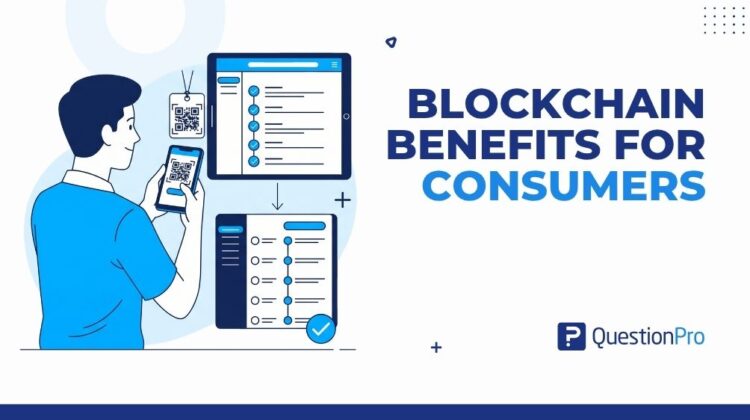
The mechanism works in three steps:
- Tagging. Each product or batch gets a unique digital identifier at the point of manufacture.
- Recording. Every step the product takes, from factory to distributor to retailer, gets logged on the shared ledger.
- Verification. The consumer or retailer scans the product to see its full, unedited history before completing a purchase.
This matters most in categories where counterfeits pose real safety risks, such as prescription medication, and in categories where fakes erode brand value, such as luxury goods and designer apparel.
How does blockchain improve supply chain transparency for shoppers?
Blockchain improves transparency by giving every party in a supply chain, including the end consumer, access to the same unaltered record of where a product has been.
That access matters because the gap between what companies believe customers know and what customers actually trust is wider than most brands assume. A 2023 Deloitte Insights survey found supply chain executives estimated an 85 percent customer trust level in their transparency, while customers reported trusting that same transparency at closer to 63 percent. Blockchain-backed records give brands a way to close that specific gap with evidence instead of messaging.
What other consumer benefits does blockchain offer?
Beyond counterfeit prevention and transparency, blockchain supports a handful of other practical consumer benefits.
- Warranty management. A blockchain record of purchase and service history lets consumers transfer, claim, or verify a warranty without hunting for a paper receipt.
- Ethical sourcing verification. Shoppers who care about fair labor practices or sustainable materials can trace a product’s origin instead of relying on a label claim alone.
- Reduced dispute resolution time. Because records can’t be quietly altered by one party, disputes over delivery, authenticity, or service history resolve faster since both sides are looking at the same data.
Real-world examples of blockchain benefiting consumers
Retailers including Walmart and Carrefour joined IBM’s Food Trust blockchain network to track food products from farm to shelf. That system lets both retailers and shoppers trace a product’s origin in seconds instead of days during a recall, which matters directly to consumer safety.
Pharmaceutical companies use similar blockchain tracking to combat counterfeit medication, since a tampered or fake drug supply chain can be identified and isolated before it reaches a pharmacy shelf.
Luxury goods brands use blockchain-based digital certificates tied to individual items, giving buyers a way to confirm authenticity on resale marketplaces where counterfeits are common.
How can you tell if a brand’s blockchain claims are meaningful?
Not every “blockchain-verified” label represents a real system. Some brands use the term as a marketing signal without building the underlying infrastructure to back it up.
A meaningful blockchain claim should let a consumer independently verify a specific piece of product information, not just display a badge. If a brand can’t tell you what data the ledger actually stores or let you access it, the claim is more marketing than substance.
Brands that want to know whether this distinction matters to their own customers shouldn’t guess. This is exactly the kind of question market research is built to answer.
How can brands measure whether blockchain transparency matters to their customers?
- Start with quantitative research.
Field a survey measuring how much consumer behavior actually shifts based on supply chain transparency claims, rather than assuming interest.
- Add an open-ended follow-up.
Use open-ended survey questions to learn what “transparency” specifically means to your audience, since the term covers everything from sourcing to labor practices to data privacy.
- Segment by purchase category.
Interest in blockchain-backed authenticity tends to run much higher in categories like food safety and luxury goods than in low-consideration purchases.
- Test before you build.
Concept-test a blockchain-backed transparency feature before investing in the infrastructure, since the technology itself is only valuable if customers act on the information it provides.
Platforms like QuestionPro’s Market Research Software let teams run this kind of quantitative and qualitative research in one place, which keeps a brand from investing in blockchain infrastructure customers never asked for.
What are the risks and limitations of blockchain for consumers?
Blockchain solves a real trust problem, but it isn’t a guarantee of accuracy on its own. A few limitations are worth knowing before taking any blockchain-backed claim at face value.
| Risk | Why it matters |
|---|---|
| Data still starts with humans | Blockchain verifies that a record wasn’t altered, not that the original data entered was accurate |
| Implementation cost | Smaller manufacturers may not adopt blockchain tracking, leaving gaps in a supply chain’s coverage |
| Consumer confusion | Shoppers unfamiliar with the technology may not know how to use the verification tools brands provide |
| Overstated claims | Some brands attach a blockchain label to systems that don’t actually give consumers verifiable access |
Consumers should treat a blockchain claim the way they’d treat any other sourcing claim: worth checking, not worth assuming.
The technology matters less than what it proves
Blockchain isn’t valuable to consumers because it’s a sophisticated piece of technology. It’s valuable because it lets a shopper verify a claim instead of trusting it blindly. That shift, from taking a brand’s word to checking the record yourself, is what actually changes the relationship between companies and the people who buy from them.
The brands that get the most out of blockchain won’t be the ones that adopt it first. They’ll be the ones that first find out, through real qualitative feedback, what their customers actually want verified.
Frequently Asked Questions (FAQs)
It can, specifically around product authenticity and payment record integrity. Blockchain doesn’t prevent every type of online shopping fraud, but it does make it much harder for a seller to falsify a product’s origin or history once that data is recorded on the ledger.
No. Most consumer-facing blockchain applications work through a simple scan or lookup, similar to checking a tracking number. The technology operates in the background, so shoppers get the verification benefit without needing to understand the underlying mechanics.
Food safety, pharmaceuticals, and luxury goods see the most practical benefit, since each carries high stakes around counterfeiting or contamination. Lower-consideration purchases, like everyday household goods, see less consumer demand for this level of verification.
No. A QR code is simply a scannable link. Blockchain is what can sit behind that QR code, providing an unalterable record for the code to point to. A QR code without a blockchain-backed system behind it can still be edited or faked.
Not entirely, at least not soon. Many companies use blockchain to supplement existing tracking systems in high-risk categories rather than replace them outright, since full adoption across every supplier still carries real cost and coordination challenges.