Most companies collect customer feedback and stop there. Customer co-creation goes a step further by inviting customers to help build the product, service, or experience itself.
The idea sounds simple, but it changes how a business listens. Instead of asking “how did we do,” you ask “what should we build next,” and you let the answer come from the people who will actually use it.
This blog breaks down what customer co-creation actually means, how it differs from ordinary feedback collection, and how to run a program that produces ideas worth shipping.
What is customer co-creation?
Customer co-creation is a collaborative process where a business and its customers jointly develop a product, service, or experience, rather than the business designing it alone and asking for reactions afterward.
Customers move from being a source of opinions to being active contributors. That distinction matters because it changes what you’re asking for and how you act on it.
A few traits define genuine co-creation:
- Customers contribute ideas, prototypes, or decisions, not just ratings or comments
- The business shares real influence over the outcome, not just a survey box
- The process is ongoing, not a single one-time request
- Contributions get evaluated and, when they resonate, built
If none of those are true, what you have is feedback collection with a co-creation label on it. A comment card is not co-creation. An advisory board that helps prioritize next year’s feature roadmap is.
The concept has roots in academic marketing research, where it was described as a shift from companies creating value for customers to companies and customers creating value together. That framing still holds. The business brings the resources and the platform. The customer brings the need and, often, the idea nobody on the inside had considered.
Customer feedback vs customer co-creation
The two get confused constantly because both start with listening to customers. The difference is what happens after.
Feedback tells you how something performed. Co-creation involves customers in deciding what gets built in the first place.
| Aspect | Customer feedback | Customer co-creation |
|---|---|---|
| Timing | After a product or experience exists | Before or during development |
| Customer role | Rates or reacts | Proposes, designs, or decides |
| Typical tool | Surveys, reviews, ratings | Advisory boards, idea platforms, workshops |
| Output | Scores and comments | New features, products, or services |
| Business use | Fix what’s broken | Build what’s wanted |
Most mature voice of the customer programs use both: a system for capturing what customers say across every touchpoint. Feedback surfaces the problem. Co-creation supplies the solution.
Why customer co-creation matters
Products built without customer input are a gamble. Companies routinely spend months developing features that customers never asked for and rarely use, because the assumptions behind them were never tested with anyone outside the building.
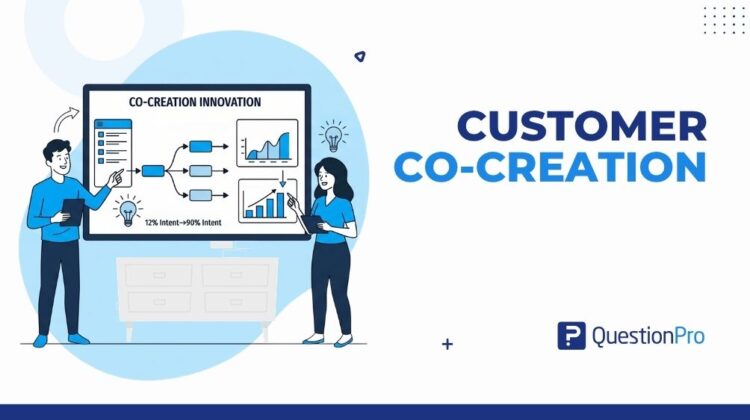
Involving customers directly changes those odds, though not as dramatically as some marketing claims suggest. According to McKinsey research, co-creation’s real effect on new product success is modest, nudging the likelihood of success up by roughly 4 percent rather than transforming it overnight. The same research found that while 90 percent of executives wanted to involve consumers in co-creation, only 12 percent of internet users had actually participated in one, a wide gap between intent and execution.
That gap is the opportunity. A well-run customer experience strategy that includes real co-creation, not just a suggestion box, tends to outperform competitors who only ask for star ratings.
Beyond product success rates, co-creation tends to produce customers who feel invested in the outcome. Someone who helped shape a feature is more likely to defend it, recommend it, and forgive the rough edges of a first release.
Common customer co-creation models
Companies run co-creation through a handful of proven formats. Most programs use more than one, depending on the size of the idea, matching lightweight formats to small decisions and heavier, ongoing formats to bigger ones.
- Crowdsourcing: Open the floor to a large group, customers, fans, or the public, to submit and vote on ideas. Works best for high-volume idea generation.
- Customer advisory boards: A smaller, recurring group of engaged customers who weigh in on roadmaps, pricing, or major changes before they launch.
- Lead user co-creation: Partnering with the customers who push a product hardest and encounter needs before the rest of the market does.
- Community platforms: Ongoing online spaces where customers submit, discuss, and refine ideas together over time.
- Beta testing and piloting: Letting a select group use an early version and shape the final release through structured feedback loops.
Real-world customer co-creation examples
Seeing how established brands run co-creation makes the concept concrete. These four programs each use a different model.
LEGO Ideas
LEGO Ideas lets fans submit set concepts and vote on each other’s designs. Winning creators get a share of royalties and public credit, and the platform has driven several commercially released sets.
Starbucks My Starbucks Idea
Starbucks built a dedicated platform where customers could submit product and service ideas, then upvote favorites. Several menu and store changes originated directly from customer submissions.
Heineken Open Design Explorations
Heineken invited emerging designers from four cities to jointly reimagine the nightclub experience, working alongside a market research partner through an online community. The project generated design concepts the brand could not have produced internally.
Nike By You
Formerly NikeID, this platform lets customers choose materials, colors, and details to design their own sneakers. It turns personalization into both a product feature and a source of design insight for Nike’s broader line.
When does customer co-creation make sense?
Co-creation is not the right tool for every decision, and running it as a default for every question wastes both your team’s time and your customers’ patience. It works best under specific conditions.
- You’re developing something genuinely new, not just tweaking an existing feature
- You have an engaged customer base willing to spend time contributing
- Leadership is prepared to act on ideas, not just collect them
- The decision benefits from diverse outside perspective rather than internal expertise alone
- You can commit to a process, not a one-off campaign
If a decision is narrow, technical, or time-sensitive, a quick survey or internal review usually works faster.
How to start a customer co-creation program
Launching a program does not require a large platform investment on day one. It requires a clear goal and a way to close the loop with participants.
- Pick one focused challenge. A specific goal, such as improving onboarding or redesigning a single feature, works better than an open-ended request for ideas.
- Choose your model. Match the format (advisory board, crowdsourcing, community) to the size of the decision and the customers available to you.
- Recruit the right participants. Target engaged, vocal customers rather than a random sample. Quality of input matters more than volume here.
- Set expectations up front. Tell participants how ideas will be reviewed and roughly when they’ll hear back.
- Prototype and validate quickly. Turn promising ideas into a rough version fast, then bring the same customers back in to react.
- Close the loop publicly. Tell contributors what was built, what wasn’t, and why. Skipping this step is the fastest way to kill future participation.
How QuestionPro supports customer co-creation
Turning scattered customer input into a co-creation pipeline requires more than a feedback form. QuestionPro’s NPS+ feature was built for exactly this gap, helping teams separate root cause analysis from genuine customer-driven innovation ideas within the same response.
Ideas that surface through open-ended feedback rarely arrive organized. QuestionPro’s case management tools route promising suggestions to the right team and track them through to a decision, so a good idea from one customer doesn’t disappear into an inbox.
How to measure customer co-creation success
A co-creation program without metrics tends to produce a lot of activity and little proof of impact. Track outcomes on both the idea side and the business side.
- Idea-to-launch rate: What share of submitted or discussed ideas actually shipped
- Time to market: Whether co-created ideas moved faster than internally generated ones
- Participant retention: Whether the same contributors keep coming back
- Customer satisfaction shift: Movement in scores among participants versus non-participants
- Net Promoter Score change: A measure of customer loyalty, tracked before and after a co-created feature launches
Pair these with regular customer satisfaction surveys so you can see whether co-created changes actually move the numbers that matter.
Common customer co-creation mistakes to avoid
Most co-creation programs fail quietly. Customers stop submitting ideas, engagement drops, and the initiative gets shelved without anyone identifying the actual cause. These five mistakes are the usual culprits.
- Treating it as a one-time campaign.
A single contest generates ideas once. A sustained program generates a pipeline. Co-creation works best as an ongoing relationship, not a launch event.
- Asking for ideas without a review process.
If nobody evaluates submissions on a schedule, participants notice and stop contributing.
- Recruiting too broadly.
A large, disengaged crowd produces more noise than signal. A smaller group of genuinely invested customers beats a large passive one.
- Never explaining the outcome.
Customers who never learn what happened to their idea assume it went nowhere, whether or not that’s true.
- Confusing co-creation with a focus group.
A focus group reacts to something you already built. Co-creation shapes what gets built in the first place.
The best ideas are already in your feedback
Most businesses already have customers willing to help shape what comes next. The missing piece is usually a structured way to invite them in and a commitment to act on what they contribute.
Start with one challenge, one small group, and one honest loop back to the people who helped.
Frequently Asked Questions (FAQs)
It depends on scale. A small advisory board can cost less than a single research study, while a large crowdsourcing platform requires ongoing investment in moderation, review, and rewards for contributors.
Small businesses often run it more easily than large ones. A direct relationship with a loyal customer base makes recruiting participants and closing the loop faster than it is for a global brand managing thousands of submissions.
Teams need someone to manage community engagement, a product or service owner who can evaluate ideas quickly, and a process for prototyping. Marketing and product functions typically share this work.
Timelines vary by scope, but focused challenges with a clear goal often move from idea collection to a testable prototype within a few months, faster than typical internal development cycles.
B2B companies use it frequently, often through customer advisory boards and beta programs with key accounts. The scale is smaller than consumer crowdsourcing, but the influence on product direction tends to be more direct.