Is data analytics worth it in today’s business environment? For many organizations in the USA, the answer is yes, but only when expectations are realistic.
Data analytics is no longer a niche discipline limited to statisticians or technical teams. It now plays a central role in how businesses understand customers, improve experiences, reduce risk, and decide where to invest.
In this blog, we explain the value of data analytics for businesses and how it connects directly to customer experience and customer journey analytics.
What is data analytics?
Data analytics is the process of collecting, cleaning, and analyzing data to answer specific business questions. In simple terms, it helps businesses understand what happened, why it happened, and what actions to take next.
In the USA, data analytics is used across industries such as retail, healthcare, SaaS, finance, and government. It influences everyday decisions like pricing, marketing spend, product changes, and customer support improvements.
Analytics creates real value when it moves beyond dashboards and reports. When data explains patterns, behaviors, and tradeoffs clearly, it gives businesses the confidence to act rather than guess.
To go deeper, you can learn more about data analysis types and real-world examples here: Data analysis: definition, types, and examples.
Is data analytics worth it for customer experience in the USA?
For businesses focused on customer experience, data analytics is no longer optional. In the USA, companies across industries rely on analytics to understand how customers interact with their brand and where experiences break down.
Data analytics in customer experience helps businesses move beyond surface-level feedback. Instead of reacting to isolated complaints or single survey scores, businesses can identify patterns across touchpoints and over time. This makes it easier to understand why satisfaction drops, where friction builds, and which changes actually improve the experience.
For customer journey-focused initiatives, analytics adds clarity and accountability. It allows businesses to connect experience insights to outcomes such as retention, repeat purchases, and reduced customer effort. Without analytics, CX decisions are often based on assumptions. With it, organizations can show clear cause-and-effect relationships that support smarter prioritization.
In practice, analytics helps businesses:
- Identify experience gaps that impact loyalty
- Prioritize improvements based on customer behavior
- Align teams around shared experience insights
- Measure whether CX changes are actually working
In the US market, customer experience strategies increasingly depend on analytics to turn feedback into decisions that improve both satisfaction and long-term business performance.
What are the benefits of data analytics for businesses?
The benefits of data analytics become clear when businesses use insights to reduce uncertainty in decision-making.
Instead of guessing why customers churn, why conversion drops, or why satisfaction changes, analytics connects outcomes to underlying causes. This helps businesses focus on the issues that matter most and avoid spending time or budget on assumptions.
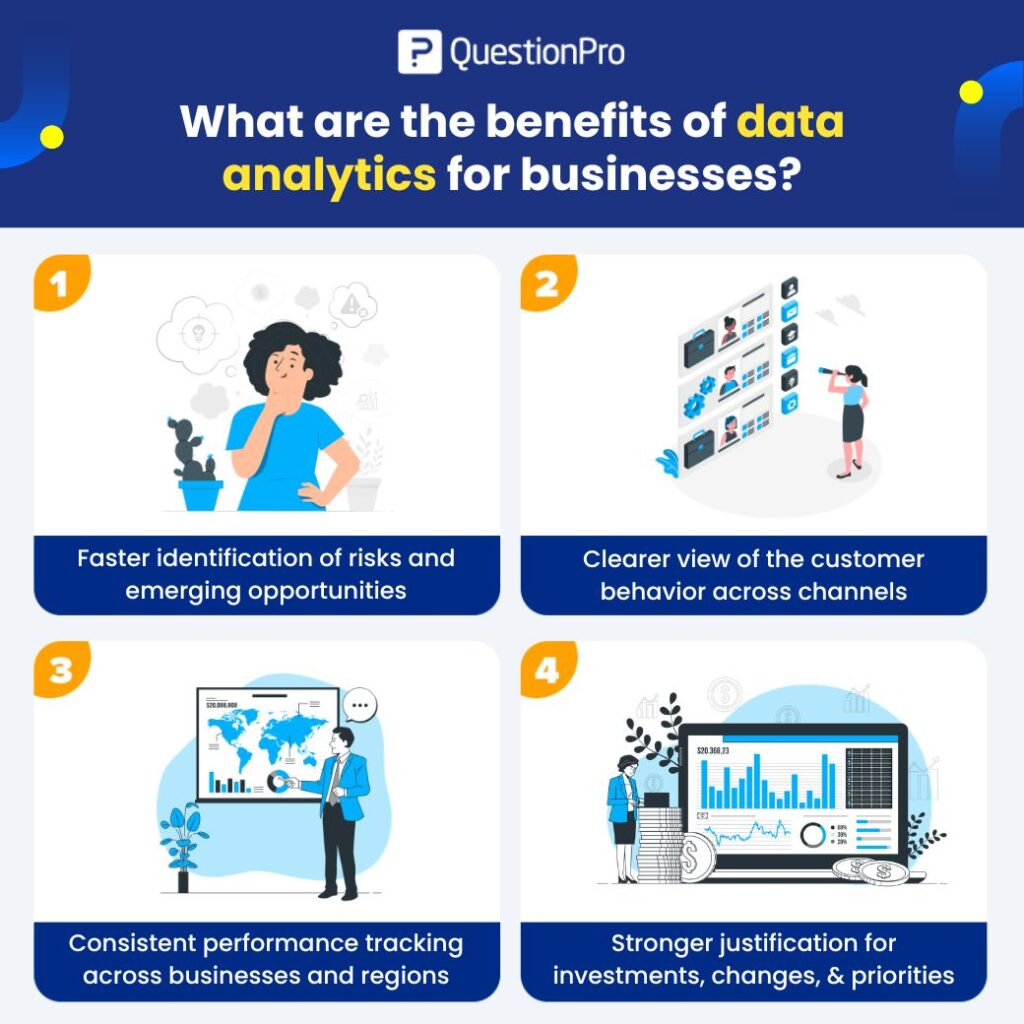
For businesses, the main benefits include:
- Faster identification of risks and emerging opportunities
- A clearer view of customer behavior across channels
- More consistent performance tracking across businesses and regions
- Stronger justification for investments, changes, and priorities
Data analytics does not eliminate uncertainty, but it reduces it. Over time, this leads to better decisions, fewer costly mistakes, and more confidence in how customer and business strategies are shaped.
How does data analytics help improve CX?
Data analytics helps improve customer experience by showing how customers interact with a business across touchpoints and over time. This includes signals from surveys, product or service usage, support interactions, and direct feedback.
Customer behavior analytics focuses on what customers actually do, not just what they say. It helps businesses spot drop-offs, friction points, and loyalty drivers that are not always visible in individual metrics.
When analytics is applied consistently, businesses can:
- Detect experience issues before they escalate
- Identify which moments in the journey have the greatest impact
- Connect experience changes to outcomes like retention and revenue
At this stage, analytics moves beyond reporting. It becomes a practical tool for improving customer experience based on evidence rather than assumptions.
Why customer journey analytics delivers the most value in data analytics
Data analytics delivers its strongest returns when applied at the customer journey level. Individual metrics like CSAT or NPS show what customers feel at a moment in time. Customer journey analytics explains how those moments connect and influence each other.
Customer journey data analysis brings together interactions across channels, stages, and systems. This includes surveys, digital behavior, support interactions, and transactional data. Viewed together, these signals reveal where customers struggle, hesitate, or disengage, not just where a single score changes.
This is where analytics for customer insights becomes practical. Instead of guessing which touchpoint matters most, businesses can see how early experiences shape later outcomes. For example, friction during onboarding often explains long-term churn, while slow support responses can reduce repeat purchases weeks after the interaction.
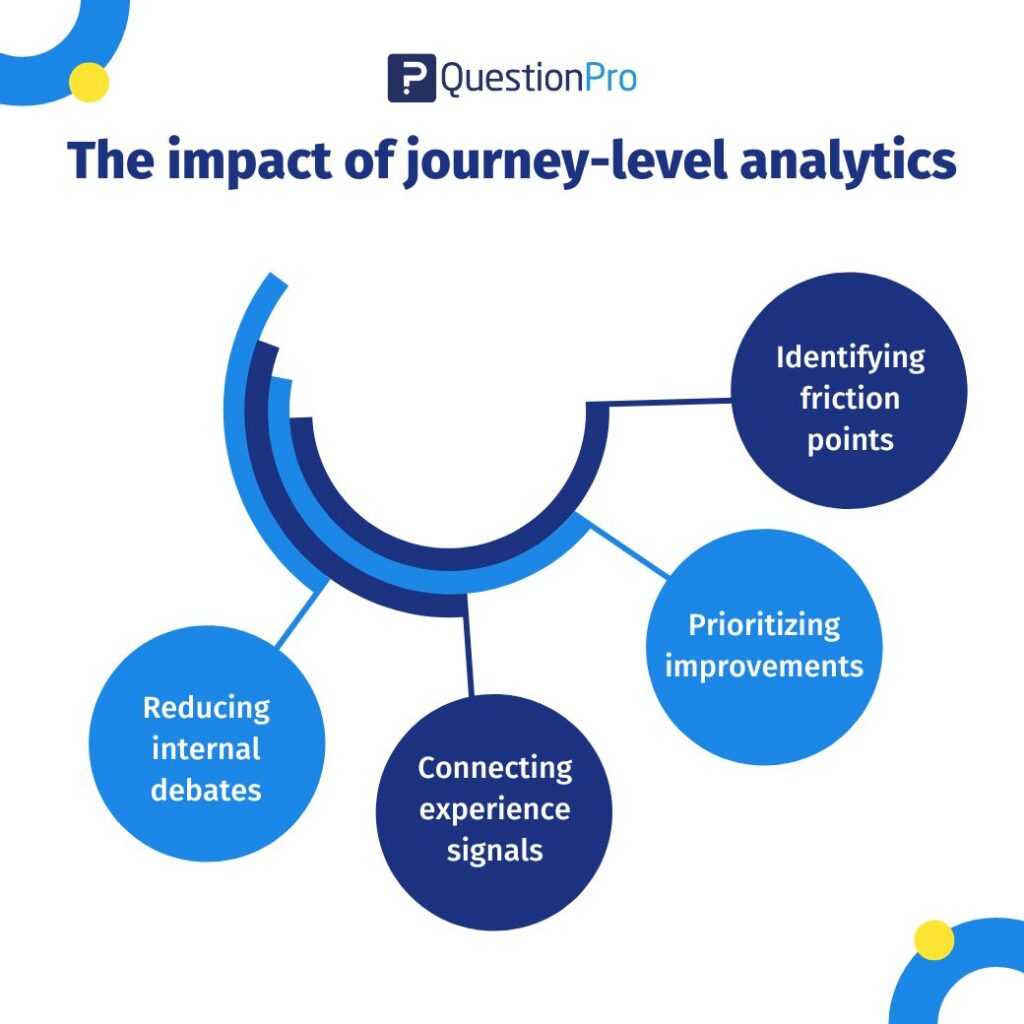
A journey-level approach creates a more data-driven customer journey by:
- Identifying friction points that compound over time
- Prioritizing improvements based on downstream impact
- Connecting experience signals to measurable business outcomes
- Reducing internal debates driven by opinion rather than evidence
This is exactly where customer journey analytics becomes critical. By connecting interactions across time, channels, and touchpoints, analytics reveals patterns that explain friction, drop-offs, and loyalty drivers far more clearly than isolated reports.
If you want to move from theory to execution, this guide explains how to use customer journey analytics effectively in CX programs.
How QuestionPro supports data analytics across the customer journey
QuestionPro supports data analytics by helping businesses capture, connect, and analyze customer experience data across the full customer journey. Instead of treating feedback and behavior as separate inputs, businesses can bring multiple signals together to understand how experiences evolve over time.
With QuestionPro, businesses can collect structured and unstructured data from surveys, digital touchpoints, and ongoing feedback programs. This makes it easier to analyze customer behavior across stages, not just at isolated moments. When these signals are viewed together, patterns emerge that explain where friction builds and why outcomes change.
The platform also helps businesses move from analysis to action. By organizing experience data around journeys and touchpoints, businesses can prioritize improvements based on impact rather than assumptions. This supports more consistent decision-making across customer experience, research, and product teams.
QuestionPro enables a more connected approach to analytics, where customer journey insights are easier to interpret, share, and apply across the organization.
Is data analytics worth it for small and mid-sized companies?
For small and mid-sized companies in the USA, data analytics is worth it when it is scoped to real business questions. The most common mistake is trying to replicate enterprise-level setups with complex tools and dashboards that add cost without clarity.
At this stage, effective analytics focuses on:
- A small number of clearly defined questions
- Reliable data sources that businesses trust
- Simple metrics directly tied to decisions
Even basic analytics can deliver meaningful results. When used consistently, it can improve marketing efficiency, reduce churn, and highlight customer experience gaps that would otherwise go unnoticed.
Is data analytics worth it without customer journey analytics?
Data analytics still has value without a journey perspective, but its impact is limited.
Without customer journey analytics, businesses often analyze data in silos. Marketing looks at campaigns, CX looks at surveys, product looks at usage, and support looks at tickets. Each dataset may be accurate on its own, but the full customer story is missing.
This leads to common problems:
- Businesses optimize individual touchpoints while the overall experience declines
- Conflicting metrics create confusion instead of clarity
- Improvements fail to scale because root causes remain hidden
From a business value of data analytics perspective, this fragmentation reduces return on investment. Insights stay tactical instead of strategic. Decisions solve symptoms rather than causes.
Customer journey analytics acts as the structure that makes analytics coherent. It turns disconnected data into a shared narrative that businesses can align around. Without it, analytics answers “what happened.” With it, analytics explains “why it happened and what to fix next.”
For organizations serious about customer experience, analytics reaches its full potential only when journeys are part of the model.
Frequently Asked Questions (FAQs)
Answer: Yes. Many roles use analytics without heavy coding. Skills like interpreting results and explaining insights are often more valuable than technical depth.
Answer: In many US organizations, early value appears within three to six months when projects focus on specific questions.
Answer: No. Spreadsheets, basic BI tools, and survey platforms can deliver value when used correctly.
Answer: No. Small and mid-sized companies often see faster returns because decisions and changes move more quickly.
Answer: Reporting shows what happened. Analytics explains why it happened and what to do next.