Marriott runs over 9,700 hotels across 40 brands, yet every stay still feels personal. This is the core of the Marriott customer experience strategy. It blends deep personalization with seamless journey mapping to drive massive guest loyalty.
That rare mix of massive scale and consistent quality makes it a gold standard. CX teams outside the hospitality sector study this exact model to fix their own retention issues.
In this blog, we’ll break down the Marriott customer experience strategy piece by piece. We will cover the Bonvoy loyalty program, personalization tactics, and the exact metrics that prove it works.
What is customer experience in the hotel industry?
Hotel customer experience is the sum of every interaction a guest has with a brand. It runs from the first search for a room to the review they leave after checkout. A few categories make up that sum.
- Digital moments, like booking, email confirmation, and mobile check-in.
- Human moments, like a front desk greeting or a housekeeping request.
- Recovery moments, like how a complaint gets handled mid-stay.
A hotel can have excellent facilities and still deliver poor experience if any one of those categories breaks down. That is why hospitality brands increasingly manage experience as a connected system rather than a set of separate departments.
Why is customer experience central to Marriott’s growth?
Marriott treats guest experience as a revenue driver, not a courtesy. A few forces explain why this focus pays off.
- Loyal guests book direct more often, which lowers Marriott’s dependence on costly commissions paid to online travel agencies, or OTAs, like Expedia and Booking.com.
- Consistent service across 40 brands protects the parent brand’s reputation even when a single property has a bad night.
- Positive reviews and referrals reduce acquisition costs, since travelers increasingly research a hotel through peer reviews and customer touchpoints before they ever visit the website.
- Every recovered complaint is a chance to convert a frustrated guest into a repeat customer instead of losing them permanently.
None of this happens by accident. It comes from treating the guest journey as something to design, measure, and adjust on a regular cycle. Journey performance, tracked end to end rather than touchpoint by touchpoint, is also more closely tied to business outcomes, a pattern McKinsey’s research on customer experience has found holds across industries.
How does Marriott Bonvoy build guest loyalty?
Marriott Bonvoy is the loyalty program that ties Marriott’s entire portfolio together. It remains the clearest example of the company’s experience strategy in action. Members earn points across all 40 brands and redeem them with no blackout dates on award stays. A few mechanics keep the program feeling worth the effort.
- The fifth consecutive award night is free, which rewards longer stays instead of one-off bookings.
- Elite members who narrowly miss requalifying get a soft landing instead of dropping out of status entirely.
- Members can top off a free-night award certificate with extra points if they are short, which removes a common source of frustration.
- Base membership already includes free Wi-Fi, mobile check-in, and mobile key, so the entry-level experience does not feel stripped down.
The lesson for other customer loyalty programs is not the specific perks. Bonvoy ties rewards to behavior Marriott actually wants, like repeat direct bookings. The program rules keep adjusting so the benefit stays worth the effort.
How does Marriott personalize each guest’s stay?
Personalization at Marriott happens at three points in the journey. Each one uses a different kind of guest signal.
- Preferences the guest volunteered directly.
- Behavior observed during a previous stay.
- Feedback collected after checkout.
Before arrival
Guests who share preferences during Bonvoy sign-up, like pillow type or floor preference, can have their room set up before they check in. This only works because the guest opted in, which keeps the personalization from feeling invasive.
During the stay
Small, unscripted gestures still matter more than any app. A few examples show up across Marriott properties.
- A handwritten welcome note instead of a printed one.
- A local recommendation tied to a guest’s stated interests, not a generic city guide.
- A room service adjustment made for a dietary need without the guest having to ask twice.
These moments are cheap to deliver and hard to fake, which is exactly why they build loyalty.
After checkout
Post-stay surveys and Bonvoy activity feed back into the guest’s profile, so the next stay reflects what was learned from the last one. A customer journey map makes this loop visible by showing where feedback should be collected and where it should change the next interaction.
What does the Marriott guest journey look like end to end?
Mapping the guest journey by stage shows where Marriott invests attention and where most hotels still lose guests.
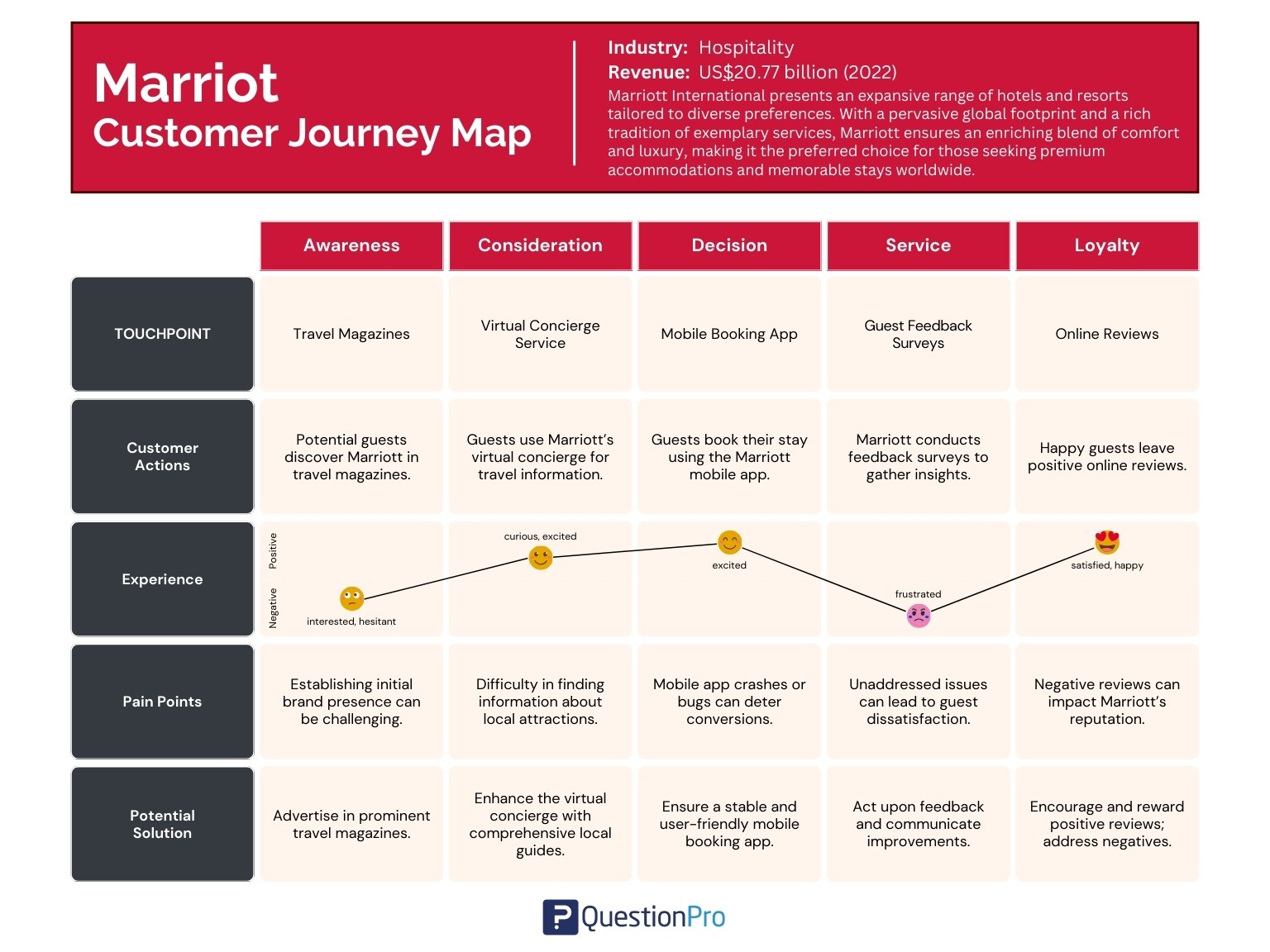
| Stage | Key touchpoint | Common pain point | What Marriott does |
|---|---|---|---|
| Awareness | Search, social ads, travel press | Getting noticed among dozens of competing brands | Runs brand-specific campaigns for each of its 40 sub-brands instead of one generic message |
| Consideration | Website, reviews, virtual concierge | Guests can’t judge fit without enough local detail | Publishes brand-level amenity pages and responds publicly to reviews |
| Booking | Mobile app, direct site, email confirmation | Complicated booking flows or missing confirmations | Keeps direct booking friction low and confirms instantly by email and app |
| Stay | Mobile key, front desk, in-room requests | Guests feel anonymous despite loyalty status | Surfaces guest preferences and status to staff before check-in |
| Post-stay | Feedback survey, Bonvoy points post, reviews | Feedback collected but never acted on | Routes negative feedback into service recovery instead of just a dashboard |
How can you apply Marriott’s journey approach to your own CX strategy?
Most businesses don’t need Marriott’s scale to use its logic, and a few practical journey examples make the pattern easier to copy. What matters most is choosing where to invest first.
- Start with the touchpoint that has the highest complaint volume, not the one that is easiest to fix.
- Separate signals guests gave you on purpose, like stated preferences, from signals you inferred from behavior, and treat the first group with more confidence.
- Decide which loyalty perks guests actually redeem before adding new ones. An unused benefit does not build loyalty.
- Fix your feedback loop before you expand your survey program. Collecting more opinions without acting on them erodes trust faster than collecting none.
How do hotels measure guest experience success?
Guest experience needs numbers attached to it, or improvement plans stay theoretical. Three metrics carry the most weight in hospitality.
- Guest satisfaction or review index: The hospitality benchmark reached roughly 86.7% globally in 2025, up slightly year over year even as review volume grew, according to the 2026 Guest Experience Benchmark reported by Hospitality Net. Track your own score against that baseline, not against last quarter alone.
- Net Promoter Score: Measured through a single post-stay question about recommendation likelihood, then segmented by promoters, passives, and detractors so you know exactly who needs follow-up.
- Direct booking rate: the share of stays booked outside OTAs. A rising rate is one of the clearest signs that loyalty and personalization are converting into behavior, not just goodwill.
What common mistakes weaken hotel CX strategies?
A few patterns show up repeatedly in hotel brands that struggle with experience, even when they have the budget to do better.
- Collecting feedback surveys but never running a proper closed-loop feedback process with the guest who filed the complaint.
- Building a journey map once and never updating it as booking channels or guest expectations shift.
- Personalizing based on inferred behavior without guest consent, which reads as surveillance instead of service.
- Adding loyalty tiers faster than the property can actually deliver the benefits attached to them.
- Training front-line staff on scripts instead of on the judgment needed to handle an unscripted moment well.
How can QuestionPro support a Marriott-style guest experience program?
Most hotel brands don’t have Marriott’s internal data science team. The underlying workflow is still reachable with the right platform. QuestionPro’s customer experience management software pairs journey mapping with a closed-loop feedback system. In practice, that looks like this.
- A negative post-stay survey response automatically opens a ticket.
- The ticket gets assigned to the right team instead of sitting in a shared inbox.
- Resolution status is tracked, so a manager can confirm the guest’s issue actually got fixed.
That closes the exact gap most hotels struggle with: collecting feedback without ever circling back to the guest who gave it.
The real takeaway from Marriott’s customer experience strategy
Marriott’s advantage was never a single feature or perk. It comes from treating experience as something to measure, staff, and revise continuously across a portfolio too large for guesswork. Brands outside hospitality can borrow that discipline without copying the loyalty math.
Map the journey honestly. Personalize only what guests actually shared. Close every feedback loop you open.
Frequently Asked Questions (FAQs)
Marriott runs roughly 40 distinct brands under one loyalty program and one shared data system. Guest preferences and status carry over even when someone switches between a budget brand and a luxury one within the same portfolio.
No. Membership is free, and it immediately unlocks perks like mobile check-in, mobile key access, and member-only room rates. A guest gets these before earning any elite status, before building a points balance, and before their first paid stay.
Post-stay surveys and ongoing review monitoring feed directly into service recovery workflows at the property level. A complaint typically triggers a direct response from hotel staff within a short window, rather than sitting unanswered in a corporate dashboard.
Yes, at a smaller scale. The core habit is using only guest-given preferences and acting on post-stay feedback. That requires a feedback system and discipline more than it requires Marriott’s size or budget.