
Survey solutions help businesses collect feedback, analyze responses, and solve common business problems with clearer data. They are used for customer feedback, employee satisfaction, market research, product decisions, and audience segmentation.
A good survey solution does more than create a questionnaire. It helps teams ask better questions, reach the right people, understand response patterns, and share findings with decision-makers.
For businesses in the USA, surveys are often used to reduce guesswork. They can show why customers leave, what employees need, which product features matter, and where marketing messages are missing the mark.
What are survey solutions?
Survey solutions are software tools that help businesses create, distribute, analyze, and manage surveys.
They usually include question builders, survey templates, distribution channels, reporting dashboards, and data export options. More advanced survey software may also include survey logic, CRM integrations, sample audience access, compliance controls, and advanced analysis methods.
Survey logic means changing the survey path based on a respondent’s answer. For example, a customer who says they are unhappy can be shown a follow-up question asking why.
A survey solution is useful when a business needs structured feedback instead of scattered opinions from emails, reviews, support tickets, or social media comments.
How do survey solutions help businesses solve problems?
Survey solutions help businesses solve problems by turning feedback into organized data. Instead of relying on assumptions, teams can ask targeted questions, collect responses from the right audience, and look for patterns.
The basic process works like this:
- Define the business problem.
- Choose the right audience.
- Create focused survey questions.
- Send the survey through the right channel.
- Analyze the responses.
- Share the findings.
- Take action based on the results.
For example, if customer churn is increasing, a business can send customer feedback surveys to recent buyers, inactive customers, or canceled accounts. The results may show whether the problem is pricing, product quality, support, delivery, or unclear expectations.
What common business problems can survey solutions solve?
Survey solutions can help businesses solve problems across customer experience, employee experience, product development, market research, and reporting. The key is to connect every survey to one clear decision.
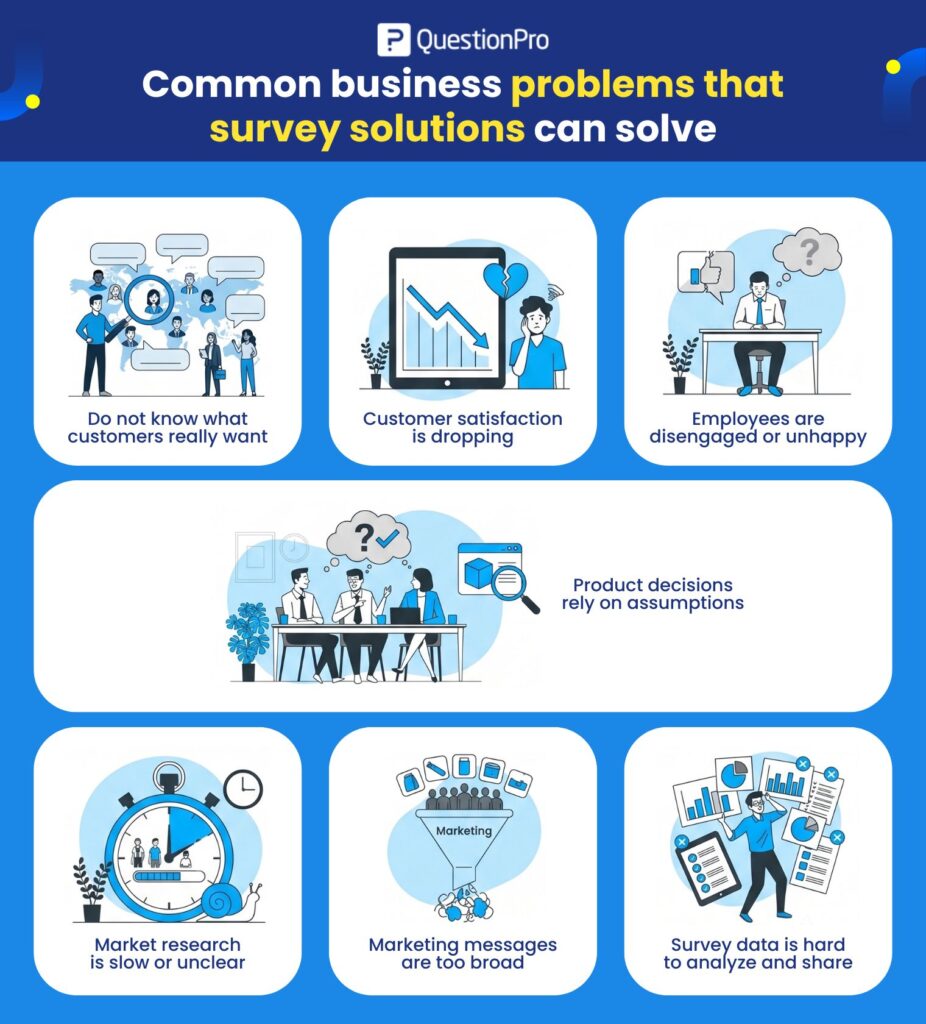
Below are seven common business problems that survey solutions can help identify and handle.
1. You do not know what customers really want
Businesses often lose time and money when they guess what customers want. Customer feedback surveys help identify customer needs, expectations, frustrations, and buying motivations.
Useful survey questions include:
- What problem were you trying to solve when you chose our product?
- What almost stopped you from buying?
- Which feature or service matters most to you?
- What would make your experience better?
These answers help teams improve messaging, product features, support, and customer experience. They also help businesses find gaps between what they think customers value and what customers actually care about.
2. Customer satisfaction is dropping
Customer satisfaction problems are easier to fix when businesses know where the issue starts. A survey solution can help measure satisfaction after a purchase, support interaction, delivery, onboarding process, or renewal.
Customer satisfaction surveys can show whether problems are connected to:
- Product quality.
- Pricing.
- Customer service.
- Website experience.
- Delivery speed.
- Communication.
- Follow-up support.
Metrics like CSAT and NPS can help track customer sentiment over time. CSAT measures how satisfied customers are with a specific experience. NPS measures how likely customers are to recommend a business.
The best use of these surveys is not just collecting scores. It is reading the comments, finding repeat issues, and closing the loop with customers.
3. Employees are disengaged or unhappy
Employee satisfaction surveys help businesses understand what affects morale, productivity, retention, and workplace culture. This is especially useful when leaders sense a problem but do not know what is causing it.
Employee feedback can reveal issues with:
- Communication.
- Workload.
- Manager support.
- Team collaboration.
- Recognition.
- Training.
- Career growth.
- Remote or hybrid work policies.
A short employee satisfaction survey can give teams a safer way to share honest feedback. Anonymous responses can be especially useful when employees may not feel comfortable raising concerns directly.
The goal is not to collect complaints. The goal is to find patterns that leadership can act on.
4. Product decisions rely on assumptions
The product teams often face a familiar problem: everyone has an opinion, but not enough customer evidence. Product feedback surveys help teams test ideas before spending time and budget on the wrong features.
Survey solutions can support product decisions through:
- Feature preference surveys.
- Concept testing.
- Usability feedback.
- Pricing feedback.
- Post-launch product surveys.
- Churn feedback surveys.
For example, a business can ask users to rank possible features by importance. If customers keep choosing one feature over others, the product team has a clearer signal for prioritization.
This does not replace product strategy. It adds evidence to the decision-making process.
5. Market research is slow or unclear
Market research surveys help businesses understand audiences, competitors, buying behavior, and demand. They are useful when a company wants to launch a product, enter a market, update positioning, or understand customer segments.
A good survey solution can make market research faster by offering survey templates, distribution tools, reporting dashboards, and access to sample audiences.
Sample audience means a group of respondents selected to match the target market. For example, a company may want feedback from US consumers between 25 and 45 who recently bought fitness equipment.
Market research surveys can answer questions like:
- Who is our ideal customer?
- What problem are they trying to solve?
- How do they compare different options?
- What price range feels reasonable?
- Which message is most persuasive?
The answers can guide marketing, product, pricing, and sales decisions.
6. Marketing messages are too broad
Broad marketing messages often fail because they try to speak to everyone. Survey solutions help businesses segment audiences based on needs, behavior, demographics, preferences, or purchase intent.
Market segmentation means dividing a larger audience into smaller groups with shared characteristics.
A survey can help identify segments by asking about:
- Goals.
- Pain points.
- Buying triggers.
- Budget.
- Industry.
- Role.
- Location.
- Product usage.
- Purchase timeline.
Once segments are clear, marketing teams can write more relevant emails, ads, landing pages, and sales materials. This is especially useful for US businesses selling to different regions, industries, or customer types.
Collecting feedback is only useful if teams can understand and share the results. Survey reporting tools help turn raw responses into charts, dashboards, filters, and exportable reports.
Good reporting helps teams answer:
- How many people responded?
- Which answers were most common?
- Which groups responded differently?
- Where did respondents drop off?
- What trends changed over time?
- Which comments need attention?
Custom filters can show results by location, customer type, employee department, product line, or response source. This makes the data easier to use in meetings, planning sessions, and leadership reports.
When survey data is easy to read, it is more likely to become action.
What features should good business survey solutions include?
Good business survey solutions should support the full feedback process, from survey creation to action planning.
The most useful features include:
- Survey creation: Teams should be able to build surveys with different question types, templates, and clear formatting.
- Survey logic: Logic keeps surveys shorter by showing only relevant questions to each respondent.
- Survey distribution: Businesses should be able to send surveys by email, SMS, website, QR code, social media, mobile app, or direct link.
- Offline response collection: Some teams need mobile survey apps that collect responses without internet access and sync later.
- Reporting dashboards: Dashboards should show response rates, completion rates, drop-off points, charts, and trends.
- Data exports: Teams may need to export results to PDF, Excel, SPSS, or other formats for reporting and analysis.
- Integrations: CRM and business app integrations help connect feedback with customer records, support workflows, marketing tools, or analytics systems.
- Compliance and security: Survey tools should support secure data collection and privacy requirements. The European Commission provides current information on data protection and GDPR, which is important for businesses collecting personal data from EU residents.
- Sample audience access: Some survey solutions help businesses reach respondents who match a target audience, which is useful for research projects where the business does not already have a contact list.
Businesses that need more than basic forms can use survey software to create surveys, distribute them across channels, analyze data, and share reports with stakeholders.
How do survey questions support problem-solving?
Problem-solving survey questions help businesses understand what is wrong, how often it happens, who is affected, and what should change.
Strong questions are clear, specific, and tied to one decision.
Examples include:
- What is the biggest challenge you face with our product?
- What caused your most recent poor experience?
- Which part of our service needs the most improvement?
- What would make you more likely to buy again?
- What is one thing leadership could improve?
- Which feature would save you the most time?
- What stopped you from completing your purchase?
Avoid questions that push respondents toward a preferred answer. For example, instead of asking, “How helpful was our excellent support team?” ask, “How would you rate your recent support experience?”
Clear questions produce cleaner data. Cleaner data leads to better decisions.
Final thoughts on survey solutions
Survey solutions are most valuable when they are connected to real business problems. A survey should not exist only to collect responses. It should help a team make a decision, fix an issue, or understand an audience better.
The strongest use cases are practical: finding out why customers are unhappy, why employees feel disconnected, which product idea matters most, how a market is changing, or where reporting needs to improve.
Businesses do not need to survey everyone all the time. They need to ask the right audience the right questions, analyze the results carefully, and take action on what they learn.
Frequently Asked Questions (FAQs)
Survey solutions are used to create, send, and analyze surveys for business feedback. Companies use them for customer satisfaction, employee engagement, product feedback, market research, event feedback, and audience segmentation.
Survey solutions solve business problems by collecting structured feedback from the right audience. They help teams identify patterns, measure satisfaction, understand needs, and make decisions based on data instead of assumptions.
Survey software usually refers to the tool itself. Survey solutions often refer to the broader workflow, including survey creation, distribution, reporting, integrations, compliance, sample access, and support for business decisions.
Surveys can identify customer dissatisfaction, employee disengagement, product gaps, weak messaging, poor segmentation, pricing concerns, service issues, and reporting problems. The survey should be designed around one clear problem to get useful answers.
No, businesses do not need sample audiences for every survey. Customer, employee, and event surveys usually use existing contacts. Sample audiences are useful for market research when the business needs responses from a specific target group.
A reliable survey solution should offer secure data collection, clear reporting, multiple question types, survey logic, distribution options, integrations, and privacy controls. It should also make results easy to analyze and share with stakeholders.