Synthetic data is artificially generated information that replicates the statistical patterns of real-world data without containing any actual records from real people. It’s built using algorithms, models, or simulations designed to preserve the trends and relationships found in genuine data while leaving out anything that could identify a real individual.
The appeal is straightforward: you get data that behaves like the real thing, without the privacy exposure or regulatory weight that comes with handling sensitive records directly. That trade-off is why synthetic data has moved from a niche research technique to a standard tool in machine learning, software testing, and privacy-conscious analysis.
This guide covers what synthetic data actually is, how it’s created, where it’s used, and when it makes sense over working with real data directly.
What is synthetic data and how is it different from anonymized data?
Synthetic data is artificially generated to mirror real data’s statistical properties, while anonymized data starts as real data with identifying details removed or masked.
The distinction matters because anonymized data can sometimes still be reverse-engineered to identify individuals, especially when combined with other datasets. Synthetic data avoids that risk more completely, since no single record traces back to a real person in the first place.
Neither approach is a perfect substitute for the other. Anonymized data preserves more of the original data’s nuance, while synthetic data offers stronger privacy guarantees at the cost of some fidelity to real-world edge cases.
What are the benefits of using synthetic data?
Synthetic data solves three problems that come up constantly in data-driven work: privacy exposure, data-sharing friction, and the need for realistic test data.
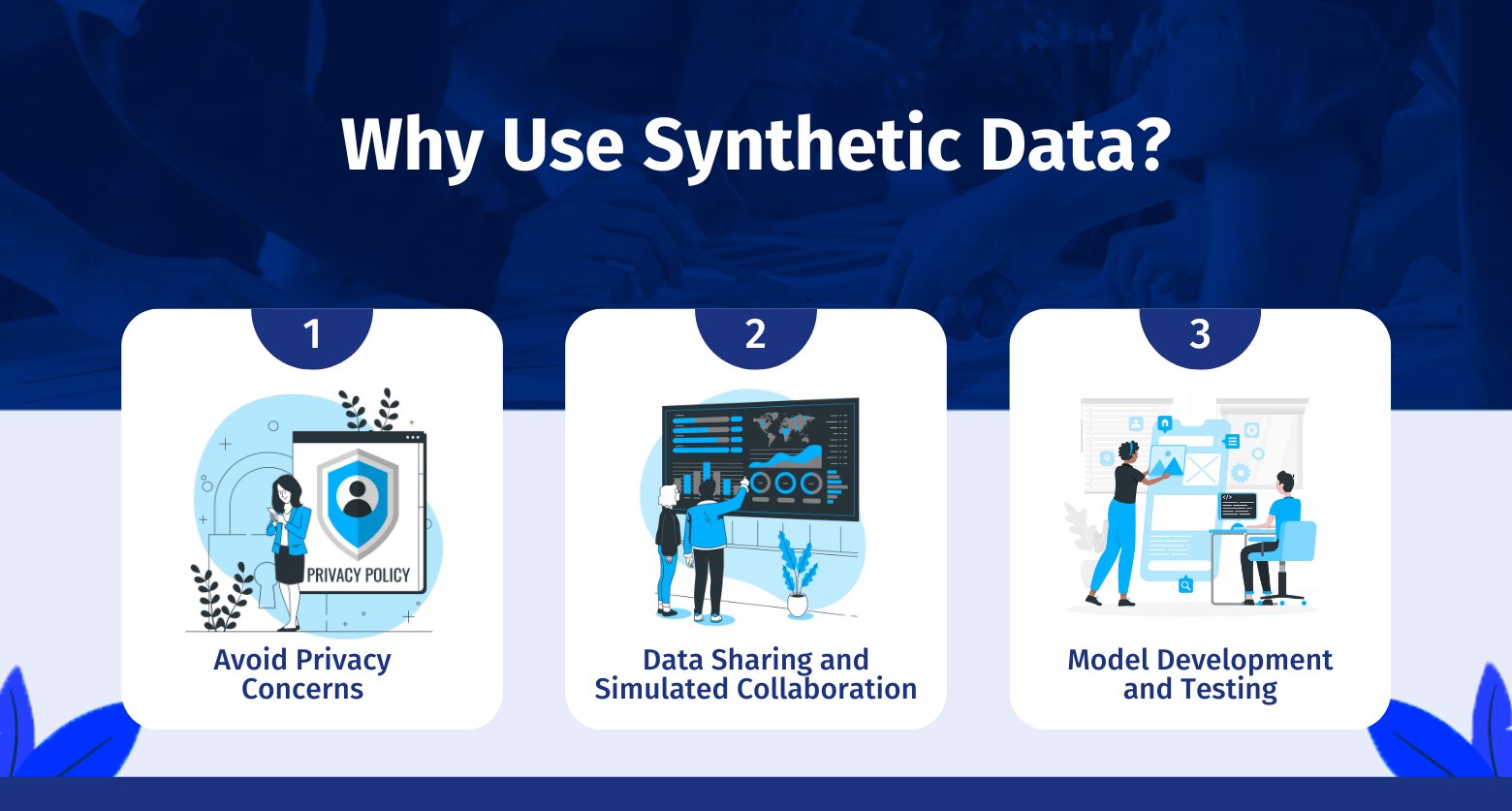
- Privacy protection. Sensitive categories like medical records or financial data can be replicated statistically without exposing any real person’s information, letting teams analyze patterns safely.
- Easier collaboration. Legal and proprietary restrictions often block direct data sharing between organizations. Synthetic datasets sidestep that barrier since they contain no protected information.
- Better model testing. Teams can stress-test machine learning models against synthetic data that mirrors real-world distributions, catching problems like overfitting before deployment.
What are real-world use cases for synthetic data?
Synthetic data has moved well beyond research labs into everyday business and public-sector applications.
- Healthcare. Simulated patient records and imaging let researchers test algorithms without exposing real patient data.
- Financial services. Synthetic transaction and market data support fraud detection and trading model testing without touching sensitive account information.
- Social science research. Researchers can model behavior and social dynamics without breaching individual privacy.
- Online advertising. Synthetic user profiles support ad targeting and personalization testing while keeping real user identities anonymous.
A fraud detection team, for example, can generate synthetic transaction patterns that mimic known fraud behavior, then train a detection model against them without ever exposing a real customer’s financial history.
Learn more about: Synthetic data use cases
What are the types of synthetic data?
Synthetic data isn’t one uniform category. The three main types trade off privacy and data utility differently.
| Type | What it does | Best for |
|---|---|---|
| Fully synthetic | Entirely generated, no original records | Maximum privacy protection |
| Partially synthetic | Replaces only sensitive fields, keeps the rest | Datasets with personally identifiable fields |
| Hybrid synthetic | Blends real and synthetic records | Balancing privacy with data fidelity |
Partially synthetic data works well for a survey dataset where names and addresses are replaced with placeholders, while responses to other questions stay untouched. Hybrid approaches take more memory and processing time but offer the closest match to real-world complexity.
How is synthetic data generated?
Four methods account for most synthetic data generation today, ranging from simple statistical modeling to advanced neural networks.
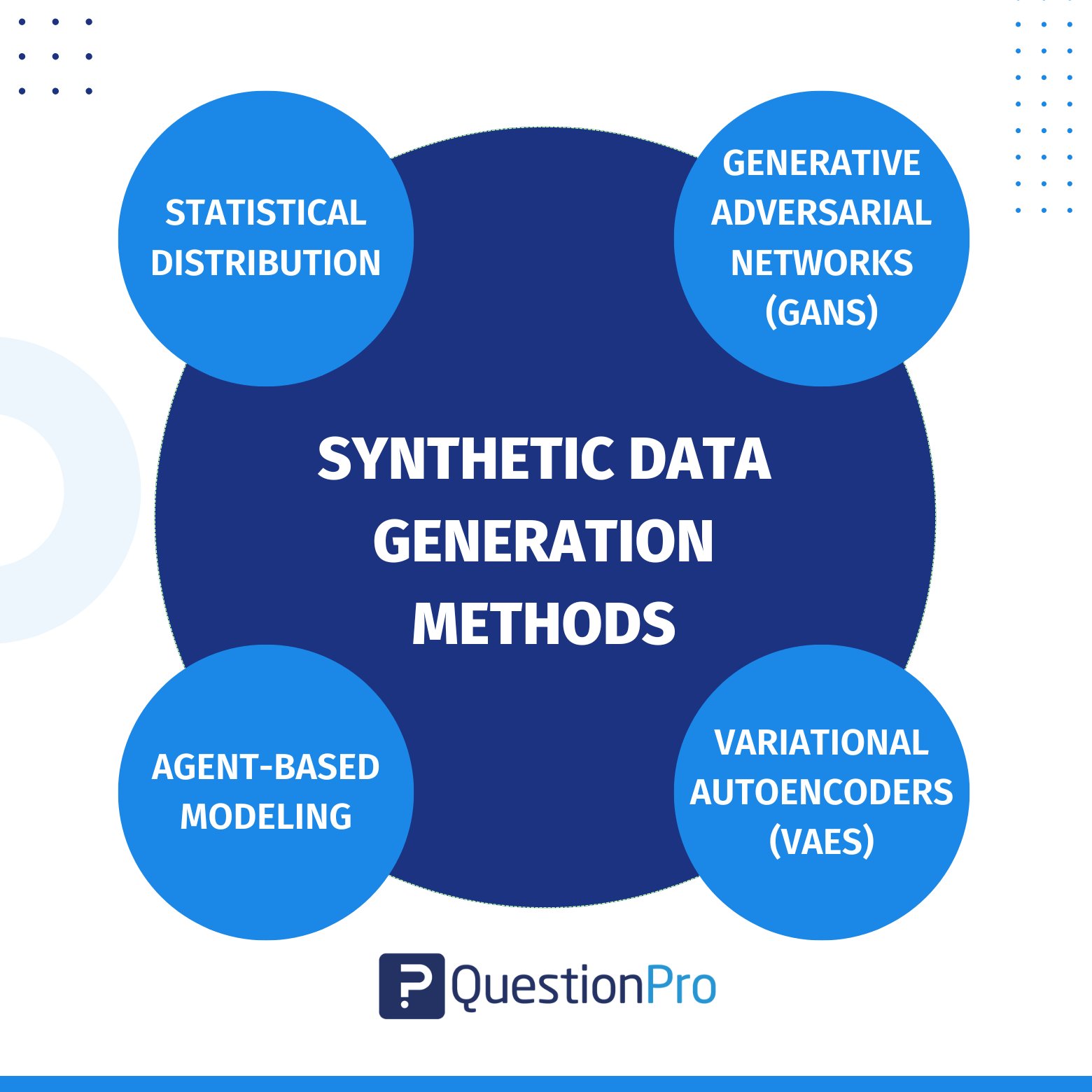
- Statistical distribution modeling draws new data points from a known distribution, such as normal or exponential, based on patterns found in real data. It’s the simplest method and works well when the underlying data behavior is well understood.
- Agent-based modeling builds a model that explains observed behavior, then generates new data from that model. It’s useful for business simulations but can overfit when used for forecasting.
- Generative adversarial networks (GANs) pit two neural networks against each other. One generates synthetic samples, the other tries to distinguish them from real data, and the process improves both networks until the synthetic output is highly realistic. GANs are powerful but computationally expensive and can be difficult to train reliably.
- Variational autoencoders (VAEs) learn the underlying distribution of a dataset through an encode-decode process, generating new data that closely mirrors the original statistical shape.
What are the risks and limitations of synthetic data?
Synthetic data isn’t a risk-free substitute for real data, and treating it as one is where most projects run into trouble.
- Replicating the exact distribution of real-world data is difficult, which can introduce subtle errors
- Complex correlations between variables are hard to preserve accurately
- Models trained only on synthetic data may underperform when applied to real-world data
- Balancing privacy protection against data utility is an ongoing trade-off, not a solved problem
- Without a validation process, there’s no reliable way to confirm synthetic data quality
When should you use synthetic data instead of real data?
Synthetic data makes the most sense when privacy risk, data scarcity, or collaboration barriers would otherwise block the work entirely, not as a default replacement for real data.
Reach for synthetic data when you need to test a model against edge cases that are rare in real data, when sharing real records across teams or organizations isn’t legally possible, or when you need volume that your actual dataset can’t provide. Stick with real data, or at least validate heavily against it, whenever the stakes involve a final decision that affects real people, since synthetic data should inform development and testing, not replace ground-truth validation before launch.
How do you validate synthetic data quality?
Validation means comparing the synthetic dataset against real data on both statistical and practical grounds before trusting it for a serious application.
Start by comparing descriptive statistics like mean, variance, and distribution shape between the synthetic and real datasets. Follow with a visual comparison to catch discrepancies numbers alone might miss, then train a model on both datasets separately to see how performance compares. Involving domain experts in this review catches issues a purely statistical check would miss.
How can QuestionPro support synthetic data workflows?
QuestionPro’s survey software helps teams collect the real, high-quality survey data that forms the foundation for generating reliable synthetic datasets. Converting genuine survey responses into structured data gives synthetic data generation a stronger, more representative starting point than working from incomplete or low-quality inputs.
Making synthetic data part of a bigger data strategy
Synthetic data works best as one tool in a broader research and development process, not a wholesale replacement for real-world data collection.
Used well, it lets teams test faster, protect privacy, and collaborate across boundaries that would otherwise block the work. Used carelessly, it can quietly bake distortions into a model that only surface once it meets the real world.
Frequently Asked Questions (FAQs)
Yes, synthetic data generally carries fewer regulatory restrictions than real personal data, since it doesn’t contain identifiable information. Specific industries like healthcare and finance still have their own compliance standards worth reviewing before use.
No. Synthetic data works well for testing, development, and privacy-sensitive analysis, but final decisions affecting real customers should still be validated against real-world data before launch.
Costs vary widely based on method and scale. Simple statistical modeling can be done with existing analytics tools at low cost, while GAN-based generation for large, complex datasets typically requires more specialized infrastructure and expertise.
It can, especially if the original data used to build the generation model already contained bias. Synthetic data reflects the patterns of its source data, so it inherits any skew present in that source.
Healthcare, financial services, and autonomous vehicle development are among the heaviest users, largely because each faces strict privacy or safety requirements that make working with unlimited real-world data impractical.