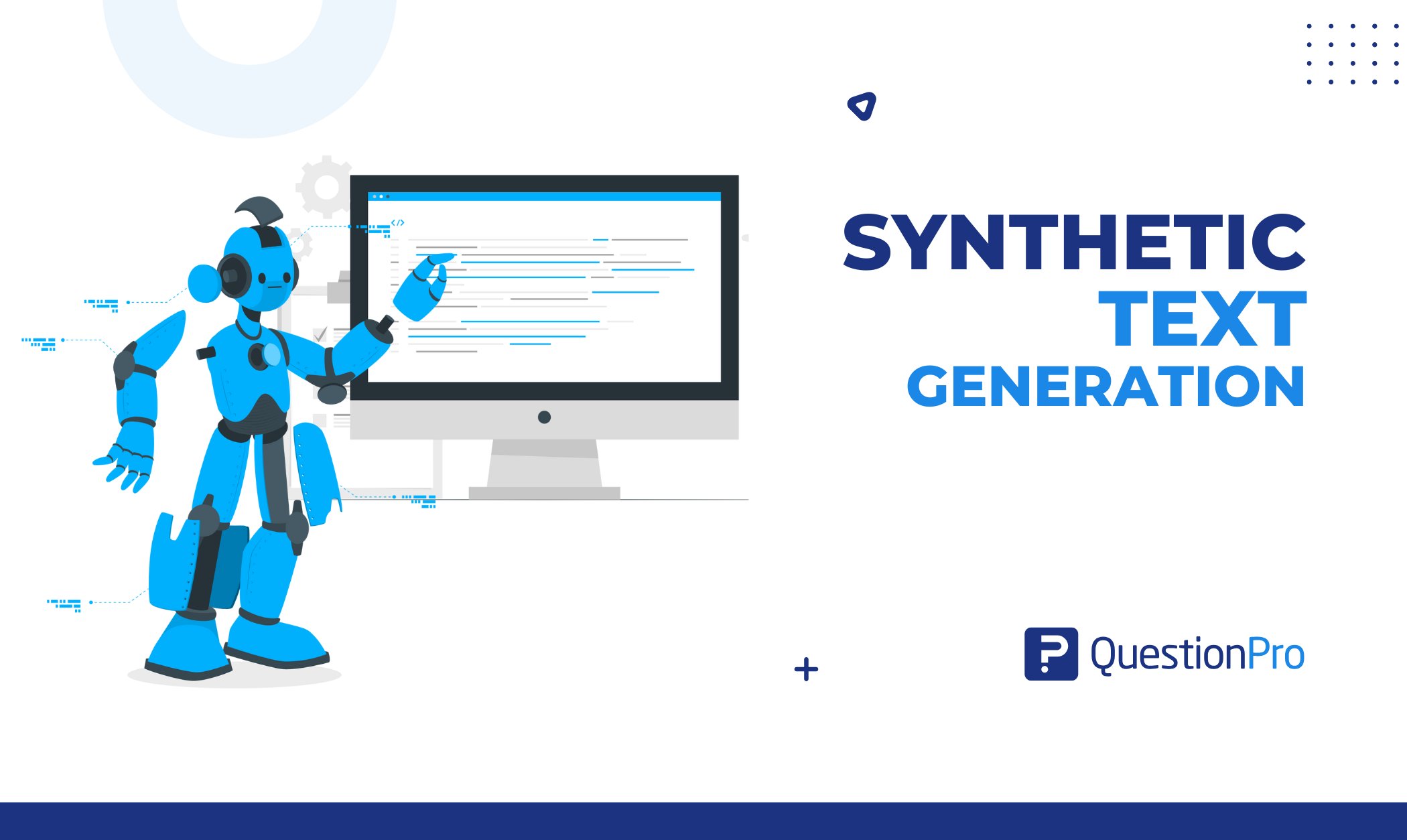
Synthetic text generation is the process of using AI models or rules to create new, artificial text that mimics the style, structure, and patterns of real human writing. The output is original wording. It does not copy any one person’s answer.
In survey research, synthetic text data usually means open-ended responses, which are answers respondents type in their own words instead of picking from a list. It can also cover comments, chat transcripts, and interview-style answers.
Synthetic text is one branch of synthetic data, the wider family that also includes artificial tables, images, and sensor readings. What sets text apart is that language is messy. Tone, slang, hesitation, and context all matter, so text is harder to fake well than a column of numbers.
One point deserves emphasis. A synthetic answer is not a respondent. Nobody lived the experience it describes, so it can show you how a comment might look, not what your customers actually feel.
How does synthetic text generation work?
Most modern synthetic text generation relies on large language models (LLMs), which are AI systems trained on huge collections of text to predict and produce fluent language. Older template and rule-based methods still work for simple jobs (these synthetic data generation techniques cover them), but LLM synthetic data now covers most real projects. Three approaches span the range, and they differ mainly in how much real data they touch.
Prompting a general-purpose model
The simplest route is to write a prompt, which is a set of instructions telling the model what to produce. Here is a small example:
Prompt: Write 3 short comments from US shoppers who abandoned a checkout page. Vary the tone and length.
Output 1: Shipping cost showed up at the very end. Felt like a bait and switch.
Output 2: Had to create an account just to buy socks, so I left.
Output 3: Page kept timing out on my phone. Will try again later, maybe.
This approach needs no real data and takes minutes. The trade-off is fit. The model draws on general patterns from its training text, not on your audience, so the output tends to sound like an average voice. Notice how tidy those comments are. Real comments include typos, half sentences, and tangents.
Grounding the model in real data
A stronger route is grounding, which means feeding the model real examples or fine-tuning it. Fine-tuning is the practice of training an existing model further on your own text so it picks up your audience’s vocabulary and concerns.
Grounding matters. In a widely cited 2024 study, researchers built AI agents from interview transcripts of 1,052 people. According to the study on arXiv, the agents replicated participants’ General Social Survey answers 85 percent as accurately as participants replicated their own answers two weeks later. The agents also showed smaller accuracy gaps across racial and ideological groups than agents given only demographic descriptions.
Keep the limits in view. Those tests used structured survey items, not free-text answers, so the result does not automatically carry over to open-ended writing.
Privacy-preserving synthetic text with differential privacy
If the source text is sensitive, you can add protection at training time. Differential privacy is a mathematical technique that limits how much any single person’s data can shape the model’s output.
One ACL 2023 paper reports that fine-tuning a pretrained language model with differential privacy produced useful synthetic text with strong privacy protection. NIST adds a caution in its overview of differentially private synthetic data. Many synthetic data techniques do not meet differential privacy at all, and accuracy remains the main challenge for those that do.
Synthetic text generation is the technique. The other terms below are outputs, users, or neighbors of that technique, and mixing them up leads to confused briefs and wrong expectations.
| Term | What it means | How it relates |
|---|---|---|
| Synthetic text generation | Creating artificial written text with AI or rules | The core technique |
| Synthetic data | Artificial data of any type, including text, tables, and images | The parent category |
| Synthetic responses | Generated answers to a specific survey | A common output of the technique |
| Synthetic respondents | Simulated participants who produce those answers | The simulated author of the output |
| AI text analysis | Software that reads and organizes real text | Analyzes text but does not create it |
| AI-assisted human answers | Real people using AI tools to write their replies | A data quality risk, not synthetic data |
The last row is the one people miss. A reply written by a real person with an AI assistant is still a real respondent, but its wording may no longer reflect their own voice.
Where synthetic open-ended responses help in survey research
Synthetic open-ended responses work best as a rehearsal tool, helping you test questions, tools, and workflows before real respondents take part. Researchers are already studying this. A 2023 human-computer interaction study had GPT-3 write open-ended questionnaire answers about video games as art. A later literature review noted the output read as plausible while urging researchers to double-check conclusions against real data.
Practical uses include:
- Pilot an open-ended question
Generate 200 varied answers to a question like “What almost stopped you from buying today?” and see whether it invites one-word replies or off-topic ones. Fix the wording before launch. - Stress-test AI text analysis
Plant five known themes in generated comments, then check whether your AI text analysis recovers them and scores sentiment sensibly. - Share safer demo data
Give a vendor or intern realistic comments instead of real customer text, after a privacy review. - Train and test classifiers
A classifier is a model that sorts comments into categories. Add generated examples of rare types, such as safety complaints, then validate on real comments. - Onboard analysts
New team members can practice coding themes on generated comments before touching live data.
Outside research, NVIDIA notes that synthetic text supports tasks such as training cybersecurity models and spotting phishing emails, along with privacy-preserving medical records.
What can go wrong with synthetic text?
The main risks are sameness, privacy leakage, hidden bias, and false confidence. Each is easy to miss because generated text reads smoothly.
- Sameness: A study in Sociological Methods & Research compared human-written answers from three pre-ChatGPT studies with LLM-generated text. Per the Stanford GSB summary, the LLM responses were more homogeneous and positive, especially on sensitive questions about social groups. Homogenization means responses converge on similar wording and views, and it can erase the variation that makes open-ended questions worth asking.
- Privacy leakage: Synthetic does not mean anonymous. A 2025 privacy audit of LLM-generated text points out that text can still leak information without a direct link to original records. The generator’s design decides how much leaks.
- Hidden bias and hallucination: A model can repeat bias from its training data. It can also hallucinate, which means it invents plausible-sounding details.
- False confidence: The most damaging error is treating generated comments as evidence. Never quote synthetic text as if a customer said it, and never blend it into a real dataset without labels.
Five checks before you trust synthetic text
Before using synthetic text for anything beyond rehearsal, run it through five checks: diversity, realism, task fit, privacy, and comparison with real data. None takes long, and skipping them is how weak synthetic data ends up in reports.
- Diversity
Read a random sample of 50 comments and count the distinct ideas. If 200 comments repeat the same five points, the generator is too narrow. - Realism
Mix 20 generated comments with 20 real ones and ask two colleagues to spot the fakes. If it is easy, adjust length, tone, and typos to match reality. - Task fit
est the data on the job it is meant for. For a classifier, train on synthetic comments and score it on real, held-out ones. - Privacy
Search the output for verbatim overlap with source text, plus rare names, places, or job titles. Involve privacy or legal review when the source data includes regulated information, such as health records under HIPAA, the US health privacy law. - Real-data comparison
Compare theme mix, sentiment, and length against a small real pilot sample. Record the model, prompt, and date so the method is repeatable.
What QuestionPro offers for synthetic research
QuestionPro’s Synthetic data feature generates synthetic responses and reports from the survey or community data you already hold in your own account. That grounds the output in your audience rather than a generic model. It is part of QuestionPro’s market research software and sits under the Audience menu.
The setup follows the grounding approach described earlier. You sync up to five surveys per job, and each survey needs more than 100 responses and at least 20 questions. You can also sync a community. Then you pick a mode, according to the help documentation. Synthetic Responses simulate answers to a survey using your synced data. Synthetic Cohort runs interview-style research with matched synthetic members, where QuestionPro AI puts your questions to them and compiles a report with key takeaways, quotes, and recommended actions.
Two more details matter. Some question types are not supported for synthetic responses, and the tool flags an incompatible survey before launch. QuestionPro also states that your data is not accessible to other users and is not used to train language models.
The reverse problem gets attention too. Data Quality AI flags bot, AI-generated, and gibberish responses as they arrive from real respondents. As with any synthetic method, treat findings from synthetic runs as hypotheses to confirm with real people.
When to use synthetic text and when to collect real responses
Use synthetic text when the goal is to test, train, or rehearse, and collect real responses when the goal is to learn what people actually think. The dividing line is whether a decision will rest on the data.
Use synthetic text when:
- You are pilot testing question wording or survey flow.
- You need to test analysis tools or dashboards before launch.
- Real data is too sensitive to share and a privacy review is in place.
- You want practice material for training analysts.
Collect real responses when:
- The findings will guide pricing, product, policy, or hiring decisions.
- You need to hear from a specific segment or region, such as rural customers.
- Minority or unusual viewpoints matter to the outcome.
- You will quote, publish, or show the results to regulators or clients.
Rehearse with synthetic text, decide with real voices
Synthetic text generation is at its best when it makes real research better prepared, not when it stands in for it. A rehearsal catches the clumsy question, the broken dashboard, and the confusing survey flow before anyone real has to sit through them.
The decisions still belong to real people’s words. Use generated text to sharpen your tools and your questions, label it clearly wherever it appears, and let actual respondents have the final say.
Frequently Asked Questions (FAQs)
Not always. Prompting a general model needs none, but the output reflects generic language patterns. Grounding the model in your own comments or transcripts produces text closer to your audience, though it also demands stronger privacy checks.
Look for polished, uniform, unusually positive wording across many respondents, then add automated quality checks. A Stanford GSB study found 34 percent of surveyed participants on one research-recruitment platform reported using LLMs for open-ended answers.
Yes, especially to add examples of rare categories. The safest approach is to train on a mix of real and synthetic comments. Then test only on real, held-out comments, so accuracy reflects real language rather than the generator’s habits.
Yes. Label generated text clearly, name the model and method, and describe how you validated it. Never present synthetic comments as respondent quotes. Disclosure protects your credibility and helps stakeholders judge how much weight the findings deserve.
Not automatically. HIPAA and state privacy laws often turn on whether data can point back to a specific person. Test re-identification risk, meaning the chance of picking out a real person, and consult legal counsel before sharing text from regulated data.