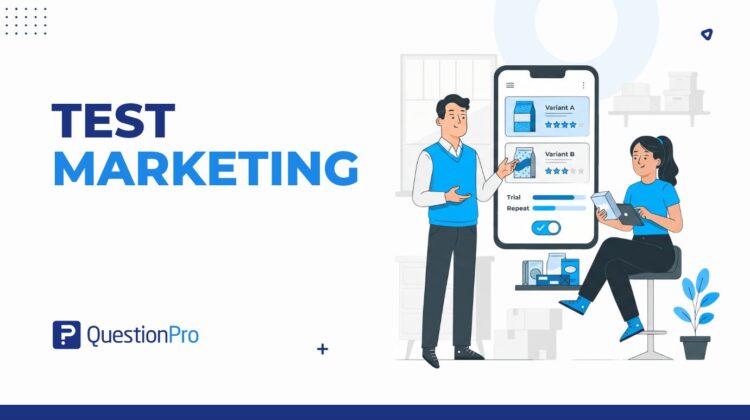
Test marketing is a small-scale trial of a product, price, or campaign in a limited market before a full launch. It shows how real customers react while the cost of being wrong is still small. Businesses use it to decide whether to launch, change, or drop an idea.
Most launch failures are not production failures. They are fit failures: the wrong message, the wrong price, or the wrong audience. A well-run trial catches those early.
In this guide, we cover what test marketing is, its main types, the 10 benefits, a step-by-step process, the metrics that decide go or no-go, and when it is not worth the cost.
What is test marketing?
Test marketing is a limited release of a product or campaign to a representative group of customers, used to forecast national results. The test copies the planned launch on a smaller scale: same product, same price, same channels, same message. Results are then extrapolated to the full market.
A test market can be a city, a region, a store group, an online audience, or a panel of recruited consumers. The best test areas look like the target market in terms of demographics and buying habits.
How is test marketing different from similar terms?
People often mix up test marketing with other research methods. The table separates them.
| Term | What it tests | When it happens |
|---|---|---|
| Test marketing | The full marketing mix (product, price, promotion, place) in a real market | Late stage, just before launch |
| Concept testing | Reactions to an idea, name, or description | Early stage, before a product exists |
| A/B testing | Two versions of one element, such as an ad or landing page | Any time, usually online |
| Beta testing | Whether a product works as intended with early users | Before release, mostly software |
For a broader view of validating a product before release, read our guide on market testing for a product launch.
What are the types of test marketing?
There are four common types of test marketing, and they differ in cost, speed, and realism. Pick the type that matches your budget, your timeline, and how much you worry about competitors seeing the test.
- Standard test market: You sell through normal channels in a few chosen cities or regions, then compare results with a control area. It is the most realistic type and also the slowest and most visible.
- Controlled test market: A research firm or panel handles distribution and shelf placement for you. You get tight control over the test conditions, but the setting is less natural.
- Simulated test market: Recruited shoppers see ads and then buy from a mock store or online shop. It is fast, low-cost, and hard for competitors to detect.
- Online test market: You run versions of an offer, ad, or page with different digital audiences and compare conversions. It is the cheapest option and gives results within days.
How do businesses benefit from test marketing?
Businesses benefit from test marketing because it replaces guesses with evidence before the big spend. The 10 benefits below fall into three groups: risk and cost, product and message quality, and launch decisions.
Lower risk and lower cost
A small trial limits what you can lose. These three benefits are the reason most teams run one.
- Lower financial risk: You spend a fraction of the launch budget to learn whether the full launch will pay off.
- Less waste in production: Demand data helps you avoid overproducing a product nobody wants or underproducing a hit.
- Early problem detection: Packaging flaws, confusing instructions, and distribution gaps show up while they are cheap to fix.
Better products, prices, and messages
A trial also tests the parts of the offer you control, which is where small changes pay off most.
- Real customer feedback: Buyers react to the actual product, not a description of it, so their comments are more honest than survey answers about hypothetical ideas.
- A better price point: You can test two or three prices in matched markets and see which one holds up. Our guide to pricing research explains the survey methods behind this.
- A sharper message: You learn which headline, claim, or visual actually moves people to buy, and which one only sounds good in a meeting.
- A cleaner marketing mix: You can compare channels, promotions, and shelf placement in different test areas before you commit to one.
Smarter launch decisions
The last group of benefits is about decisions at the leadership level.
- A clear go/no-go call: Pre-set targets turn a debate into a yes or no. The result is easy to defend to finance and to executives.
- Forecasts you can trust: Sales in a representative market scale up to national projections more reliably than a desk estimate.
- Internal and customer buy-in: Sales teams, retailers, and early customers who saw a working pilot are easier to bring along at launch.
How do you run a test marketing campaign, step by step?
A reliable test marketing campaign has six steps, and the first one matters most. Write down what a pass looks like before the test starts, so the results cannot be argued afterward.
- Set the decision and the success targets.
Define the go/no-go question and the numbers that count as a pass, such as a trial rate, repeat rate, or conversion rate. - Choose representative test markets.
Pick areas that match your target market on age, income, and buying behavior, and avoid places with unusual media coverage or heavy competitor activity. - Decide what you will vary.
Test one thing at a time, such as price, message, pack design, or channel. Keep a matched control area with no change. - Build the survey and tracking.
Combine sales or conversion data with short customer surveys that ask about awareness, purchase intent, satisfaction, and reasons for buying or not buying. - Run the test long enough to see repeat behavior.
A single purchase tells you about curiosity. A repeat purchase tells you about value. Fast-moving consumer goods often need weeks or months, while a digital offer may need days. - Analyze, decide, and document.
Compare results with your targets, check them against the control area, and choose to launch, adjust and retest, or stop. Record why, for the next project.
What should you measure in a test marketing campaign?
Measure what the customer did and what the customer said, because each one covers a gap in the other. Sales show behavior, and surveys explain it.
| Metric | What it shows | Example target (set your own) |
|---|---|---|
| Trial rate | Share of exposed people who buy once | Set from your category norm |
| Repeat rate | Share of buyers who buy again | Higher than the product you replace |
| Purchase intent | Stated likelihood to buy, from a survey | Top-2-box score above your benchmark |
| Conversion rate | Share of visitors who complete the action | Better than the control version |
| Customer satisfaction | How well the product met expectations | At or above your current line |
The targets in the last column are placeholders. Use your own history and category benchmarks, and agree on them before the test.
What does a go/no-go decision look like?
Consider an illustrative example. A snack brand tests a new flavor in three mid-sized cities against two control cities. Its target is a repeat rate of at least 25% and a purchase intent score above its current best seller. After eight weeks, repeat purchase is 31%, but purchase intent trails the best seller because shoppers find the pack unclear. The team launches the flavor but redesigns the pack first, then retests the new pack online.
That result is the real value of the test. It did not just say yes or no. It said yes, after this fix.
What are real examples of test marketing?
Test marketing examples range from small-town product trials to digital ad experiments. These cases show different types in action.
- Traditional test towns: US marketers have long used mid-sized cities such as Columbus, Ohio, Albany, New York, and Peoria, Illinois as test markets, because their populations resemble the national mix. The phrase “Will it play in Peoria?” comes from this habit.
- Digital ad testing: Allbirds tested several Instagram video concepts, each built on a different theme, before the launch of its Dasher running shoe. The result guided its wider social advertising.
- A cautionary case: Coca-Cola’s New Coke replaced an existing product and alienated loyal customers. It is often cited as a warning that taste tests alone do not capture brand attachment.
Each example comes down to the same lesson: the closer your test is to real buying conditions, the more you can trust it.
When is test marketing not worth it?
Test marketing is not worth it when the cost or delay is greater than the risk it removes. Four situations call for caution.
- Fast-moving trends: A test that takes three months can mean you miss a fashion or social media window.
- Competitor exposure: A standard test market is public. Rivals can copy the idea, or distort your results by cutting prices in the test area.
- Small, reversible bets: If a mistake costs little and you can undo it, launch and learn instead.
- Unrepresentative markets: A test area that does not match your national customer base can give false confidence.
Smaller options such as a pre-launch survey or product testing can answer the key question at a lower cost.
How does QuestionPro support test marketing?
QuestionPro supports test marketing by giving you the survey, the audience, and the analysis in one workflow. Teams use QuestionPro Market Research Software to build trial surveys, show each test cell a different concept or price, and compare results side by side.
- Audience: Recruit respondents who match your test market through QuestionPro Audience.
- Cell comparison: Compare purchase intent, satisfaction, and reasons for buying across test cells in one report.
- Digital tests: A roundup of A/B testing software shows how to pair experiments with survey feedback.
Is test marketing still worth doing?
Test marketing is worth doing whenever a launch is expensive, hard to reverse, or built on an untested assumption. The best teams treat it as a learning tool, not a pass-or-fail exam.
A good trial answers three things: will customers buy, why, and what should change before launch. If your test answers those, it has paid for itself, even when the answer is no.
Frequently Asked Questions (FAQs)
The main purpose of test marketing is to forecast how a product or campaign will perform nationally by trialing it in a small, representative market. It lets you fix problems, confirm demand, and make a go/no-go decision before committing the full launch budget.
It should run long enough to capture repeat purchases, not just first-time trial. For consumer packaged goods, that often means several weeks to a few months. Online tests can give a usable read in days, depending on traffic.
Cost depends on the type. Online and simulated tests are the cheapest. Standard test markets cost the most because they need real distribution, advertising, and tracking. Always compare the test budget against the cost of a failed national launch.
Market research is the wider discipline of studying customers and markets, using surveys, interviews, and data. Test marketing is one method within it, and it tests a real product or campaign in a live or simulated market rather than asking opinions alone.
The main risks are cost, delay, and exposure to competitors. A test area that does not match the national market can also mislead you. Define success targets in advance and choose matched control areas to protect the reliability of the results.