Testing marketing messages with surveys means showing real people two or more versions of your messaging before launch and measuring which one is clearer, more persuasive, and most on-brand. It replaces internal guesswork with evidence from the audience the message is actually meant to reach.
Spending a media budget on an untested message is a common, avoidable mistake. Surveys let you confirm what resonates, catch confusing wording, and see how different audience segments react, all before a single dollar goes toward paid promotion.
In this guide, we’ll cover what message testing involves, the main survey methods available, and a step-by-step process for running your own test with confidence.
What is message testing with surveys?
Message testing with surveys means presenting a small set of message options, such as headlines or short ad copy, to real respondents and measuring clarity, appeal, and motivation to act.
The basic process looks like this: pick two to six message candidates, ask simple rating questions alongside an open-ended “why,” then compare results by audience segment to see which version performs best for each group. The output is a defensible choice backed by data, plus specific language edits to sharpen the final version.
Why does testing marketing messages matter before launch?
Testing matters because it turns internal opinions into audience-validated evidence before real budget is at risk.
- Reduced campaign risk. Confirming message effectiveness with the target audience first catches problems before they cost ad spend.
- Better performance. Rolling out a proven headline or subject line tends to improve click-through rate, conversion rate, and cost efficiency compared to guessing.
- Stronger positioning. Testing keeps messaging aligned with brand positioning while still speaking to specific customer pain points.
- Segment clarity. Results often shift by persona or journey stage, revealing where one-size-fits-all messaging falls short.
Surveys add a qualitative layer that pure analytics can’t: the “why” behind a preference, which explains what to fix even in the message that didn’t win.
What survey methods work best for message testing?
The right method depends on how many messages you’re testing, your available sample size, and how much depth you need in the results.
| Method | How it works | Best when |
|---|---|---|
| A/B test | Two separate groups each see one message | You have 2-3 messages and want a fast winner |
| Monadic testing | Each respondent rates only one message | You want unbiased, comparison-free reactions |
| Sequential monadic | Same respondent rates several messages in random order | You need efficient use of a limited sample |
| MaxDiff | Respondents pick most and least compelling from small sets | You need a ranked list across many messages |
| Conjoint analysis | Tests combinations of tone, benefit, and CTA | You want to know which message components drive choice |
Match the method to your goal and timeline first. A quick two-option decision rarely needs the complexity of a full conjoint study.
What questions should a message-testing survey ask?
A strong message-testing survey mixes clarity, emotional response, and action-intent questions rather than relying on a single rating scale.
Useful question angles include:
- How clear is this message to you, on a scale from very clear to not clear at all
- How strongly do you agree that this message applies to you or your situation
- Compared to other brands, does this message feel unique or does it sound the same as everyone else
- How likely are you to take action after seeing this message
- What would you change to make this message better
The open-ended “what would you change” question consistently surfaces the most actionable detail, since it explains the reasoning behind a rating rather than just the rating itself.
How do you test marketing messages with surveys step by step?
Survey-based message testing works best as a repeatable five-step process rather than a one-time exercise.
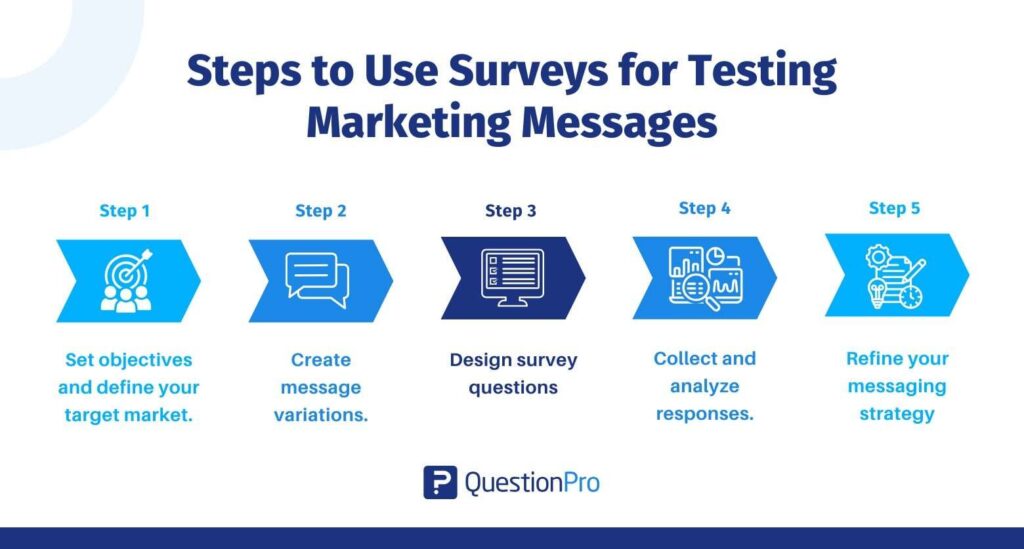
- Set objectives and define your audience.
Decide exactly what you’re testing, whether that’s a subject line, ad copy, or a full positioning statement, and pick the audience segment most likely to see the real campaign.
- Create message variations.
Draft two or more distinct versions with genuinely different value propositions, not just minor wording tweaks.
- Design the survey.
Combine a rating or ranking question with at least one open-ended follow-up to capture the reasoning behind the choice.
- Collect and analyze responses.
Distribute through email, SMS, or intercept surveys, then review both the quantitative scores and the qualitative comments together.
- Refine and roll out.
Apply what you learned, adjust any language that caused confusion, and consider a second round of testing on the refined version before full launch.
What metrics show whether a message is working?
The clearest signal is a top-choice preference score, but clarity and motivation metrics round out the picture.
Track the percentage of respondents selecting each message in a head-to-head test as your primary preference indicator. Pair that with a clarity benchmark, aiming for 70% or more of respondents rating the message as clear, since confusion at launch tends to suppress performance regardless of how persuasive the message otherwise is. For qualitative depth, review open-ended responses for recurring themes, objections, and phrases worth keeping in the final copy.
Once the campaign goes live, confirm the survey findings against real performance data such as click-through rate, conversion rate, and cost per qualified lead, since stated preference in a survey doesn’t always translate one-to-one into live campaign behavior.
What mistakes should you avoid in message testing?
The most common mistake is testing wording variations that are too similar to reveal a meaningful difference, then concluding the results are inconclusive.
Other frequent issues include skipping the open-ended “why” question and losing the reasoning behind a preference, testing with a sample that doesn’t match the real target audience, and rolling out a winning message without validating it again after launch against real campaign data. Nielsen Norman Group’s research on quantitative usability studies suggests aiming for roughly 40 participants per segment to reach a reasonable margin of error, a useful benchmark for message testing sample sizes as well.
How can you test marketing messages with QuestionPro?
QuestionPro’s survey software supports the full range of message-testing question types, including multiple-choice, ranking, Likert scales, and open-ended text, alongside built-in A/B testing for quick reactions to taglines or short copy. Conjoint analysis and MaxDiff scaling are available for teams comparing multiple message components, and text analytics can process open-ended responses to surface themes and objections without manual tagging.
Building message testing into your campaign workflow
Testing marketing messages with surveys works best as a standing step before every major campaign, not a one-off exercise reserved for big launches. The teams that get the most value treat each test as a chance to sharpen not just the message, but the questions they ask next time. That habit, more than any single tool, is what separates campaigns that resonate from campaigns that simply went out the door.
Frequently Asked Questions (FAQs)
Two to four variations usually work best. Testing more than five or six at once increases respondent fatigue and can dilute the clarity of results, especially in monadic or sequential monadic designs.
A focused test can be designed, fielded, and analyzed within three to five business days using an online panel, though timelines extend if you need a highly specific niche audience segment.
Not fully. Survey-based message testing predicts likely performance before launch, while live A/B testing confirms actual behavior with a real budget. The two work best as sequential steps, not substitutes for each other.
Yes, though B2B audiences are often smaller and harder to reach in volume. Sequential monadic or MaxDiff approaches tend to work well here since they extract more insight per respondent.
It depends on the method, but 100 to 200 responses per message variation is a reasonable starting benchmark for most business message tests, with larger samples needed for finer-grained segment analysis.