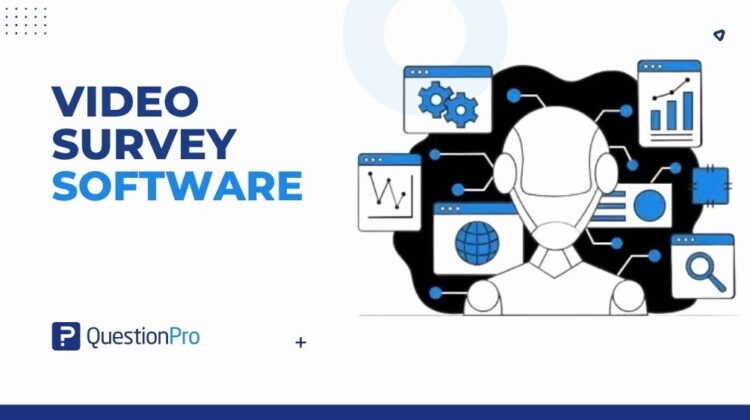
Video survey software lets respondents answer research questions on camera instead of typing, then uses AI to transcribe and analyze what they said. It solves a problem that has followed survey research for decades: ratings tell you what people think, but they rarely explain why.
A 1-to-5 scale can flag that satisfaction dropped. It cannot show you the hesitation in someone’s voice when they describe a confusing checkout flow, or the visible relief on a customer’s face after a support call went well. That gap between what a score shows and what actually happened is where video-based feedback adds value that text alone cannot.
This guide covers how AI video survey analysis works, where it earns its place in a research program, and what to weigh against text-based open-ended questions before adding it to a study.
What is video survey software?
Video survey software is a survey question type that lets respondents record a short video response instead of typing text or selecting a rating, with AI handling transcription and analysis afterward.
Traditional open-ended questions still rely on a respondent’s willingness to type a full explanation, which often produces short, heavily edited answers that miss emotional nuance. A video response captures tone, hesitation, and facial expression alongside the words themselves, giving researchers a fuller picture without booking a separate interview or focus group. It works especially well layered onto an existing metric like the NPS survey question, where the score explains what changed and the video explains why.
Why closed-ended and text-based feedback both fall short
Most research programs are built around a tradeoff between depth and speed, and neither end of that tradeoff fully solves the problem on its own.
Closed-ended questions, like rating scales and rankings, are fast to field and easy to analyze, but they leave researchers guessing about the human reasoning behind the number. Text-based open-ended questions ask for that reasoning directly, but respondents frequently give short, over-edited answers that strip out the emotional context a researcher actually needs.
Focus groups and one-on-one interviews solve both problems by capturing rich, unscripted reactions, but they are slow, expensive, and difficult to scale past a handful of participants per study. Video survey questions sit between these options: they capture the tone and immediacy of an interview while fitting inside a standard survey a much larger sample can complete on their own time.
How does AI video survey analysis work?
Video survey analysis works in five steps, moving from an added question type to a finished insight without leaving the survey platform.
- Add the question. Select a video response question type from the survey editor’s advanced question options.
- Set the parameters. Define the recording time limit and write the prompt respondents will answer.
- Respondent records their answer. Participants record directly inside the survey interface, with no separate app or download required.
- AI processes the response. The system automatically transcribes the audio and runs sentiment analysis on both the spoken content and its tone.
- Insights appear on the dashboard. Results sit alongside quantitative data from the rest of the survey, ready to filter and compare by segment.
Because transcription and sentiment scoring happen automatically, a researcher never has to sit through hours of raw footage to find a pattern worth reporting.
When should you use video survey questions instead of text?
Video responses earn their place when an instinctive, emotional reaction matters more than a carefully composed explanation. Three research situations consistently benefit most.
- Concept and ad testing.
Instead of asking whether someone liked a concept, ask them to describe their reaction to it on camera. A furrowed brow or a genuine laugh often reveals confusion or delight that a rating scale would never capture, and recruiting the right mix of panel respondents beforehand keeps the reactions representative rather than skewed toward whoever was easiest to reach.
- Brand perception and storytelling.
Brand affinity is inherently emotional, and a short video clip translates an abstract satisfaction score into a human story that lands better in an executive presentation than a bar chart does. Distributing the invitation broadly enough to reach a larger survey audience matters here too, since a handful of clips from the same small group rarely represents the full customer base.
- Investigating a sudden CX score drop.
Adding an occasional video question to an NPS or CSAT tracker gives researchers a way to understand a sudden score drop immediately, rather than waiting for a separate follow-up interview to be scheduled.
Video survey software vs. text-based open-ended questions
Choosing between the two formats comes down to what kind of answer the research question actually needs. The table below lays out where each one wins.
| Factor | Video survey questions | Text-based open-ended questions |
|---|---|---|
| Emotional signal | Captures tone, hesitation, and expression | Captures wording only |
| Respondent effort | Often faster to speak than to type a full answer | Requires typing, which shortens most answers |
| Analysis method | AI transcription plus sentiment analysis | Text mining or manual reading |
| Best use case | Concept reactions, brand storytelling, CX score-drop follow-ups | Quick clarifying detail |
| Scalability | Scales with AI processing, no manual review needed | Scales easily but loses emotional nuance |
Neither format replaces the other. Most well-rounded studies use text-based follow-ups for quick clarification and reserve video questions for the moments where emotional context actually changes the interpretation of the data.
Why unstructured feedback still gets ignored
The case for video and other unstructured feedback formats is not just theoretical. Forrester-commissioned research found that 84% of marketing and CX professionals see real value in unstructured feedback, yet only about 30% of the data organizations actually collect is unstructured. That gap is exactly what tools built specifically to process video, audio, and open-text feedback at scale are designed to close.
Common mistakes to avoid with video survey questions
- Recording durations set too long, which leads to rambling answers that are harder to analyze
- Writing vague prompts that do not tell the respondent what kind of reaction you actually want
- Adding a video question to every survey touchpoint instead of the few moments where emotional context genuinely matters
- Skipping a pilot test, which means discovering camera or microphone issues after the study has already launched
- Treating the transcript as the whole story and ignoring the tone and sentiment layer that comes with it
QuestionPro VideoAI: Video feedback built into your existing survey workflow
QuestionPro VideoAI adds video response questions directly inside the standard QuestionPro survey editor, so researchers do not need a separate tool or a new interface to learn. It is natively integrated with QuestionPro’s Customer Experience platform, which means video responses collected during an NPS or CSAT follow-up appear in the same dashboard as the rest of the study’s quantitative data, already transcribed and scored for sentiment. That unified view is the main advantage over point solutions that treat video as a disconnected add-on requiring a separate export and analysis step.
Video adds the why that a score alone cannot
A rating scale will keep telling you when something changed. It will not tell you why, and that missing context is usually the difference between a report that gets read once and one that actually changes a decision.
Video responses, used selectively at the moments that matter most, close that gap without slowing down the rest of the research program.
Frequently Asked Questions (FAQs)
Pricing varies by provider and is usually based on video response volume or the platform tier it ships with. Most vendors sell it as an add-on to an existing survey or CX platform rather than standalone, so total cost depends on your current plan.
Completion rates are generally comparable to text-based open-ended questions when recording time is short and the prompt is specific. Respondents comfortable on camera often answer faster than they would type, since speaking takes less effort than composing a written response.
Video carries the same consent and data-handling requirements as any identifiable survey data, plus the added factor that a face and voice are inherently identifying. Reputable platforms let researchers set clear consent language and control who can view raw files.
Modern transcription engines handle most accents and moderate background noise well, though accuracy drops with heavy overlapping speech or poor microphone quality. Piloting the question with a small group before full launch catches most audio issues early.
Video questions are typically used on a subset of a larger quantitative study rather than the full sample, since the goal is qualitative depth rather than statistical representativeness. Twenty to fifty video responses are usually enough to surface clear, recurring themes.