



Customer advocacy is the process of turning satisfied customers into active supporters. They recommend your brand, share feedback, join case studies, leave reviews, or refer new buyers. It goes beyond customer loyalty because advocates do not just stay with your business. They help others trust it.
For US companies, customer advocacy matters because buyers often compare reviews, peer recommendations, online communities, and social proof before speaking with sales. A strong advocacy strategy gives happy customers simple ways to share their experience while helping the business improve based on real feedback.
What is customer advocacy?
A customer advocate may recommend your product to a colleague, write a review, speak at an event, or share a customer story.
Advocacy cannot be forced through a discount or a one-time campaign. A few things have to be true first:
- The customer feels heard, not just processed
- Support and product experience have already earned trust
The relationship feels ongoing, not transactional
A simple definition of customer advocacy is:
It’s when a company creates strong customer experiences that motivate customers to recommend the brand, either publicly or privately.
This can happen in B2B, B2C, retail, SaaS, beauty, healthcare, financial services, and professional services. The channels change, but the pattern stays the same. Customers trust other customers more than brand claims, a form of social proof advertising alone can’t replace.
What is the difference between customer advocacy and customer loyalty?
A loyal customer may renew every year and never talk about your brand. An advocate goes further, extending customer loyalty into something actively shared with others. That might mean introducing your product to a peer, joining a customer advisory board, or explaining why your service worked for them.
| Topic | Customer loyalty | Customer advocacy |
|---|---|---|
| Main behavior | Repeat purchase or renewal | Recommendation or public support |
| Business value | Retention | Retention and acquisition |
| Common signal | Repeat orders, renewals, high satisfaction | Referrals, reviews, social proof, testimonials, case studies |
| Best metric | Retention rate, repeat purchase rate | NPS, referral rate, review volume, advocacy actions |
Why is customer advocacy important?
When a real customer explains why they chose a product, that message often feels more credible than a sales claim.
Advocacy helps companies learn what customers value most. A customer who is willing to recommend your brand can show you which experiences are working. A customer who is not ready to advocate can show you where the journey still needs work.
The benefits include:
- More trust: Buyers get proof from people who have used the product.
- Higher retention: Customers who feel valued are more likely to stay.
- Better referrals: Advocates can introduce your brand to relevant buyers.
- Stronger feedback loops: Advocates often give practical ideas for improvement.
- More useful content: Reviews, testimonials, case studies, and community posts create advocacy content that sales and marketing teams can use.
For US brands, there is also a compliance angle. The Federal Trade Commission expects endorsements and testimonials to reflect honest customer opinions. Material connections need disclosure when relevant, so reviews and testimonials need to be handled honestly.
How does a customer advocacy program work?
A customer advocacy program gives happy customers clear, simple ways to support the brand. The program can include referrals, testimonials, reviews, case studies, advisory boards, online communities, user groups, speaking opportunities, and product feedback sessions.
A practical customer advocacy program usually works like this:
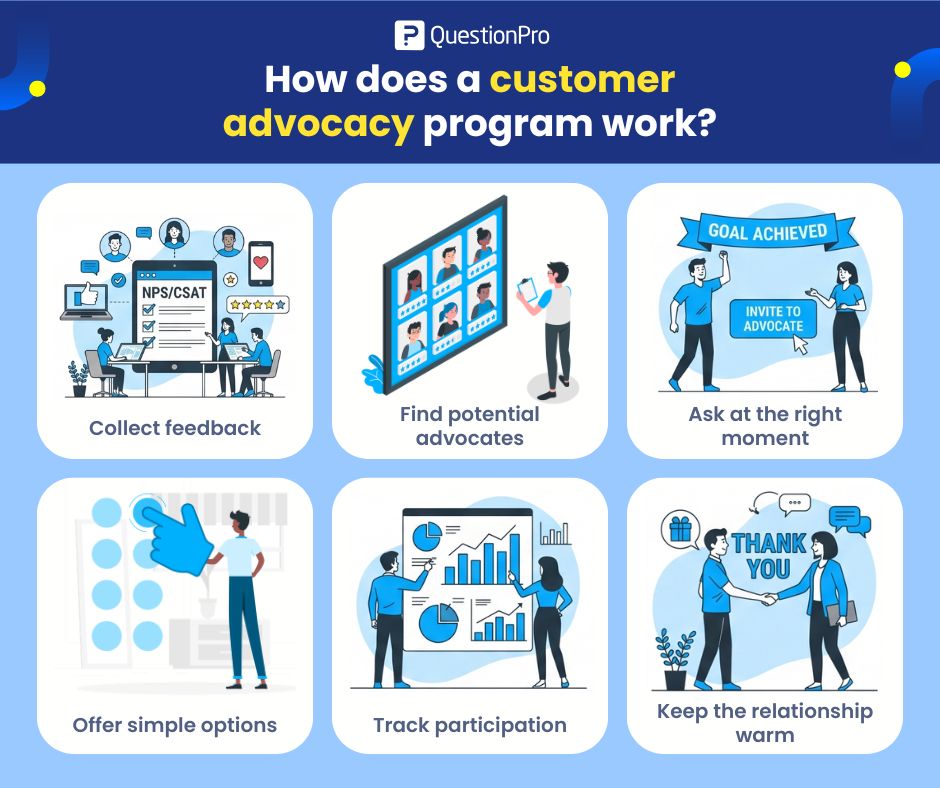
- Collect feedback: Use customer surveys, NPS, CSAT, interviews, or support data to understand customer sentiment.
- Find potential advocates: Look for customers who are highly satisfied, have strong outcomes, make repeat purchases, or leave positive comments.
- Ask at the right moment: Invite advocacy after a successful milestone, not during a support issue.
- Offer simple options: Let customers choose between a review, quote, referral, case study, webinar, or community activity.
- Track participation: Measure referrals, content use, reviews, engagement, and customer retention.
- Keep the relationship warm: Thank advocates, share outcomes, and avoid asking too often.
The mistake many companies make is treating advocacy like a one-time marketing request. It works better as an ongoing relationship.
What are customer advocacy examples?
Customer advocacy examples are actions in which customers promote, support, or validate a brand based on their own experiences. These examples can be small, such as a review, or large, such as a full case study.
Common examples of customer advocacy include:
- A SaaS customer gives a quote for a landing page.
- A retail customer posts a product review after a good experience.
- A B2B buyer refers a peer to the sales team.
- Customers sometimes join a webinar to explain how they solved a problem.
- Community members answer questions from other users in a brand forum.
- Some clients agree to participate in a case study.
- Product feedback from a promoter can directly shape a future roadmap.
- A customer joins an advisory board to shape future features.
In B2B customer advocacy, the strongest examples often come from measurable outcomes, like a customer explaining how they reduced churn or improved customer experience tracking. In B2C, advocacy often shows up through reviews, social posts, referrals, unboxing content, loyalty communities, or user-generated content.
How do you build a customer advocacy strategy?
A customer advocacy strategy is a plan for identifying satisfied customers and understanding what they value. The goal is to invite them to share their experience in ways that feel natural, not forced.
1. Start with customer experience
Advocacy starts with the customer experience, not the campaign. Before asking for reviews or referrals, check whether customers are actually getting value.
- Look closely at a few specific areas:
- Support quality and response time
- Onboarding and time to first value
- Product usability
- Communication and delivery speed
- Issue resolution
If these basics are weak, advocacy requests will feel forced.
2. Use feedback to find advocates
Customer feedback helps you identify who is ready to advocate. NPS is useful because it shows which customers are likely to recommend your business. A score of 9 or 10 often signals a potential promoter, but the open-ended response matters too.
You can also use CSAT scores, Customer Effort Score, review ratings, and support comments. Renewal history, product usage, and community participation round out the picture.
Beyond the numbers, the strongest advocates tend to share a few qualitative traits. Fierce, repeat-purchase loyalty is one. An emotional connection built on shared values is another. Proactive engagement across channels and a willingness to defend the brand when someone raises a doubt round out the pattern. A high score paired with one of these traits is a stronger signal than the score alone.
QuestionPro can support this process through surveys, CX feedback, and journey-based listening. For example, you can use QuestionPro Customer Experience to measure experiences across touchpoints and identify promoters before building advocacy requests.
3. Match the ask to the customer
Not every customer wants to do the same type of advocacy. Some are comfortable speaking publicly. Others prefer a private referral or short quote.
Offer a range of options:
- A written testimonial
- An online review
- A case study interview
- A customer panel or advisory seat
- A webinar appearance
- A product feedback call
This makes the request feel respectful instead of transactional.
4. Make participation easy
A customer advocacy strategy fails when the process takes too much effort. Give customers a clear prompt, sample structure, deadline, and approval process.
A specific question works better than a vague one:
- Instead of “Can you write a testimonial?” try: “What changed for your team after using the platform, and what would you tell another company considering it?”
- Instead of “Would you refer us?” try: “Do you know anyone facing the same challenge you had six months ago?”
That kind of specificity helps customers answer faster and gives you better content.
5. Close the loop with advocates
After a customer helps, tell them what happened. Share the published case study, thank them for a referral, or explain how their feedback shaped a product update.
Advocacy should feel like a relationship, not a favor taken and forgotten.
What are the different types of customer advocacy programs?
Customer advocacy programs come in several formats, each suited to a different goal and comfort level.
| Program type | What it means | Best for |
|---|---|---|
| Referral programs | Customers recommend your company to peers or colleagues | Lead generation and trust-building |
| Review programs | Customers leave public reviews on relevant platforms | Social proof and reputation |
| Testimonial programs | Customers share short quotes about their experience | Landing pages, sales decks, campaigns |
| Case study programs | Customers explain their challenge, solution, and results | B2B proof of value |
| Customer communities | Customers connect, share ideas, and support each other | Engagement and retention |
| Customer advisory boards | Selected customers provide strategic input | Product direction, executive relationships |
| Product feedback programs | Customers help test, evaluate, or improve products | Product development and loyalty |
| Event or webinar advocacy | Customers speak publicly about their experience | Thought leadership and credibility |
A mature advocacy program usually combines several of these rather than picking just one. A SaaS company might use NPS to identify promoters, invite some to leave reviews, ask high-impact accounts for case studies, and bring the most engaged users onto a customer advisory board.
What customer advocacy metrics should you track?
Customer advocacy metrics measure how many customers are willing to support the brand and how much business impact those actions create. The right metrics depend on your program goals.
Useful customer advocacy metrics include:
- Net Promoter Score: Measures how likely customers are to recommend your brand.
- Referral volume: Tracks how many referrals customers submit.
- Referral conversion rate: Shows how many referred leads become customers.
- Review volume and rating: Measures public advocacy across review platforms.
- Testimonial and case study participation: Tracks how many customers agree to share their story.
- Customer retention rate: Shows whether advocates stay longer than other customers.
- Community engagement: Tracks posts, comments, answers, and peer support.
- Content influence: Measures whether advocacy content supports sales conversations.
- Customer satisfaction: Shows whether advocacy is built on real positive experiences.
A program with many review requests but low satisfaction can damage trust. The best measurement connects advocacy actions with customer health, retention, and experience quality.
How do you choose the best customer advocacy platform?
The best customer advocacy platform depends on your business model, customer volume, sales process, and advocacy goals. A B2B software company may need references and case studies. A retail brand may need reviews, referrals, and social sharing.
Before choosing customer advocacy software, ask:
- Do we need B2B reference management?
- Do we need referral tracking?
- Will review generation matter for our brand?
- Does gamification fit our audience?
- Is CRM integration a requirement?
- Do we need customer community features?
- Would AI-assisted segmentation or reporting help?
- Can the platform show advocacy impact on pipeline, retention, or revenue?
AI customer advocacy software can help identify likely advocates, summarize feedback, and suggest segments. Still, the human relationship matters. Advocacy works best when customers feel respected, not automated.
What are customer advocacy best practices?
Customer advocacy works best when it is honest, useful, and easy for the customer. The strongest programs protect trust while making customer participation simple.
Use these customer advocacy best practices:
- Ask only after the customer has had a real positive experience.
- Personalize the request based on the customer’s relationship with your brand.
- Make the action small and clear.
- Offer choices instead of one fixed request.
- Be transparent about incentives.
- Do not pressure customers to leave only positive reviews.
- Keep approvals simple for quotes and case studies.
- Track consent before using customer names, logos, or stories.
Recognize and thank advocates.
A thank-you needs to be concrete, not just a message. Consider early access to new features before launch, a branded item that reflects the relationship rather than generic swag, or an invitation to a small event with the team. Credit by name works well too, especially when an advocate’s suggestion actually shapes a product decision. Some programs also give advocates a shareable badge for their own blog or social profiles. That turns recognition into something the advocate can display, not just receive privately.
The most important rule is simple: never create fake advocacy. Trust is the whole point.
What common mistakes should you avoid in customer advocacy?
Most advocacy programs fail for a handful of avoidable reasons, not because advocacy itself doesn’t work.
- Asking too soon: Requesting advocacy before a customer has a strong, proven experience makes the ask feel premature and transactional.
- Reading the score without the comment: An NPS number alone doesn’t explain why a customer feels that way. Open-ended feedback is where the real signal lives.
- Sending the same generic request to everyone: A form-letter ask gets a form-letter response rate. Personalization matters more than volume.
- Publishing without clear permission: Using a name, logo, or quote without explicit consent damages trust fast, even when the feedback was genuinely positive.
- Treating advocacy as a one-time campaign: A single push for testimonials before a launch isn’t a program, it’s an event, and it stops producing results the moment it ends.
The strongest programs stay small in scope but consistent in cadence, checking in regularly rather than running one large campaign and moving on.
How can QuestionPro support customer advocacy?
QuestionPro helps companies increase customer advocacy by turning customer feedback into clear action. Before asking customers for referrals, reviews, testimonials, or case studies, you first need to know who is satisfied and what they value.
With QuestionPro, you can collect and analyze feedback across key touchpoints. This helps companies find customers who are more likely to become advocates and understand what drives customer loyalty.
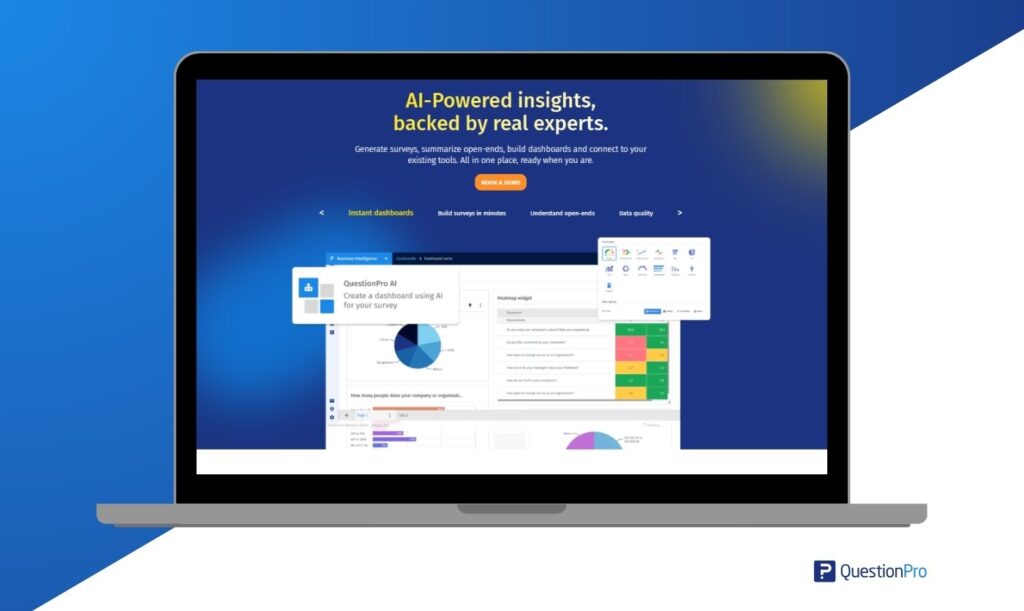
QuestionPro can support customer advocacy by helping you:
- Identify promoters with NPS surveys: Find customers who are most likely to recommend your brand.
- Track satisfaction with CSAT and CES: Understand whether customers are happy with specific experiences and how easy it is to work with your company.
- Collect open-ended feedback: Learn why customers feel satisfied, frustrated, loyal, or ready to recommend.
- Analyze feedback trends: Spot recurring themes across locations, teams, products, or customer segments.
- Close the loop with detractors: Respond to unhappy customers before small issues turn into churn.
- Find advocacy-ready customers: Use feedback signals to identify people who may be open to reviews, referrals, testimonials, or case studies.
- Measure touchpoint performance: See which parts of the customer journey create trust and which need improvement.
For example, if a customer gives a high NPS score and explains that support helped them quickly resolve an urgent issue, that customer may be a strong fit for a testimonial or review request. If another customer gives a low effort score, fix the experience first before asking for any advocacy action.
Final thoughts
Customer advocacy is not a campaign you switch on when the sales team needs proof. It is the result of consistent customer experience, honest feedback collection, and strong relationships.
The best customer advocates are not created by incentives alone. They become advocates because the product works, the service feels reliable, and the company listens when something goes wrong. A customer advocacy program gives that trust a structure. It helps you find the right customers and ask at the right time. That turns real experiences into referrals, reviews, stories, and long-term loyalty.
Frequently Asked Questions (FAQs)
Customers become advocates when they consistently feel valued, supported, and successful. A strong product experience, helpful service, and quick issue resolution all make customers more willing to recommend a brand to others.
Yes. A loyal customer may keep buying or renewing without publicly supporting the brand. An advocate goes further by sharing recommendations, referrals, reviews, or customer stories that help others trust the company.
For US businesses, customer advocacy builds trust in a market where buyers compare reviews and peer recommendations before speaking with sales. Real customer voices can make brand claims feel more credible.
Companies can identify potential advocates by tracking NPS, CSAT, and customer effort scores. Review ratings, renewal history, product usage, support comments, and community participation all add signal too. Open-ended feedback helps explain why customers may advocate.
Common formats include referral programs, review and testimonial programs, case studies, customer communities, advisory boards, product feedback programs, and event or webinar advocacy. Most mature programs combine several formats rather than relying on just one.
QuestionPro can help you collect NPS, CSAT, CES, and open-ended feedback across customer touchpoints. These insights help identify promoters, understand satisfaction drivers, close the loop with detractors, and find customers ready for testimonials, referrals, or reviews.