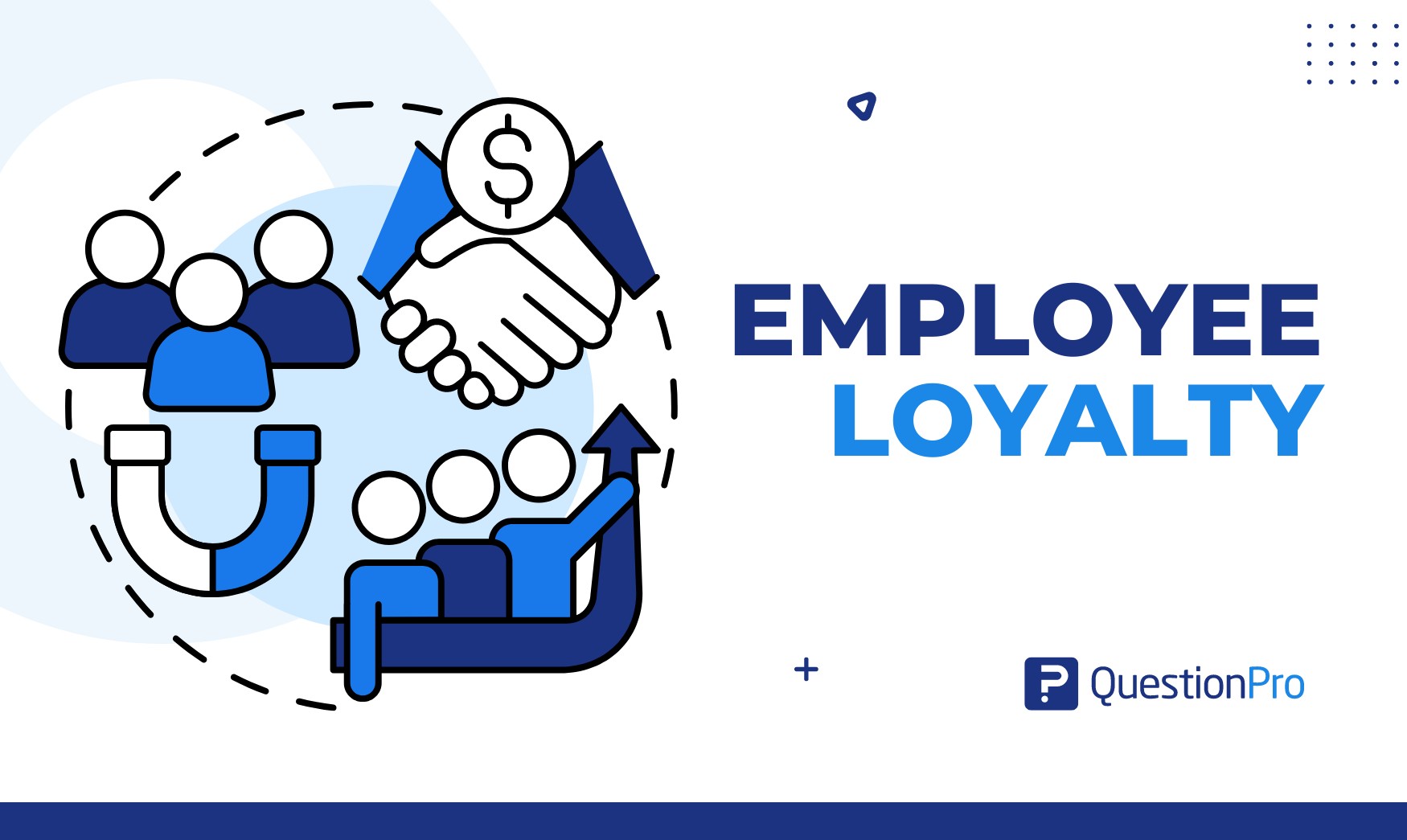
Employee loyalty is what keeps a skilled employee turning down a recruiter’s call instead of taking it. It shows up when a team stays invested even after a project gets hard or a competitor comes calling. That kind of commitment builds slowly, through fair pay and feeling heard. It rarely comes from a single perk or a mission statement on the wall.
Median tenure with a single U.S. employer has fallen to 3.9 years, the lowest level since 2002, according to the Bureau of Labor Statistics. Treating loyalty as automatic no longer works.
In this article, we’ll learn what employee loyalty actually is and how it differs from engagement and satisfaction. It also covers how to measure loyalty with real numbers and the strategies that build it without relying on pay alone.
What is employee loyalty?
Employee loyalty is an employee’s willingness to stay with an organization, defend it to outsiders, and put in real effort. That holds true even when better-paying or higher-profile options exist elsewhere. It reflects trust built up over time, not a single good review cycle.
Loyal employees tend to share a few traits:
- They believe the company’s mission is worth their effort
- They trust leadership to act on feedback
- They see a future for themselves inside the organization, not just in their next job search
That belief usually comes from lived experience. It comes from recognition that actually happened, a promotion delivered as promised, and a manager who followed through.
Employee loyalty vs. Employee engagement vs. Employee satisfaction
These three terms get used interchangeably, but they measure different things and call for different fixes.
| Term | What it measures | Time horizon | Example signal |
|---|---|---|---|
| Employee satisfaction | Contentment with current conditions | Short-term, point-in-time | Happy with current pay and workload |
| Employee engagement | Discretionary effort brought to the role | Medium-term | Volunteers for stretch projects, contributes ideas |
| Employee loyalty | Commitment to stay and actively support the company | Long-term | Turns down competing offers, defends the company publicly |
An employee can be satisfied without being loyal, for example in a comfortable job with no future. An employee can also be engaged without being loyal: energized now, but already interviewing elsewhere for the next step up. Loyalty is the one that predicts whether someone stays. Strategies that build employee engagement help, but they work best paired with the loyalty-specific practices below.
Why employee loyalty matters for the business
Employee loyalty matters because it directly lowers turnover costs and protects the institutional knowledge that keeps teams productive. Replacing a single employee costs between 50% and 200% of that person’s annual salary. That range covers recruiting, onboarding, and lost productivity, according to SHRM research on the cost of replacing key employees.
Culture is the strongest lever behind that number. Workers who rate their organization’s culture as good or excellent report much higher satisfaction at work. They’re also far less likely to be job hunting than workers who call their culture poor, according to SHRM’s global workplace culture research. Beyond retention, loyal employees tend to:
- Cover for teammates and absorb short-term disruption without disengaging
- Give managers honest feedback instead of quiet complaints on the way out
- Represent the company positively to candidates, customers, and their own networks
- Stay through downturns or restructuring instead of job hunting at the first sign of instability
Global employee engagement sits at just 20%, its lowest point since 2020. Gallup estimates the resulting drag on productivity at roughly $10 trillion worldwide. Loyalty is the layer that keeps a disengaged market from becoming a mass exodus for any one employer.
How to measure employee loyalty
Employee loyalty is measurable with three concrete numbers: employer Net Promoter Score, retention rate, and average tenure. Treating it as a vague feeling makes it impossible to improve.
- Employer Net Promoter Score (eNPS): Ask employees, “How likely are you to recommend this company as a place to work, on a scale of 0 to 10?” Group responses into promoters (9 to 10), passives (7 to 8), and detractors (0 to 6). Subtract the detractor percentage from the promoter percentage. Average organizations score around 14. Strong performers reach 20 or higher; compare your own result against current eNPS benchmarks by industry.
- Retention rate: Divide the number of employees who stayed the full period by the number employed at the start of that period. Multiply the result by 100. A 92% annual retention rate, for example, means 8 out of every 100 employees left in a year.
- Average tenure: Track how long employees stay relative to your industry’s median. The current U.S. median across all industries is 3.9 years. It ranges from 2.1 years in leisure and hospitality to 6.2 years in the public sector, so benchmark against your own sector rather than the national figure alone.
Run these three side by side quarterly. A rising eNPS paired with falling retention usually signals a specific problem: people like the company in theory but are leaving for a fixable reason, such as pay or a stalled promotion.
What drives employee loyalty?
Employee loyalty is shaped by seven recurring factors that show up across engagement research and exit interviews alike.
- Job satisfaction: Meaningful work, fair pay, and manageable workload
- Recognition: Consistent, specific acknowledgment of effort and results
- Career development: Visible paths for growth, not just verbal promises
- Work-life balance: Flexibility that respects life outside the job
- Leadership trust: Managers who communicate honestly and follow through
- Company culture: An inclusive environment aligned with employees’ own values
- Job security: Confidence that a role and the company itself are stable
No single factor carries loyalty on its own. A high salary paired with a distrusted manager rarely produces loyal employees. A beloved manager can’t fully offset chronic understaffing or pay that falls behind the market, either.
How to build employee loyalty: 7 Strategies
Building employee loyalty means acting on the drivers above with specific, repeatable practices rather than one-off gestures.
1. Keep pay and benefits honest with the market
Review compensation against current market data at least annually, not only when someone threatens to leave. A retention counteroffer after a resignation letter reads as damage control, not investment.
- Quick check: if a raise only happens after a resignation is submitted, the process is reactive, not a loyalty strategy.
2. Make recognition specific and consistent
Generic praise fades fast. Recognition that names the exact contribution and its impact lands harder and is easier to remember months later.
- Example: a monthly team shoutout tied to a named outcome (“shipped the client dashboard two weeks early”) works better than a rotating award with no context behind it.
3. Show, don’t just tell, the career path
Employees stay longer when they can picture their next two roles inside the company, not just their next raise.
- Example: pair each employee with a documented 12-month development plan reviewed at least twice a year, tied to real skills and openings, not a generic template.
4. Protect flexibility and real time off
Flexible hours or remote options only build loyalty if people can actually use vacation time without guilt or backlash.
- Example: normalize managers visibly taking their own vacation and not messaging the team while out, which signals real permission better than any written policy.
5. Train managers to communicate and follow through
Employees rarely quit companies; they quit managers who don’t listen or don’t act on what they hear. Manager training on feedback and follow-through pays off directly in loyalty.
- Example: require every manager to close the loop on team feedback within two weeks, even if the answer is “not this quarter, here’s why.”
6. Build a culture people actually want to stay in
Inclusion and belonging predict loyalty better than perks. Employees who feel they can be themselves at work are far less likely to be quietly job hunting.
- Example: rotate who leads team rituals such as standups, retros, and socials, so culture doesn’t depend on one personality or department. A documented employee experience framework helps keep this consistent as teams grow.
7. Be transparent about performance and job security
Uncertainty erodes loyalty faster than bad news delivered honestly. Regular, plain-language updates on company performance beat silence followed by a surprise layoff announcement.
- Example: a short monthly note from leadership covering wins, misses, and what’s ahead, even in a tough quarter, keeps trust intact.
Which loyalty strategy should you prioritize first?
The right starting point depends on company size and what’s actually driving turnover, not a generic best-practices checklist.
| Situation | Start here | Why |
|---|---|---|
| Early-stage company, high growth, limited budget | Career paths and manager communication | Cheapest to implement and most valued when pay can’t yet compete |
| Mid-size company with rising turnover | Compensation review plus recognition | Closes the gap fastest between underpaid-and-unheard and fairly treated |
| Established enterprise with flat engagement | Culture and transparency | Larger organizations lose loyalty to bureaucracy and silence more than to pay |
| Remote or hybrid workforce | Flexibility plus deliberate recognition | Distance removes the informal recognition that happens naturally in an office |
Pick one starting point, then measure eNPS and retention before and after. Expand from there rather than launching all seven strategies at once. If turnover itself is the more urgent problem, a closer look at employee retention strategies can help sequence the work.
Common mistakes that undermine employee loyalty
Loyalty efforts often fail for predictable, avoidable reasons.
- Treating recognition as a one-time event: An annual awards ceremony does not offset months of silence in between.
- Copying a competitor’s perks without checking fit: Unlimited PTO means little if the culture never lets anyone use it.
- Ignoring exit interview data: Patterns in why people leave are wasted if no one reviews them at the team or department level.
- Assuming loyalty is permanent once earned: A leadership change, a missed promise, or a bad restructuring can undo years of trust quickly.
- Measuring engagement but not loyalty: Engagement surveys alone miss the “would I stay if a recruiter called today” question that eNPS is built to catch.
How QuestionPro Employee Experience supports employee loyalty programs
QuestionPro Employee Experience closes the loop between measuring loyalty and acting on it. That’s the step most loyalty programs skip. Instead of running a single annual survey and filing results away, the platform pairs short pulse surveys and 360 feedback with eNPS tracking. It then routes flagged responses to the right manager for follow-up.
- Assigns low-scoring or detractor responses directly to a manager or HR owner with a required action and deadline
- Tracks whether a promised fix, such as a schedule change, a recognition gap, or a pay concern, actually happened before the next survey cycle
- Benchmarks a company’s eNPS against industry data so a score of 14 or 25 has real context, not just a number in isolation
The value isn’t the survey itself. It’s confirming that feedback led to a visible change. That follow-through is what turns a measured score into actual loyalty.
Employee loyalty is built, not assumed
Employee loyalty is not a personality trait some employees happen to have. It is the compounding result of fair pay, real recognition, and honest managers. It also comes from a company that keeps its word when that’s inconvenient.
- Measure it with eNPS, retention rate, and tenure, not gut feel
- Start with one strategy that matches your company’s actual gap, not every strategy at once
- Recheck the numbers after each change to confirm it worked
Organizations that treat loyalty as an ongoing practice, not a one-time initiative, come out ahead. They’re the ones still retaining their best people when the next recruiter call comes in.
Frequently Asked Questions (FAQs)
Using employer Net Promoter Score, average U.S. organizations score around 14, with strong performers reaching 20 or higher. A score above 0 means more promoters than detractors. Treat anything below your industry benchmark as a reason to review open-text feedback, not a final verdict.
Somewhat. Newer workers tend to weigh growth and flexibility more heavily, while longer-tenured employees often value stability and recognition more. The underlying drivers, fair pay, respect, and a clear path forward, stay consistent; only the emphasis shifts by career stage.
No. Pay removes a source of dissatisfaction but rarely creates loyalty by itself. Employees who feel well paid but unheard or stuck in place still leave. Loyalty needs compensation paired with recognition, growth opportunities, and trust in leadership.
Loyalty typically builds over the first 6 to 12 months, shaped heavily by onboarding quality and early wins. Judging a new hire’s commitment before they’ve had a fair chance to experience the culture usually produces an inaccurate read.
No. Retention is the outcome, whether someone stays. Loyalty is the underlying commitment that makes staying likely even when other options appear. You can retain someone through inertia without ever earning genuine loyalty.