Most brands that try to build an online community make the same mistake. They talk about their products instead of the problems their customers care about. Learning how to build an online community that people actually show up for starts with a different focus: build around what your audience cares about, not what you sell.
The upside is real. Among consumers who regularly take part in online communities, 95% say they have found genuinely helpful information there, and more than half post actively rather than just browse, according to a 2026 Clutch report. A well-built community is not just a marketing channel. It is a retention and loyalty engine.
In this blog, we’ll explore seven steps for building a community that earns real engagement, plus how to know whether it is working.
What is an engaged online community?
An engaged online community is a group of people who gather around a shared interest, topic, or identity and actively take part through posts, replies, and support for other members. The key word is “actively.” A community of 10,000 people who never post anything is not an engaged community. It is an email list with a different name.
Three things separate an engaged community from a dormant one.
- Relevance: The topic connects to something members genuinely care about
- Consistency: Discussions happen on a regular rhythm, not only when someone has something to sell
- Reciprocity: The brand listens, responds, and visibly acts on what members share
Engagement does not happen because a platform exists. It happens because members find the community valuable enough to return to on their own.
Why does online community engagement matter for your business?
Online community engagement matters because it builds trust and spending habits that social media rarely produces. Customers who belong to a brand community spend 19% more than those who do not, and companies with strong customer engagement strategies retain 89% of their customers, according to research compiled by Gitnux. Separately, 77% of US consumers say they are more likely to buy from a brand where they feel a sense of community.
For US businesses, a community offers something social platforms cannot: an owned audience. Social networks control reach, change algorithms, and can limit visibility at any time. A community on a platform your brand manages gives direct, ongoing access to your most engaged customers.
Community also lowers support costs and speeds up product feedback. Members answer each other’s questions, surface bugs early, and generate word of mouth that paid advertising rarely matches at the same cost.
For a closer look at how community connects to long-term retention, see this guide to online research communities.
7 Steps to build an online community people actually engage with
These steps work whether you are starting from scratch or reviving a community that has gone quiet. They are not a one-time checklist. Each is an ongoing practice, and the order matters, since getting the niche and platform right early saves real time later.
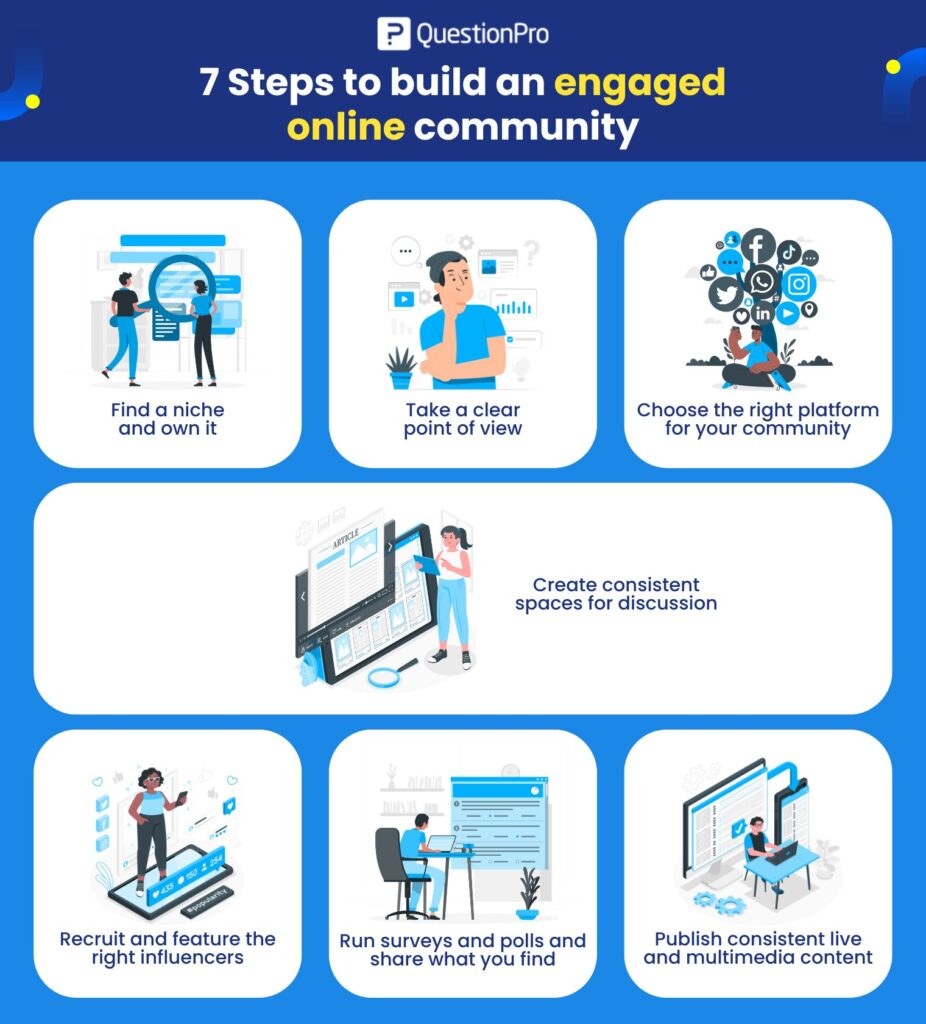
1. Pick a niche specific enough to matter
The most common reason online communities fail is that they try to cover too much ground. A community for “business owners” is too broad. A community for “independent restaurant owners managing labor costs” has a reason to exist.
To find your niche:
- Identify the most specific problem your product or service solves
- Define who experiences that problem most urgently
- Find the overlap between that problem and what your brand can credibly lead discussions about
A narrow niche is not a limitation. It is what makes members feel like they belong. The more specific the topic, the stronger the shared identity.
2. Take a clear point of view
A community without a point of view has nothing to argue about, agree on, or rally around. What do you genuinely believe about your industry that most people do not say out loud?
Your point of view does not need to be controversial. It needs to be specific. “Small businesses grow faster through community than through advertising” is a position. “We believe in great customer service” is not.
A clear point of view attracts people who agree and want to talk about it, and it gives your content and community norms a consistent direction. That is also how you stand apart from generic industry forums.
3. Choose the right platform for your community
The platform shapes the kind of community you can build. There is no single right answer, only the right answer for your audience and use case.
| Platform | Best for | Trade-off |
|---|---|---|
| Discord | Real-time chat with younger or tech-leaning audiences | Free, but can feel chaotic without structure |
| Slack | Professional and B2B peer groups | Familiar to US professionals, weaker discovery |
| Circle | Paid communities, coaching, courses | More structure, but a recurring platform cost |
| LinkedIn Groups | B2B audiences already active on LinkedIn | Lower engagement than a dedicated platform |
| Reddit or forums | Organic reach and listening | Limited brand control over the space |
Pick the platform where your specific audience already spends time. Moving people to a brand-new platform is hard. Meeting them where they already are is much easier. For a wider comparison, this roundup of the best online community platforms breaks down more options by use case.
4. Build structure for discussion, not just a feed
Having a platform is not enough. Members need specific spaces and prompts that give them a reason to post and return.
Practical ways to create structure:
- Set up channels or categories by topic, not one single feed
- Post a discussion prompt at least three times a week
- Share relevant industry news and ask members what they think
- Feature member wins, projects, or insights to reward participation
- Use a recurring weekly format, like “What are you working on this week?”
Structured formats, such as topic-specific threads or weekly prompts, consistently produce more engagement than an open feed with no direction. You do not need to create all the content yourself. The fastest way to build an engaged online community is to build enough structure that members start generating it for you.
5. Recruit early practitioner voices, not celebrities
Your earliest members set the tone for everything that follows. In most US industries, the most credible voices are not celebrities or enterprise brands. They are practitioners who have solved the same problems your community is built around, and who already have an audience of peers that trusts them.
To find the right voices:
- Use audience research tools like SparkToro to see who your target audience already follows and reads
- Search LinkedIn and industry newsletters for people who publish regularly on your niche topic
- Look for people who respond to comments and engage with their own audience, not only broadcast
Feature their content before asking for anything. Share their posts, reference their work, and invite them to answer a community question. Practitioners are far more likely to participate once they see you have already added value to their audience, and the most active among them often become organic advocates over time.
6. Use polls and surveys to fuel the conversation
One of the fastest ways to build online community engagement is to ask members what they think and then show them you listened. Surveys and polls give quieter members a low-effort way to participate, and the results create content worth discussing.
A simple poll about the biggest challenge members face this quarter gives you both data and a discussion starter. Turning those results into a short summary or infographic gives you shareable content that can pull in new members. Tools like QuestionPro’s live polls and quizzes make it easy to run these polls directly inside a discussion and show live results.
For research and customer insight communities, this cycle of gathering input and sharing findings is the core engagement loop. It is the difference between a community that feels like a conversation and one that feels like a brand talking at people.
7. Publish consistent live and multimedia content
Live and recurring media formats keep a community from going quiet between discussions. They create anchor moments members plan around.
Formats worth testing:
- Live video: YouTube Live, LinkedIn Live, or Instagram Live for real-time interaction with a searchable archive
- Podcasts: Audio builds familiarity over time, and featuring members as guests strengthens the community bond
- Recorded video series: Short, regular videos on your niche topic give members something to watch and respond to
- Live Q&A sessions: Scheduled sessions where community leaders answer member questions directly
Consistency matters more than format. One format you can sustain weekly is worth more than three you abandon after a month.
Common online community mistakes to avoid
Most struggling communities fail for a handful of predictable reasons, not bad luck. Watching for these early can save months of wasted effort.
- Treating the community as another ad channel.
Posting promotions instead of prompts trains members to stop paying attention.
- Picking a platform for its popularity, not its fit.
A trendy platform your audience never visits will not generate activity.
- Going quiet after launch week.
Without someone owning ongoing prompts and moderation, early energy fades fast.
- Tracking member count instead of activity.
A large, silent group is not a healthy community.
- Covering too broad a topic.
A vague niche gives members nothing specific to rally around.
Real-world examples of online communities that work
Seeing how established brands apply these principles makes the steps above easier to picture.
LEGO Ideas lets fans submit and vote on new set concepts, and winning designs become real products with the creator credited. The community works because members are shaping something they will actually be able to buy, not just chatting about the brand.
Sephora’s Beauty Insider Community brings skincare and makeup fans together to ask questions, share routines, and give each other advice. It positions Sephora as a trusted advisor rather than only a retailer, which keeps members returning outside of a purchase cycle.
Peloton blends live classes, leaderboards, and in-person events to turn individual workouts into a shared, social experience. The community layer is what keeps members motivated long after the initial equipment purchase.
How do you measure online community engagement?
Tracking the right metrics keeps community building from becoming a vanity exercise. Follower counts and total members matter far less than whether people are actually participating.
| Metric | What it tells you |
|---|---|
| Active member rate | Share of total members who post, comment, or react in a given period |
| Contribution rate | How many members create posts versus only consume them |
| Response rate | How fast discussions get replies and how many each post receives |
| Retention rate | Whether members who joined months ago are still active today |
| Community NPS | Whether members would recommend the community to a peer |
Net Promoter Score, or NPS, is a single-question metric that measures how likely someone is to recommend something to others. It works for communities the same way it works for products and services: ask members directly, then track the trend over time rather than a single snapshot.
How QuestionPro Communities supports online community building
For teams building insight-driven or research communities, QuestionPro Communities provides a single branded space for running surveys, polls, discussions, and live activities. Members can be segmented and engaged through ongoing research cycles instead of one-off surveys.
The platform is particularly useful for US brands that want a private customer community where members contribute feedback on products or experiences over time. Results feed into dashboards that show engagement trends and response patterns, which makes it easier to show leadership the community’s value.
Teams that also need broader research capabilities can pair Communities with QuestionPro’s survey software to run one-off studies alongside the ongoing community.
The part of community building most brands skip
Knowing how to build an online community is one thing. Doing the work consistently after the first few months is where most communities succeed or fail. The brands that sustain engagement are not the ones with the biggest budgets or the most members. They are the ones that show up regularly, listen to what members say, and keep making the topic worth being part of.
The engagement itself is the sales pitch. Stop selling in your community, and you will likely sell more because of it.
Frequently asked questions (FAQs)
Early activity usually shows up within the first few months if the niche, platform, and prompts are right. Deep, self-sustaining engagement where members drive most of the conversation typically takes longer and depends heavily on consistency, not just launch effort.
No. Many effective communities start on free tools like Discord, Slack, or a Facebook Group. The budget matters less than having someone consistently responsible for prompts, moderation, and following up on what members share.
Yes. A small business can start inside an existing space, such as a Facebook Group or a niche forum, before investing in dedicated software. The priority early on is proving people will show up, not picking the perfect tool.
A following is an audience that a platform controls and can limit at any time. A community is an owned space where members interact directly with each other, not just with the brand, which is why it tends to drive deeper loyalty.
There is no fixed number. A tightly niched community of a few hundred engaged members often feels more active and performs better for the business than a passive group of tens of thousands.