Competitor benchmarking survey questions help brands understand how customers compare their experience with competing options. If you have ever thought, “Our company is doing well, but compared to whom exactly?”, you are already thinking about competitor benchmarking surveys.
Rather than guessing how your brand performs, these surveys use structured customer feedback to show how people experience your brand compared with others in the category. In the USA, where customers often evaluate multiple alternatives before choosing, competitor benchmarking surveys play a vital role in understanding brand position.
In this article, we explain how competitor benchmarking surveys fit into a broader market research strategy, how they reveal brand position, which competitor benchmarking survey questions matter most, and how to collect comparable feedback across channels.
What are competitor benchmarking surveys?
Competitor benchmarking surveys are research tools used to compare your brand’s performance, customer perceptions, and experience metrics with those of competitors in the same market.
Instead of relying on assumptions, these surveys show how customers actually rate your brand alongside alternatives they know or use. By collecting consistent feedback across multiple brands, you can evaluate product quality, ease of use, pricing fairness, customer support, loyalty intentions, and likelihood to recommend.
Because every brand is measured using the same questions and scales, the results create reliable, side-by-side comparisons based on real customer experiences.
Competitor benchmarking surveys matter because they help you:
- Clarify your true market position
- Understand customer perception and brand preference
- Identify strengths and weaknesses across key touchpoints
- Prioritize improvements that influence loyalty and recommendations
This keeps decision-making focused on what customers value most, not internal assumptions.
Also check: What competitor research is + how to conduct one
50 competitor benchmarking survey questions to measure brand position
The right competitor benchmarking survey questions help you understand how customers evaluate your brand alongside others they trust or consider. These questions are designed to create fair, side-by-side brand comparisons across the most important experience touchpoints.
Product quality and how customers compare it across brands
Questions that uncover how people judge reliability, durability, and overall product standards across multiple brands in the same category.
- How would you rate our product quality compared to other brands?
- How consistent is the quality each time you use or buy our product?
- Which brand do you think offers the best overall quality?
- How satisfied are you with the durability of our product?
- What could we improve to offer better quality than our competitors?
- Which product features do competitors do better than us?
- What quality factors matter most when choosing a brand?
Ease of use and how customers experience your product versus alternatives
Questions that measure how simple, intuitive, and efficient your product feels in comparison to competing solutions.
- How easy is it to start using our product compared to others?
- Which brand has the easiest user experience?
- How efficient is our product for everyday tasks?
- Where does our product feel harder to use than competitors?
- What changes would make our product easier to use?
Pricing fairness and how customers evaluate value against competitors
Questions that capture perceptions of value for money, affordability, and price-to-benefit comparison across your competitive landscape.
- How fair is our pricing compared to similar brands?
- Does our price match the value you receive?
- Which brand offers the best value for the price?
- How do you feel about our pricing overall?
- How do our payment or subscription options compare to competitors?
- What pricing changes would make our brand more appealing?
- How clear and transparent is our pricing compared to others?
Customer support and how service quality stacks up across brands
Questions that evaluate responsiveness, clarity, expertise, and overall service experience when customers interact with different companies.
- How responsive is our support compared to other brands?
- How would you rate your experience with our customer support?
- Which brand provides the best support experience?
- How satisfied are you with how quickly issues are resolved?
- How do our support channels compare with competitors?
- What would improve our support experience?
Loyalty intention and how customers decide whether to stay or switch
Questions that reveal long-term commitment, switching triggers, and the strength of preference compared to rival brands.
- How likely are you to keep using our brand over the next year?
- What would make you switch to another brand?
- Which brand do you see yourself using long term, and why?
- How does your loyalty to our brand compare to others?
- What would encourage you to stay with our brand?
- How committed do you feel to our brand based on recent experiences?
Recommendation likelihood and how customers talk about brands they prefer
Understanding how likely customers are to recommend your brand reveals more than satisfaction. It shows trust, confidence, and perceived value compared to competitors.
- How likely are you to recommend our brand to others?
- How likely are you to recommend competing brands?
- What influences whether you recommend our brand?
- What experiences made you less likely to recommend us?
- Which features make you recommend us over competitors?
- What would make our brand your top recommendation?
Perception ratings and how customers see your brand in the market
Questions that explore how customers perceive your brand’s image, trustworthiness, and relevance compared to competitors.
- How would you describe our brand compared to competitors?
- How trustworthy does our brand feel compared to others?
- Does our brand feel modern or outdated?
- Which brand feels most relevant to your needs, and why?
- How clear is our brand message compared to competitors?
- How strong is your overall impression of our brand?
Feature comparisons and how your offering stacks up against alternatives
Questions that help you understand how customers compare specific features, capabilities, and benefits between your brand and competing options.
- Which brand offers the most useful features for you?
- How do our features compare with your preferred competitor?
- Are there features you miss that other brands offer?
- Which competitor features do you think are better than ours?
- How easy is it to use advanced features in our product?
- How unique do our features feel compared to others?
- Which feature improvements would most influence you to choose our brand?
How competitive analysis works for a brand with surveys
Competitive analysis with surveys gives you a structured way to see how customers compare your brand to others they know, use, or are considering. This helps you spot satisfaction gaps and understand which competitors are setting the standard in your category.
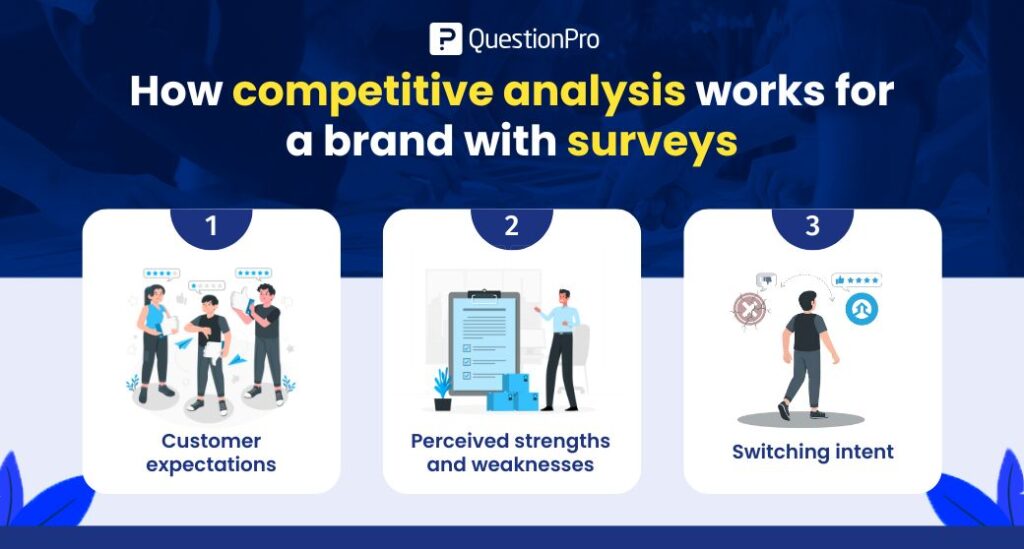
Surveys can capture signals such as:
- Customer expectations: What customers believe a “good” product, service, or experience should look like.
- Perceived strengths and weaknesses: Which features, services, or touchpoints do customers say you do better or worse than competitors?
- Switching intent: How likely customers are to move to another brand and why they might do it.
To make competitive analysis more actionable, surveys often combine several techniques:
- Voice of the Customer programs centralize feedback across different channels.
- Touchpoint monitoring to measure satisfaction at key stages of the customer journey.
- Sentiment and text analytics to interpret open comments and understand emotions behind scores.
When you apply these methods consistently across multiple brands, survey data turns into a comparable set of performance indicators. That gives you a clearer view of where you stand, where competitors outperform you, and which changes are most likely to shift customer preference in your favor.
Best practices for use competitor benchmarking survey questions
Competitor benchmarking survey questions work best when the approach is consistent and repeatable.
Best practices to use competitor benchmarking survey questions:
- Use neutral, standardized wording
- Survey respondents with real category experience
- Combine perception ratings with experience metrics
- Use consistent scales across benchmarking cycles
- Include open-ended feedback for context
- Apply sentiment and text analytics to comments
Following these practices ensures benchmarking customer satisfaction across competitors remains accurate and actionable.
How QuestionPro helps run competitor benchmarking surveys
QuestionPro gives you the tools to design, distribute, and analyze competitor benchmarking surveys in a structured and reliable way. Rather than piecing together different platforms, you can manage every step of your benchmarking workflow in one place.
Key Capabilities for Competitor Benchmarking
- Goal-aligned survey templates
Start quickly with templates for brand comparison, perception ratings, feature evaluation, and pricing studies, so each question ties directly to a benchmarking metric.
- Advanced question types for comparison data
You can standardize rating scales, apply skip logic, and reuse question blocks so every brand is measured with the same structure.
- Dashboards for side-by-side competitive views
Compare brands across metrics like satisfaction, pricing fairness, ease of use, and feature strength. Segment results by region, customer type, or experience level.
- Text AI and sentiment analysis
Turn open-ended feedback into themes that highlight strengths, weaknesses, and emotional drivers behind brand preference.
- QuestionPro AI
QuestionPro AI helps simplify survey creation by automatically generating questions based on the needs. It saves time and ensures relevant, high-quality questions that align with your research goals.
By combining these capabilities, QuestionPro helps you run repeatable, accurate competitor benchmarking studies that yield clear insights, actionable patterns, and a strong understanding of where your brand stands in the market.
Conclusion
Competitor benchmarking surveys give brands a structured way to understand how customers compare their brand with the alternatives they know and trust. By using well-designed competitor benchmarking survey questions, teams can move beyond assumptions and base decisions on real customer feedback.
Measuring experience quality, pricing fairness, customer support, feature strength, and loyalty across multiple brands creates a clear picture of true market position. These insights help identify what customers value most, where competitors outperform you, and which improvements are most likely to influence satisfaction and recommendations.
With tools like QuestionPro, the entire process becomes easier to execute. From survey design to side-by-side competitive analysis, you can run reliable benchmarking studies that support better decisions and long-term brand growth.
Frequently Asked Questions (FAQs)
Answer: They provide structured feedback that shows how customers compare your brand to competitors across areas like quality, pricing, features, and support.
Answer: You can uncover customer perception, satisfaction gaps, switching triggers, and areas where competitors outperform you.
Answer: Common metrics include product quality, ease of use, pricing fairness, support experience, feature strength, loyalty intention, and recommendation likelihood.
Answer: Text responses help explain ratings by highlighting emotions, themes, and pain points through sentiment and text analytics.
Answer: AI supports question generation, text analysis, sentiment tagging, and real-time monitoring, making it easier to interpret competitive insights.