
Brand preference is the tendency of customers to choose one brand over competing options in the same category, because they trust it, value it, or have had better experiences with it. It sits between two other stages of the customer relationship: brand awareness, where people simply know a brand exists, and brand loyalty, where repeated preference turns into a habit.
In this blog, we break down what brand preference actually means, how it differs from adjacent concepts like loyalty and equity, real examples, and how to build and measure it in a way that holds up under real market pressure.
What is brand preference?
Brand preference is the tendency of customers to choose one brand over competing brands in the same category, driven by trust, perceived value, recognition, or past experience.
Brand preference sits in the middle of a longer customer journey. People may know a brand exists long before they prefer it, and repeated preference over time is what eventually turns into brand loyalty. A shopper can be aware of ten brands in a category, prefer three of them, and remain fully loyal to only one.
This preference is shaped by a mix of rational and emotional factors:
- Product quality and consistency over time
- Price relative to perceived value
- Past customer experience, good or bad
- The brand’s overall reputation
None of these factors work in isolation. A brand with a strong reputation but a recent bad customer experience can lose preference quickly, even among long-time customers.
How is brand preference different from brand awareness, loyalty, and equity?
Brand preference, awareness, loyalty, and equity are related concepts that get used interchangeably, but each describes a different stage of the customer relationship.
| Concept | What it means | Example |
|---|---|---|
| Brand awareness | People recognize or remember a brand | A shopper knows a brand exists |
| Brand preference | People choose a brand over alternatives | A shopper picks that brand first |
| Brand loyalty | People keep buying the same brand over time | A shopper repeatedly buys that brand |
| Brand equity | The value a brand adds beyond the product itself | Customers pay more because of the brand name |
Customer-Based Brand Equity model describes this progression as a pyramid, moving from basic awareness at the base up through meaning, response, and ultimately brand resonance at the top. Preference sits in the middle of that climb, not at either end.
Why does brand preference matter?
Brand preference matters because it directly affects revenue, resilience, and how much a company has to spend to keep its customers.
- Higher purchase intent among existing and prospective customers
- Lower switching behavior when a competitor launches a promotion
- Stronger customer retention without constant win-back campaigns
- Better word of mouth, since preferred brands get recommended more often
- More pricing power, since preferred brands can support a premium
- Lower dependence on discounts to keep customers buying
A brand trusted enough to be someone’s default choice does not need to compete on price every single time. Edelman’s 2025 Trust Barometer found that people trust the brands they use more than they trust most institutions, which is exactly the kind of trust that keeps preference stable even when competitors cut prices.
Consider two competing coffee shop chains in the same city. One runs frequent discount promotions to win customers away from the other. If the second chain has strong brand preference, most of its regulars stay put anyway, since the decision to visit was never primarily about price to begin with. That’s the practical value of preference: it buys a business room to compete on more than discounts.
What are examples of brand preference?
Brand preference shows up any time a customer picks one option without comparing every alternative first.
- A shopper chooses a specific smartphone brand repeatedly because of a trusted ecosystem of connected devices
- A buyer picks a specific sportswear brand over similarly priced competitors because of design and identity
- A family buys the same grocery brand every trip because it has never let them down
- A B2B buyer sticks with a known software vendor because of trusted support and security history
- A patient chooses the same healthcare provider repeatedly based on past experience and reputation
Each of these examples has one thing in common. The customer had other options available and chose the same brand anyway, not because it was the only choice, but because it was the preferred one.
What separates these cases from simple habit is that the customer could name a reason if asked. That’s the practical test for real brand preference: a customer who can explain why they chose a brand, even briefly, is showing preference rather than just convenience or inertia.
What factors influence brand preference?
Several factors shape whether a customer prefers a brand, and most of them are things a business can actually influence.
- Product quality: Consistent quality builds the track record preference depends on.
- Price and perceived value: Preference survives a higher price when the value feels justified.
- Past experience: A single bad interaction can undo years of consistent preference.
- Social proof: Reviews and recommendations shape preference before a first purchase ever happens.
- Emotional connection: Shared values and brand identity matter as much as functional benefits for many customers.
- Availability and convenience: A preferred brand that’s hard to find loses ground to an accessible alternative.
How do you build brand preference?
You build brand preference by understanding the customer’s choice set, creating a clear brand position, delivering consistent experiences, and measuring whether customers actually prefer your brand over alternatives.
Define the audience and choice set
Start by identifying who you want to win preference from and which brands they compare you against. A choice set is the group of brands a customer considers before buying.
Questions worth asking:
- Who is the target audience?
- What problem are they trying to solve?
- Which competitors do they compare?
- What matters most in the buying decision?
- Which triggers make them switch brands?
- What keeps them from leaving?
You cannot build preference if you do not know whose preference you are trying to earn.
Create a clear brand position
Brand position explains what a brand stands for in the customer’s mind and why it’s different from alternatives. It should be specific enough to guide messaging, product decisions, and customer experience.
A clear position answers:
- What category are we in?
- Who do we serve?
- What do we help them do?
- Why should they choose us?
- What proof supports that claim?
If customers cannot explain why a brand is different, preference will be harder to build.
Deliver a consistent customer experience
Brand preference grows when customers get the experience they expected. Inconsistent experiences weaken preference, no matter how strong the marketing is.
Consistency needs to hold across every touchpoint:
- Website and pre-purchase research
- Sales process and onboarding
- Product quality and delivery
- Customer support and billing
- Post-purchase communication
A strong ad campaign cannot fix a product that disappoints or a support process that frustrates customers.
Align product quality with the brand promise
A brand promise is the expectation a business creates in the customer’s mind. Product quality must support that promise, or preference erodes fast.
If the brand claims simplicity, the product should be easy to use. Premium positioning needs to show up in the small details, not just the price tag. A brand built on speed cannot afford a slow support process. Preference gets stronger when the promise and the experience match.
Common mismatches worth checking:
- A “simple” product with a confusing onboarding flow
- A “premium” brand with cheap packaging or slow shipping
- A “fast” service with a support queue that takes days
Create emotional and practical value
Customers prefer brands for practical reasons, emotional reasons, or both. Practical value includes price, quality, convenience, support, or features. Emotional value includes trust, identity, confidence, belonging, or pride.
Strong brands often combine both. They solve a real problem and make the customer feel good about choosing them.
Use customer feedback to close gaps
Customer feedback helps identify the gap between what a brand promises and what customers actually experience. This is where brand preference can grow or decline.
Useful feedback sources include:
- Customer satisfaction surveys
- Brand perception surveys
- Product feedback surveys
- Reviews and support tickets
- Sales objections and churn feedback
- NPS comments
Look for repeated patterns. If customers consistently say a brand is hard to use, too expensive, or unreliable, preference will suffer.
Build trust through proof and consistency
Trust is built through repeated proof, not a single campaign. Claims become more believable when customers see evidence in product performance, reviews, case studies, service quality, and consistent delivery.
Brands build preference when they do what they said they would do, again and again.
How do you measure brand preference?
Measuring brand preference requires combining direct survey data with observed purchase behavior, since neither on its own tells the full story.
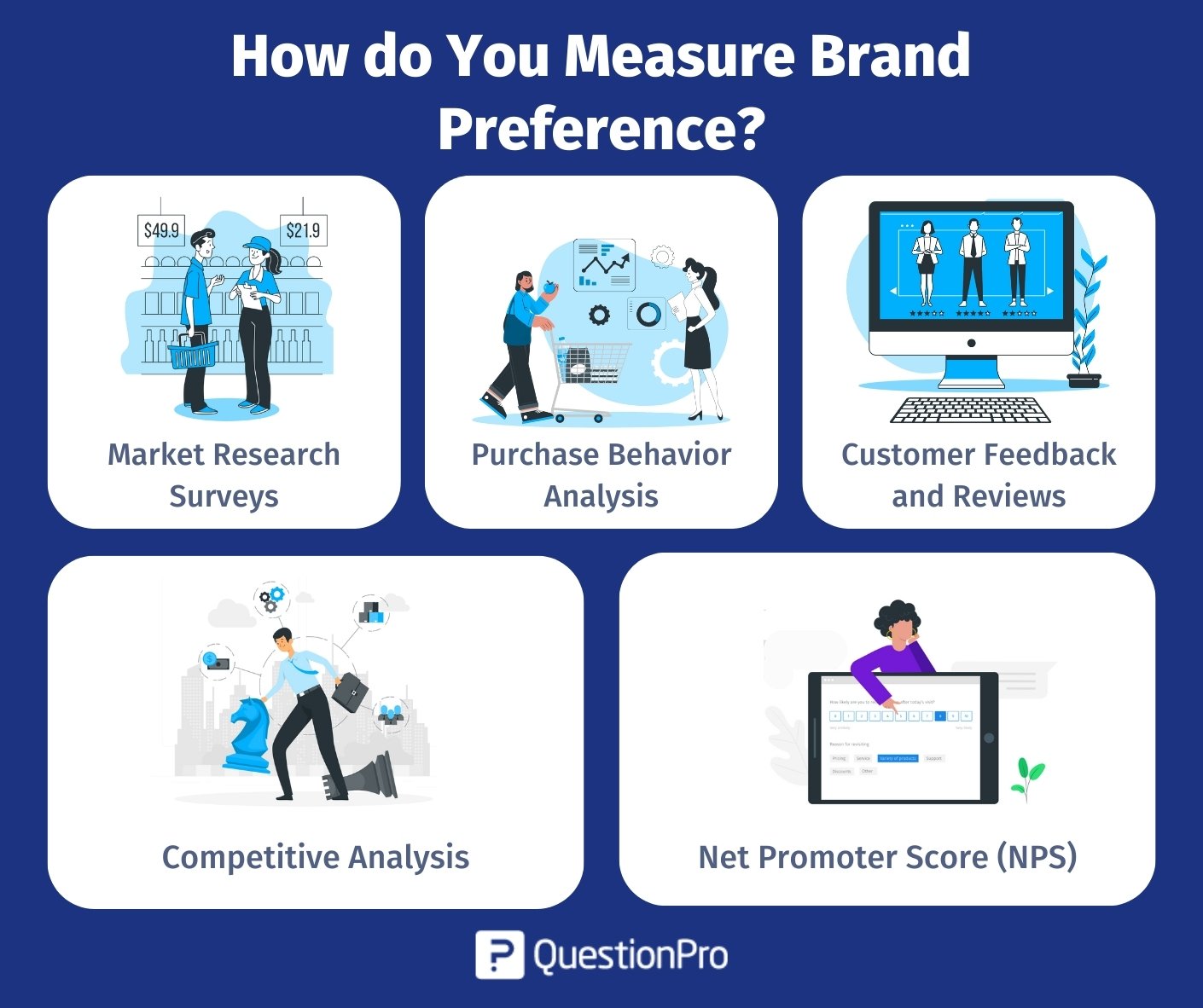
- Market research surveys: Ask customers directly which brand they’d choose first in a category.
- Purchase behavior analysis: Repeat purchases in sales data reveal preference that surveys alone can miss.
- Customer feedback and reviews: Consistent positive mentions across channels signal strong preference.
- Competitive analysis: Market share and growth relative to competitors indicate relative preference strength.
- Net Promoter Score (NPS): Classifies customers as Promoters, Passives, or Detractors based on recommendation likelihood.
Ongoing brand tracking adds a metric worth watching closely: share of preference, which shows how a brand’s preference compares to competitors within the same consideration set, not just in isolation.
Share of preference matters more than a standalone preference score, because a brand can score well on its own while still losing ground to a specific competitor within the same category. Tracking both numbers together, overall preference and preference relative to the closest competitor, gives a clearer picture of where a brand actually stands.
What survey questions measure brand preference?
The right survey questions ask customers to choose directly, rather than rate a brand in isolation.
- Which of these brands would you choose first?
- Which brand do you prefer most in this category?
- If your preferred brand were unavailable, which would you choose next?
- How likely are you to buy from this brand in the next three months?
- Which brand do you trust most?
- Why do you prefer this brand?
Forced-choice questions, like asking a customer to pick one brand from a list rather than rate each separately, tend to produce more reliable preference data than open rating scales. Pairing these questions with a broader brand perception study gives context for why customers answer the way they do, not just which brand they picked.
Final thoughts on brand preference
Brand preference means being chosen when real alternatives exist, not just being recognized. It’s built through consistent quality, trust, and experience, and it erodes quickly when any of those slip.
Surveys, brand tracking, and purchase behavior data all reveal whether preference is growing or slipping, which matters more than assuming it’s stable. QuestionPro’s brand perception and NPS survey tools can help track these signals over time, but the real work happens in how consistently a business delivers on what earned that preference in the first place.
Frequently Asked Questions (FAQs)
Brand preference is choosing a brand when alternatives exist. Brand loyalty is a deeper, repeated commitment to that brand over time, where customers are less likely to switch even during a bad experience.
There’s no fixed timeline. It depends on category, competition, and consistency, but most brands need sustained positive experiences over several purchase cycles before preference becomes measurable.
Yes. Small businesses often build preference through personalized experience and community trust, areas where large competitors struggle to match the same level of consistency.
Not usually. Preference tends to survive a higher price when perceived value and past experience support it, while quality issues erode preference regardless of price.
Most brands benefit from measuring preference quarterly, with additional pulse surveys around major campaigns or competitive shifts that could affect customer choice.