The benefits of customer journey analytics go far beyond better dashboards. For US businesses facing rising acquisition costs and tighter competition, understanding the full customer path has become essential.
Customer journey analytics connects every touchpoint across channels so companies can see how customers move, where they struggle, and what drives them to convert or leave.
In this blog, we’ll explore what journey analytics is, how it works, and why it matters for organizations operating in the USA today.
What is customer journey analytics?
Customer journey analytics is the process of collecting and analyzing behavioral data across all customer touchpoints to understand the full customer lifecycle.
Unlike traditional reporting that focuses on isolated metrics such as website visits or NPS scores, journey analytics connects interactions across:
- Websites
- Mobile apps
- Contact centers
- Email campaigns
- In-store visits
- Social media
It transforms disconnected data into a unified customer timeline. If you want a deeper overview of how it works in practice, this guide to customer journey analytics explains the mechanics clearly.
In simple terms, it shows the story behind the numbers.
How does customer journey analytics work?
Understanding the benefits of customer journey analytics starts with understanding how the process works in real business environments. It is not a single report or dashboard. It is a structured system that connects data, behavior, and decision-making.
Below is a clear breakdown of how it typically works.
- Data collection across touchpoints
Organizations collect behavioral and feedback data from both digital and offline interactions. This includes transaction logs, clickstreams, CRM records, and survey responses.
- Identity resolution
Interactions from different systems are unified into a single customer profile. This ensures that website visits, purchases, and support calls are accurately attributed to the same individual, creating a complete view of the customer journey.
- Journey mapping based on real data
Customer journey mapping visualizes the actual paths customers follow before purchasing, renewing, or disengaging. These maps are built on observed behavioral data rather than assumptions.
- Pattern detection and behavioral analysis
Customer journey analytics tools identify recurring trends, such as common drop-off points or sequences of actions associated with higher customer lifetime value. This analysis highlights where performance improves or declines.
- Segmentation based on customer behavior
While traditional segmentation focuses on demographics like age or location, journey analytics enables behavioral segmentation. Journey analytics enables behavioral segmentation, which groups customers based on actions rather than static traits.
- Optimization and journey orchestration
Insights are only valuable if they lead to action. They guide changes in CX strategy, messaging, onboarding flows, or support processes. Journey orchestration is the process of coordinating these touchpoints consistently and on time across channels.
Customer journey analytics works because it follows a disciplined structure. It transforms fragmented behavioral data into coordinated action. Instead of isolated reports, organizations gain a living system that continuously improves the customer experience based on evidence.
What are the core benefits of customer journey analytics?
The benefits of customer journey analytics fall into four main categories: visibility, optimization, retention, and revenue impact.
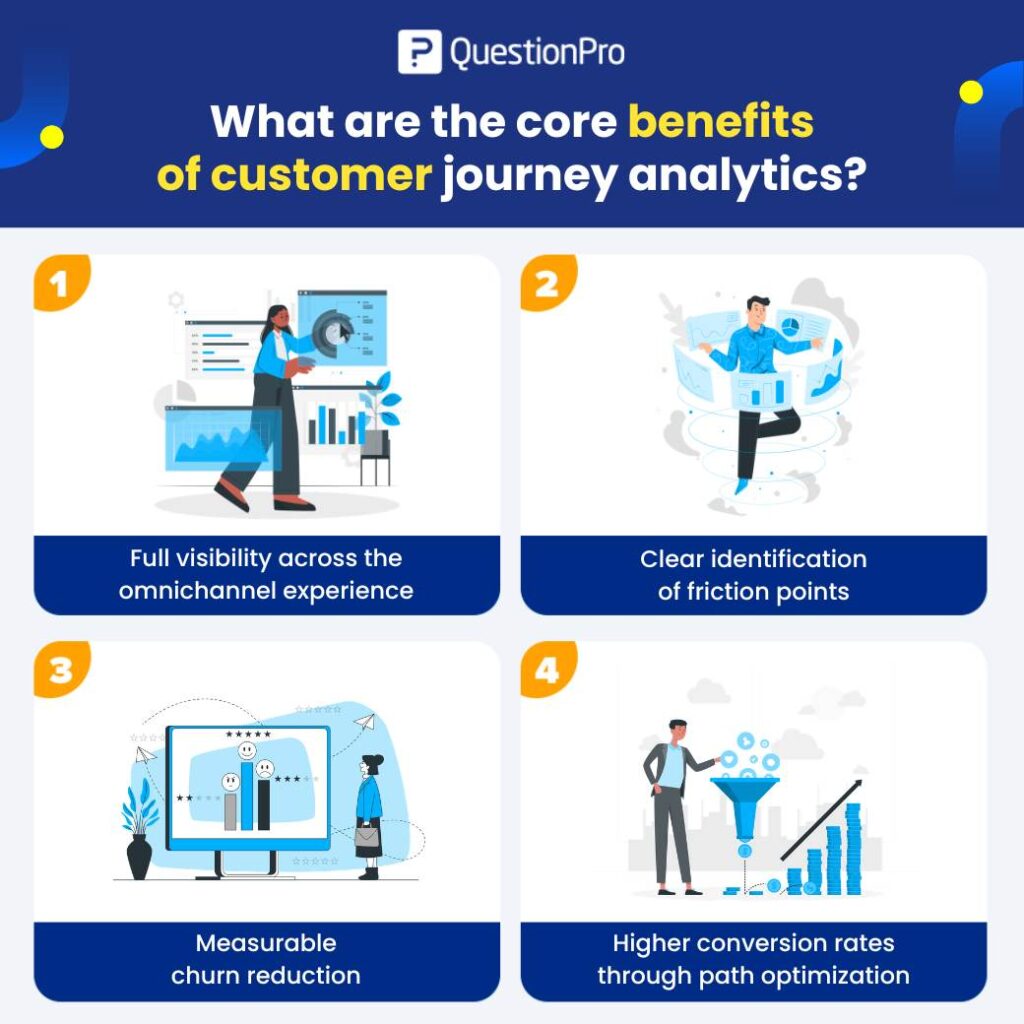
1. Full visibility across the omnichannel experience
Modern US consumers move fluidly between devices and channels. Omnichannel analytics ensures that businesses see the entire path rather than isolated interactions.
This helps businesses answer questions like:
- Did customers research online before visiting a store?
- Does mobile friction affect desktop conversions?
- Are support interactions impacting renewal rates?
Without journey-level visibility, these connections remain hidden.
2. Clear identification of friction points
One of the most practical benefits is pinpointing where customers drop off. Instead of guessing why conversion rates decline, companies can see:
- Where onboarding stalls
- Which checkout steps cause abandonment
- Which service interactions lead to dissatisfaction
In the US retail sector, for example, cart abandonment averages around 70 percent according to Baymard Institute research. Journey analytics shows not just the rate, but the behavioral causes behind it.
3. Measurable churn reduction
Churn reduction becomes more predictable when patterns are visible. Journey data can highlight early warning signals, such as:
- Reduced login frequency
- Increased complaint volume
- Declining feature usage
By identifying these signals, companies can intervene before customers leave. This proactive approach supports retention, which is often more cost-effective than acquiring new customers. The US Small Business Administration consistently emphasizes retention as a driver of sustainable growth.
4. Higher conversion rates through path optimization
Not all journeys are equal. Some paths convert better than others. Customer experience analytics allows businesses to:
- Compare high-performing and low-performing journeys
- Identify key actions before purchase
- Simplify unnecessary steps
Optimizing the right touchpoints often increases conversion rates without increasing ad spend.
How do customer journey analytics tools support decision-making?
Customer journey analytics tools provide real-time insights instead of static reports.
These platforms often include:
- Predictive modeling to estimate churn risk
- Visual journey maps for executive reporting
- Automated alerts when friction increases
- Segmentation based on behavioral patterns
For US enterprises managing large customer bases, these tools reduce decision lag. Businesses act faster because insights are continuously updated.
This also improves cross-functional alignment. Marketing, product, and support teams work from the same journey data instead of separate dashboards.
How does customer journey analytics improve personalization?
Personalization based on demographics alone is limited. Journey-based personalization uses behavioral data such as:
- Browsing patterns
- Purchase timing
- Channel preferences
- Service interactions
Instead of sending generic campaigns, companies tailor communication based on actual behavior.
For example:
- Customers stuck in onboarding receive targeted guidance
- Repeat buyers receive loyalty offers
- At-risk users receive proactive outreach
This improves relevance without increasing marketing volume.
Why are US businesses prioritizing journey analytics now?
Three trends are driving adoption in the USA:
- Rising acquisition costs
- Higher consumer expectations for seamless digital experiences
- Increased data availability across platforms
Customers expect frictionless service whether interacting online or offline. Journey orchestration, which coordinates touchpoints across channels, is becoming a competitive requirement rather than a luxury.
Organizations that ignore journey data risk losing customers to competitors who offer smoother experiences.
Customer journey analytics is not about collecting more data. It is about connecting the data you already have and turning it into structured action. For US businesses competing in crowded markets, that clarity often makes the difference between guessing and knowing.
Frequently Asked Questions (FAQs)
Answer: The main purpose is to understand the complete customer lifecycle across touchpoints and identify opportunities to improve experience, retention, and revenue.
Answer: Customer journey mapping is a visual representation of the journey. Customer journey analytics uses real behavioral data to validate and optimize that map.
Answer: No. While large enterprises benefit from scale, mid-sized US companies can implement journey analytics through cloud-based platforms without heavy infrastructure.
Answer: Yes. By identifying friction and optimizing high-converting paths, businesses often see improved retention and higher conversion rates.
Answer: Yes. It relies heavily on behavioral data, but combining it with feedback strengthens insights.