Journey orchestration relies heavily on data. It involves the collection and analysis of vast amounts of customer data to gain insights into behaviors, pain points, and preferences. This data-driven approach ensures that each customer’s journey is informed by their unique characteristics. This strategic approach goes beyond traditional marketing methods, focusing on creating seamless and personalized customer journeys.
In this blog, we’ll discover what Journey Orchestration is and how it works to enhance customer experiences.
What is journey orchestration?
Journey orchestration involves designing, managing, and optimizing customer journeys across various touchpoints and channels.
A customer journey is the series of interactions and experiences that a customer has with a brand or organization throughout their relationship. These interactions can include online and offline interactions, such as website visits, social media engagement, customer support, and more.
Journey orchestration involves coordinating and sequencing customer touchpoints to create a seamless and personalized experience. It often leverages technology, data, and automation to deliver relevant and timely messages or actions at each customer journey stage.
Why is journey orchestration important?
Journey orchestration helps businesses create consistent, personalized, and efficient customer experiences across every touchpoint. It allows you to guide interactions in a structured and data-informed way.
Here are some key reasons why journey orchestration is important:
- Personalized customer experiences: Interactions are optimized based on behavior, preferences, and past data, making each step more relevant.
- Consistent cross-channel journeys: Customers move between website, mobile, email, and support without friction or mixed messaging.
- Improved touchpoint performance: Businesses can identify weak points and optimize them to reduce drop-offs and improve engagement.
- Proactive customer engagement: Triggers and behavioral signals allow timely outreach before issues arise or opportunities are missed.
- Better decision-making with data: Insights from journey orchestration analytics help you understand what works and what needs adjustment.
How does customer journey orchestration work?
Journey orchestration is a structured process that connects customer data, triggers actions, and continuously improves experiences through analysis and iteration.
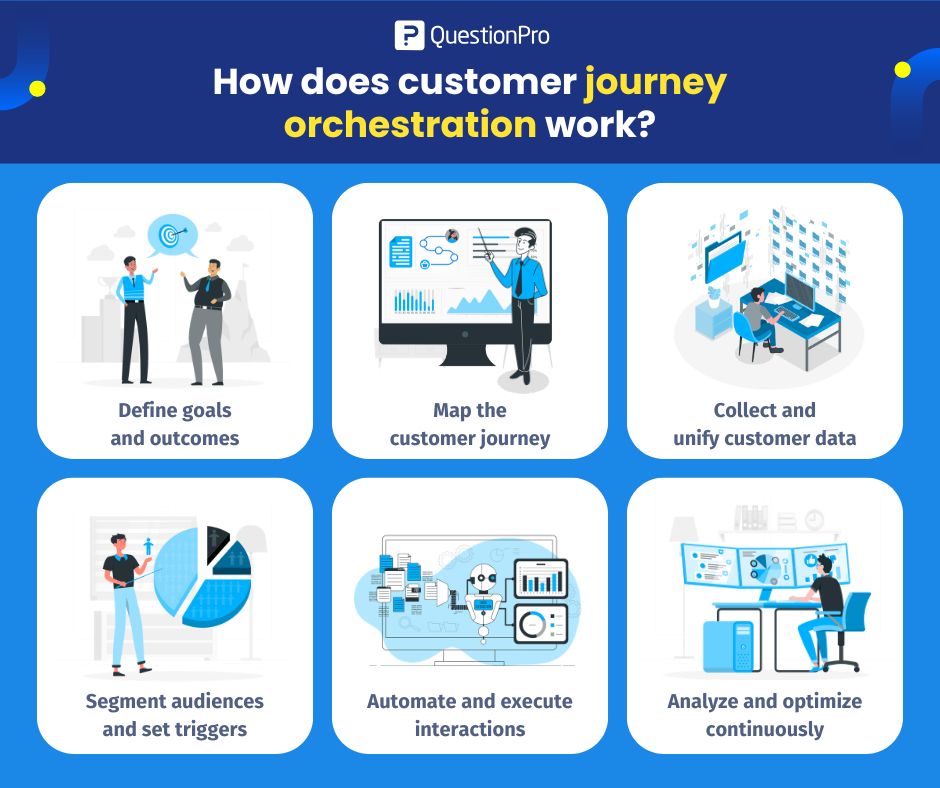
Step 1: Define goals and outcomes
Start by identifying what you want to improve, such as conversion rates, retention, or customer satisfaction. Clear goals guide the entire orchestration strategy.
Step 2: Map the customer journey
Map out the end-to-end customer journey, from the initial awareness stage to post-purchase and beyond.
Identify key touchpoints and interactions that customers have with your brand. This helps identify where orchestration is needed most.
Step 3: Collect and unify customer data
Bring together data from multiple sources, such as website behavior, transactions, and feedback, to build a complete customer view.
Focus on combining data such as:
- Behavioral data from website visits, clicks, and app usage
- Transactional data like purchases or subscriptions
- Customer feedback from surveys, reviews, and support interactions
- Demographic data, such as location or preferences
Step 4: Segment audiences and set triggers
Group customers based on behavior or characteristics, then define triggers such as abandoned carts or repeated visits that require action.
Step 5: Automate and execute interactions
Once triggers and rules are set, the next step is execution. This is where journey orchestration becomes active.
Automation ensures that every customer receives timely and relevant interactions. It removes manual effort and keeps communication consistent. Key elements include:
- Channel selection
- Message timing
- Content personalization
- Trigger-based actions
- Real-time responses
Step 6: Analyze and optimize continuously
Use journey orchestration analytics to measure performance, track KPIs, and refine journeys based on real customer behavior.
What is journey orchestration analytics?
Journey orchestration analytics is the process of tracking and analyzing how customers move across touchpoints and how interactions impact outcomes.
In US companies, customers engage across digital and physical channels, making visibility essential for consistent experiences. It focuses on key metrics such as:
- Conversion rates across journey stages
- Drop-off points in the journey
- Engagement across channels
- Customer lifetime value
It helps you understand which orchestration strategies are effective and where improvements are needed.
What is the difference between journey mapping and journey orchestration?
Journey mapping and journey orchestration are related concepts in customer experience management, but they serve different purposes and have distinct focuses. Here’s a breakdown of the key differences between customer journey mapping and journey orchestration:
| Topic | Journey Mapping | Journey Orchestration |
| Definition | Visual representation of the customer journey and touchpoints. | Process of managing and optimizing interactions across the journey. |
| Focus | Understanding the current experience. | Improving and personalizing experiences in real time. |
| Purpose | Identify pain points and gaps. | Act on insights and guide customer interactions. |
| Time Frame | Static snapshot of the journey. | Continuous and dynamic process. |
| Tool Usage | Diagrams, journey maps, and visualization tools. | Automation platforms and orchestration systems. |
| Output | Insights into customer behavior and emotions. | Personalized actions, messages, and optimized journeys. |
Many companies use customer journey analytics to understand the journey and journey orchestration to improve it.
Conclusion
Journey orchestration is a powerful approach for businesses seeking to elevate their customer experience. Organizations can create a more personalized and efficient customer interaction by seamlessly integrating data, mapping customer journeys, and leveraging automation.
As technology advances, Journey Orchestration is likely to play an increasingly pivotal role in shaping the future of customer engagement. Embracing this strategy positions businesses to meet and exceed customer expectations in an ever-evolving digital landscape.
QuestionPro Customer Experience is a powerful tool for enhancing customer journey orchestration. Its robust features enable businesses to collect, analyze, and act on customer feedback seamlessly.
By providing valuable insights, personalized experiences, and streamlined communication, QuestionPro Customer Experience empowers organizations to optimize the customer journey, fostering lasting relationships and driving success.