WhatsApp has become one of the most widely used communication channels for businesses and customers. From order updates and customer support to appointment reminders and personalized communication, organizations increasingly use WhatsApp to engage customers throughout the customer journey.
But WhatsApp can do more than facilitate conversations. It can also become a powerful channel for collecting customer feedback.
WhatsApp surveys allow organizations to send surveys directly to customers through WhatsApp, making it easier to capture feedback immediately after an interaction. For Customer Experience (CX) teams, this creates an opportunity to collect more timely and contextual feedback while meeting customers on a channel they already use.
In this article, we’ll explore what WhatsApp surveys are, their benefits, common use cases, and how businesses can use them as part of a broader Voice of Customer (VoC) and CX strategy.
What Are WhatsApp Surveys?
WhatsApp surveys are customer feedback surveys distributed through WhatsApp.
Instead of sending a survey invitation through email or SMS, businesses can send a WhatsApp message containing a survey link or an appropriate WhatsApp survey experience.
For example, after a customer receives an order, a business could send:
How was your recent delivery experience?
The customer can open the survey, provide feedback, and submit their response without having to search through their email inbox or navigate to another communication channel.
WhatsApp surveys can be used to measure a wide range of customer experience metrics, including:
- Customer Satisfaction Score (CSAT)
- Net Promoter Score (NPS)
- Customer Effort Score (CES)
- Product satisfaction
- Service satisfaction
- Delivery experience
- Support experience
- Customer loyalty
- Open-ended feedback
When integrated with a CX platform, WhatsApp can become part of an automated feedback workflow. Customer transaction data can determine when a survey should be sent, which survey should be used, and which customers should receive it.
Why Use WhatsApp for Customer Surveys?
Traditional survey distribution channels such as email and SMS remain useful, but they don’t always provide the most engaging experience for every customer.
Customers may overlook emails, ignore survey invitations, or simply not have the motivation to switch between applications to provide feedback.
WhatsApp offers a more direct and familiar communication environment.
The biggest advantage is simple:
Customers can receive feedback requests in a channel they already use to communicate.
This can help organizations make feedback collection more timely, convenient, and contextual.
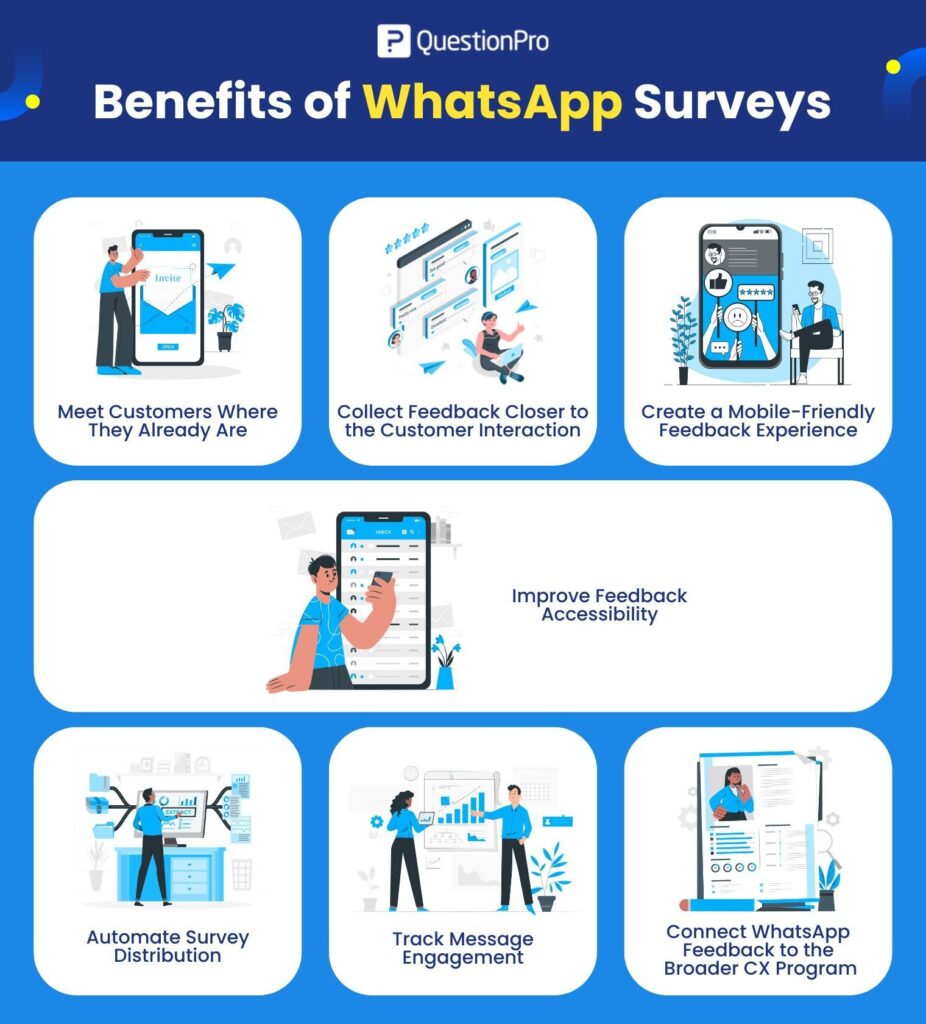
7 Benefits of WhatsApp Surveys
1. Meet Customers Where They Already Are
One of the biggest challenges in customer feedback programs is getting customers to engage with surveys.
If a customer already uses WhatsApp regularly, sending a survey invitation through WhatsApp removes some of the friction associated with switching to another channel.
Instead of:
Customer interaction – Email – Open inbox – Find survey – Respond
the experience becomes:
Customer interaction – WhatsApp message – Survey – Feedback
This shorter path can make feedback collection more convenient.
2. Collect Feedback Closer to the Customer Interaction
Timing has a major impact on the quality of customer feedback.
If a customer receives a survey several days or weeks after an interaction, they may not remember the details of their experience accurately.
WhatsApp can support more immediate feedback collection.
For example:
- Send a delivery survey shortly after delivery.
- Send a support survey after a ticket is resolved.
- Send a hotel survey after checkout.
- Send a banking survey after a service interaction.
- Send a product survey shortly after purchase.
The closer the survey is to the experience, the more contextual the feedback can be.
3. Create a Mobile-Friendly Feedback Experience
Customers increasingly interact with businesses through mobile devices.
WhatsApp is designed around mobile communication, making it a natural channel for mobile-first feedback programs.
Organizations can use WhatsApp surveys to collect short, focused feedback without requiring customers to sit at a desktop computer.
This is especially useful for:
- Retail customers
- Delivery customers
- Field-service customers
- Travelers
- Telecom customers
- Banking customers
- Healthcare customers
4. Improve Feedback Accessibility
Every customer has different communication preferences.
Some customers prefer email. Others respond better to SMS, mobile applications, web surveys, or messaging platforms.
Offering WhatsApp as another feedback channel gives organizations more flexibility in how they engage customers.
A multi-channel CX strategy can combine:
- SMS
- Web
- Mobile applications
- QR codes
- In-product surveys
The goal isn’t necessarily to replace existing channels.
Instead, WhatsApp can become another channel within a broader omnichannel feedback strategy.
5. Automate Survey Distribution
WhatsApp surveys become significantly more powerful when connected to customer transaction data and automated CX workflows.
For example, an e-commerce company could create a workflow like:
Order completed – Transaction imported – Wait 24 hours – Send WhatsApp survey
A support organization could use:
Ticket closed – Customer identified – Send WhatsApp CSAT survey
A hotel could use:
Guest checkout – Transaction recorded – Send WhatsApp experience survey
Automation reduces manual work and ensures that surveys are triggered consistently.
6. Track Message Engagement
A WhatsApp integration can provide visibility into messaging events such as whether a message was delivered or read.
This creates an important distinction between:
Survey sent
and
Customer actually received or engaged with the message.
Understanding these stages can help CX teams identify where engagement is being lost.
For example:
| Stage | What It Tells You |
| Sent | Survey invitation was initiated |
| Delivered | Message reached the customer |
| Read | Customer opened the message |
| Responded | Customer completed the survey |
This provides a more complete view of survey-channel performance.
7. Connect WhatsApp Feedback to the Broader CX Program
The real value of WhatsApp surveys isn’t simply collecting responses.
It is connecting those responses to the rest of the customer experience program.
For example, a company could combine WhatsApp feedback with:
- Customer profile data
- Transaction information
- Purchase history
- Product information
- Support interactions
- NPS
- CSAT
- CES
- Sentiment
- Customer segments
This allows organizations to move from:
“We received 10,000 survey responses.”
to:
“Customers who experienced delayed delivery have significantly lower CSAT and are more likely to become detractors.”
That difference is what turns feedback collection into a CX intelligence program.
WhatsApp Survey Use Cases
WhatsApp surveys can be used throughout the customer journey.
Here are some of the most common applications.
1. Post-Purchase Surveys
Retail and e-commerce companies can send a WhatsApp survey after a purchase.
Example:
How satisfied are you with your recent purchase?
Businesses can measure:
- Purchase satisfaction
- Checkout experience
- Product satisfaction
- Delivery experience
- Overall satisfaction
The feedback can then be connected to order or transaction data to identify patterns across products, locations, or customer segments.
2. Delivery Experience Surveys
Delivery is one of the most important moments in the customer journey.
A company can trigger a WhatsApp survey after an order has been delivered.
Example:
How would you rate your delivery experience?
Follow-up questions can explore:
- Delivery speed
- Delivery communication
- Package condition
- Delivery associate experience
- Overall satisfaction
This allows businesses to understand whether problems are related to the product itself or the fulfillment experience.
3. Customer Support CSAT
WhatsApp surveys are particularly useful after customer support interactions.
Once a support ticket is closed, the business can automatically send:
How satisfied are you with the support you received?
The survey can include a CSAT rating followed by an open-ended question:
What could we have done better?
This gives support teams both a quantitative score and qualitative context.
4. NPS Surveys
WhatsApp can also be used to measure customer loyalty through NPS.
For example:
On a scale of 0–10, how likely are you to recommend our company to a friend or colleague?
Businesses can then follow up with different questions based on the customer’s score.
For example:
Promoter:
“What do you value most about our experience?”
Passive:
“What could we improve?”
Detractor:
“What is the main reason for your score?”
This creates an opportunity to combine measurement with closed-loop follow-up.
5. Customer Effort Surveys
Customer Effort Score (CES) measures how easy or difficult it was for customers to complete an interaction.
WhatsApp is a useful distribution channel for CES because the survey can be triggered immediately after the experience.
For example:
How easy was it to resolve your issue today?
A low-effort interaction can be compared with a high-effort interaction to identify friction points in the customer journey.
6. Product Feedback
Businesses can send WhatsApp surveys after customers have had an opportunity to use a product.
For example:
How satisfied are you with your new product?
Follow-up questions can explore:
- Product quality
- Ease of use
- Features
- Performance
- Value for money
- Areas for improvement
This feedback can help product teams prioritize improvements based on actual customer experiences.
7. Hotel and Hospitality Feedback
Hotels can collect feedback at multiple stages of the guest journey.
For example:
After check-in:
“How was your check-in experience?”
During the stay:
“Is there anything we can do to improve your stay?”
After checkout:
“How would you rate your overall experience?”
This creates multiple feedback opportunities instead of relying only on a single post-stay survey.
8. Banking and Financial Services
Banks and financial institutions can use WhatsApp surveys after customer interactions such as:
- Account opening
- Loan applications
- Branch visits
- Customer support
- Digital banking interactions
- Service requests
For example:
How easy was it to complete your account opening process?
This can help identify friction in financial service journeys.
9. Healthcare Experience Feedback
Healthcare organizations can use WhatsApp surveys to collect feedback after:
- Appointments
- Telehealth consultations
- Diagnostic services
- Hospital visits
- Discharge
- Customer support interactions
Example:
How satisfied were you with your recent appointment experience?
Organizations can use the feedback to understand both clinical-service touchpoints and operational experiences.
10. Automotive Customer Experience
Automotive businesses can trigger surveys after:
- Vehicle servicing
- Test drives
- Vehicle purchases
- Repairs
- Dealership interactions
For example:
How satisfied are you with the service you received today?
This enables dealerships and automotive brands to identify experience gaps across locations and service centers.
WhatsApp Surveys vs. Email Surveys
WhatsApp surveys don’t necessarily replace email surveys. Each channel has a role in a modern CX program.
| Factor | WhatsApp Surveys | Email Surveys |
| Mobile experience | Strong | Moderate |
| Conversational environment | Strong | Low |
| Immediate engagement | Strong | Moderate |
| Long-form surveys | Less suitable | Strong |
| Transactional feedback | Strong | Strong |
| Automated workflows | Strong | Strong |
| Customer familiarity | High for WhatsApp users | High |
| Best for | Timely, mobile-first feedback | Detailed and broader surveys |
The best approach for many organizations is channel optimization rather than choosing a single channel.
For example:
- Use WhatsApp for immediate transactional feedback.
- Use email for longer relationship surveys.
- Use SMS for customers who prefer text messaging.
- Use in-app surveys for digital product interactions.
Best Practices for WhatsApp Surveys
Using WhatsApp doesn’t automatically guarantee better feedback. The survey experience still matters.
Keep Surveys Short
WhatsApp is primarily a messaging environment.
Avoid overwhelming customers with lengthy surveys.
Focus on the most important questions.
For example:
Rating → Reason → Optional comment
can often be more effective than a 20-question survey.
Ask for Feedback at the Right Moment
Survey timing should match the customer journey.
Examples:
- Immediately after support resolution
- Shortly after delivery
- After checkout
- After onboarding
- After product usage
Avoid sending surveys so late that customers no longer remember the interaction.
Personalize the Experience
Where appropriate, personalize the message using information such as:
- Customer name
- Product
- Order
- Service interaction
- Location
- Transaction
For example:
Hi Sarah, we’d love to hear how your recent order experience was.
Relevant personalization can make the invitation feel more contextual and less like a generic marketing message.
Use Clear Calls to Action
Customers should immediately understand what you want them to do.
Instead of:
“We’d appreciate your feedback regarding your recent interaction with our organization.”
Use:
How was your recent support experience? Take our 1-minute survey.
Clear messaging reduces cognitive effort.
Respect Customer Consent and Privacy
Businesses should follow applicable WhatsApp Business policies, customer consent requirements, and privacy regulations.
Customers should understand why they are receiving the message and how their feedback will be used.
Organizations should also establish appropriate rules around:
- Consent
- Opt-outs
- Frequency
- Data retention
- Personal data
- Survey invitations
How QuestionPro Enables WhatsApp Surveys
QuestionPro CX enables organizations to incorporate WhatsApp into their broader customer experience program.
Organizations can connect their WhatsApp Business Account and configure the required Meta credentials, including the Phone Number ID, WhatsApp Business Account ID, Meta App ID, and access token.
The integration can also use webhooks to receive WhatsApp messaging events such as delivery and read status.
Once connected, organizations can use WhatsApp as a survey distribution channel within their CX workflows.
A typical workflow can look like:
Customer transaction
↓
CX workflow
↓
Survey assignment
↓
WhatsApp invitation
↓
Customer response
↓
CX analytics
↓
Action
QuestionPro CX can also integrate transaction data through APIs, FTP, Excel, Google Sheets, and other supported methods, allowing organizations to automate survey distribution based on customer interactions.
This makes WhatsApp more than a standalone survey channel. It becomes part of an integrated Voice of Customer program.
From WhatsApp Feedback to Actionable CX Insights
Collecting feedback is only the first step.
The real objective is to understand why customers feel the way they do and what the organization should do next.
Consider an e-commerce example.
A business sends 50,000 post-delivery surveys through WhatsApp.
The company discovers:
- Overall CSAT = 82%
- Customers with delayed deliveries = 61% CSAT
- Customers with damaged packages = 48% CSAT
- Customers with on-time deliveries = 91% CSAT
The insight isn’t simply that CSAT is 82%.
The more important finding is:
Delivery performance is a major driver of customer satisfaction.
The organization can then take action by:
- Improving delivery operations
- Monitoring delayed orders
- Investigating fulfillment partners
- Proactively communicating delays
- Following up with dissatisfied customers
This is where a WhatsApp survey becomes part of a larger CX improvement cycle.
The Future of WhatsApp Surveys
WhatsApp surveys are likely to evolve from simple survey invitations into more conversational customer feedback experiences.
The future of CX feedback can combine:
WhatsApp + AI + Automation + Customer Data + Closed-Loop Action
For example:
- Customer completes a purchase.
- A WhatsApp survey is automatically triggered.
- Customer gives a low satisfaction score.
- AI analyzes the customer’s comment.
- The system identifies the likely root cause.
- A support or customer success workflow is triggered.
- The customer receives a personalized follow-up.
- The issue is resolved.
- The outcome is recorded against the customer’s CX journey.
This creates a continuous feedback loop:
Listen – Understand – Act – Learn
Rather than treating surveys as isolated questionnaires, organizations can use WhatsApp as part of a continuous customer conversation.
Final Thoughts
WhatsApp surveys provide organizations with a convenient way to collect customer feedback through a familiar and mobile-first communication channel.
They can help businesses:
- Reach customers more conveniently
- Collect feedback closer to the interaction
- Automate survey distribution
- Measure NPS, CSAT, CES, and other CX metrics
- Track message engagement
- Connect feedback with customer transactions
- Identify experience issues
- Trigger closed-loop actions
However, the value of WhatsApp surveys ultimately depends on what happens after the response is collected.
The strongest CX programs don’t simply ask
customers for feedback. They use that feedback to understand customer needs, identify friction, prioritize improvements, and take action.
WhatsApp can make it easier to listen to customers. A connected CX platform can help organizations turn that feedback into action.
Start Collecting Customer Feedback Through WhatsApp
With QuestionPro CX, organizations can integrate WhatsApp into their customer experience strategy and use it as another channel for automated survey distribution and feedback collection.
Explore QuestionPro CX to see how WhatsApp surveys can become part of your broader Voice of Customer program.