Bank of America customer experience has become a reference point for how large retail banks compete on service, not just rates. The bank serves more than 68 million consumer and small business clients. Over the past several years, it has rebuilt its digital tools, branch layouts, and feedback systems around what customers actually do, not just what they say they want.
In this blog, we’ll break down what customer experience means in banking. We’ll walk through a stage-by-stage journey map built on Bank of America’s real initiatives, and share a practical framework for building and prioritizing your own.
What is customer experience in banking?
Customer experience (CX) in banking is the sum of every interaction a customer has with a financial institution. It starts with the first ad they see and continues through the last time they call support. It covers digital tools, branch visits, phone calls, statements, and everything in between.
Banking CX carries higher stakes than most industries. Money, trust, and security are involved in nearly every touchpoint. That’s why financial services organizations tend to invest in CX earlier and more heavily than retail or hospitality brands. A single confusing fee disclosure can undo months of goodwill built through a smooth app experience.
The stakes show up clearly in the data:
- Overall satisfaction with retail banks climbed to 657 on a 1,000-point scale in 2026, according to the J.D. Power 2026 U.S. Retail Banking Satisfaction Study
- Satisfaction with phone, branch, online, and automated channels still showed sharp declines partway through the same study period
That gap between a stable headline score and cracking channel-level experience is exactly why banks map the customer journey instead of relying on one satisfaction number.
What is a customer journey map, and why do banks use one?
A customer journey map is a visual breakdown of every stage, touchpoint, and emotion a customer moves through while interacting with a company. For banks, it turns a vague goal like “improve service” into a specific list of moments that can actually be fixed.
Most banking journey maps use five or six stages:
- Awareness: The customer first learns the bank exists
- Consideration: The customer compares products, rates, and reviews
- Purchase or onboarding: The customer opens an account, applies for a card, or takes out a loan
- Usage: The customer’s everyday banking, from the app to the ATM
- Loyalty: The customer keeps using the bank and engages with its programs
- Advocacy: The customer refers others or leaves public reviews
Mapping each stage against its touchpoints and pain points gives CX teams a shared, evidence-based view of where the relationship breaks down. That’s more reliable than relying on assumptions from any single department. If you haven’t built one before, this step-by-step guide to creating a customer journey map walks through the process in more depth.
Bank of America’s customer journey map, stage by stage
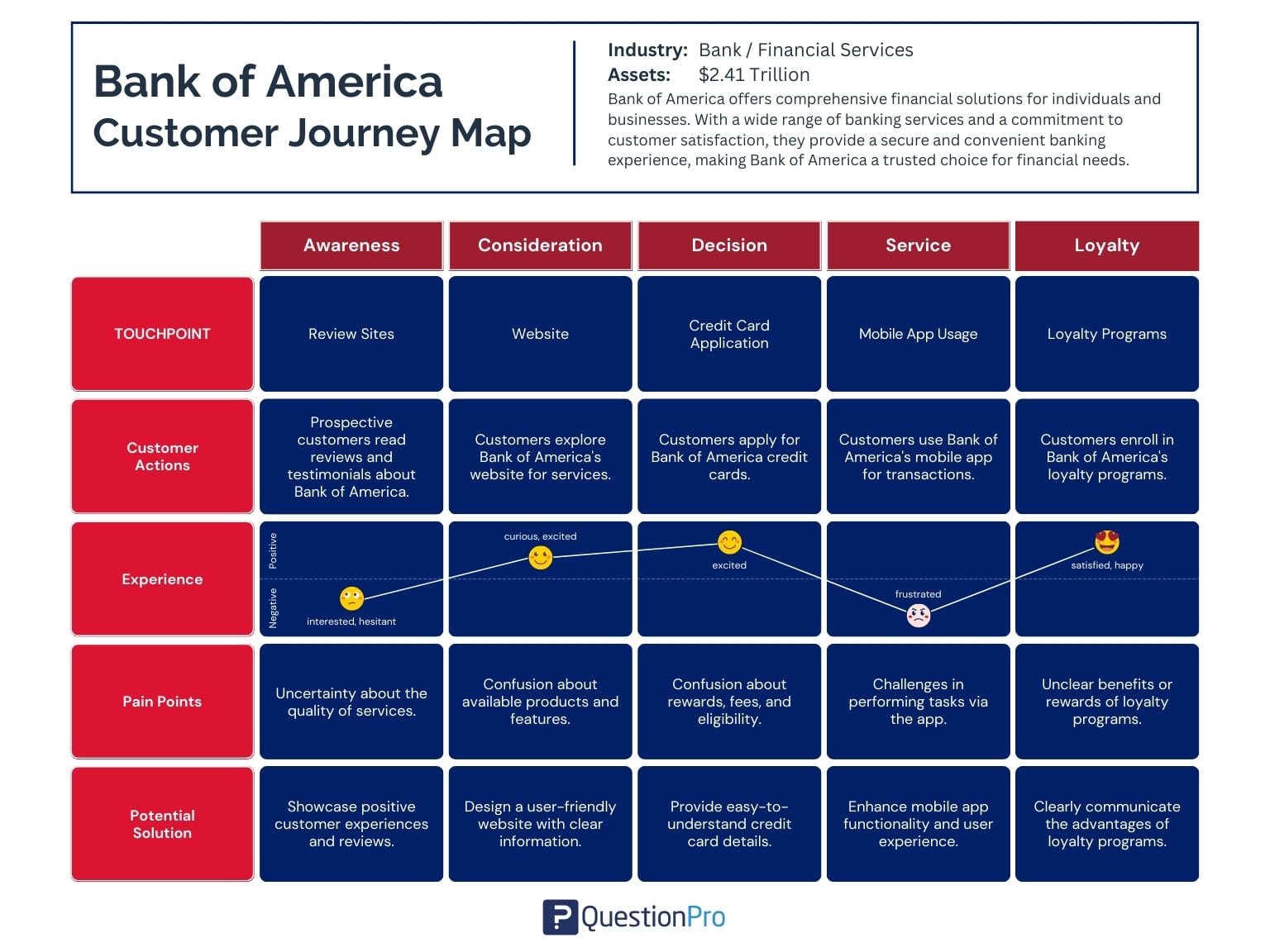
Bank of America hasn’t published its internal journey map. But its public initiatives map cleanly onto the standard banking journey. The table below shows how a CX team might build that map using the bank’s known programs, common industry pain points, and the fixes those programs represent.
| Stage | Key Touchpoints | Common Pain Point | How It’s Addressed |
|---|---|---|---|
| Awareness | Advertising, social media, referrals, financial education events | Prospects don’t know which products fit their needs | Targeted campaigns and free financial education content |
| Consideration | Website, mobile app previews, reviews, rate comparisons | Confusion about fees, rates, and account types | Clear product pages and visible rate and fee comparisons |
| Onboarding | Account opening, card and loan applications, branch visits | Long forms and unclear approval timelines | Streamlined digital applications with real-time status updates |
| Usage | Mobile app, online banking, ATMs, Erica virtual assistant | Difficulty completing tasks without calling support | In-app guidance, expanded ATM access, and AI-assisted self-service |
| Loyalty | BankAmeriDeals, personalized offers, mobile alerts | Rewards or offers that feel generic | Behavior-based offers tied to actual spending patterns |
| Advocacy | Referral programs, review sites, social engagement | Few incentives to refer or leave feedback | Referral rewards and active social response |
Reading this map top to bottom shows a pattern worth copying. Every fix targets a specific, named pain point, not a general “improve experience” goal. That specificity is what makes a journey map actionable instead of decorative, a pattern that holds true across the customer journey examples other industries build too.
What sets Bank of America’s customer experience apart?
Bank of America’s public CX initiatives cluster around four areas. These are the mobile app, its AI assistant, its rewards program, and how it blends digital convenience with in-person access.
Mobile and online banking
The Bank of America app centers a handful of core actions in one place:
- Managing checking, savings, and credit accounts
- Sending payments and transfers
- Budgeting and spending tracking
- Locking cards and managing security settings
Consolidating these actions into a single interface removes the need to jump between separate tools. That’s one of the most common sources of friction in an omnichannel banking journey that spans app, web, and branch.
Erica, the AI-powered virtual assistant
Erica is Bank of America’s built-in AI assistant. It launched in 2018 to help clients manage day-to-day finances with proactive, personalized guidance. As of March 2026, 20.6 million clients had interacted with Erica nearly 700 million times in the prior year. Total client interactions with Erica had surpassed 3.2 billion since launch, according to Bank of America’s own reporting. That scale matters. It shows AI-assisted self-service has moved from a novelty feature to a primary support channel for everyday banking questions.
BankAmeriDeals cashback offers
BankAmeriDeals gives account holders personalized cashback offers, surfaced directly in the mobile app. A few things make the program work:
- Offers come from retailers and restaurants the customer already shops at, not a generic list
- Cashback posts automatically once the customer uses their linked card at that merchant
- Offers rotate regularly, which keeps the loyalty stage from feeling static
This targeted approach reduces the “irrelevant rewards” pain point that shows up in the loyalty stage of most banking journey maps.
Online appointment scheduling
Bank of America also lets customers book branch appointments online instead of walking in and waiting. Scheduling ahead means customers meet a specialist at a set time, without a teller line, and can share what they need help with in advance so staff can prepare. This blends digital convenience with in-person expertise. That combination matters most for complex requests like mortgages or wealth transfers that customers are reluctant to handle purely by app.
How banks measure customer experience
A journey map only stays useful if it’s tied to numbers a team can track over time. Bank of America’s own feedback program, called Voices, rates client interactions on a 1-to-10 scale and asks whether the customer would recommend the bank. Both the score and any comments route straight to the employees and managers involved. Most banking CX teams build their measurement approach around a similar mix of metrics:
- Net Promoter Score (NPS): The percentage of promoters minus the percentage of detractors, based on “How likely are you to recommend us?” on a 0-10 scale
- Customer Satisfaction (CSAT): A 1-to-5 rating of a specific interaction, such as a branch visit or a support call
- Customer Effort Score (CES): A 1-to-7 rating of how easy a task was to complete, useful for app and online banking flows
- Digital engagement rate: The share of active customers using the app or online banking in a given period
- First-contact resolution: The percentage of support issues solved without a transfer or follow-up call
Tracking these side by side, broken out by journey stage, shows exactly where a strong overall score can hide a weak individual channel. That’s the same gap J.D. Power flagged in its 2026 study. Capital One’s customer experience approach follows a similar pattern of tying feedback to specific stages rather than one blended score.
Common mistakes when mapping the banking customer journey
Most banking journey maps fail for the same handful of reasons:
- Mapping the intended journey instead of the real one. Teams often map what the process is supposed to look like, not what customers actually experience when a step breaks.
- Treating the map as a one-time project. Products, channels, and regulations change fast enough that a map older than a year is usually already outdated.
- Ignoring the handoffs between channels. Most friction happens when a customer moves from app to phone to branch, not within any single channel.
- Building one map for every customer type. A retail checking customer and a wealth management client have different goals and pain points. A single generic map hides both.
- Collecting feedback without routing it anywhere. A survey score that never reaches the branch or team involved doesn’t change anything. JPMorgan Chase’s customer experience strategy works to avoid this by centralizing feedback routing.
Where to focus first: prioritizing your journey map fixes
Once a map is built, most teams have too many pain points and not enough budget to fix them all at once. Rank issues against the dimensions customers say matter most, then fix the highest-impact, lowest-effort items first.
- Score each pain point against customer priorities.
J.D. Power’s research ranks trust, people, account offerings, the ability to bank how and when customers want, saving time and money, digital channels, and resolving problems as the seven dimensions that drive satisfaction, in that order. Weight your fixes accordingly.
- Flag anything tied to trust or security first.
Issues here erode the relationship fastest and are the most expensive to repair once broken.
- Fix cross-channel handoffs before single-channel polish.
A customer who repeats themselves between chat and phone notices that before a minor app layout issue.
- Pilot the fix with one segment or branch region.
Confirm the change actually moves the metric before rolling it out everywhere.
- Re-survey the same touchpoint after the fix ships.
Without a before-and-after comparison, it’s impossible to know if the change helped.
Map your own banking customer journey with QuestionPro SuiteCX
A spreadsheet works for a first-draft journey map, but it breaks down once you need to update it regularly or tie it to live feedback. QuestionPro Journey Management Tool is purpose-built for this. It offers persona-based mapping templates for financial services, so a retail checking journey and a wealth management journey can live as separate, comparable maps instead of one flattened view. Two things it adds that a static diagram can’t:
- Live survey data feeding directly into each touchpoint on the map, so pain points update as new feedback comes in
- Persona-based templates that let banking teams compare journeys across customer segments side by side
The bar for banking customer experience keeps rising
Bank of America customer experience works because every initiative points at a named pain point in a specific journey stage, not a vague brand promise. That’s the real lesson for any bank or credit union building its own strategy. A journey map is only as useful as the specificity of the fixes attached to it. Switching between banks keeps getting easier, and expectations keep climbing. The institutions that keep mapping, measuring, and adjusting stage by stage are the ones that hold onto trust when a competitor is one tap away.
Frequently Asked Questions (FAQs)
Its initiatives target specific stages of the customer journey rather than a single generic goal. The AI assistant Erica supports the usage stage, BankAmeriDeals supports loyalty, and online appointment booking bridges digital convenience with in-person expertise for complex requests.
Most banking journey maps use five or six stages: awareness, consideration, onboarding or purchase, usage, loyalty, and advocacy. Each stage gets its own touchpoints, pain points, and planned fixes, which keeps improvement work specific rather than generic.
Net Promoter Score, Customer Satisfaction, Customer Effort Score, digital engagement rate, and first-contact resolution are the core set. Tracking them by journey stage reveals channel-level problems a single overall score can hide.
At least once a year, with lighter reviews whenever a product, channel, or regulation changes significantly. Journey maps built around outdated app features or discontinued programs quickly stop reflecting what customers actually experience.
No. Retail, wealth management, and small business customers have different goals and pain points from each other. Most banks build separate maps per segment rather than flattening every customer type into one generic view.