
A customer-first strategy is a business approach where every major decision is judged by how it affects the customer. It does not mean saying yes to every request. It means understanding customer needs, removing friction, and building products, services, and processes that make customers more likely to stay, buy again, and recommend your brand.
For US companies, this matters because customers have more choices, more public review channels, and less patience for poor service. Forrester’s US Customer Experience Index reported that only 3% of companies were categorized as customer-obsessed, while customer-obsessed organizations reported faster revenue growth, profit growth, and customer retention than companies that were not customer-obsessed.
What is a customer-first strategy?
A customer-first strategy means putting customer needs, expectations, and outcomes at the center of business decisions. It connects product, marketing, sales, support, operations, and leadership around one simple question: Will this make the customer experience better or worse?
This strategy works when it becomes part of daily decision-making. A pricing change, a product update, a support policy, or a shipping process should all be reviewed through the customer’s point of view.
A customer-first strategy usually includes:
- Clear customer research
- Customer journey mapping
- Regular feedback collection
- Fast response to customer issues
- Cross-team ownership of customer experience
- Metrics tied to loyalty, retention, and satisfaction
The goal is not to make every customer happy at any cost. The goal is to create a business that consistently understands customers and acts on what it learns.
How is a customer-first strategy different from “the customer is always right”?
A customer-first strategy is not the same as “the customer is always right.” The old phrase suggests the business should agree with the customer even when the request is unrealistic, unfair, or outside the company’s responsibility.
A customer-first strategy is more practical. It means listening carefully, explaining decisions clearly, and solving the real problem when possible.
For example, a customer may ask for a refund outside the policy. A customer-first response does not automatically mean approving it. It may mean reviewing the context, explaining the policy in plain language, offering a fair alternative, and documenting the issue so the business can prevent similar confusion later.
That approach protects both sides: the customer feels respected, and the company keeps standards that are consistent and sustainable.
Why does a customer-first strategy matter?
A customer-first strategy matters because customer experience has a direct effect on loyalty, referrals, retention, and revenue. When customers feel heard and supported, they are more likely to stay with a company and less likely to switch after one bad moment.
This is especially important in the USA, where many industries are crowded, and switching costs are often low. A customer can compare software, banks, retailers, healthcare providers, and service companies in minutes.
A strong customer experience strategy helps companies:
- Reduce churn
- Improve customer satisfaction
- Find product gaps earlier
- Turn complaints into service improvements
- Build trust through transparency
- Increase repeat purchases and referrals
Customer-first companies do not wait for complaints to become trends. They look for weak signals early, then fix the process behind the issue.
Learn about: A complete guide to customer experience management strategy
What are the pros and cons of a customer-first strategy?
A customer-first strategy can create stronger relationships, but it also needs structure. Without clear priorities, teams may confuse “customer first” with “do everything customers ask.”
| Pros | Cons |
| Improves customer loyalty and retention | Can become expensive without clear limits |
| Helps teams make better decisions | Requires strong cross-team alignment |
| Reduces repeated complaints | Needs regular feedback and analysis |
| Creates better products and services | Can slow decisions if ownership is unclear |
| Builds trust with customers | Requires leadership support, not just support team effort |
The best approach is to define where the company can be flexible and where it must set boundaries. Customers usually do not expect perfection. They expect honesty, speed, and a fair solution.
Step-by-step guide to building a customer-first strategy
A customer-first strategy works best when it is built in clear steps. Each step should answer a specific customer question and connect to a business action.
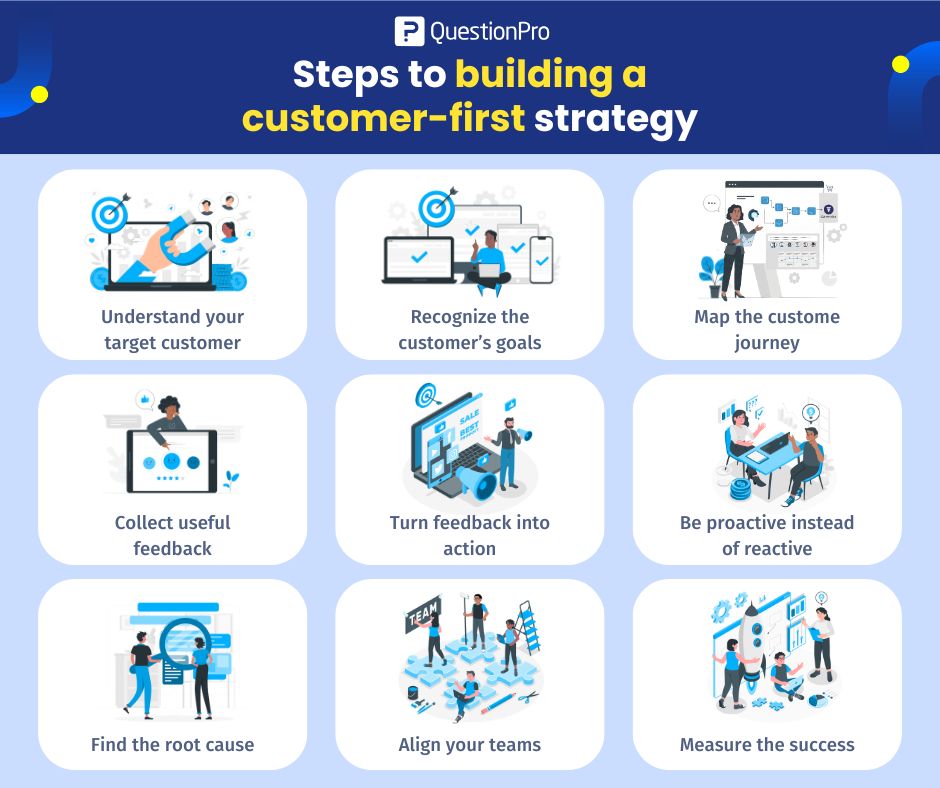
1. Who is your target customer?
Start by defining the customer you are trying to serve. A company cannot be customer-first if it treats every audience the same.
Look at customer data, sales notes, support tickets, website behavior, reviews, and survey responses. Your goal is to understand who buys from you, why they buy, what they expect, and what gets in their way.
Useful details include:
- Industry or market segment
- Company size or household profile
- Role or decision-making power
- Buying motivation
- Main pain points
- Common objections
- Support needs
- Renewal or repeat purchase behavior
For US audiences, segmentation may also include region, state-level regulations, language preference, income range, or local service expectations when those factors affect the experience.
2. What goals are customers trying to achieve?
Customers do not buy a product just to own it. They buy it because they want a result. A customer-first strategy should identify that result clearly.
For example:
- A small business buying survey software may want faster customer feedback.
- A healthcare team may want better patient experience data.
- A retail brand may want to understand why repeat purchases are dropping.
- A SaaS company may want to reduce churn after onboarding.
Once you know the customer’s goal, you can judge whether your product, service, and communication actually help them reach it.
This is where many companies miss the mark. They focus on features, while customers care about outcomes.
3. How do you map the customer journey?
Customer journey mapping is the process of outlining each step a customer takes with your business, from awareness to purchase, support, renewal, and advocacy.
A good customer journey map shows:
- What the customer is trying to do
- Which channel they use
- What questions they have
- Where friction appears
- Which team owns that moment
- What data is collected
- What action should happen next
This makes customer problems easier to fix. Instead of saying “support is slow,” you can identify that customers are confused during onboarding, contacting the wrong team, or waiting too long for a handoff.
Journey mapping is also a natural place to connect a customer-first strategy with customer experience management software, especially when teams need surveys, dashboards, journey data, and closed-loop feedback in one place. QuestionPro CX supports customer journey management, feedback collection, analytics, and closed-loop workflows.
4. How do you collect customer feedback without creating noise?
A customer feedback strategy is the system a company uses to collect, organize, and act on customer opinions. The key is to ask the right questions at the right time.
Do not rely only on annual surveys. Use feedback at key moments, such as:
- After onboarding
- After a support interaction
- After a purchase
- After a cancellation
- Before renewal
- After a product update
Use short surveys when the moment is simple. Choose interviews when the issue needs context. Add open-ended questions when you need customers to explain the reason behind a score.
Common customer feedback metrics include:
- NPS: Net Promoter Score, used to measure likelihood to recommend.
- CSAT: Customer Satisfaction Score, used to measure satisfaction with a specific interaction.
- CES: Customer Effort Score, used to measure how easy or hard it was to complete a task.
The point is not to collect more data. The point is to collect feedback your team can actually use.
5. How do you turn feedback into action?
Feedback only matters when someone owns the next step. A strong customer-first strategy needs a closed feedback loop.
A feedback loop means the business collects feedback, reviews it, assigns action, follows up, and tracks whether the issue improves.
A simple process looks like this:
- Collect feedback from the customer.
- Tag the issue by topic, team, and severity.
- Assign ownership.
- Fix the issue or explain the limitation.
- Follow up with the customer when needed.
- Track the trend over time.
This prevents feedback from becoming a dashboard no one uses. It also shows customers that their input was not ignored.
6. How can teams be proactive instead of reactive?
A proactive customer experience strategy solves problems before customers have to complain. This is often where customer-first companies separate themselves from companies that only respond when something breaks.
Examples of proactive service include:
- Warning customers about a known issue before they report it
- Sending onboarding tips based on customer behavior
- Flagging accounts with falling engagement
- Reaching out before renewal if usage drops
- Offering help when a customer repeats the same failed action
Proactive service requires customer data, but it also requires judgment. Not every alert needs a message. The best teams focus on moments where outreach is useful, timely, and specific.
7. How do you use the 5 Whys method for customer problems?
The 5 Whys method is a root cause analysis technique where teams ask “why” several times until they find the real cause of a problem. Root cause means the underlying issue, not just the visible symptom.
Example:
Problem: Customers are complaining that onboarding takes too long.
- Why? They are waiting too long for setup instructions.
- Why? The instructions are sent manually by the support team.
- Why? There is no automated onboarding email for new accounts.
- Why? Marketing and support never agreed on ownership.
- Why? The onboarding process was not mapped after the last product update.
The real issue is not just slow support. It is an unclear onboarding process with no ownership. That is the kind of finding a customer-first strategy should uncover.
8. How do you align employees around customer-first goals?
Employees create the customer experience. If internal teams are confused, overloaded, or measured only on speed, customers will feel it.
A customer satisfaction strategy should include employees because frontline teams often know where customers struggle before leadership sees it in reports.
Ask teams:
- What customer complaints repeat every week?
- Which policies create the most friction?
- Which tools slow down service?
- Which customer questions are hard to answer?
- Where do handoffs fail?
Then connect customer goals to team goals. Support should not own the customer experience alone. Product, sales, marketing, operations, finance, and leadership all shape what customers experience.
9. How do you measure customer-first strategy success?
A customer-first strategy should be measured with customer, operational, and business metrics. One metric is never enough.
Track customer metrics such as:
- NPS
- CSAT
- CES
- Review ratings
- Customer sentiment
- Complaint themes
Also track operational metrics such as:
- First response time
- Resolution time
- Repeat contact rate
- Onboarding completion rate
- Escalation rate
Track business metrics such as:
- Retention rate
- Churn rate
- Renewal rate
- Repeat purchase rate
- Referral volume
- Customer lifetime value
The best signal is not one good score. It is a pattern: fewer repeated problems, faster recovery, better retention, and customers who say the experience is easier.
How much does a customer-first strategy cost?
A customer-first strategy can cost very little at the start, but it requires time, ownership, and consistency. The cost depends on company size, feedback channels, research needs, technology, and whether teams need outside support.
Typical cost areas include:
- Survey and feedback tools
- Customer experience management software
- Journey mapping workshops
- Customer research interviews
- Data analysis and reporting
- Training for support and frontline teams
- Process improvements
- Customer success or CX staffing
A small US business may begin with simple surveys, customer interviews, and a shared feedback tracker. A larger company may need a full Voice of Customer program, dashboards, text analytics, CRM integrations, and closed-loop case management.
The practical rule: start with the highest-friction customer moments before buying more tools. Technology helps, but it cannot fix unclear ownership or poor follow-through.
What mistakes should companies avoid?
The biggest mistake is treating customer-first as a slogan. Customers notice what the company does, not what it says.
Avoid these common mistakes:
- Asking for feedback and never acting on it
- Tracking NPS without reading open-text responses
- Making support responsible for problems caused by the product or policy
- Confusing speed with quality
- Rewarding sales growth while ignoring churn
- Saying yes to every request without clear boundaries
- Using customer data without explaining how it improves the experience
A customer-first strategy should be honest. If you cannot fix something right away, say so. If a request is not possible, explain why. Clear communication often protects trust better than vague promises.
How can QuestionPro support a customer-first strategy?
QuestionPro can support a customer-first strategy by helping teams collect feedback, understand customer needs, analyze trends, and close the loop with customers.
For example, teams can use QuestionPro to:
- Run customer satisfaction surveys
- Track NPS, CSAT, and CES
- Collect feedback across customer touchpoints
- Analyze open-ended responses
- Build dashboards for teams and leaders
- Map customer journeys
- Identify detractors and follow up
- Share customer insights across departments
A customer-first strategy works when feedback becomes part of everyday decisions. QuestionPro helps make that process easier by connecting feedback collection, analysis, and action in one workflow.
Conclusion
A customer-first strategy is not only good practice but also required to retain and nurture your customers. They prefer to do business with companies that understand and meet their needs.
When you have a complete team, transparent approaches, original ideas, and a genuine love for your customers, you can completely change the game. Use the steps we just discussed, and you’ll be well on your way to scoring the game.
Do you have any concerns or questions about the customer-first strategy? Fill out the contact form to reach out to us. We eagerly await your call! Alternatively, you can book a free demo right now.
Customer-First Strategy FAQs
A customer-first strategy means making business decisions based on customer needs, expectations, and outcomes. It helps companies improve customer experience, reduce friction, and build stronger long-term relationships.
An example is a SaaS company that notices new US customers often contact support during onboarding. Instead of only answering tickets faster, the company redesigns onboarding emails, adds in-product guidance, and checks in before customers get stuck.
Customer-first and customer-centric are closely related, but they are not always the same. Customer-first usually describes the decision-making mindset. Customer-centric strategy often describes the broader operating model, including research, journey mapping, metrics, and team alignment.
Measure it with a mix of customer and business metrics. Useful metrics include NPS, CSAT, CES, churn rate, retention rate, repeat purchase rate, first response time, and complaint themes.
US customers often have many alternatives and can share negative experiences quickly through reviews, social media, and community forums. A customer-first strategy helps companies earn trust, respond faster, and reduce preventable churn.
The first step is understanding your target customer. Review feedback, sales data, support tickets, interviews, and behavior patterns to identify who your customers are, what they need, and where the experience breaks down.