Customer journey analysis is the process of evaluating every interaction a customer has with your brand across the entire lifecycle. It examines how touchpoints connect, where friction occurs, and how those experiences influence retention, loyalty, and revenue.
In competitive US markets, small breakdowns quickly turn into churn. Understanding the full journey is no longer optional. It directly affects lifetime value and brand reputation.
In this guide, we’ll explore what customer journey analysis is, how it works, and how companies can apply it in business settings.
What is customer journey analysis?
Customer journey analysis is the systematic process of examining how customers interact with a business across multiple touchpoints and stages.
A touchpoint is any interaction between a customer and a company, including:
- Website visits
- Mobile app usage
- Customer support calls
- In-store visits
- Email communication
Rather than evaluating single metrics like NPS or CSAT in isolation, customer journey analysis links performance data across the full lifecycle. This typically includes:
- Awareness
- Consideration
- Purchase
- Onboarding
- Ongoing support
- Renewal or cancellation
By connecting these stages, organizations can pinpoint where friction occurs, uncover recurring behavior patterns, and make targeted improvements that strengthen the overall customer experience.
Why is customer journey analysis important?
Customer journey analysis is important because it reveals how experiences across touchpoints influence real business outcomes. Instead of treating interactions as isolated events, it connects behavior, feedback, and operational performance into one lifecycle view.
In competitive US markets, customers move quickly between brands. If onboarding is confusing, support is slow, or billing communication lacks clarity, they often switch providers rather than wait for improvement. Small friction points compound over time and quietly increase churn.
Customer journey analysis matters because it:
- Identifies root causes of churn
- Connects marketing, product, and support performance
- Reveals friction before revenue is affected
- Supports lifecycle optimization
In mid-sized US SaaS companies, this often reveals onboarding complexity as a primary churn driver, even when pricing and product quality remain competitive. Without journey-level visibility, these patterns are easy to miss.
When organizations understand how stages influence one another, they can act earlier, prioritize smarter, and protect long-term customer value.
How does customer journey analysis work?
Customer journey analysis works by connecting journey mapping, behavioral data, and customer feedback into a unified view of the lifecycle. The goal is not simply to measure satisfaction at a single touchpoint, but to understand how experiences at one stage influence outcomes at another.
At a high level, the process follows four core principles:
Step 1: Map the customer journey
Customer journey mapping is the visual outline of every stage and touchpoint customers experience. It creates a shared understanding across marketing, product, sales, and support teams.
A typical journey map includes:
- Key lifecycle stages
- Primary touchpoints
- Customer goals at each stage
- Known pain points
- Emotional shifts
Mapping matters because internal assumptions are often wrong. For example, teams may believe onboarding is smooth because conversion rates are strong, while customers may be confused during setup but push through anyway.
A clear map anchors the analysis in reality.
Step 2: Collect experience and behavioral data
Journey analysis requires combining feedback metrics such as NPS and CSAT with operational and behavioral data like website activity, resolution time, and churn patterns.
In US markets, where customers move fluidly between digital and offline channels, integrating omnichannel data is critical. Without cross-channel visibility, important cause-and-effect relationships remain hidden.
Step 3: Identify cross-stage relationships
Instead of analyzing each touchpoint in isolation, customer journey analysis examines how early friction influences later behavior.
For example:
- Does poor onboarding predict lower renewal rates?
- Do repeated support contacts reduce loyalty?
- Does delayed follow-up affect repeat purchases?
This cross-stage perspective distinguishes journey analysis from traditional reporting.
For a structured overview of measurement frameworks and analytical tools, see this guide on customer journey analytics.
Step 4: Translate insights into operational action
The final principle is execution. Insights must lead to changes in processes, communication, or design.
Reducing onboarding complexity, improving support responsiveness, or clarifying pricing communication are common examples.
Customer journey analysis works when mapping, measurement, and operational change are tightly connected. Without action, data becomes static. Without data, improvement becomes guesswork.
Step-by-step guide to customer journey analysis
Customer journey analysis becomes manageable when broken into clear stages. Each step builds on the previous one. Skipping steps usually leads to incomplete insights or disconnected improvements.
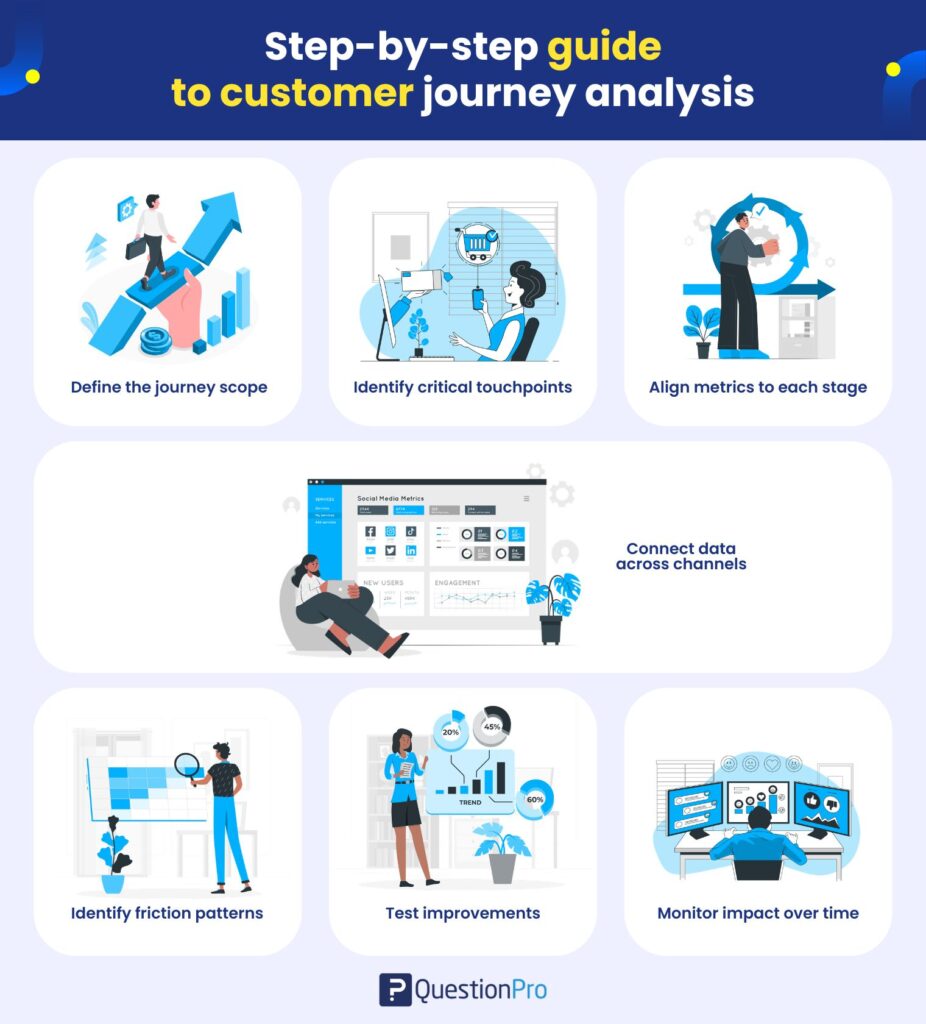
Step 1: Define the journey scope
Start small and focused. Choose one high-impact journey, such as:
- New customer onboarding
- Subscription renewal
- Product purchase
- Support resolution
Trying to analyze the entire lifecycle at once creates complexity and delays action. A single journey with clear business impact allows faster learning and measurable results.
Ask:
- Which journey most affects revenue?
- Where do customers drop off most often?
- Which stage generates the most complaints?
A clear scope prevents analysis from becoming abstract.
Step 2: Identify critical touchpoints
Not every interaction carries equal weight. Focus on moments that influence decisions or perception.
Examples of critical touchpoints:
- Checkout process
- Account setup
- Cancellation flow
- First support interaction
- Billing communication
These are often referred to as “moments of truth,” meaning points where customers decide whether to continue, upgrade, or leave.
Mapping critical touchpoints ensures the analysis prioritizes what actually drives behavior, not just what is easy to measure.
Step 3: Align metrics to each stage
Every stage of the journey needs at least one measurable indicator. Without metrics, improvement becomes guesswork.
Common stage-level metrics include:
- Conversion rate: Percentage of users who complete a desired action
- Time to resolution: Average time required to resolve support issues
- NPS: Net Promoter Score, which measures loyalty by asking how likely customers are to recommend the company
- CSAT: Customer Satisfaction Score, which measures immediate experience satisfaction
- Retention rate: Percentage of customers who continue using the product or service over time
The key is alignment. For example:
- Onboarding may focus on time-to-value and early satisfaction.
- Support may focus on resolution speed and follow-up ratings.
- Renewal may focus on retention and promoter scores.
Each stage should answer a clear question: Is this part of the journey helping or hurting long-term loyalty?
Also read: Customer journey analytics metrics and why they matter?
Step 4: Connect data across channels
Modern customer journeys are rarely linear. A customer may:
- Discover a brand through social media
- Research on the desktop
- Purchase on mobile
- Contact support by phone
- Renew via email
Omnichannel feedback collection ensures that analysis reflects this reality.
If website analytics, survey data, CRM systems, and call center logs remain disconnected, patterns remain hidden. For example, repeated website visits before cancellation may signal confusion that never appears in a survey score.
Customer journey analysis must integrate behavioral data with feedback data to create a unified view.
Also learn: Omnichannel customer journey strategies & solutions
Step 5: Identify friction patterns
This step moves from measurement to insight.
Look for:
- Drop-offs between stages
- Repeated complaints in open-ended responses
- Low satisfaction clusters tied to specific touchpoints
- Delays correlated with churn
Sentiment analysis, which evaluates the emotional tone of written feedback, can help detect patterns in open-text responses. For example, recurring words like “confusing,” “slow,” or “unclear” often signal structural issues.
The goal is not just to spot dissatisfaction, but to understand why it happens and where it begins.
Step 6: Test improvements
Once friction points are identified, test solutions before rolling them out broadly.
Examples:
- Simplify onboarding steps for a test group
- Shorten support scripts
- Clarify pricing language on the checkout page
- Adjust follow-up email timing
Controlled experiments reduce risk. Comparing a test group to a control group reveals whether changes actually improve conversion, satisfaction, or retention.
Customer journey analysis without experimentation leads to assumptions. Testing turns assumptions into validated decisions.
Step 7: Monitor impact over time
Customer journey analysis is ongoing
After implementing improvements:
- Track metric changes over several months
- Compare retention rates before and after changes
- Monitor complaint trends
- Re-evaluate touchpoints as customer behavior shifts
In US markets where customer expectations evolve quickly, periodic reviews are not enough. Continuous monitoring ensures the journey remains aligned with real behavior and competitive standards.
One-time audits provide insight. Continuous journey analysis drives sustainable improvement.
Also learn: What is customer journey monitoring, tools, and its importance
What is the difference between customer journey mapping and journey analytics?
This is one of the most common questions.
Customer journey mapping is qualitative and visual. It shows stages and emotions. Journey analytics is quantitative and behavioral. It connects data points across systems to measure how people actually move through the journey.
In practice:
- Mapping helps teams understand structure.
- Analytics validates assumptions with data.
Both are necessary for effective customer journey analysis.
Also read: How to use customer journey analytics effectively
What are the pros and cons of customer journey analysis?
Customer journey analysis can significantly improve decision-making, but only when implemented with discipline and clear ownership. Like any structured framework, it comes with advantages and trade-offs.
Understanding both sides helps organizations set realistic expectations and avoid common pitfalls.
What are the main benefits of customer journey analysis?
The main benefits of customer journey analysis lie in its ability to connect cause and effect across the customer lifecycle. Instead of reacting to declining satisfaction scores, teams can identify which touchpoints drive long-term outcomes.
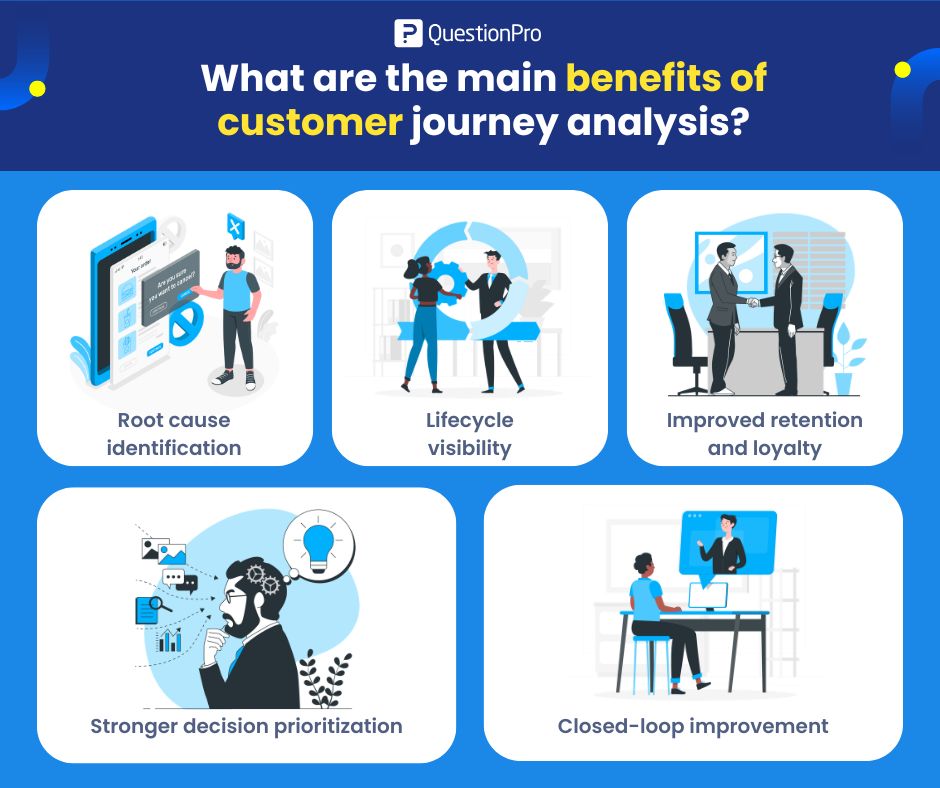
Key benefits include:
- Root cause identification
Links early friction, such as onboarding delays, to later churn or cancellation.
- Lifecycle visibility
Shows how awareness, purchase, support, and renewal interact rather than operating as silos.
- Improved retention and loyalty
Detects risk signals early, allowing teams to intervene before customers leave.
- Stronger decision prioritization
Highlights which stages influence revenue most, guiding resource allocation.
- Closed-loop improvement
Integrates feedback with operational action, ensuring customer concerns lead to measurable change.
In practice, organizations often discover that churn is rarely caused by a single dramatic failure. It is usually the result of repeated friction across multiple stages. Customer journey analysis makes those patterns visible and actionable.
By turning scattered data into a connected lifecycle view, companies gain clarity, accountability, and measurable improvement in customer experience performance.
What are the challenges and risks of customer journey analysis?
Customer journey analysis requires coordination, data integration, and executive sponsorship. Without structure, it can quickly become a complex reporting exercise that produces insight but no change.
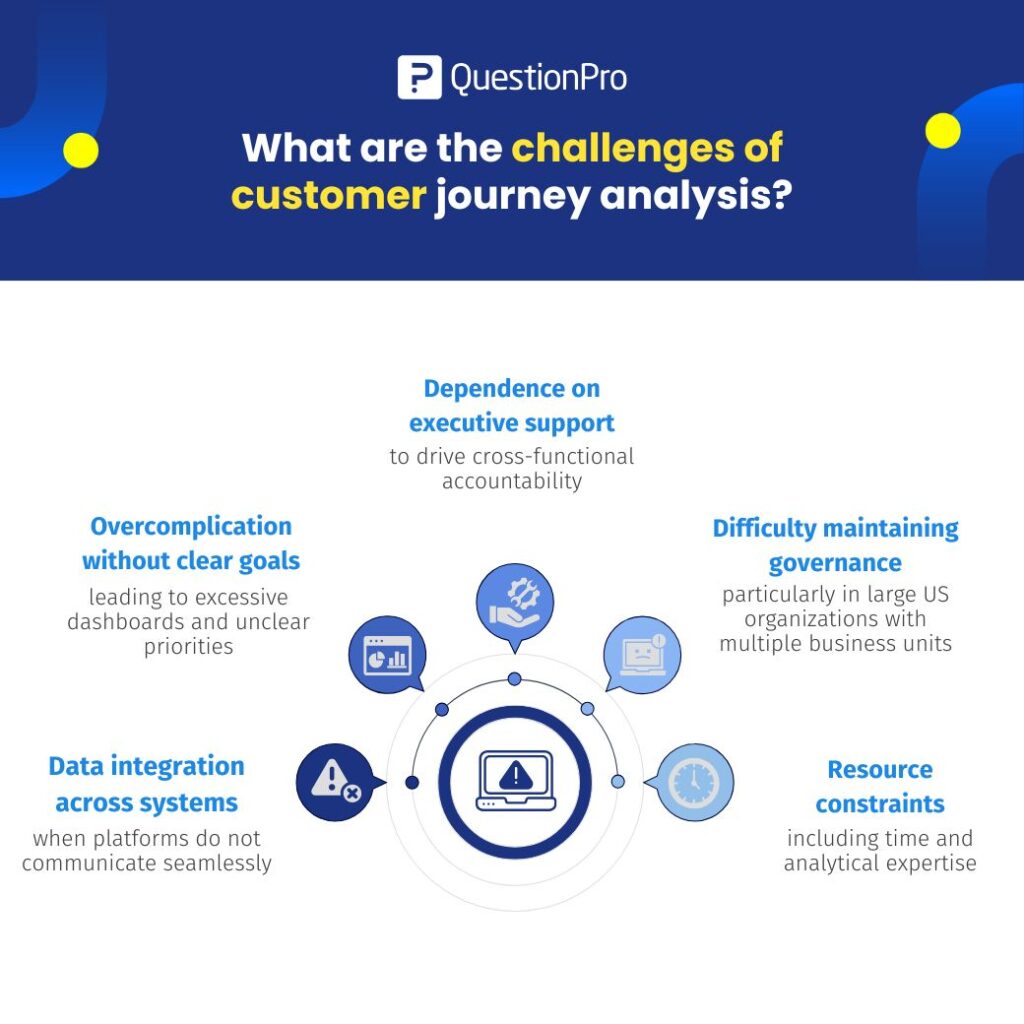
Common challenges include:
- Data integration across systems, especially when CRM, survey tools, and operational platforms do not communicate seamlessly
- Overcomplication without clear goals, leading to excessive dashboards and unclear priorities
- Dependence on executive support to drive cross-functional accountability
- Difficulty maintaining governance, particularly in large US organizations with multiple business units
- Resource constraints, including time and analytical expertise
Without governance and accountability, journey programs stall. Insights remain in slide decks instead of shaping operations. The difference between success and failure often comes down to ownership, prioritization, and follow-through.
Also read: Is data analytics worth it for customer experience?
Common mistakes in customer journey analysis
Customer journey analysis often starts with strong intent but loses impact because of structural mistakes. Many organizations invest in mapping exercises, dashboards, and feedback programs, yet fail to translate insights into measurable change. The problem is rarely a lack of data. It is misalignment, narrow focus, or poor execution.
Below are the most common mistakes that limit the effectiveness of customer journey analysis, especially in complex US markets where customer expectations are high and competition is constant.
- Focusing only on satisfaction scores
- Ignoring operational data
- Mapping journeys without validating them
- Treating insights as a marketing-only responsibility
- Failing to act on findings
Customer journey analysis succeeds when it is treated as an enterprise responsibility rather than a reporting exercise. It requires cross-team integration, data-driven validation, and consistent follow-through.
Real progress happens when marketing, product, operations, and leadership share ownership of the journey. Without cross-functional accountability, even the most detailed analysis will fail to improve the customer experience.
How can QuestionPro support customer journey analysis?
Customer journey analysis requires more than isolated surveys. It demands connected feedback, behavioral tracking, and analytics that reflect how customers actually move across touchpoints. This is where an integrated platform becomes critical.
QuestionPro supports customer journey analysis by helping teams:
- Collect omnichannel feedback
- Trigger stage-based surveys
- Track NPS and CSAT by touchpoint
- Combine operational and experience data in BI dashboards
- Automate alerts for closed-loop workflows
For US companies managing large customer bases, automation and segmentation matter. QuestionPro allows teams to segment results by region, product line, or customer type, making it easier to identify localized friction or performance gaps.
The platform also supports closed-loop feedback workflows. When a customer reports a poor experience, alerts can be triggered so teams can follow up quickly. This helps reduce churn and strengthens retention efforts.
Customer journey analysis works best when insights lead to action. By centralizing data collection, analytics, and reporting, QuestionPro helps organizations move from isolated metrics to a structured, measurable journey strategy.
Why customer journey analysis should guide business decisions
Customer journey analysis is not a reporting exercise. It is a decision framework. When done properly, it connects touchpoints, behavior, and feedback into a single, measurable view of how customers experience your brand.
For US businesses operating in competitive, digital-first markets, small friction points can quickly turn into churn. Journey analysis helps identify those weak spots early, before they affect retention or revenue. It also aligns teams around real customer behavior instead of internal assumptions.
The key is consistency. Map clearly. Measure what matters. Connect data across channels. Act on findings. Then monitor the impact.
When customer journey analysis becomes part of regular operations rather than a one-time project, it turns customer experience into a managed, measurable business asset.
Frequently Asked Questions About Customer Journey Analysis
Answer: It means studying every step a customer takes with your company to identify where friction occurs. The goal is to improve retention and long-term loyalty by fixing weak points in the lifecycle.
Answer: Customer experience management focuses on overall strategy and governance. Customer journey analysis is the tactical process of examining specific stages and touchpoints within the customer journey.
Answer: US markets are highly competitive and digitally mature. Small friction points can quickly lead to churn because alternatives are easy to find.
Answer: Ongoing monitoring is recommended. At a minimum, major journeys should be reviewed quarterly to track changes in behavior or satisfaction.
Answer: Common tools include survey platforms, behavioral analytics software, CRM systems, and business intelligence dashboards that combine feedback with operational data.