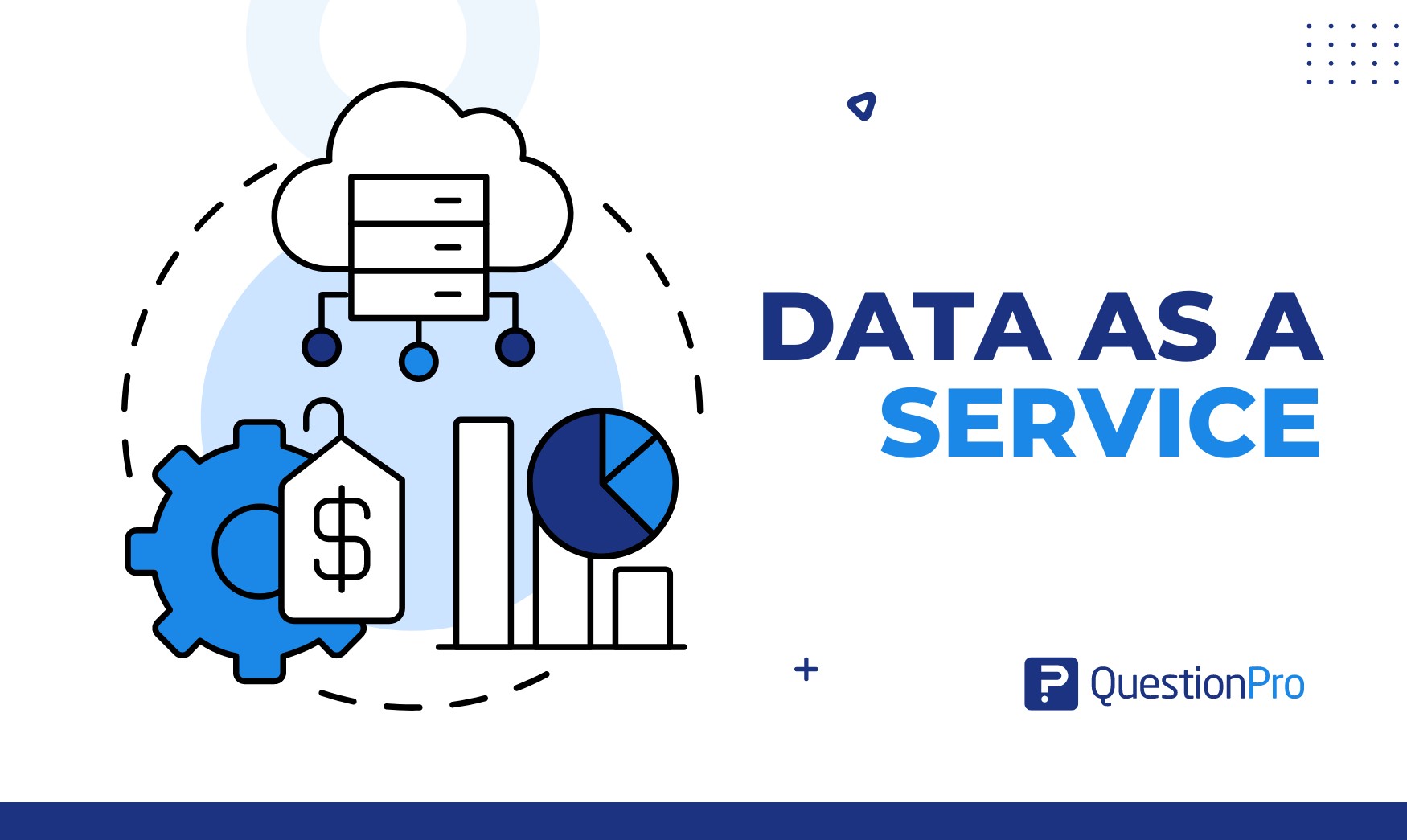
Data as a service (DaaS) is a cloud model that delivers data to customers on demand, usually through an API, a file download, or a dashboard. The customer never builds the storage or the pipelines. A provider collects, cleans, and maintains the data, and customers pay to use it.
That simple trade explains why DaaS now sits behind credit checks, mapping apps, marketing lists, and market research. Teams get fresh data without running the machinery behind it.
In this blog, we’ll explain how DaaS works, compare it with look-alike terms, and walk through examples, use cases, risks, and a simple way to choose and measure a provider.
What is data as a service?
Data as a service is a cloud-based delivery model in which a provider supplies data to customers on demand over a network. Customers use the data without building or maintaining the systems behind it.
The model borrows from cloud computing. Cloud computing is “a model for enabling ubiquitous, convenient, on-demand network access to a shared pool of configurable computing resources”. DaaS applies the same idea to data instead of servers.
Two parties take part:
- The provider owns collection, quality, storage, and updates.
- The consumer queries or downloads the data and pays by subscription or by usage.
DaaS also works inside one company. A central data team can serve other departments the same way a vendor would, with clear access points and clear support.
How does data as a service work?
DaaS works by storing curated data in the cloud and exposing it through standard access points that customers can call at any time. The customer sees a simple request and a ready answer.
- Collect: The provider gathers data from sources such as sensors, public records, partners, or surveys.
- Clean and enrich: The provider standardizes the data and adds missing details. Enrichment means filling gaps, such as adding company size to a contact record.
- Store: The data lands in cloud storage, often a data warehouse, which is a database built for analysis.
- Expose: The provider offers access through APIs, files, tables, or dashboards. An API is a standard way for software to request data. AWS Data Exchange, for example, lists data files, data tables, and data APIs as access formats.
- Meter and refresh: Customers sign in and pull data. The provider counts usage, bills for it, and updates the data on a schedule.
On the customer side, the feed usually flows into a BI tool, a CRM, or a model. Many teams combine it with their own records through data integration.
How is data as a service different from SaaS, data as a product, and traditional data management?
DaaS delivers data, SaaS delivers software, and data as a product is a management approach. People mix these terms up often, and the confusion can derail vendor talks.
| Term | What you get | Who runs the infrastructure | Example |
|---|---|---|---|
| Data as a service | Data delivered on demand | The provider | A credit bureau API that returns a score |
| Software as a service (SaaS) | Software you use through a browser or app | The provider | A survey tool or a CRM |
| Data as a product | A way of treating each dataset like a product, with an owner and quality promise | Your own teams | A governed customer table with documentation |
| Traditional data management | Data you store and maintain yourself | Your IT team | An on-premises warehouse built in-house |
The two ideas also work together. A DaaS provider that follows the product mindset will document its data, name an owner, and promise quality. Our guide to data as a product explains that approach in detail.
What are the types of data as a service?
DaaS comes in several forms, depending on what the provider delivers. Most offers fit one of the groups below.
- Raw or licensed datasets: Unprocessed records, such as transaction logs or public statistics.
- Enriched datasets: Records with extra attributes added, such as location or firmographics (company traits like size and industry).
- Insights and benchmarks: Finished analysis, such as percentile comparisons against peers.
- Data integration as a service (DIaaS): A vendor that moves and merges data across systems for you.
- Data quality as a service (DQaaS): A vendor that cleans, checks, and fixes records.
- Master data management as a service (MDMaaS): A vendor that keeps one trusted version of core records, such as customers or products.
- Data marketplaces: Platforms where buyers and sellers trade datasets, such as demographic or consumer data.
The first three describe what you buy. The next three describe work done on your behalf. Marketplaces describe where you shop.
What are examples of data as a service?
Real DaaS examples range from regulated credit data to free government statistics. The table shows how different they can look.
| Provider type | Example | What customers get | Typical use |
|---|---|---|---|
| Credit bureaus | Experian, TransUnion, Equifax | Credit history and scores | Lending and screening decisions |
| Government open data | Census Bureau Data API | Raw statistical data tied to geographic areas | Site selection and planning |
| Cloud data marketplace | AWS Data Exchange | Third-party datasets by file, table, or API | Enrichment and analytics |
| Research panel data | QuestionPro Audience | Access to online panelists, with 300+ profile data points per member, according to its product page | Survey sampling and market research |
| Mobility data | Streetlight Data | Traffic and movement data | City and transit planning |
What are the common use cases of data as a service?
DaaS suits any task where fresh outside or shared data improves a decision. Seven use cases show up across most industries.
- Market research and customer insights: Teams pull panel, survey, and market data into one place to find customer insights faster.
- Personalized marketing: A marketer joins behavior data with third-party attributes to build customer segments and tailor campaigns.
- Predictive analytics: Analysts feed prepared datasets into models for churn, demand, or adoption forecasts.
- Supply chain optimization: Planners combine inventory, supplier, shipment, and demand signals.
- Risk management and fraud detection: Banks and retailers check outside data against spending patterns to flag unusual activity.
- Benchmarking: A company compares its results with industry peers using aggregated data.
- Financial reporting: Finance teams automate reports from shared, governed sources.
Pick use cases where speed matters and the data changes often. Static data rarely needs a subscription.
What are the pros and cons of data as a service?
DaaS lowers upfront cost and speeds up access, but it adds dependence on a provider and new security duties. The right answer depends on how critical the data is to your business.
Pros:
- Lower upfront cost: Spending shifts from capital expenditure, the large upfront cost of owned infrastructure, to operating expenditure, the ongoing cost of a subscription.
- Speed: Teams can start using data in days instead of building pipelines for months.
- Scalability: Providers can scale storage and delivery as demand grows.
- Consistent quality: A specialist provider often cleans and updates data better than a busy internal team.
- Wider access: More people reach trusted data without waiting on a central team.
Cons:
- Security and privacy exposure: Data moves across networks and vendors, which widens the attack surface.
- Vendor lock-in: Switching providers can mean reworking integrations.
- Variable quality: Not every provider documents how accurate or fresh its data is.
- Legacy system friction: Older tools may not connect cleanly to APIs.
- Cost creep: Usage-based pricing can grow faster than expected.
- Unclear rights: Licenses may limit resale, storage, or model training.
How do you keep data as a service secure and compliant?
Secure DaaS depends on encryption, strict access control, audit logs, and a contract that spells out each party’s duties. In the US, the rules depend on the type of data involved.
Credit and screening data falls under the Fair Credit Reporting Act. The Federal Trade Commission explains that the law protects data held by credit bureaus, medical information providers, and tenant screening services, and limits who may access it. State laws such as the California Consumer Privacy Act give residents rights to know, delete, and correct personal information. Health data may fall under HIPAA.
Practical controls include:
- Encrypt data in transit and at rest.
- Give each user the minimum access they need.
- Log every query and download.
- Ban resale or re-sharing in the contract unless you need it.
Strong data governance ties these controls together. Governance sets the rules, and the provider contract enforces them.
Step-by-step guide to choosing a data as a service provider
Choose a provider by testing the data against a real decision, not by reading the sales deck. The steps below work for most purchases.
- Define the decision.
Write down which question the data must answer and who will use it. - Check coverage.
Confirm the data covers your regions, segments, and time range. - Test a sample.
Compare a sample with records you already trust, and note the match rate. - Confirm delivery fit.
Make sure the API, file, or table format works with your tools. - Review security and compliance.
Ask for certifications, audit reports, and data handling terms. - Model total cost.
Estimate cost at current volume and at three times that volume. - Read the SLA.
A service level agreement (SLA) is a written promise about uptime, support, and fixes. - Run a pilot.
Try the service with one team for 30 to 60 days before you sign a long contract.
If two providers tie, pick the one with clearer documentation. Good documentation predicts good support.
What should a data as a service contract include?
A good DaaS contract states exactly what data you get, how fresh it is, and what happens when something breaks. Many problems trace back to terms nobody wrote down.
A data contract is a written agreement about the shape and meaning of the data. Pair it with the SLA, and cover these points:
- Schema and definitions: Field names, formats, and plain-language meanings.
- Freshness: How often data updates, such as daily by 8 a.m.
- Uptime: The share of time the service must be available. Many SLAs state a figure such as 99.9 percent, but the right level depends on your use.
- Quality thresholds: Accuracy, completeness, and duplicate limits.
- Change notice: How early the provider must warn you before changing a field.
- Usage rights: Whether you can store, share, resell, or train models on the data.
- Support and remedies: Response times and credits for missed targets.
- Exit terms: How you get your data and mappings back if you leave.
How do you measure the value of data as a service?
Measure DaaS by access speed, reliability, data quality, cost, and the decisions it improves. Track a few metrics and review them every quarter.
| Metric | What it shows | Example starting target |
|---|---|---|
| Time to first query | How fast a new user gets value | Under one business day |
| Freshness | Whether data arrives as promised | On time 95% of the time |
| Uptime | Reliability of the service | Meets the SLA every month |
| Match or accuracy rate | Quality against a trusted sample | 95% or higher on key fields |
| Cost per active user | Whether usage justifies the bill | Flat or falling as users grow |
| Active users | Adoption across teams | 60% of intended users each month |
| Decision impact | Whether results improved | One documented decision change per quarter |
These targets are starting points, not industry benchmarks. Adjust them to your data, your budget, and your risk level.
What mistakes derail data as a service projects?
Most DaaS failures come from buying before defining the need. A few mistakes appear again and again.
- Buying data without a decision in mind: Unused feeds still cost money every month.
- Skipping the sample test: Polished demos can hide gaps in coverage.
- Ignoring license terms: A dataset you cannot store or share loses much of its value.
- Forgetting integration work: Getting data into your tools often costs more than the data itself.
- No internal owner: Without a named owner, nobody tracks quality, cost, or renewals.
- Overlooking exit plans: Lock-in grows quietly when mappings live only in the vendor’s tools.
- Treating compliance as the vendor’s job: You stay responsible for how you use personal data.
How can QuestionPro InsightsHub deliver research data on demand?
QuestionPro InsightsHub works like an internal DaaS layer for research, giving teams one managed place to find past studies instead of rerunning them. Research often hides in decks, spreadsheets, PDFs, and old project folders, which causes repeated work and missed insights.
QuestionPro InsightsHub addresses that in three ways:
- One repository: It gathers surveys, reports, presentations, documents, videos, and transcripts in one place.
- Search by question: Teams type a question in natural language and search across connected sources.
- Answers with sources: Its AI layer returns answers with the source material attached, so readers can check the evidence.
It connects QuestionPro surveys, Communities discussions, and Research Suite, plus Google Drive and SharePoint files. New feedback collected with survey software can flow into the same place. As with any DaaS setup, it works best when an owner keeps the content current.
A final thought on data as a service
Data as a service works best when you treat it as a relationship, not a download. The provider handles collection and upkeep. You still own the question, the controls, and the decision.
Start small, and follow this order:
- Pick one decision the data should improve.
- Test one provider on a real sample.
- Write the terms down.
If the data changes a decision within a quarter, expand. If it does not, cancel and try another source.
Frequently Asked Questions (FAQs)
No. A one-time purchase hands you a fixed file. DaaS delivers data continuously, with updates, support, and access controls included. You pay for ongoing access and freshness, not a single snapshot that begins aging the day you download it.
Not always. The provider usually runs its own storage. Your side needs only a way to receive the data, such as a BI tool or spreadsheet connector. A warehouse becomes useful when you combine several feeds with your own records.
Providers use several models: flat subscriptions, tiered plans by volume, per-call API fees, and per-record charges. Ask about overage rates and minimum commitments before signing, because usage-based plans can cost much more as adoption grows.
Yes. Free public sources, such as the Census Bureau API, and pay-as-you-go marketplaces make DaaS accessible without a data team. A small retailer can enrich customer records or study local demographics without owning any infrastructure.
Both sides share it. The provider must collect and deliver data lawfully, while you must use it within the license and applicable laws, such as the FCRA, HIPAA, or state privacy laws. Put each party’s duties in writing.