
Theoretical research studies existing ideas, concepts, and theories instead of collecting new field data. In this blog, we’ll break down what theoretical research means.
We’ll also explain how it differs from empirical research, the methods researchers use, and real examples across several fields. Researchers use it to explain why something happens, not just to record that it happens.
What is theoretical research?
Theoretical research is the systematic study of existing theories, concepts, and abstract ideas to explain a topic. It works with what already exists in the literature rather than generating fresh measurements.
A wide range of professionals use it, including:
- Biologists building models of how populations or organisms behave
- Sociologists comparing competing theories of social trust
- Economists testing whether an existing model still explains modern markets
- Philosophers and historians interpreting texts or events through an established theory
In each case, the goal stays the same: build a clearer explanation using ideas that already exist. This differs sharply from a field research process, where new data drives the conclusion.
Theoretical research vs. empirical research
Theoretical research works with existing ideas and logic. Empirical research collects new, real-world data to test a claim. The two approaches usually work together: theory proposes an explanation, and empirical work checks it against evidence.
| Factor | Theoretical research | Empirical research |
|---|---|---|
| Data source | Existing literature, theories, and logic | New observations, surveys, or experiments |
| Goal | Explain or interpret a concept | Test or measure a claim |
| Output | A model, framework, or argument | Measured results and statistics |
| Typical question | Why might this happen? | Did this happen, and how often? |
Neither approach replaces the other. Strong empirical research is usually built on a theory that predicts what the data should show.
Theoretical research vs. basic and applied research
Theoretical research is not automatically the same as basic research. Empirical and theoretical describe how a study builds its explanation, while basic and applied describe why the research exists in the first place.
The National Science Foundation defines basic research as work aimed at expanding knowledge without an immediate practical application in mind. Applied research, by contrast, targets a specific real-world problem. A study can combine either purpose with either method:
- Basic and theoretical: developing a general theory of human decision-making, with no specific application in mind.
- Basic and empirical: running experiments to understand how memory works, without solving a business problem.
- Applied and theoretical: building a model that explains why subscription customers cancel.
- Applied and empirical: surveying former customers to identify the exact factors driving cancellations.
This distinction matters because theoretical research often gets mistaken for basic research, when in practice it can support either basic or applied work.
What is a theoretical framework?
A theoretical framework is the set of existing theories a researcher uses to explain a topic. It works as a lens, and it shapes which questions get asked and which variables get studied.
A framework is not the same as the broader research process. Theoretical research is the activity of building explanations. A theoretical framework is one tool inside that process. It functions much like a conceptual framework, which maps out how the key ideas in a study connect to each other.
A study on employee turnover, for example, might use a motivation-based framework to explain why people leave. That framework then shapes which survey questions get written and which data gets collected later.
Researchers sometimes confuse a theoretical framework with a conceptual framework, and the line between them is worth clarifying.
| Factor | Theoretical framework | Conceptual framework |
|---|---|---|
| Basis | One or more established theories | A mix of theories, concepts, and researcher-built ideas |
| Function | Explains the study through a recognized theory | Maps the concepts and expected relationships for one study |
| Flexibility | Tied closely to existing theory | More flexible and study-specific |
When should you use theoretical research?
Theoretical research works best when you need to explain a pattern or build an explanation before collecting new data. It is not enough on its own when the goal is to measure something happening right now.
Reach for theoretical research when:
- Several theories offer competing explanations for the same problem
- A key concept lacks a clear, consistent definition
- You need a framework in place before designing a study
- A new trend or technology has not been explained yet
Lean on empirical research instead when the goal is to measure how many people feel a certain way, compare groups, or test whether an observed relationship actually holds. Whichever path fits the project, that decision should shape the research design from the start.
Benefits of theoretical research
Theoretical research gives researchers a foundation to explain patterns before they test them. This saves time and sharpens later data collection.
- Predictive power. A tested theory helps forecast outcomes in complex systems, such as how a policy change might shift public opinion.
- Clearer understanding of behavior. Social science theories explain why people act certain ways. This helps fields like human resources design better training programs, which matters given that U.S. employee engagement sat at just 32% in 2024 after an 11-year low, according to Gallup.
- A foundation for later studies. New theoretical research rarely starts from zero. It refines or extends work that came before it.
- Better policy design. Theory helps policymakers balance competing goals, such as individual rights against collective benefit, before a program launches.
- Stronger empirical research later. A solid theory gives fielded studies a clear hypothesis to test. That leads to more focused, credible data collection.
- Long-term value. A well-built theory keeps informing new research long after the original study ends.
Theoretical research methods
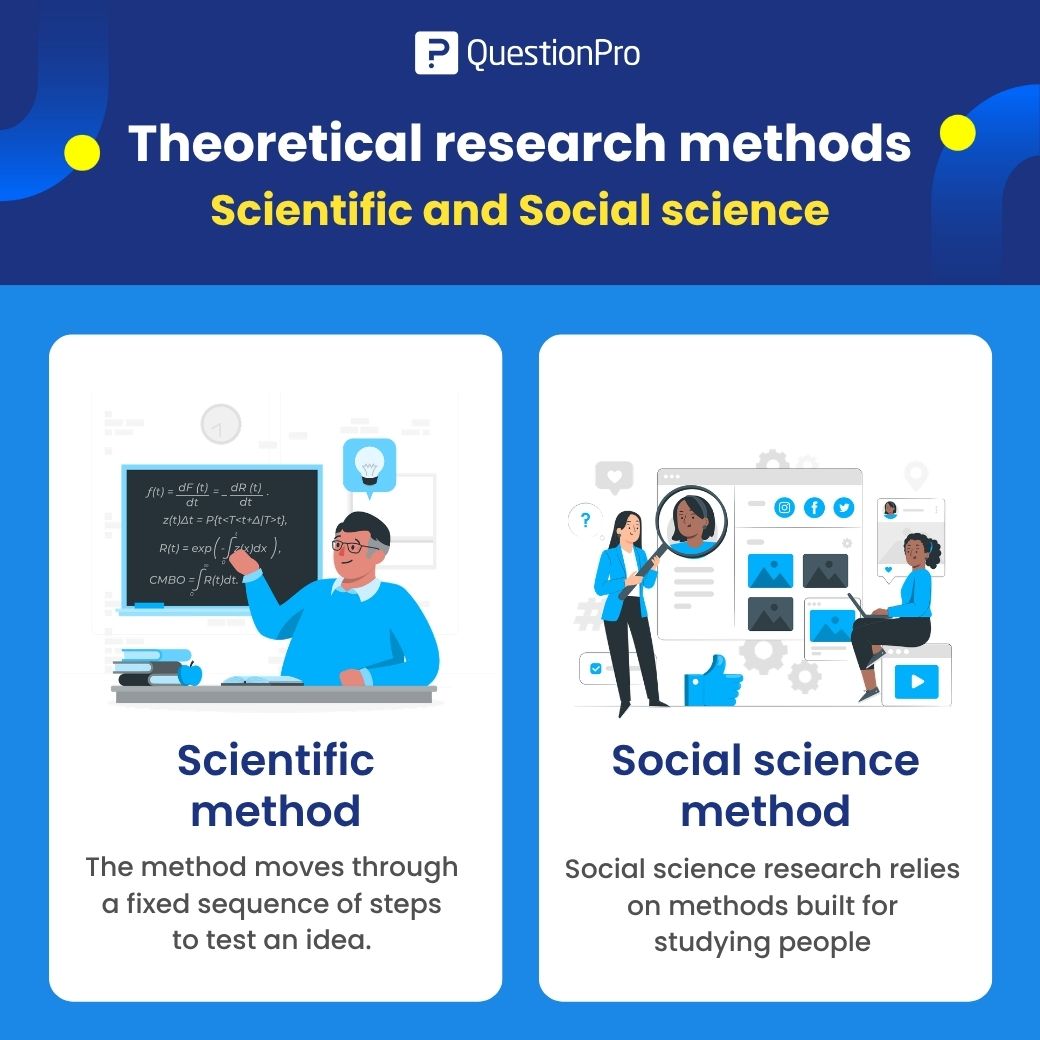
Researchers generally rely on two categories of methods. One is the scientific method, and the other covers social science methods built specifically for studying people.
Scientific method
The scientific method moves through a fixed sequence of steps to test an idea. The Stanford Encyclopedia of Philosophy describes this process as the backbone of how theoretical claims get evaluated against evidence.
- Observation. The researcher notices a pattern or problem worth explaining.
- Hypothesis. The researcher puts a possible explanation into a testable statement. A clear research hypothesis is what separates a guess from a testable theory.
- Experimentation. The hypothesis gets tested, often indirectly, through logic, modeling, or existing data.
- Theory building. A theory forms once an explanation holds up across repeated testing.
- Conclusions. The researcher records what the process revealed, along with where it still falls short.
Social science methods
Social science research relies on methods built for studying people, most often polls, documentation review, and statistical analysis.
- Polls. A structured, topic-specific questionnaire collects opinions or beliefs without changing the environment being studied.
- Documentation review. The researcher studies existing literature or archives to see what has already been established on a topic.
- Statistical analysis. Researchers apply probability-based methods to identify patterns in existing data. This technique is common in sociology and linguistics, and it often overlaps with qualitative research methods when the underlying data is text-based.
Other common theoretical research methods
Beyond the scientific method and social science methods, researchers use a few additional techniques depending on the field and the type of contribution they want to make.
- Conceptual analysis. Defines a concept and separates it from related ideas, such as distinguishing customer satisfaction from customer loyalty.
- Theory synthesis. Combines ideas from multiple theories when no single theory fully explains the phenomenon.
- Theory comparison. Evaluates two or more explanations against each other based on their assumptions and evidence.
- Deductive reasoning. Starts from an established theory and works out specific, testable propositions that logically follow from it.
How to conduct theoretical research: a step-by-step guide
Theoretical research follows a repeatable process. It starts with choosing a topic and ends with conclusions other researchers can build on.
- Choose a specific topic or problem. A narrow, well-defined question produces a sharper theory than a broad one.
- Review the existing literature. Map out what theories already exist and where the gaps are.
- Select or build a theoretical framework. Decide which existing concepts will anchor the explanation.
- Form a hypothesis or central argument. State the explanation you plan to defend or explore.
- Test the reasoning through logic or modeling. No new field data gets collected, so this step relies on internal consistency and existing evidence.
- Draw conclusions and note limitations. Be specific about what the theory explains and what it does not.
- Document the work for future researchers. Theoretical research only compounds in value when others can build on it.
Examples of theoretical research
Theoretical research looks different across fields, but the approach stays consistent. Each example below explains a pattern using existing ideas rather than new field data.
- Biology. A researcher studying hemp’s active compounds reviews existing chemical literature. The goal is to build a theory about which compounds could plausibly serve as medication, before any clinical trial confirms it.
- Linguistics. A researcher studying Basque language use might build a theoretical model of language decline. That model draws on prior sociolinguistic theory to predict where native speaker numbers are likely dropping fastest.
- Philosophy. A researcher analyzing Hannah Arendt’s writing on politics and ethics builds an interpretive argument using existing philosophical theory. No new data gets collected at any point.
- Human resources. A researcher building a theory of workplace motivation might combine psychology and management theory. The resulting model explains why recognition programs affect retention differently across job types.
- Economics. A researcher studying consumer behavior during inflation might revisit existing pricing theory to explain why spending habits shift unevenly across income groups, without running a new consumer survey to confirm it.
Advantages and disadvantages of theoretical research
Theoretical research is valuable for building explanations, but it comes with real trade-offs. Weigh both sides before choosing this approach for a project.
Advantages
- Builds a clear explanation before committing resources to data collection.
- Costs little compared to fielded studies, since no new data collection is required.
- Produces frameworks other researchers can reuse and build on.
- Works well for exploring abstract or hard-to-measure concepts.
Disadvantages
- Findings can stay abstract until empirical work confirms them.
- Real-world impact often takes longer to materialize than with applied studies.
- Weak or outdated source literature can limit the quality of the resulting theory.
- It cannot confirm cause and effect on its own.
How QuestionPro supports theory-driven research
Once a theory is built, researchers still need a reliable way to test it against real people. QuestionPro’s survey tools let researchers turn a theoretical hypothesis into a fielded questionnaire without starting from scratch.
Live polling features help researchers gather quick, real-time reactions from an audience. That makes them useful for an early, low-cost check on a theoretical assumption. A researcher can confirm the assumption still holds before committing to a full study built around it.
Getting the most out of theoretical research
Theoretical research will not replace fielded data, and it was never meant to. Its real value is in sharpening the questions researchers ask before they spend time and budget on new data collection.
A few things are worth keeping in mind before starting a theoretical research project:
- Ground the framework in current literature, not outdated theory.
- Be explicit about what the theory does and does not explain.
- Treat it as the first step toward empirical testing, not the final word.
The strongest theoretical work treats itself as a starting point, not a finished conclusion. It earns its real value once someone tests it against evidence.
Frequently Asked Questions (FAQs)
They overlap but are not identical. Basic research is a funding and policy category for work done to expand knowledge without a specific application in mind. Theoretical research describes the method itself: building explanations from existing ideas rather than new data.
Yes. Theoretical research often draws on existing qualitative sources, such as interviews, case studies, or historical texts, to build or refine an explanation. It just does not involve collecting brand-new qualitative data in the field.
A strong framework clearly defines its key concepts, connects logically to the research question, and is grounded in credible, current literature. If it cannot explain the variables under study or conflicts with well-established evidence, it needs revision before use.
Not automatically. A literature review only becomes theoretical research when it goes further than summarizing sources, actively comparing, extending, or critically evaluating the theories and concepts it covers to build a new explanation.
Surveys are an empirical data-collection method, not a theoretical one. Researchers can design survey questions based on a theory, but the moment they collect responses from real people, that part of the project becomes empirical rather than theoretical.