• Skip to main content
  • Skip to primary sidebar
  • Skip to footer
QuestionPro

QuestionPro

questionpro logo
  • Products
    survey software iconSurvey softwareEasy to use and accessible for everyone. Design, send and analyze online surveys.research edition iconResearch SuiteA suite of enterprise-grade research tools for market research professionals.CX iconCustomer ExperienceExperiences change the world. Deliver the best with our CX management software.WF iconEmployee ExperienceCreate the best employee experience and act on real-time data from end to end.
  • Solutions
    IndustriesGamingAutomotiveSports and eventsEducationGovernment
    Travel & HospitalityFinancial ServicesHealthcareCannabisTechnology
    Use CaseAskWhyCommunitiesAudienceContactless surveysMobile
    LivePollsMember ExperienceGDPRPositive People Science360 Feedback Surveys
  • Resources
    BlogeBooksSurvey TemplatesCase StudiesTrainingHelp center
  • Features
  • Pricing
Language
  • English
  • Español (Spanish)
  • Português (Portuguese (Brazil))
  • Nederlands (Dutch)
  • العربية (Arabic)
  • Français (French)
  • Italiano (Italian)
  • 日本語 (Japanese)
  • Türkçe (Turkish)
  • Svenska (Swedish)
  • Hebrew IL (Hebrew)
  • ไทย (Thai)
  • Deutsch (German)
  • Portuguese de Portugal (Portuguese (Portugal))
  • Español / España (Spanish / Spain)
Call Us
+1 800 531 0228 +1 (647) 956-1242 +55 9448 6154 +49 030 9173 9255 +44 01344 921310 +81-3-6869-1954 +61 (02) 6190 6592 +971 529 852 540
Log In Log In
SIGN UP FREE

Home Surveys Academic Research

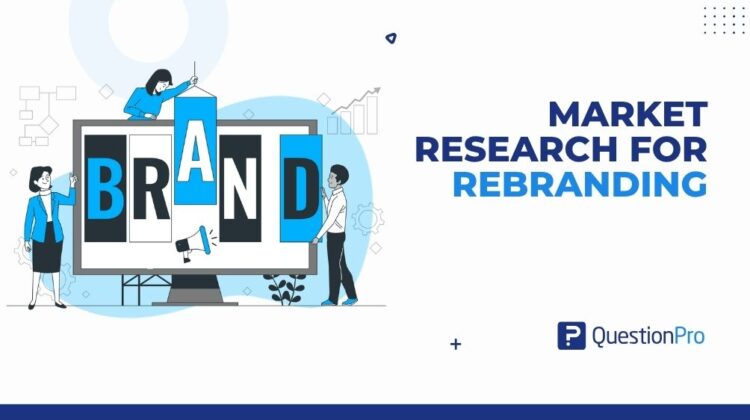
Market Research for Rebranding: A Practical Guide

market-research-for-rebranding

Brands drift before they decide to change. A new product line, a shift in who you serve, or a change in what customers expect can move your brand identity long before anyone updates a logo. Market research for rebranding is how you catch that drift and confirm it with evidence instead of a hunch.

This matters because a rebrand based only on internal opinion tends to miss how customers actually experience the business. Research closes that gap.

In this guide, we will walk through the signals that suggest it is time to rebrand, the research methods that validate the decision, and how to run the process without alienating the customers you already have.

Content Index hide
1. What is market research for rebranding?
2. How do you know it’s time to rebrand?
3. Why customer input matters before you rebrand
4. Step by step guide to rebrand research
5. Common mistakes to avoid when rebranding
6. How QuestionPro supports brand research
7. A brand should evolve with evidence, not guesswork
8. Frequently Asked Questions (FAQs)

What is market research for rebranding?

Market research for rebranding is the structured process of collecting customer and market data to confirm whether, and how, a brand should change its identity, message, or positioning.

It typically combines qualitative research, such as social listening and open-ended interviews, with quantitative validation through surveys. The goal is not to invent a new brand from scratch. It is to test whether your current brand still matches what your business does and what your customers value.

Unlike general market research, rebrand-focused research centers on perception gaps. It asks: does the outside view of the brand match the inside view of the business?

How do you know it’s time to rebrand?

You know it’s time to rebrand when there is a consistent, measurable gap between what your brand promises and what your business now delivers.

A few common signals point to that gap:

  • Your product or service lineup has changed enough that your original brand promise no longer covers it.
  • Customer support tickets, reviews, or social comments describe your business differently than your own marketing does.
  • A new competitor has repositioned the category and your messaging now sounds generic.
  • Internal teams disagree on what the brand stands for, which usually means customers are confused too.

None of these signals on their own confirms a rebrand is necessary. Together, tracked over a few months, they are a strong indicator worth testing with research.

Why customer input matters before you rebrand

A rebrand designed entirely in-house risks solving a problem customers do not have, or missing the one they do. Bringing customers into the process early reduces that risk and builds buy-in for the change once it launches.

This does not mean customers should design your brand. It means their language, priorities, and pain points should shape the direction before you commit budget to it. A business that shifts its identity without checking this first often finds that loyal customers feel left behind, and some quietly move to a competitor that still feels familiar to them.

Step by step guide to rebrand research

A rebrand research process works best in three stages, moving from open exploration to specific validation.

Stage 1: Exploratory and qualitative research

Start by listening before you ask anything directly. Monitor social conversations, support tickets, and reviews for the words customers already use to describe your business. Set a clear objective first, such as understanding whether customers associate your brand with a specific benefit or a specific price tier.

Give this stage two to four weeks. Rushing it produces a shallow read on sentiment that does not hold up once you move to quantitative testing.

Stage 2: Build focused surveys

Turn what you learned into short, targeted surveys rather than one long questionnaire. Multiple 4 to 6 question surveys, each built around a single objective, get better completion rates than one 25-question form.

Useful survey angles for a rebrand include:

  • Current brand association: what one word describes this brand?
  • Feature and benefit ranking: which of these matter most to you?
  • Price and value perception: does this brand feel premium, mid-market, or budget?

A brand perception survey template can save time here instead of building every question from scratch.

Stage 3: Test the new direction before launch

Once you have a proposed direction, whether that is new messaging, a new visual identity, or a repositioned tagline, test it with a sample of existing customers before a full launch. Concept testing at this stage catches confusion or negative reactions while changes are still cheap to make.

Common mistakes to avoid when rebranding

Most rebrand research problems come from skipping steps rather than using the wrong tool.

  • Skipping the qualitative stage and jumping straight to a survey, which produces data without context.
  • Surveying only new prospects and ignoring existing customers, who carry the most risk if the change confuses them.
  • Asking leading questions that confirm a direction leadership already prefers.
  • Treating one round of research as final instead of tracking perception again after launch.

How QuestionPro supports brand research

Running exploratory listening, short surveys, and concept testing across separate tools tends to fragment the data.

A market research platform that handles survey design, distribution, and reporting in one place makes it easier to compare the qualitative themes from stage one against the quantitative results from stage two, without exporting data between systems.

A brand should evolve with evidence, not guesswork

A rebrand grounded in real customer input tends to land better than one built purely on internal preference.

It costs more time upfront, but it reduces the risk of alienating the customers who already trust you while still moving the brand toward where the business is actually headed.

Create memorable experiences based on real-time data, insights and advanced analysis. Request Demo

Frequently Asked Questions (FAQs)

How often should a company reassess its brand?

Most brands benefit from a lightweight perception check once a year, with a deeper research process only when a major business change, such as a new product line or market expansion, creates a clear gap between brand promise and reality.

Do small businesses need formal market research to rebrand?

Yes, though the scale can be smaller. A handful of customer interviews and one short survey often give a small business enough direction to rebrand with confidence, without the cost of a full research program.

What is the difference between a rebrand and a brand refresh?

A brand refresh updates visual elements like color or typography while keeping the core positioning intact. A rebrand changes the underlying promise, name, or target audience, which requires deeper research to validate.

How many customers should I include in rebrand research?

There is no fixed number, but qualitative interviews typically need 8 to 12 participants to spot repeating themes, while a validation survey should aim for at least 100 responses from your actual customer base for reliable results.

Can rebrand research prevent a failed rebrand?

It significantly lowers the risk by catching confusion or negative reactions before launch, though no amount of research eliminates all risk once a brand change reaches the broader market.
SHARE THIS ARTICLE:

About the author
Ivana Taylor
Ivana Taylor provides DIY Marketing advice, marketing trends and marketing how-to tips and strategies for small business owners and CEOs.
View all posts by Ivana Taylor

Primary Sidebar

Gain insights with 80+ features for free

Create, Send and Analyze Your Online Survey in under 5 mins!

Create a Free Account

RELATED ARTICLES

HubSpot - QuestionPro Integration

Thinking About Skynet 2024 and Beyond? — Tuesday CX Thoughts

Jan 23,2024

Predictive NPS and CSAT: How to Forecast Customer Loyalty Before It Slips

May 28,2026

HubSpot - QuestionPro Integration

Unveiling the Top 5 Market Research Trends Redefining Insights in 2024

Dec 18,2023

BROWSE BY CATEGORY

Footer

MORE LIKE THIS

audience-self-service

Your research study, your call: How Audience self-service puts you in charge from brief to final credit

Sep 24, 2026

driver-analysis-in-employee-experience

Driver Analysis in Employee Experience: How to Find What Actually Drives Engagement

Sep 24, 2026

text-analysis-for-market-research

Here’s how emerging themes in TextAI can help you survive wave seven with a wave one codebook

Sep 23, 2026

insightshub-audio-analysis

InsightsHub Audio Analysis: How to turn interview and call recordings into searchable, quotable research

Sep 22, 2026

Other categories

questionpro-logo-nw
Help center Live Chat SIGN UP FREE
  • Sample questions
  • Sample reports
  • Survey logic
  • Branding
  • Integrations
  • Professional services
  • Security
  • Survey Software
  • Customer Experience
  • Workforce
  • Communities
  • Audience
  • Polls Explore the QuestionPro Poll Software - The World's leading Online Poll Maker & Creator. Create online polls, distribute them using email and multiple other options and start analyzing poll results.
  • Research Edition
  • LivePolls
  • InsightsHub
  • Blog
  • Articles
  • eBooks
  • Survey Templates
  • Case Studies
  • Training
  • Webinars
  • All Plans
  • Nonprofit
  • Academic
  • Qualtrics Alternative Explore the list of features that QuestionPro has compared to Qualtrics and learn how you can get more, for less.
  • SurveyMonkey Alternative
  • VisionCritical Alternative
  • Medallia Alternative
  • Likert Scale Complete Likert Scale Questions, Examples and Surveys for 5, 7 and 9 point scales. Learn everything about Likert Scale with corresponding example for each question and survey demonstrations.
  • Conjoint Analysis
  • Net Promoter Score (NPS) Learn everything about Net Promoter Score (NPS) and the Net Promoter Question. Get a clear view on the universal Net Promoter Score Formula, how to undertake Net Promoter Score Calculation followed by a simple Net Promoter Score Example.
  • Offline Surveys
  • Customer Satisfaction Surveys
  • Employee Survey Software Employee survey software & tool to create, send and analyze employee surveys. Get real-time analysis for employee satisfaction, engagement, work culture and map your employee experience from onboarding to exit!
  • Market Research Survey Software Real-time, automated and advanced market research survey software & tool to create surveys, collect data and analyze results for actionable market insights.
  • GDPR & EU Compliance
  • Employee Experience
  • Customer Journey
  • Synthetic Data
  • About us
  • Executive Team
  • In the news
  • Testimonials
  • Advisory Board
  • Careers
  • Brand
  • Media Kit
  • Contact Us

QuestionPro in your language

  • English
  • Español (Spanish)
  • Português (Portuguese (Brazil))
  • Nederlands (Dutch)
  • العربية (Arabic)
  • Français (French)
  • Italiano (Italian)
  • 日本語 (Japanese)
  • Türkçe (Turkish)
  • Svenska (Swedish)
  • Hebrew IL (Hebrew)
  • ไทย (Thai)
  • Deutsch (German)
  • Portuguese de Portugal (Portuguese (Portugal))
  • Español / España (Spanish / Spain)

Awards & certificates

  • survey-leader-asia-leader-2023
  • survey-leader-asiapacific-leader-2023
  • survey-leader-enterprise-leader-2023
  • survey-leader-europe-leader-2023
  • survey-leader-latinamerica-leader-2023
  • survey-leader-leader-2023
  • survey-leader-middleeast-leader-2023
  • survey-leader-mid-market-leader-2023
  • survey-leader-small-business-leader-2023
  • survey-leader-unitedkingdom-leader-2023
  • survey-momentumleader-leader-2023
  • bbb-acredited
The Experience Journal

Find innovative ideas about Experience Management from the experts

  • © 2022 QuestionPro Survey Software | +1 (800) 531 0228
  • Sitemap
  • Privacy Statement
  • Terms of Use