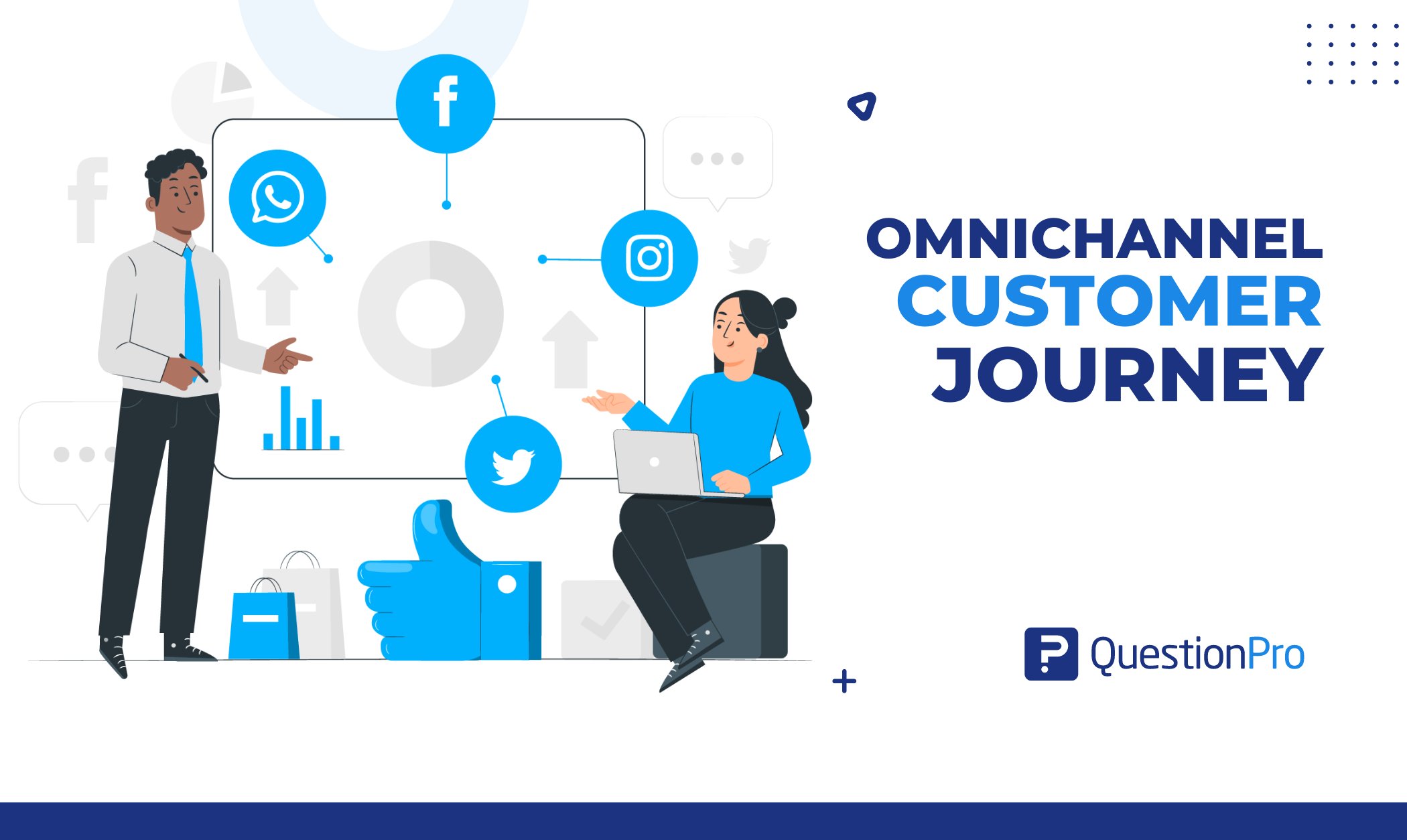
A customer finds a product on Instagram. They check reviews on a website, ask a sizing question through live chat, then walk into a store already knowing what they want. If every step remembers what came before, that is an omnichannel customer journey working the way it should.
Most customers move across several channels before they buy anything. Research from Capital One Shopping found that most shoppers visit a retailer’s website as part of an in-person shopping trip. A majority also visit a store to see and touch an item they first found online. When channels do not share context, customers feel it fast. They repeat information, restart a task, or get a different answer depending on who they talk to.
In this blog, we cover what an omnichannel customer journey means and how it differs from simply having many channels. We also walk through what a connected journey looks like in practice, and how to build, measure, and improve one.
What is an omnichannel customer journey?
An omnichannel customer journey is a customer experience model where all channels work together around the customer, instead of operating as separate paths.
A customer journey is the full set of steps a customer takes with a business. An omnichannel journey focuses on how those steps connect across channels. A customer moving from app to store to support should not have to start over.
A channel is a place where the customer interacts with the business. Common examples include:
- Websites, mobile apps, and self-service portals.
- Physical stores and call centers.
- Email, SMS, social media, and live chat.
A touchpoint is a specific interaction inside a channel, like a checkout page, a support call, a product review, or a return request. Nielsen Norman Group’s research on omnichannel experience design points to four traits of a genuinely connected journey. Channels stay consistent in tone and information. Each channel gets optimized for how people actually use it. Handoffs stay seamless when customers switch. The experience gets proactively orchestrated around what a customer needs next.
In practice, that means a customer never repeats the same information twice. They should not restart a task from zero or hear conflicting answers when they move between customer touchpoints.
Omnichannel vs. Multichannel customer journey: What is the difference?
The difference between an omnichannel and a multichannel customer journey comes down to connection, not channel count.
A multichannel journey gives customers several ways to reach a brand. A website, an app, a store, and a support line can all exist side by side. Each one may still hold its own separate information. The customer can use many channels, yet the experience can still feel broken apart.
An omnichannel journey shares context across those same channels. A support agent can see a recent order. The mobile app reflects the website cart. Store staff can see loyalty status. Follow-up emails match the customer’s current stage in the journey.
| Area | Multichannel journey | Omnichannel customer journey |
|---|---|---|
| Channel setup | Multiple channels exist | Channels are connected |
| Customer context | Often separated by channel | Shared across touchpoints |
| Experience | Can feel fragmented | Feels continuous |
| Team ownership | Often channel-based | Journey-based |
| Main goal | Be available in many places | Make channels work together |
A multichannel strategy is measured by presence. An omnichannel strategy is measured by continuity. That is why adding more channels without connecting them usually makes friction worse, not better.
What does an omnichannel customer journey look like in practice?
A practical way to see an omnichannel customer journey is to follow one retail customer from discovery to a resolved return. Each step below reads and updates the same customer record instead of starting fresh.
- The customer sees a product in a social media ad and clicks through.
- They open the website and read reviews.
- They add the product to a cart in the mobile app.
- They ask a sizing question through live chat, and the agent can see the cart.
- They visit a nearby store to try the product in person.
- Store staff can see the online cart and the customer’s loyalty status.
- The customer buys in-store, and the purchase updates their record everywhere.
- They receive a follow-up email with care instructions and support options.
- If they return the product later, support can see the full history.
The journey qualifies as omnichannel because each step recognizes what happened earlier. The customer is never treated like a stranger just because they switched channels.
This pattern is not limited to retail. In healthcare, a patient books an appointment through an app and gets a reminder by text. They check in at the front desk, where staff can already see the appointment type. Later, a billing question gets answered by phone without repeating their history.
In SaaS, a buyer researches a product on the website and starts a free trial. A check-in email arrives tied to actual usage, and a support agent can see which features they have tried and which they have not. Different industries, same test: does the next interaction know what the last one already established. For more structured walkthroughs across industries, see these customer journey examples.
What are the key components of an omnichannel customer journey?
The key components of an omnichannel customer journey are connected customer data, consistent messaging, integrated channels, journey mapping, and cross-channel analytics with feedback.
Connected customer data
- Shared history of past purchases, preferences, and support interactions.
- Context available to the right teams, not necessarily to every employee.
- A single customer identity that holds across devices and channels.
A unified view does not mean everyone sees everything. It means the right team has the right context at the right moment.
Consistent messaging
Customers should not get one promise in an email, a different one in the app, and a third answer from support. Consistent messaging covers tone, pricing, offer details, product information, return policies, and service expectations. When those line up, customers start to trust that any channel will give them the same answer.
Integrated channels
- An online cart that syncs with the mobile app in real time.
- A support ticket that reflects a customer’s recent purchases automatically.
- In-store systems that surface relevant customer context when an associate needs it.
Integration is what makes the components above usable in the moment. Otherwise the data just sits in separate systems that nobody checks.
Customer journey mapping
- Visualizes the stages, channels, emotions, and pain points customers move through.
- Surfaces gaps between what the business assumes happens and what customers actually experience.
- Works best as a living reference teams revisit, not a one-time diagram.
A customer journey map is a working tool, not decoration. Teams that treat it as a static artifact tend to miss the moment customer behavior shifts.
Cross-channel analytics and feedback
Customer journey analytics shows how customers actually move across channels. It highlights where they get stuck, connecting behavior, feedback, and outcomes into one picture. Feedback adds the customer’s own voice to that behavioral data. Together, customer journey analytics and feedback help teams tell the difference between an underperforming channel and one that is simply earlier in the funnel.
How do you decide which channels to connect first?
Not every channel deserves the same investment on day one. Prioritize based on where customers already switch channels most, and where that switching causes the most friction.
Start by pulling data on which channel pairs customers move between most often, such as social to website, or chat to store. Then weigh each pairing against how much friction shows up there today.
| Signal | What it suggests |
|---|---|
| High switching volume, high friction | Connect first; customers feel this gap the most |
| High switching volume, low friction | Monitor; already working, low urgency to change |
| Low switching volume, high friction | Fix if cheap to solve, otherwise deprioritize |
| Low switching volume, low friction | Leave alone for now |
This keeps teams from chasing every possible integration at once. It focuses connection work on the handoffs customers are already forcing the business to deal with.
How do you create an omnichannel customer journey?
To build an omnichannel customer journey, identify customer segments, map touchpoints, find friction, connect systems, personalize by context, align teams, and measure performance.
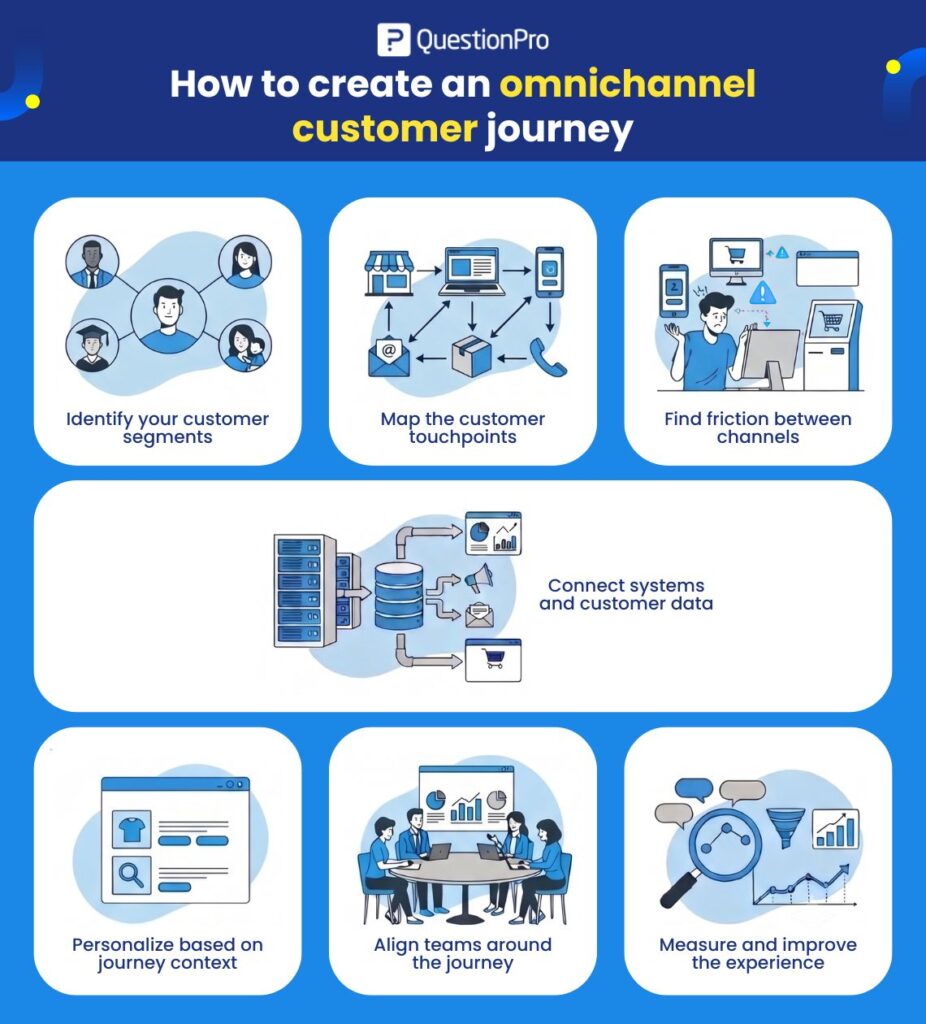
- Identify your customer segments.
A first-time buyer, a loyal repeat customer, an enterprise client, and a support-heavy user often follow different paths. One generic journey rarely fits everyone. - Map the customer touchpoints.
List the channels and moments customers use before, during, and after a purchase or service interaction. Include digital, physical, human, and automated touchpoints. - Find friction between channels.
Look for moments where customers repeat information, lose progress, get inconsistent answers, or wait through a slow handoff between teams. - Connect systems and customer data.
A CRM (customer relationship management system), along with ecommerce, support, marketing automation, loyalty, and survey tools, needs enough connection that useful context shows up where it matters, not just where it was collected. - Personalize based on journey context.
Adjust the experience around what a customer needs or has already done. Show a saved cart, or route support based on issue type, without crossing into guesswork that feels intrusive. - Align teams around the journey.
Marketing, sales, product, support, and store teams need shared journey metrics. Otherwise one team can improve its own numbers while quietly creating problems elsewhere. - Measure and improve continuously.
Use journey-level data, not single-channel dashboards, to find where customers struggle. Fix one friction point at a time.
What are the benefits of an omnichannel customer journey?
The core benefit of an omnichannel customer journey is simple. Customers can move across channels without losing context, and that shows up in several measurable ways:
- Customers stop repeating themselves at every handoff.
- Support teams get better context before a call or chat even starts.
- Marketing messages become more relevant because they reflect real behavior.
- Sales conversations start better informed.
- Journey gaps become easier to spot instead of staying hidden inside one channel’s numbers.
- Service feels more consistent across every touchpoint.
- Teams gain visibility into behavior across channels, not just their own.
- Retention often improves as friction drops, and customer journey benefits tend to compound once the biggest gaps close.
For US businesses, this matters even more. Customers increasingly expect fast digital access, flexible buying options, easy returns, and consistent support whether they interact online or in person.
What challenges should businesses expect?
Building an omnichannel journey rarely fails because of one big mistake. It usually fails because of a few recurring gaps that compound over time.
| Challenge | Why it happens | What helps |
|---|---|---|
| Fragmented customer data | Systems were bought separately over time, not designed together | Prioritize a shared customer identity before adding new tools |
| Teams measured by channel, not journey | Incentives and dashboards were built around individual channels | Add at least one shared journey metric every team reports on |
| Inconsistent messaging | Support, sales, and marketing update content independently | Centralize policy and pricing language in one source of truth |
| Weak feedback loops | Feedback gets collected but rarely routed to the team that can fix it | Route feedback to an owner, not just a dashboard |
| Privacy and compliance limits | State laws like the CCPA restrict how customer data can move between systems | Design data sharing around consent from the start |
Privacy deserves particular care on this list. Omnichannel work should make an experience easier, not make customers feel tracked. Connecting data should always come with a reason a customer would recognize as helpful.
How do you measure an omnichannel customer journey?
You measure an omnichannel customer journey by tracking experience, behavior, and operational metrics across connected touchpoints, not just inside one channel.
- Customer Satisfaction Score (CSAT): measures satisfaction right after a specific interaction. Many teams treat scores below 70 percent as a signal to investigate that touchpoint.
- Net Promoter Score (NPS): measures how likely a customer is to recommend the business overall. It works best tracked at the relationship level, not after a single transaction.
- Customer Effort Score (CES): measures how hard a task felt to complete. It is often the fastest metric to catch a broken handoff between channels.
- Conversion rate by channel: shows where customers actually take action, not just where they show up.
- Drop-off rate: shows the exact step where customers leave the journey.
- Repeat purchase and retention rate: shows whether the journey earns a second visit, not just a first one.
- First contact resolution: shows whether support solves an issue without a handoff to another channel.
- Customer lifetime value: shows the long-term payoff of a journey that keeps context intact.
Comparing NPS, CSAT, and CES side by side helps teams pick the right metric for the right moment. A single strong number rarely tells the full story. A high email click rate means little if customers still abandon checkout or need to call support right after.
How can QuestionPro Customer Experience support omnichannel journey improvement?
QuestionPro Customer Experience helps teams collect feedback, build journey maps, monitor experience metrics, and spot friction across touchpoints in one connected view. Teams commonly use it to:
- Collect feedback right after key journey moments, not weeks later.
- Build and update customer journey maps as behavior changes.
- Track satisfaction, effort, and loyalty metrics side by side.
- Segment feedback by customer type or journey stage.
- Support closed-loop follow-up so a flagged issue reaches an owner.
QuestionPro Journey Management treats journeys as living systems. Teams revisit them as customer behavior shifts, rather than filing away a diagram built once. The platform supports the work. It does not replace the need for clear goals, connected systems, and someone accountable for fixing what customers report.
What mistakes should teams avoid?
The most common mistake is assuming omnichannel means being everywhere. It actually means making the channels that matter work together around the customer.
- Adding new channels without connecting them to existing ones.
- Mapping a journey once and never revisiting it, a habit that quietly turns a useful map into an outdated one nobody trusts.
- Measuring channels separately instead of tracking journey-level outcomes.
- Personalizing without a clear reason a customer would value.
- Ignoring support and post-purchase moments in favor of acquisition channels.
- Letting teams own a channel but not the outcome that channel contributes to.
- Collecting feedback without a process for acting on it.
A practical rule of thumb: if a customer repeats the same information twice, the journey still needs work. That holds true no matter how many channels are technically connected.
Where an omnichannel customer journey earns its keep
An omnichannel customer journey works when channels share context and teams act on what customers report. Customers should feel recognized at every step, not treated as new each time. None of that depends on adding more technology. It depends on closing the specific gaps customers already feel, one at a time, and checking that the fix holds the next time behavior shifts.
Frequently Asked Questions (FAQs)
A digital journey can still be disconnected if a website, app, and email do not share customer context. Omnichannel status depends on whether channels, digital or physical, carry that context forward, not on how many of them are online.
No. Retail is the most common example, but healthcare, banking, SaaS, insurance, and hospitality all involve customers switching between channels. Any organization with more than one customer touchpoint can apply the same principles.
Web analytics tracks behavior inside a website or app. Customer journey analytics connects behavior across every channel and touchpoint over time, which is what actually shows where a journey breaks down between systems.
Watch Customer Effort Score right after a channel switch, such as chat to store or app to support. A sharp jump in effort at that step usually points to missing shared context, not a channel problem on its own.
Tools rarely fail on their own. Journeys fail when teams still get measured by channel instead of by journey outcome, so each team optimizes its own piece while the customer feels the seams between them.