NPS software turns a single loyalty question into a system you can actually run. Instead of manually tracking who scored you a 9 and who scored you a 3, the right platform automates survey delivery and sorts responses into promoters, passives, and detractors. It also routes low scores to the team that can fix them.
This guide compares 12 of the strongest NPS platforms for 2026. It also covers how NPS is measured and what to check before you commit to a tool.
What is NPS software?
NPS software is a platform that automates sending Net Promoter Score surveys and turning responses into a usable score. Net Promoter Score itself is a customer loyalty metric based on one question: how likely someone is to recommend a company to a friend.
Manually running this process doesn’t scale past a handful of customers. Sending emails, tallying scores by hand, and cross-referencing complaints takes real time. NPS software handles the repetitive parts automatically:
- Distributes surveys across email, web, and mobile
- Categorizes every response into promoters, passives, and detractors
- Replaces a spreadsheet with a live, shareable dashboard
Most platforms in this category also handle the harder part: closing the loop. That means automatically flagging detractors for follow-up, tagging recurring complaint themes, and connecting NPS data to CRM or support systems.
Why does NPS software matter?
NPS software matters because it turns a loyalty score from a one-time snapshot into an ongoing, actionable system. A few concrete benefits explain why most CX teams rely on dedicated tools:
- Standardized measurement. Every survey uses the same 0-10 question, so scores stay comparable across time periods, teams, and customer segments.
- Faster detractor response. Automated alerts route unhappy customers to support before they churn, instead of surfacing the complaint weeks later in a report.
- Segmentation. Filtering NPS by plan, region, or support history reveals patterns that a single company-wide average hides.
- Benchmarking. Most platforms show how your score compares to industry peers, giving context to a number that means little in isolation.
Without dedicated software, most of this work either doesn’t happen or happens too late to matter.
How is Net Promoter Score measured?
NPS is measured with one question, one scale, and one formula, which is what makes it comparable across companies and industries.
Respondents answer one question, scored 0 to 10: how likely are they to recommend the company to a friend? Based on that score, they fall into three groups.
- Promoters (9-10): Loyal customers likely to recommend and repurchase
- Passives (7-8): Satisfied but not enthusiastic, open to competitors
- Detractors (0-6): Unhappy customers at risk of churning
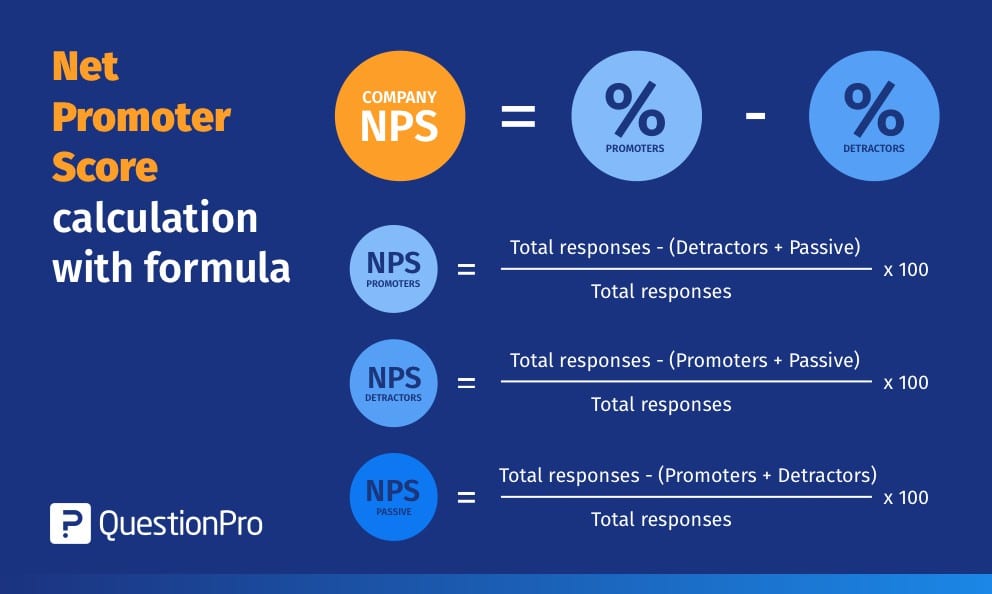
The formula is simple: NPS equals the percentage of promoters minus the percentage of detractors. The result ranges from -100 to +100. Scores above 0 are generally positive. Above 30 is good, and above 50 is excellent, though the right benchmark depends on your industry.
12 Best NPS software tools
Here are 12 NPS platforms worth evaluating in 2026, based on the features, pricing, and use cases that set each one apart.
| Tool | Best for | Starting price |
|---|---|---|
| QuestionPro | Teams that want scores tied to root-cause context | Free plan; paid from ~$83/user/mo |
| SurveySparrow | Conversational, chat-style surveys | ~$19/mo |
| SurveyMonkey | General-purpose survey teams already on the platform | Free plan; paid from ~$39/mo |
| Qualtrics | Large enterprises needing a full CX/EX suite | Custom quote |
| SatisMeter | SaaS teams triggering surveys by in-app behavior | ~$49/mo |
| CustomerGauge | B2B companies tracking loyalty by account | Custom quote |
| AskNicely | Service businesses coaching frontline staff on scores | Custom quote |
| Nicereply | Support teams wanting NPS, CSAT, and CES together | Custom quote |
| Survicate | Multi-channel distribution across email, web, and app | Custom quote |
| Qualaroo | Behavior-based micro-surveys to specific segments | Custom quote |
| Zonka Feedback | Multi-channel and offline feedback collection | ~$99/mo |
| ProProfs Survey Maker | Small teams needing NPS plus other survey types | Free plan; paid from budget tier |
1. QuestionPro
QuestionPro is a versatile NPS platform with multi-channel distribution and real-time analytics. AskWhy captures the reason behind every score, not just the number.
Best features: Customizable NPS templates, real-time dashboards, multi-channel distribution, segmentation and trend analysis, closed-loop follow-up workflows.
Pros: Strong analytics, flexible survey customization, responsive support.
Cons: Some advanced features require a learning curve.
Pricing: Free Essentials plan available; paid plans start around $83 per user per month, billed annually (Team Edition, 5+ users).
2. SurveySparrow
SurveySparrow stands out for conversational, chat-style NPS surveys that tend to drive higher completion rates than a static form.
Best features: Conversational survey format, real-time reporting, omnichannel distribution across email, web, and mobile.
Pros: Strong response rates, mobile-friendly design, CRM integrations.
Cons: Higher-tier plans require contacting sales for pricing.
Pricing: Starts around $19 per month on the Basic plan, billed annually; team plans cost more per seat.
3. SurveyMonkey
SurveyMonkey is a well-known, general-purpose survey platform that also handles NPS surveys alongside its broader survey library.
Best features: Extensive template library, multi-channel survey distribution, benchmarking against industry data.
Pros: Familiar interface, strong integration ecosystem, scalable for teams of any size.
Cons: NPS-specific features are less specialized than dedicated NPS tools.
Pricing: Free plan available; paid individual plans start around $39 per month, billed annually.
4. Qualtrics
Qualtrics is an enterprise experience management platform. NPS is one piece of a much larger customer and employee experience suite.
Best features: Closed-loop feedback routing, text analytics on open-ended comments, advanced dashboards.
Pros: Deep analytical capability, strong for large, complex organizations.
Cons: Pricing is quote-based and tends to run high for smaller teams.
Pricing: Custom pricing available on request.
5. SatisMeter
SatisMeter focuses on in-app NPS surveys for SaaS products, triggering surveys based on user behavior rather than a fixed schedule.
Best features: Event-based survey triggers, helpdesk integrations, automated follow-up campaigns.
Pros: Easy setup for SaaS teams, response-based pricing model.
Cons: Narrower fit outside of SaaS and app-based businesses.
Pricing: Starts around $49 per month.
6. CustomerGauge
CustomerGauge is built around closed-loop NPS. Account-level reporting suits B2B companies tracking loyalty by client rather than individual respondent.
Best features: Closed-loop feedback workflows, account-level NPS tracking, CRM integration.
Pros: Strong B2B fit, thorough feedback management.
Cons: Setup can be complex for smaller teams.
Pricing: Custom pricing available on request.
7. AskNicely
AskNicely targets service-based businesses that want to tie NPS scores directly to frontline staff performance and coaching.
Best features: Customizable follow-up questions by score, CRM and helpdesk integrations, automated alerts on low scores.
Pros: Built for service teams, fast automated follow-ups.
Cons: Pricing rises quickly on advanced plans.
Pricing: Custom pricing available on request.
8. Nicereply
Nicereply pairs NPS with CSAT and CES in one tool. It suits support teams that want all three metrics in a single dashboard.
Best features: Combined NPS, CSAT, and CES tracking, real-time reporting, helpdesk integrations.
Pros: Simple setup, clear analytics, strong for support-focused teams.
Cons: Less survey design flexibility than general-purpose platforms.
Pricing: Contact Nicereply for current pricing.
9. Survicate
Survicate supports NPS surveys across email, website widgets, and mobile apps. Its strength is multi-channel reach rather than one specific use case.
Best features: Multi-channel survey delivery, real-time tracking, brand-matched survey design.
Pros: Flexible distribution options, responsive support.
Cons: Pricing can run high for smaller teams.
Pricing: Custom pricing available on request.
10. Qualaroo
Qualaroo specializes in targeted micro-surveys, showing NPS questions to specific user segments based on behavior rather than blasting every visitor.
Best features: Behavior-based targeting, customer segmentation, integration with analytics tools.
Pros: Precise targeting, useful qualitative insights.
Cons: Fewer advanced features than larger competitors.
Pricing: Custom pricing available on request.
11. Zonka Feedback
Zonka Feedback is a broader feedback management platform. NPS is one of several supported survey types, alongside multi-channel and offline collection.
Best features: In-depth analytics, role-based access control, automated follow-up workflows.
Pros: Strong reporting depth, works across multiple feedback channels.
Cons: Some advanced features sit behind higher-tier plans.
Pricing: Paid plans start around $99 per month.
12. ProProfs Survey Maker
ProProfs Survey Maker is a general survey tool that supports NPS alongside many other survey types. It fits teams that don’t need an NPS-only platform.
Best features: Broad survey type support, advanced analytics, respondent segmentation.
Pros: Wide range of survey types, budget-friendly for small teams.
Cons: Fewer NPS-specific features than dedicated tools.
Pricing: Free plan available; paid plans start at a budget-friendly monthly rate.
How to choose the right NPS software
The right NPS platform depends less on feature count and more on fit with how your team actually works.
- Define your objective first.
Reducing churn, growing referrals, and benchmarking against competitors each point toward different features, so pick your goal before comparing tools.
- Check distribution channels.
Confirm the platform reaches customers where they actually are, whether that’s email, in-app, SMS, or a website widget.
- Look for closed-loop workflows.
A tool that only reports a score without routing detractors to a human is missing the most valuable part of NPS software.
- Confirm integration with your existing stack.
CRM and helpdesk integrations determine whether NPS data actually reaches the team that can act on it.
- Test before committing.
Most platforms offer a free trial or free tier. Use it to confirm the interface fits your team’s workflow, not just the feature list.
Why teams choose QuestionPro for NPS
QuestionPro’s customer experience software approach to NPS centers on connecting the score to the reason behind it. AskWhy adds a structured follow-up question directly inside the NPS survey. It captures a root-cause category and an open comment alongside the 0-10 rating, so a low score arrives with context instead of a bare number.
That context feeds directly into a broader workflow. Teams can:
- Segment NPS by touchpoint, plan, or customer group
- Route detractor responses into a closed-loop workflow with an assigned owner
- Distribute surveys across email, web, and mobile from one platform
- Track trends on real-time dashboards instead of static reports
Combined, these pieces turn a single score into a repeatable process.
Picking an NPS tool that fits your workflow
The best NPS software is the one your team actually uses consistently, not the one with the longest feature list. A platform with strong closed-loop workflows will outperform a feature-heavy tool that sits half-configured after month one.
Start with your objective. Shortlist two or three tools that fit your channels and budget, then use free trials before committing to an annual contract.
Frequently Asked Questions (FAQs)
Tools with free plans or low-cost entry tiers, such as QuestionPro’s Essentials plan or SurveySparrow’s Basic plan, work well for small businesses testing NPS first. Prioritize ease of setup over advanced features at this stage.
Yes, technically, using email and a spreadsheet, but it doesn’t scale. Manual tracking makes it difficult to segment responses, spot trends, or route detractors for timely follow-up. That gap is where most of NPS software’s value comes from.
Pricing varies widely, from free plans with limited responses to enterprise platforms with custom quotes. Most mid-market tools fall between $20 and $100 per user per month. Pricing usually scales by response volume, seats, or feature tier.
Not necessarily. Several platforms here, including QuestionPro, Nicereply, and Zonka Feedback, support NPS alongside CSAT and CES in one dashboard. That’s usually simpler and cheaper than managing separate tools for each individual metric across different vendors.
Most companies run relational NPS quarterly or twice a year to track overall sentiment. Transactional NPS runs automatically after specific events, like a support ticket closing or a completed purchase, to catch feedback in the moment.