A school emergency preparedness survey helps administrators, nurses, and safety coordinators find out how ready staff and students actually feel before an incident happens, not after. It replaces guesswork with real answers about knowledge gaps, confidence levels, and gaps in existing plans.
Many schools run drills and post policies, then assume the job is done. A well-designed survey shows whether staff can actually act on that training when it matters, which is a different question entirely.
In this blog, we will define what belongs in a school emergency preparedness survey, walk through how to structure a pre and post-training survey, and look at a real example of a nonprofit using this approach to train school staff on anaphylaxis response.
What is a school emergency preparedness survey?
A school emergency preparedness survey is a structured set of questions used to measure how informed, confident, and equipped staff and students feel about handling a medical or safety emergency. It covers knowledge of procedures, awareness of available resources, and comfort acting under pressure.
Unlike a general satisfaction survey, this type focuses on specific, actionable gaps. A question like “How confident are you in recognizing the signs of a severe allergic reaction?” produces a very different kind of insight than “Are you happy with our safety program?”
Schools typically run this survey before implementing a new training program to establish a baseline, then again afterward to measure what changed.
The format works for any emergency type, whether that is a severe allergic reaction, a lockdown scenario, or a natural disaster response plan. What stays the same is the goal: turning assumptions about readiness into measurable data.
School emergency preparedness survey vs a safety checklist: What’s the difference
A safety checklist and a preparedness survey often get treated as the same thing, but they measure different aspects of readiness. A checklist confirms whether something exists. A survey reveals whether people actually understand and trust it.
| Aspect | Safety checklist | Preparedness survey |
|---|---|---|
| Format | Yes or no compliance items | Open and scaled questions |
| Captures | Whether a policy or item is in place | How confident and informed staff feel |
| Owned by | Facilities or compliance team | Program managers and school nurses |
| Example question | Do we have an epinephrine auto-injector on site | How confident are staff in recognizing anaphylaxis symptoms |
A school can pass every item on a checklist and still have staff who freeze during an actual emergency. Surveys catch that gap because they measure people, not paperwork.
Why measure school emergency preparedness with surveys
Food allergies alone affect an estimated 8% of children in the United States, or roughly two students in every classroom, according to the CDC. That single statistic explains why training programs built around real emergencies, not hypothetical ones, matter so much for schools.
Measuring preparedness with a survey gives program leaders three things a checklist cannot:
- A baseline: You know exactly where staff knowledge stands before training begins.
- Proof of impact: You can show funders, boards, or district leadership that a program actually changed behavior.
- A way to target improvements: Low scores on a specific question point directly to what the next training session needs to cover.
- A record over time: Comparing results year over year shows whether preparedness is improving or slipping as staff turns over.
Without this data, a school or nonprofit is left assuming their program works instead of knowing it does. Pairing this measurement with a broader emergency survey action plan helps a program respond quickly when results point to a gap.
How to design a pre and post-training survey for schools
A pre and post-training survey compares the same group’s answers before and after a training program to measure real change. The structure matters more than the number of questions.
- Survey before training starts to capture a genuine baseline, including existing knowledge, confidence levels, and any current plans staff already follow.
- Keep the post-survey nearly identical to the pre-survey so the two sets of answers are directly comparable.
- Send it through a channel people already use, such as a learning management system, email, or a link shared by the school nurse.
- Compare specific answers, not just averages, since one confusing question can hide a real skills gap.
Programs with a limited survey budget should prioritize knowledge-check questions first, since those tend to show the clearest measurable change between the two survey rounds.
Real-world example: How Code Ana measures anaphylaxis training with surveys
The Code Ana Program is the flagship initiative of The Teal Schoolhouse, a nonprofit founded by allergist Dr. Alice Hoyt to help schools respond to anaphylaxis and other medical emergencies. It began in 2016 after a local school asked for help building a school-wide response plan.
Before running any training, Code Ana surveys schools to understand their current state of preparedness. This benchmark shows the program where a school’s biggest gaps are before a single training session happens.
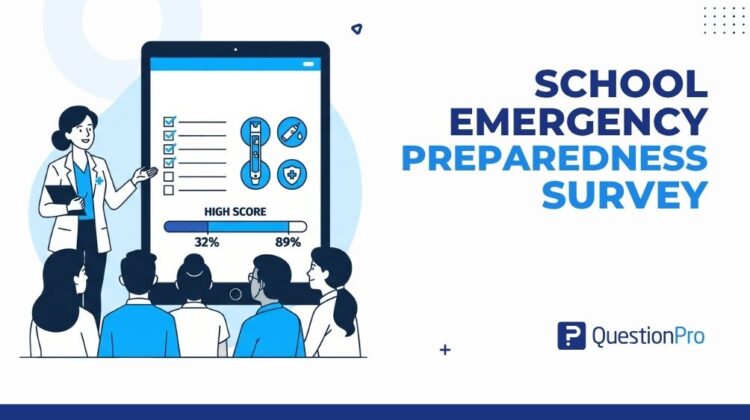
The program then embeds a pre and post-training survey directly into its online coursework, so schools complete the same preparedness questionnaire both before and after the program. In one epinephrine auto-injector workshop for early childhood personnel, only 32% could identify every symptom of anaphylaxis before training. After the workshop, that number rose to 89%. Dr. Hoyt has said her goal is for “all schools to have Code Ana.”
What to include in a school emergency preparedness survey
A useful survey covers more than one type of question, since knowledge, confidence, and available resources do not always move together.
- Baseline knowledge questions: Can the respondent identify the specific symptoms or steps involved in a given emergency?
- Confidence questions: How prepared the respondent feels to act, independent of what they technically know.
- Procedural awareness questions: Whether staff know who to call, where supplies are kept, and what the chain of communication looks like.
- Resource availability questions: Whether the tools needed, such as an epinephrine auto-injector or a first aid kit, are actually accessible when needed.
Mixing these categories catches situations where staff know the right answer on paper but would not feel confident acting on it in the moment. Reviewing general training survey questions can help a program spot categories it may be missing beyond emergency-specific content.
Common mistakes when surveying school emergency preparedness
A few recurring mistakes can quietly undermine an otherwise well-designed program.
- Surveying only once.
Without a pre and post-comparison, there is no way to prove the training changed anything, which makes it hard to justify renewing the program next year.
- Asking leading questions.
A question like “wasn’t this training helpful?” nudges respondents toward a positive answer instead of an honest one, which quietly erases the data a program actually needs.
- Ignoring open-ended responses.
Free-text answers often reveal specific confusion that multiple-choice questions miss entirely, especially when a respondent explains a scenario the survey did not anticipate.
- Skipping privacy protections.
Health-related questions need the same privacy safeguards as any other sensitive data collection, especially in a school setting where parents and district policy expect them.
How QuestionPro supports school emergency preparedness programs
Programs collecting health-related feedback from schools need a survey tool built with privacy in mind, not bolted on afterward.
QuestionPro’s survey software offers HIPAA-compliant security and privacy settings, which matters when questions touch on medical history or student health information. For academic and education programs, the platform also supports embedding assessments directly into existing coursework, so pre and post-training data collection happens without adding a separate step for schools to manage.
Turning training data into safer schools
A school emergency preparedness survey only matters if the results change what happens next. The value is not in the data itself, but in the training adjustments, resource decisions, and follow-up sessions it points to.
Programs that treat measurement as a one-time formality miss most of that value. The ones that build it into every training cycle end up with staff who are not just aware of the plan, but ready to use it.
Frequently Asked Questions (FAQs)
Most effective surveys take five to ten minutes to complete. Longer surveys see higher drop-off rates, especially among school staff who are already stretched thin, so keeping questions focused on the most actionable gaps matters more than covering every possible scenario.
Distribution depends on the emergency type, but teachers, school nurses, front office staff, and early childhood personnel are common recipients. Programs focused on allergy response often prioritize staff who supervise meals, recess, or after-school activities where reactions are more likely.
Yes, though the questions should differ from staff surveys. Parent surveys often focus on awareness of school policies and communication preferences, while student surveys, when age-appropriate, can check basic knowledge of what to do during a drill or emergency.
Most programs repeat the survey at least once a year or after any major staff turnover, policy change, or update to training materials. Repeating it after turnover matters most, since new staff start without the knowledge the previous survey measured.
Start with a short baseline survey focused on one emergency type, such as severe allergic reactions or lockdown procedures. Use the results to shape a single training session, then repeat the same questions afterward to confirm the training closed the gap.