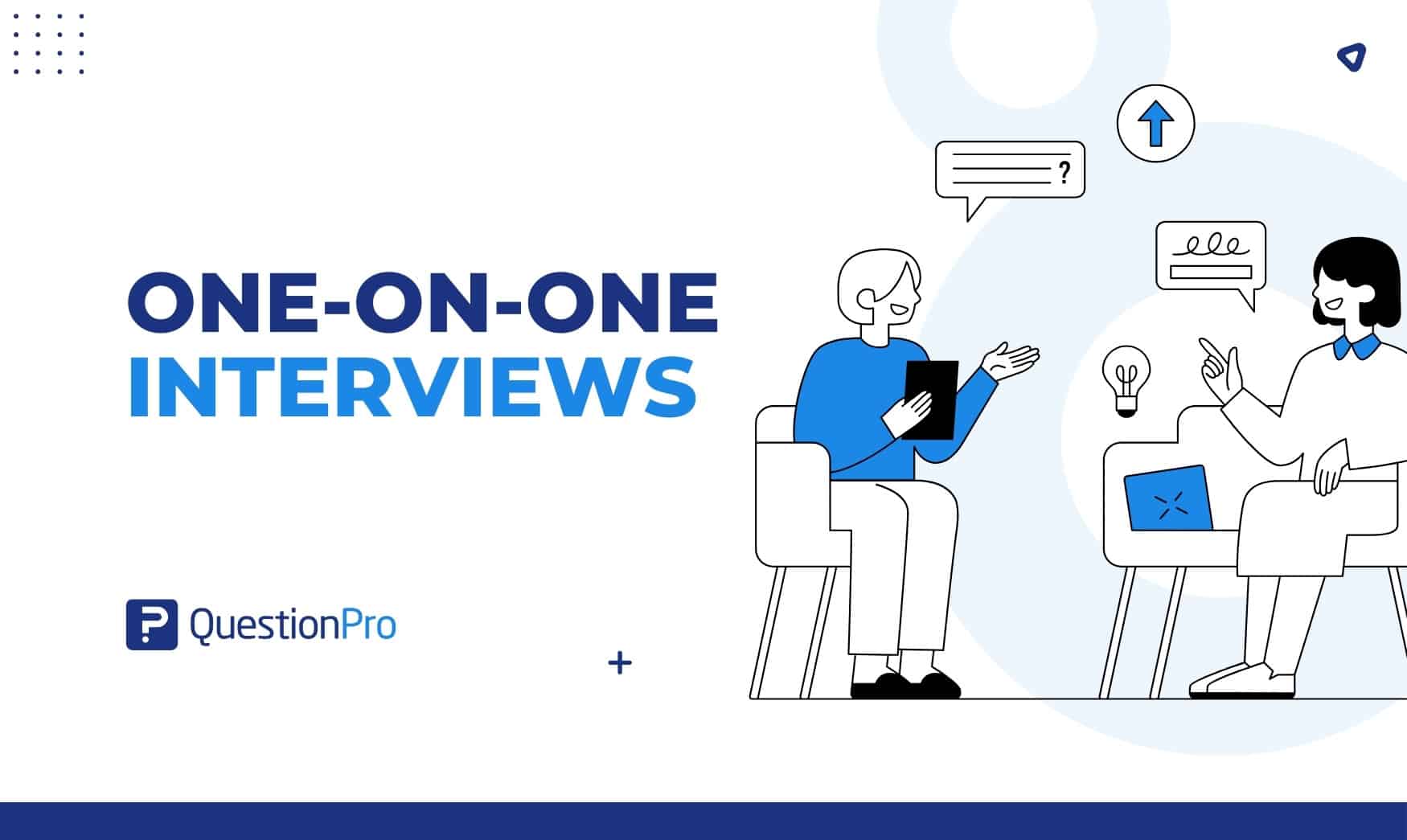
One-on-one interviews are guided conversations between one interviewer and one participant, held in person, by phone, or online. Researchers use them to learn how people think and behave. Employers use them to judge whether a job candidate fits a role. The format trades scale for depth, privacy, and room to follow up.
A good session feels easy, but its results depend on early choices. Decide who to invite, what to ask, and how to record answers. Weak choices produce friendly chats that nobody can compare or defend.
In this blog, we’ll explore types, steps, questions, sample sizes, and pros and cons.
In brief
- A one-on-one interview pairs one interviewer with one participant, either for research or for a hiring decision.
- Semi-structured interviews suit most research, while structured interviews suit hiring because every candidate gets comparable questions.
- A 2022 systematic review found that interview studies with fairly similar participants often reached saturation within 9 to 17 interviews.
- Prepare a short guide, get consent, ask open questions, probe for specific events, and write notes the same day.
- Interviews offer depth and privacy, but they take time and cannot show how common a view is across a population.
What is a one-on-one interview?
A one-on-one interview is a planned, two-person conversation in which an interviewer asks questions to learn about a participant’s experiences, opinions, skills, or decisions. Also called a one-to-one interview, the format serves research studies, job hiring, journalism, and employee listening. The interviewer guides the topics, and the participant does most of the talking.
In studies, the one-on-one interview research method collects qualitative data, meaning words and stories rather than numbers. A scripted version with fixed answer choices can also produce countable data. In hiring, the same format helps one interviewer assess a candidate against the needs of a job.
How is a one-on-one interview different from similar formats?
A one-on-one interview differs from similar formats mainly in who takes part and whether the exchange happens live. The table compares five terms that people often mix up.
| Format | Who takes part | Best use |
|---|---|---|
| One-on-one interview | One interviewer and one participant, usually live | Personal detail, private topics, focused assessment |
| Panel interview | Two or more interviewers and one candidate | Hiring decisions that need several viewpoints at once |
| Focus group | One moderator and a small group | Reactions that grow from group discussion |
| One-way video interview | One person recording answers with no live interviewer | Early screening of many applicants on their own schedules |
| Manager one-on-one meeting | A manager and a direct report | Ongoing coaching, priorities, and support |
An in-depth interview is a specific kind of one-on-one conversation: A long, exploratory research session built around deep probing. Every in-depth interview of this kind is one-on-one, but a 15-minute screening call is not in-depth.
When should you use one-on-one interviews?
Use one-on-one interviews when you need detailed individual accounts, when the topic is private, or when group pressure could shape answers. Pick another method to measure how common a view is or to watch people interact. Surveys also reach hundreds of people faster and at lower cost.
- Sensitive topics: Money, health, job loss, and workplace complaints are easier to discuss without an audience.
- Complex decisions: A buyer can walk you through each step of a software purchase, including who objected and why.
- Hard-to-gather participants: Executives, clinicians, and business owners can book a private slot more easily than a shared session.
- Early discovery: A few conversations reveal the words customers use before you write a survey.
- Hiring assessment: One interviewer can examine a candidate’s past work in detail.
- Poor fit: Market sizing, trend tracking, and statistically representative estimates call for a survey instead.
Good market research often pairs both approaches. Interviews explain why something happens, and surveys show how widespread it is.
What are the types of one-on-one interviews by structure?
The three main types of one-on-one interviews are structured, semi-structured, and unstructured. Each type differs in how closely the interviewer follows a script. More structure makes answers easier to compare. Less structure leaves more room for surprises, but it also asks more of the interviewer during the session and during analysis.
Purpose varies too. A discovery interview, a stakeholder interview, a stay interview, and a job interview can each use any of the three structures. Our guide to structured vs unstructured interviews compares them in more detail.
Structured interview
A structured interview asks every participant the same planned questions in the same order and rates answers against set criteria. The US Office of Personnel Management (OPM) is the federal government’s HR agency. According to OPM, structured interviews “employ rules for eliciting, observing, and evaluating responses.” In a 2022 reanalysis, Sackett and colleagues compared common hiring methods. Structured interviews showed the highest average validity for predicting job performance (r = .42).
Best for: Hiring, and studies that compare answers across many people.
Semi-structured interview
A semi-structured interview uses a fixed set of core questions but lets the interviewer reorder them and ask follow-ups. A product researcher might ask every user about their last export, then explore whatever went wrong for that person.
Best for: Most customer, user, and employee research.
Unstructured interview
An unstructured interview starts with a topic and lets the participant’s answers shape the questions. A researcher studying a little-known community might simply ask someone to describe a typical week.
Best for: Early exploration when you don’t yet know which questions matter.
Should you interview in person, by phone, by video, or with AI?
Choose the interview mode based on the participant’s access, the sensitivity of the topic, and the cues you need to observe. In-person sessions give the richest context, phone and video calls cut travel, and AI-moderated sessions let participants answer on their own time. The best mode is one the participant can use comfortably.
| Mode | Main strength | Main limitation |
|---|---|---|
| In person | Body language, setting, and shared materials are visible | Travel, rooms, and scheduling add cost |
| Live video | Faces and screen sharing without travel | Weak connections interrupt the flow |
| Phone | Easy to join and feels less formal | No visual cues |
| Live text chat | Written record is ready at once | Answers tend to be shorter and lose tone |
| AI-moderated | Participants join any time, with automated follow-ups | Software can miss nuance or sensitive moments |
AI-moderated sessions replace the live human interviewer with software, so treat them as a related method with their own design and review needs. Whichever mode you use, test the technology before the first real session.
Which question styles work in one-on-one hiring interviews?
Hiring interviewers usually combine behavioral, situational, and competency-based questions in a one-on-one session. Some jobs also call for case questions or role-play. Each style tests something different. Choose styles from the job’s actual duties, and ask every candidate for the same role the same core set.
- Behavioral: Asks about past actions, such as how the candidate handled a missed deadline. Many interviewers listen for the situation, task, action, and result (STAR).
- Situational: Presents a realistic future scenario and asks what the candidate would do.
- Competency-based: Targets named skills, such as negotiation or analysis, identified from a job analysis.
- Case: Gives a business problem to reason through, which is common in consulting and finance.
- Role-play: Simulates a task, such as calming an upset customer, so the interviewer can watch the behavior.
- Informational: Explores background, goals, and motivation in a relaxed conversation, usually without a hiring decision attached.
Guides to interview techniques cover the live skills behind these styles, including rapport, probing, silence, and note-taking.
How do you conduct a one-on-one interview?
To conduct a one-on-one interview, set a goal, recruit suitable people, and write a short guide. Then get consent, ask open questions, probe for specifics, close politely, and write up the evidence. Preparation matters most, because a skilled conversation cannot rescue the wrong participant or an unclear goal.
Follow these eight steps to learn how to conduct a one-on-one interview in research or hiring.
- Define the goal.
Write one sentence that names the decision the interview will inform, such as why trial users cancel. - Choose participants.
List the experience or role each person must have, then screen applicants against that list. - Draft the guide.
Order five to eight core questions from easy to sensitive, and add one or two follow-up prompts under each. - Pilot the questions.
Run a practice session with a colleague or a similar participant, then fix confusing or leading wording. - Get consent.
Explain the purpose, recording, data use, and right to stop, and wait for a clear yes before recording. - Open gently.
Introduce yourself, say there are no wrong answers, and start with a question the participant can answer easily. - Listen and probe.
Ask about a recent, specific event, pause after answers, and say “Tell me more about that” when detail is thin. - Close and record.
Ask what you missed, explain next steps, thank the participant, and write your notes the same day.
What does a 45-minute interview guide look like?
A 45-minute interview guide splits the session into timed blocks, so core questions get most of the minutes. The following hypothetical example studies why customers cancel a meal-kit subscription.
| Time | Block | Example prompt |
|---|---|---|
| 0 to 5 minutes | Welcome and consent | “May I record our conversation for the research team?” |
| 5 to 10 minutes | Warm-up | “How do you usually plan dinners during the week?” |
| 10 to 30 minutes | Core story | “Walk me through the day you decided to cancel.” |
| 30 to 40 minutes | Alternatives and ideas | “What are you doing for dinner now instead?” |
| 40 to 45 minutes | Wrap-up | “What should I have asked that I didn’t?” |
What questions should you ask in one-on-one interviews?
Good one-on-one interview questions are open, neutral, and tied to the goal. Ask about real events before opinions, cover one idea per question, and avoid wording that hints at the answer you want. Five to eight core questions are usually enough for a session when you leave time for follow-ups.
Avoid “Did you find checkout frustrating?” Ask “What happened at your last checkout?” instead. The second version lets the participant decide whether frustration belongs in the story.
Hiring questions by category
Hiring questions work best when each one maps to a skill or duty listed for the job.
- Background: “Walk me through the experience that best prepares you for this role.”
- Behavior: “Describe a challenging situation at work and how you handled it.”
- Problem solving: “Tell me about a tough decision and how you reached it.”
- Teamwork: “How have you resolved a disagreement within a team?”
- Motivation: “What kind of work gives you the most energy, and why?”
- Goals: “Where would you like your skills to be in five years?”
Browse more interview questions to ask by skill and role. US employers should also keep questions job-related. The Equal Employment Opportunity Commission (EEOC) advises that pre-employment inquiries be limited to what is essential for judging whether a person is qualified.
Research questions by purpose
Research questions move from context to a specific story and then to meaning.
- Context: “Tell me about your role and where this task fits in your week.”
- Story: “Walk me through the last time you did that, from the start.”
- Friction: “Where did you slow down or ask someone for help?”
- Choice: “What other options did you consider before deciding?”
- Meaning: “Why did that moment matter to you?”
- Close: “If you could change one thing, what would it be?”
What does a one-on-one interview look like in practice?
A strong one-on-one interview moves from a broad question to a specific moment through short, neutral follow-ups. The hypothetical exchange below continues the meal-kit cancellation study. Notice that the interviewer never suggests a reason, yet later answers reveal different problems from the first one mentioned.
Interviewer: “Walk me through the day you decided to cancel.”
Participant: “It just got too expensive.”
Interviewer: “What was happening when the price felt like too much?”
Participant: “I threw out a box we never cooked. I’d worked late three nights.”
Interviewer: “What did you try before canceling?”
Participant: “I looked for a way to skip a week, but I couldn’t find it.”
A survey might have logged “price” and stopped there. The follow-ups point to wasted boxes and a hidden skip option, which a team could test with more participants. One person’s story is a lead to check, not proof of a pattern.
How many one-on-one interviews do you need?
Many focused research studies need roughly 9 to 17 one-on-one interviews before new themes slow sharply, a point researchers call saturation. Broad goals, several distinct audiences, and comparisons between groups usually need more. Hiring works differently: The number depends on how many candidates pass screening and how many interview rounds the role requires.
Treat published sample sizes as planning estimates rather than rules.
- Systematic review: Hennink and Kaiser’s review of 23 studies found that empirical tests reached saturation within 9 to 17 interviews, particularly with similar participants and narrow objectives.
- US comparison study: Namey and colleagues’ “Evaluating Bang for the Buck” (American Journal of Evaluation, 2016) drew on 40 interviews with African American men in Durham, North Carolina, about health-seeking behavior. The median needed was 8 interviews for 80% thematic saturation and 16 for 90%.
- Cost against focus groups: The same 2016 study needed a median of 3 and 5 focus groups for those levels, yet interviews cost 20% to 36% less, at the median, to reach saturation.
For a hypothetical study with two audiences, you might plan 12 interviews per audience, or 24 in total. At 45 minutes each, the live conversations alone take 18 hours. Recruiting, notes, and analysis add more time, so budget for them separately.
How do you analyze one-on-one interview data?
To analyze interview data, check transcripts or notes and label relevant passages with short codes. Then group codes into themes and test each theme against contradicting cases. Report themes with supporting quotes and the type of people who expressed them. Avoid turning a small interview sample into population percentages, because participants were not chosen to represent everyone.
Track quality while fieldwork is still running. The targets in the table are suggested starting points, so adjust them to your study.
| Quality check | How to measure it | Suggested target |
|---|---|---|
| Guide coverage | Core questions answered divided by core questions planned | At least 90% per session |
| Talk balance | Participant speaking time divided by total speaking time | 70% or more |
| New codes | Codes first seen in each added interview | Near zero across three interviews in a row |
| Coder agreement | Matching codes divided by all coded passages in a shared sample | 80% or higher before splitting work |
| Evidence trail | Themes linked to quotes from named participant IDs | Every reported theme |
In hiring, replace themes with a scorecard. Rate each answer on the same scale, record the evidence beside the score, and finish ratings before discussing the candidate with colleagues.
What are the advantages and disadvantages of one-on-one interviews?
The main advantages of one-on-one interviews are depth, privacy, flexibility, and the chance to clarify answers immediately. The main disadvantages are time, cost, interviewer influence, and limited generalization. Weighing the one-on-one interview advantages and disadvantages against your goal shows whether the format fits, or whether a survey or group method would work better.
Advantages
Interviews give you detail that closed survey questions rarely capture.
- Depth: You can probe an answer until you understand the events and reasons behind it.
- Personalization: Follow-ups adapt to each person’s background and experience.
- Flexibility: Time, place, mode, and pace can change to suit the participant.
- Rapport: Undivided attention can help people speak more openly.
- Nonverbal cues: In person or on video, you can notice hesitation, tone, and expression, though you should confirm what they mean.
Disadvantages
Interview drawbacks come from relying on small numbers and human judgment, and each drawback has a practical response.
- Interviewer bias: Personal expectations shape questions and scoring, so use a shared guide and learn to spot interview bias.
- Social desirability: People may give the answer that sounds acceptable, so ask about specific past actions.
- Limited perspective: One conversation shows one viewpoint, so sample different kinds of participants.
- Resource demands: Scheduling and analysis take hours, so interview only as many people as the goal requires.
- Participant discomfort: Being the sole focus can feel tense, so explain the process and allow skipped questions.
- Weak generalization: Small samples cannot show prevalence, so confirm key findings with a survey.
How should candidates prepare for a one-on-one interview?
Candidates should study the job description, prepare short stories that prove the required skills, learn about the interviewer and employer, and bring thoughtful questions. A one-on-one format gives one person your full attention, so clear and specific answers matter. Practice aloud, but keep your wording natural enough to handle unexpected follow-ups.
- Match stories to duties: Choose four or five examples that show your actions and their results.
- Confirm logistics: Ask for the interview length, format, interviewer’s role, and any materials to bring.
- Test your setup: Check camera, microphone, lighting, and connection before a video interview.
- Answer, then stop: Give the direct answer first, add one example, and let the interviewer follow up.
- Ask back: Prepare questions about success measures, team priorities, and next steps.
Which mistakes spoil a one-on-one interview?
The mistakes that most often spoil a one-on-one interview are vague goals, leading questions, an overloaded guide, constant interruption, missing consent, and late note-taking. Each mistake reduces the accuracy or comparability of answers. Most are preventable with a pilot session, a short guide, and a habit of reviewing your own recordings after fieldwork.
- Starting without a decision.
Interesting answers pile up, but nobody can say what should change. - Leading the participant.
Phrases such as “How much did you love it?” plant the answer. Ask “How was it?” instead. - Reading the guide like a survey.
Rushing through every line leaves no room to explore the one answer that matters. - Filling every silence.
Waiting a few seconds often draws out the detail an interruption would erase. - Accepting general claims.
“I usually compare prices” needs a recent example before you treat it as behavior. - Skipping consent for recording.
US recording laws vary by state, so ask everyone and follow your legal team’s guidance. - Delaying the write-up.
Memory fades and sessions blur together, so capture observations before the next interview.
How does QuestionPro support one-on-one interview research?
QuestionPro supports interview research through AI-moderated interviews, scheduling for live sessions, and analysis of recordings. QuestionPro Market Research Software is a market research software platform that pairs AI tools with expert human oversight. Its coverage includes survey research, InsightsHub, Audience panels, online communities, business intelligence, UX research, and research services. Capabilities below were checked in November 2026.
- QuestionPro ListenAI: Participants open one link and answer by video, audio, or text. AI asks one question at a time, follows up on brief or unclear answers, and produces summaries, themes, quotes, and clips.
- Scheduling in QuestionPro UX: Researchers set availability, invite participants, run live one-on-one sessions, and give observers access.
- InsightsHub audio analysis: Uploaded MP3, WAV, or M4A recordings receive timestamped transcripts, speaker labels, AI-suggested insights, and theme and sentiment tags.
A research team might run live sessions for sensitive topics and use AI moderation for a broader follow-up round. Either way, a researcher should review quotes in context before reporting conclusions. Software handles logistics and first-pass analysis, while people decide what the evidence means.
Treat every one-on-one interview as evidence
One-on-one interviews earn their cost when each conversation answers a defined question and leaves a record someone else can check. Decide what you need to learn, invite people who have lived it, ask about real events, and let silence work. Then compare accounts before acting, especially when one story is vivid.
Start small with three interviews, read your transcripts critically, and revise the guide before continuing. The fourth conversation will usually teach you more than the first, because your questions will be sharper.
Frequently Asked Questions (FAQs)
One-on-one interviews are usually qualitative because they collect open answers, stories, and explanations. A fully scripted interview with closed answer choices can produce quantitative data, especially when interviewers collect survey responses from a properly selected sample.
Paying research participants is often reasonable because interviews ask for focused time and preparation. Match the amount to session length and participant difficulty, disclose it before consent, and avoid payments so large that people feel pressured to join.
A one-on-one interview is not automatically harder than a panel interview. Candidates face fewer people and can build rapport more easily, but one interviewer may probe vague answers closely, and one person’s impression carries more weight.
One-on-one interviews usually suit sensitive topics better than focus groups because participants avoid speaking before peers. Privacy still depends on the setting, data handling, and trust, so explain who will see recordings and how names will be protected.
A candidate should send a brief thank-you message, ideally within a day. Mention one specific topic from the conversation, restate interest in the role, include any promised material, and avoid repeating the whole resume.