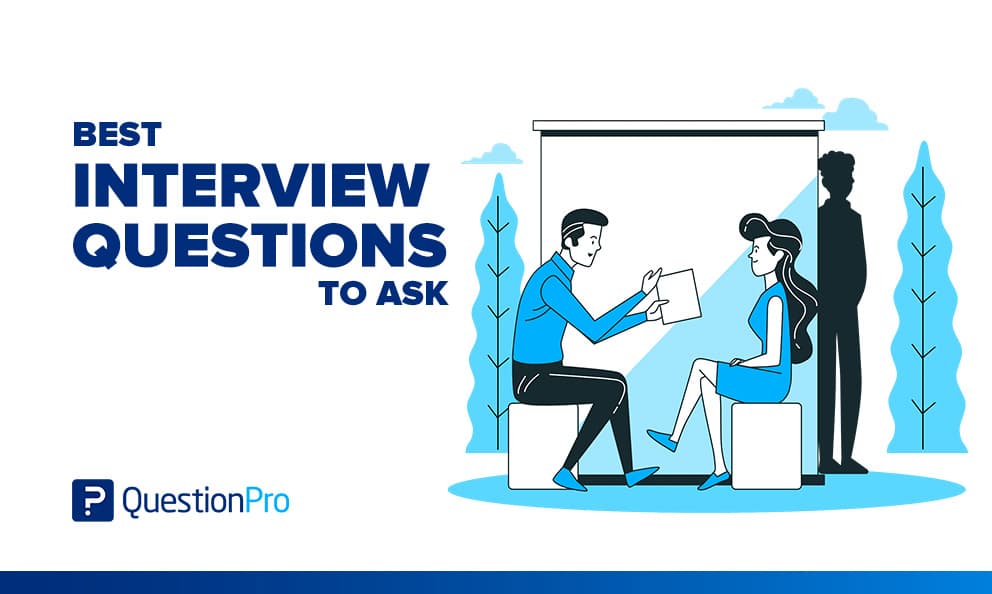
The best interview questions to ask are open-ended, tied to the job, and asked the same way to every candidate. They make people describe real past actions or realistic choices, so you can compare evidence instead of impressions.
This guide gives you more than 30 questions grouped by skill, with what a strong answer shows. It also covers follow-up probes, scoring, questions to avoid, and what candidates should ask you.
What makes a good interview question?
A good interview question is an open-ended prompt that maps to one job skill. It produces an answer you can score. It asks for specifics, such as a situation, an action, and a result, instead of a yes or no.
Four traits separate strong questions from filler:
- Job-related: You can name the skill the question tests before you ask it.
- Open-ended: It starts with “tell me,” “describe,” or “how,” not “do you.”
- Evidence-seeking: It asks for a real example or a clear approach, not a self-description.
- Scorable: You know in advance what a weak, solid, and strong answer sounds like.
The same traits apply whether you hire for a retail floor or an engineering team. What changes is the skill being tested.
How do the main question types differ?
Most interview questions fall into five types. Mixing them gives a fuller picture than relying on one.
| Question type | What it asks | Example opener | Best for |
|---|---|---|---|
| Behavioral | What you did in the past | “Tell me about a time when…” | Proven skills |
| Situational | What you would do | “Suppose a deadline moves up…” | Judgment and problem solving |
| Competency-based | Evidence for one named skill | “Describe how you prioritize…” | Structured scoring |
| Motivational | Why you want this work | “What draws you to this role?” | Fit and retention |
| Technical | How you apply job knowledge | “Walk me through how you would…” | Role-specific skills |
Pick two or three types per interview. Keep the total to six to ten questions so each gets a real follow-up.
How do you choose the interview questions to ask for a specific role?
You choose interview questions by starting from the job, not from a list. Define what success looks like in the role, then write or select one question for each critical skill.
- Study the candidate and the role: Read the resume and profile, and note gaps or achievements worth exploring. Then list the four to six skills the job really requires.
- Prepare your questions in advance: Write them down and ask them in the same order for every candidate in the pool. Our guide on structured and unstructured interviews explains why consistency matters.
- Tailor one or two probes to each person: Keep the core questions identical, then add a probe based on what that candidate’s background raises.
- Look for critical incidents: Ask for a specific moment, such as a failed launch or a tense client call. Concrete episodes reveal more than general claims.
- Watch how they answer, not just what they say: Pauses, hesitation, and changes in tone are clues to dig into with a follow-up. Treat them as prompts to ask more, not as proof.
For delivery tactics such as pacing, note-taking, and panel formats, see our guide to interview techniques.
What are the best behavioral interview questions to ask?
Behavioral interview questions ask candidates to describe how they handled real situations. The premise is that past behavior predicts future behavior. The prompts below work for most professional roles.
- Problem solving.
Ask: Tell me about a time you solved a problem in a tough spot. A strong answer names the problem, the steps taken, and the result. - Handling pressure.
Ask: Describe a time you worked under intense pressure. What did you do? Listen for healthy coping and a clear outcome. - Leading a project.
Ask: Give me an example of a successful project you led. Look for their specific role, not just what the team did. - Receiving feedback.
Ask: Tell me about feedback that was hard to hear. What did you change? Strong answers show a visible change in behavior. - Working with a difficult colleague.
Ask: Describe working with someone whose style clashed with yours. Look for professionalism and a constructive resolution. - Making a difficult decision.
Ask: Tell me about a hard decision you made with incomplete information. Listen for the reasoning, the trade-offs, and what followed. - Adapting to change.
Ask: Describe a time you had to learn a new tool or process quickly. Strong answers include how fast they became proficient. - Managing deadlines.
Ask: How did you handle several competing deadlines at once? Look for a clear method for prioritizing.
The STAR method (Situation, Task, Action, Result) is a handy way to check that an answer is complete. If one part is missing, that is your follow-up.
What situational interview questions should you ask?
Situational interview questions describe a realistic scenario and ask what the candidate would do. They suit entry-level candidates with limited work history, and they test judgment on problems the role will actually present.
- Priorities: “You have three urgent requests from three managers and time for one. How do you decide?”
- Quality versus speed: “A client wants delivery two days early, but you spot an error in your work. What do you do?”
- Ethics: “A coworker shares information they should not have. How do you respond?”
- Ambiguity: “You start a project with unclear goals and no one available to clarify. What are your first steps?”
- Customer pressure: “A customer is upset about a mistake that was not yours. How do you handle the call?”
Score these on the quality of the reasoning, not on whether the candidate lands on your preferred answer. Strong candidates explain trade-offs and say who they would involve.
Which culture fit and motivation questions work?
Culture and motivation questions test how a candidate likes to work and why they want this job. They work best when you define “culture” as specific behaviors, such as how the team gives feedback.
- Work environment: “Describe the environment where you do your best work.”
- Motivation: “What keeps you engaged when the work gets repetitive or hard?”
- Reason for leaving: “What are you looking for in your next role that you do not have now?”
- Relationships: “How would former colleagues and managers describe working with you?”
- Growth: “What do you want to learn in the next two years?”
- Learning habits: “How do you stay current with developments in your field?”
Avoid vague “culture fit” judgments, which let bias in. Describe your own culture in specific behaviors first.
What interview questions should you ask managers and leaders?
Management interview questions test how a candidate leads people, delegates, and communicates under load. Ask for specific examples, and probe for the candidate’s own decisions rather than the team’s results.
- Delegation.
Ask: How do you assign work across your team? Listen for criteria beyond “whoever is free.” - Underperformance.
Ask: Tell me about a time someone on your team underperformed. How did you raise it? Strong answers include a direct conversation and a follow-up plan. - Motivation.
Ask: How do you motivate team members to reach goals that feel like a stretch? Look for approaches that differ by person. - Starting from scratch.
Ask: Describe a project you launched from nothing. What were the biggest hurdles? Listen for planning and recovery. - Conflict.
Ask: Tell me about a team member who disagreed with most of your decisions. What did you do? Look for listening before directing. - Workload.
Ask: How do you manage your own heavy workload while your team keeps asking for help? Strong answers show boundaries and coaching. - Communication.
Ask: Walk me through how you prepared and ran an important meeting. Listen for structure, preparation, and follow-up.
How do you probe for depth with follow-up questions?
A follow-up question is a short probe that turns a general answer into a specific one. It is often more revealing than the scripted question that came before it.
The table below shows which probe fixes which weak answer.
| If the answer is… | Probe with… |
|---|---|
| Vague or general | “Can you give me a specific example?” |
| About the team, not the person | “What was your own part in that?” |
| Missing an outcome | “How did it turn out?” |
| Too polished | “What would you do differently now?” |
| Missing the reasoning | “Why did you choose that approach?” |
| Hypothetical only | “Has this ever happened to you in real life?” |
Plan one probe per question, and use it only when the answer needs it. Our guide to follow-up questions has more probes for different situations.
How do you score answers so you can compare candidates?
You score answers by rating each one on a fixed scale against a description of what good looks like. Without this step, the interview with the most charming candidate usually wins.
Use a simple five-point scale and write anchors for the low, middle, and high scores before the first interview. For example, a 1 means no concrete example. A 3 means a real example with an unclear result. A 5 means a specific example, the candidate’s own actions, and a measurable result.
Score right after each answer, and keep your score separate from other interviewers until the debrief. Our article on interview bias covers rubrics and bias checks in detail.
Which interview questions should you never ask?
Avoid any question that targets protected characteristics. These include age, race, religion, national origin, sex, family plans, and disability. In the US, the EEOC advises that pre-employment questions should be limited to what is essential to judge whether someone is qualified. Employers may not ask about disability before an offer.
Rephrase risky questions around the job itself:
| Avoid | Ask instead |
|---|---|
| “How old are you?” | “Are you legally able to work in the US?” |
| “Do you plan to have children?” | “This role requires travel two weeks a month. Can you meet that?” |
| “Do you have a disability?” | “Can you perform the essential duties of this role, with or without accommodation?” |
| “Where were you born?” | “Which languages do you use at work?” (only if the job requires them) |
| “What church do you attend?” | “Are you able to work the required schedule?” |
When in doubt, ask whether the answer changes your view of the person’s ability to do the job. If it does not, leave the question out. Have your legal or HR team review the final list.
What questions should candidates ask the interviewer?
A good interview leaves time for the candidate’s questions. They show priorities and let you sell the role. If you are the candidate, these are strong questions to bring.
- Role scope: “Can you walk me through what a typical week looks like in this role?”
- Training: “What does onboarding and training look like in the first 90 days?”
- Expectations: “What would success look like after six months?”
- Culture: “How does the team give feedback and handle disagreements?”
- Growth: “What paths have people in this role taken?”
- Next steps: “What happens after this interview, and when should I expect to hear back?”
Avoid yes or no questions and anything you could find on the company website. Wait until you have an offer to ask detailed questions about pay and perks.
Interviewers should answer honestly and in detail. A vague answer is also a signal to the candidate.
How can QuestionPro help you improve your interview process?
QuestionPro helps you check whether your interview process works from the candidate’s side. A candidate survey sent after each stage shows whether questions felt relevant. It also shows whether interviewers were prepared and where people dropped out.
You can use QuestionPro Employee Experience to gather this feedback. A ready-made recruitment satisfaction survey template is a fast starting point, and our guide to candidate experience surveys explains which questions to include.
The same approach works at the other end of the employee journey, such as exit interview survey templates. Comparing candidate, new hire, and exit feedback shows whether you hired for the right things.
What mistakes weaken your interview questions?
Most weak interviews fail for a small set of repeatable reasons. Avoiding them improves your results more than adding new questions.
- Asking different questions to each candidate: It makes scores impossible to compare.
- Using hypothetical questions only: Candidates can describe ideal behavior without ever having done it.
- Leading questions: “You’re good at working under pressure, right?” tells the candidate the answer you want.
- Skipping follow-ups: Surface answers go unchallenged.
- Talking too much: If you speak for more than a quarter of the interview, you learn less.
- Not reviewing the questions: Check which questions actually separated strong hires from weak ones, and drop the rest.
Review your question set after each hiring round. Keep what predicted success and cut what did not.
Great interviews start with the right questions and a fair process
The right interview question gives a candidate room to show real evidence. A consistent process lets you compare that evidence fairly. Start with the skills the job requires. Write open-ended questions for each, plan one probe, and agree on what a strong answer looks like before anyone walks in.
Then keep improving. Ask candidates how the process felt, track which questions predicted performance, and retire the ones that did not.
Frequently Asked Questions (FAQs)
Plan six to ten core questions for a 45 to 60 minute interview. That leaves time for follow-up probes, the candidate’s own questions, and a closing summary. Asking more usually means shallow answers and rushed note-taking.
Behavioral questions ask what a candidate actually did in a past situation. Situational questions present a hypothetical scenario and ask what they would do. Behavioral questions suit experienced candidates, while situational ones work better for entry-level roles with limited history.
They rarely predict job performance, because candidates rehearse the answers. Replace them with behavioral questions, such as feedback you struggled to accept. You learn how the person behaves, not how well they prepared.
Federal law does not ban every question. Questions about age, race, religion, national origin, pregnancy, family plans, or disability can be used as evidence of discrimination. Employers cannot ask about disability before a job offer. Keep every question tied to the job.
Yes for the core questions. Identical questions and a shared scoring scale make candidates comparable and reduce bias. You can add one or two tailored follow-ups. Just score the core questions the same way.