
Customer feedback management is the heartbeat of every successful business. It tells you what works, what needs improvement, and where the next opportunity lies. When companies take the time to listen, they discover exactly how customers think, feel, and experience their products and services.
From short post-purchase surveys to detailed online reviews, every opinion offers a clue about how to make things better. Feedback is more than just data; it is a bridge that connects businesses with real human experiences. It helps improve products, refine services, and build the kind of trust that keeps people coming back.
Effective customer feedback management helps teams collect opinions, analyze patterns, and act on insights to improve products, services, and experiences. In this blog, we will explore why customer feedback matters in today’s competitive market, how surveys help collect and analyze insights, and how to turn those insights into meaningful action.
What Is Customer Feedback Management and Why Is It Important?
Customer feedback management is the process of collecting, analyzing, and acting on customer feedback to improve products, services, and overall experience. Feedback can come from many sources, such as surveys, online reviews, social media comments, or direct conversations. Effectively managing this feedback allows businesses to identify what works well and what needs improvement.
Surveys are one of the most effective ways to collect and manage customer feedback because they allow companies to gather structured opinions and measurable data. Whether it’s a quick post-purchase form or a detailed Net Promoter Score (NPS) survey, feedback helps businesses capture the real voice of their customers and identify areas for improvement.
Here are a few key reasons why customer feedback is important:
- It improves products and services. Feedback helps teams see what customers value most and where issues need fixing.
- It strengthens customer relationships: When people feel heard, they trust the brand more.
- It supports better decision-making: Real opinions from surveys guide product updates and business strategies.
- It drives customer satisfaction and loyalty: Companies that act on feedback often see higher retention rates.
Listening to customers is no longer optional. In a competitive market, understanding what customers think and feel helps businesses stay relevant, improve experiences, and grow sustainably. Ignoring feedback can lead to missed opportunities, while acting on it builds loyalty and long-term success.
How Surveys Help Businesses Collect and Understand Customer Feedback
Surveys play a central role in customer feedback management by helping companies collect insights at every stage of the customer journey. They turn opinions, emotions, and experiences into clear data that businesses can measure and act on. Instead of guessing what customers want, surveys give real answers straight from the people who matter most.
How Surveys Collect Customer Feedback
Surveys make it easy to gather opinions at scale. Businesses can use them at different stages of the customer journey to learn what is working and what is not. For example:
- Post-purchase surveys show how satisfied customers are after buying a product or using a service.
- Website or app surveys reveal if users find the experience easy or confusing.
- Customer Satisfaction (CSAT) and Net Promoter Score (NPS) surveys measure loyalty and overall satisfaction.
- Employee touchpoint surveys uncover how internal service quality affects the customer experience.
Each of these formats captures specific insights that help companies understand their customers’ expectations, needs, and pain points.
2. Why Surveys Are So Effective
Surveys organize feedback in a way that is easy to analyze and share across teams. They help companies see patterns, compare responses over time, and track how changes impact satisfaction.
Here’s why they matter:
- They collect structured data: Surveys turn opinions into measurable results using scales and ratings.
- They uncover deeper insights: Open-ended questions capture what customers really think in their own words.
- They reveal trends quickly: Businesses can spot recurring issues or emerging needs before they grow.
- They support better decisions: From product updates to marketing messages, survey data points the way forward.
3. Understanding Feedback Through Analysis
Collecting feedback is only the first step. The real value appears when businesses take time to analyze survey results. Using tools and dashboards, teams can filter responses, compare satisfaction scores, and identify what drives positive or negative experiences.
When done consistently, survey analysis helps businesses understand not just what customers say, but why they say it. This analytical process is an essential step in customer feedback management, turning raw opinions into clear insights for decision-making.
How to Manage Customer Feedback to Turn Feedback into Actionable Insights?
Collecting feedback is valuable, but in the context of customer feedback management, it only creates impact when businesses take the next step: turning that information into actionable insights that drive improvements.
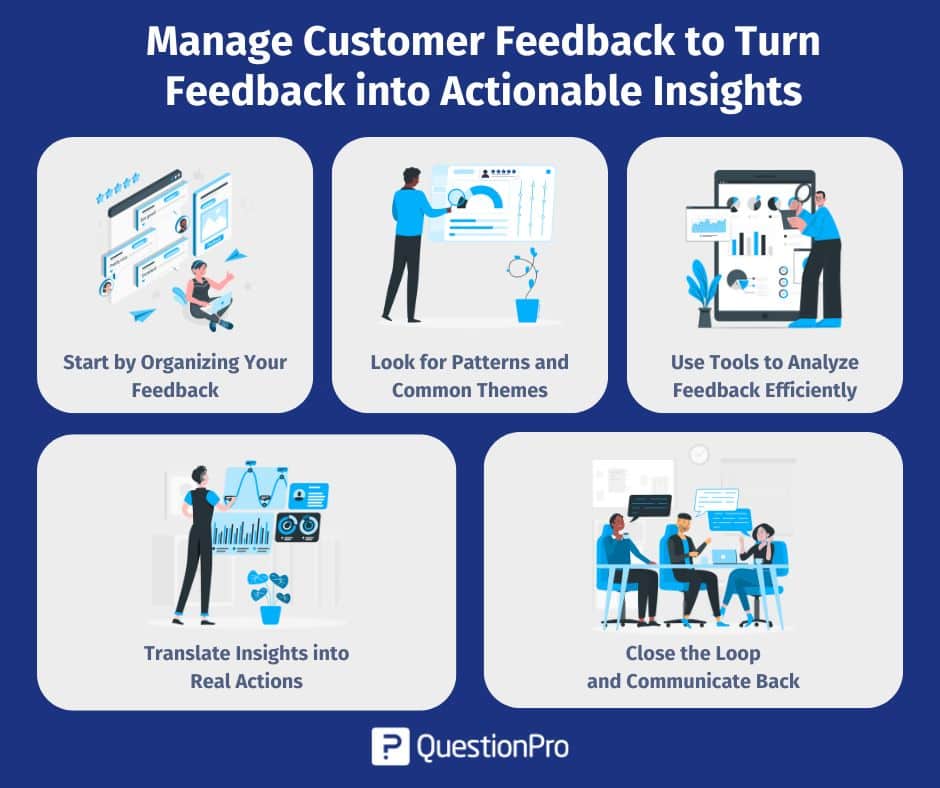
Every comment, rating, or suggestion from customers contains clues about what works well and what needs attention. The real magic happens when feedback is analyzed, understood, and transformed into practical improvements.
1. Start by Organizing Your Feedback
Before doing any analysis, it’s important to keep feedback structured and easy to read. Group responses by type, topic, or department. For example:
- Product feedback can go to the development team.
- Service experience feedback can go to customer support.
- Website or app feedback can go to the UX or design team.
In any customer feedback management process, organizing data by topic or team ensures that no valuable insight is overlooked.
2. Look for Patterns and Common Themes
Once the feedback is organized, the next step is to look for trends. Ask questions like:
- Are customers often mentioning the same issue or feature?
- Which aspects of the experience receive the most positive comments?
- Do satisfaction scores drop after certain interactions?
Identifying patterns gives businesses a clear view of what drives satisfaction and what causes frustration. This makes it easier to prioritize fixes and plan improvements that align with customer expectations.
3. Use Tools to Analyze Feedback Efficiently
Modern survey platforms and customer feedback tools make analysis faster, clearer, and more accurate. Many of these tools include visual dashboards that display results in real time, showing averages, sentiment, and trends across different customer segments.
Quantitative data from rating scales helps businesses track performance metrics, while qualitative data from open-ended questions provides deeper insights into customer emotions and motivations.
By combining both types of information, teams gain a complete picture of what customers think and feel. Using these tools not only saves time but also reduces guesswork, helping teams share insights easily and make better, data-informed decisions across departments.
4. Translate Insights into Real Actions
Turning insights into action is where change begins. Each team should decide what to do based on what the feedback reveals. Examples include:
- Improving a feature that users find confusing.
- Training staff based on customer service complaints.
- Adjusting pricing or policies that create friction.
- Creating new FAQs or tutorials for common issues.
Even small changes can have a big impact when they come directly from what customers say.
5. Close the Loop and Communicate Back
After making improvements, it’s important to let customers know that their voices were heard. This step, known as closing the feedback loop, builds trust and shows genuine care. When people see that their opinions lead to action, they are more likely to respond again in the future and remain loyal to the brand.
How Feedback Management Improves Products and Services
Customer feedback management helps businesses see their products through the eyes of the user, uncovering both strengths and weaknesses. By systematically collecting and acting on this feedback, companies can make ongoing product improvements and refine their services to better meet customer expectations.
It reflects how people feel about a brand’s products, services, and overall experience. When companies collect feedback through surveys and act on it, they make smarter choices that keep customers happy and engaged.
1. Improving Products Through Real Feedback
Every product can improve when customers share their experiences. Feedback helps businesses see their products through the eyes of the user, uncovering both strengths and weaknesses.
For example, if several customers mention that a certain feature is hard to use, the product team can simplify the design. When people request new features, those ideas can shape the next update or release.
A few ways feedback supports product improvement include:
- Spotting recurring issues that need fixing.
- Prioritizing updates based on what matters most to users.
- Testing ideas early with real customer input.
This process helps companies create products that are more useful, reliable, and aligned with customer expectations.
2. Enhancing Service Quality with Customer Insights
Service quality often defines whether a customer stays or leaves. Feedback from surveys, emails, and social channels gives companies a clear picture of how customers feel during interactions with their teams.
When service feels slow, unclear, or impersonal, feedback highlights those moments and gives businesses a chance to improve. By listening carefully, companies can refine communication, train staff better, and make sure every customer feels valued.
Even small changes, such as quicker replies or a friendlier tone, can have a major impact on satisfaction and loyalty.
3. Creating a Better Customer Experience
A great customer experience connects everything: the product, the service, and how people feel throughout their journey. Feedback helps businesses understand the customer journey from start to finish.
Surveys and reviews often reveal small but meaningful details. Maybe the checkout page takes too long to load, or customers struggle to find help when needed. Fixing these issues can make the experience smoother and more enjoyable.
When customers see that a business truly listens and acts on what they say, they feel more connected. This builds trust, encourages repeat purchases, and turns satisfied buyers into loyal advocates.
Common Challenges in Collecting and Managing Customer Feedback
1. Low Response Rates: Many customers ignore survey requests or abandon them halfway.
Tips to fix it:
- Keep surveys short and relevant.
- Use simple, friendly language.
2. Survey Fatigue: Customers lose interest when they receive too many surveys.
How to avoid it:
- Limit the number of surveys you send.
- Let customers know their opinions lead to real improvements.
3. Response Bias: Some surveys only attract very happy or very unhappy customers, leading to unbalanced results.
How to reduce bias:
- Ask neutral questions.
- Combine ratings with open-ended comments.
- Gather feedback from a wider customer group.
4. Managing Too Much Feedback: Large volumes of feedback can be hard to organize or analyze manually.
Smart solution:
- Use survey tools with dashboards and analytics.
5. Not Acting on Feedback: Collecting data without taking action makes customers feel ignored.
How to fix it:
- Review results regularly.
- Prioritize key improvements.
- Close the feedback loop by communicating updates to customers.
Addressing these obstacles early makes customer feedback management more efficient and reliable.
Best Practices for Effective Customer Feedback Management
Strong customer feedback management is all about three things: asking the right people, understanding what they say, and actually doing something with it. The following simple habits make the whole process smoother and more useful for your team.
- Ask clear and focused questions: Keep your survey questions short and simple. For example, ask “What is one thing we could improve about your experience?” rather than “Tell us everything you think about our product and how we can improve it.”
- Collect feedback at the right moment: Send surveys when the experience is still fresh, like right after a purchase, a support chat, or a delivery.
- Use more than one channel: Do not rely on a single source. Use email, your website, your app, and social media to reach different customer types.
- Keep all feedback in one place: Store responses in a single system so nothing gets missed. For example, QuestionPro InsightsHub brings survey responses, trends, and reports together in one place, making it easy for teams to review feedback and share insights.
- Look for trends, not single comments: Pay attention to issues that recur and themes that many customers mention, whether good or bad.
- Close the loop with customers: Tell customers what you changed based on their feedback. It shows you are listening and makes them more likely to respond next time.
How to Use QuestionPro in Collecting and Managing Customer Feedback?
QuestionPro simplifies customer feedback management by combining survey creation, response collection, and real-time analytics in one platform. This all-in-one solution allows businesses to collect feedback seamlessly, analyze results quickly, and take action to improve the customer experience.
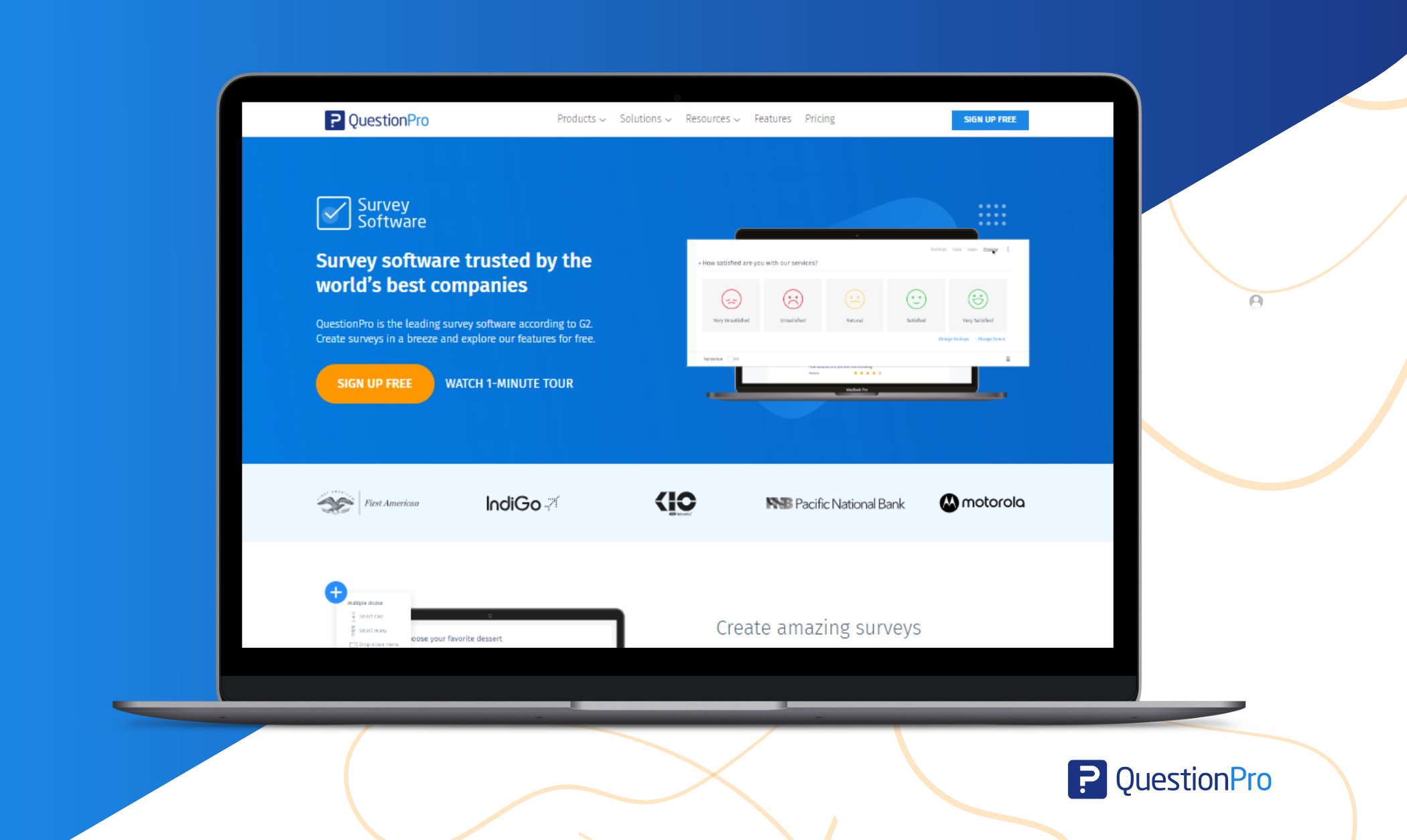
It combines flexibility with powerful analytics so teams can listen to customers, understand their opinions, and make informed decisions.
01. Create Surveys That Fit Your Goals
QuestionPro allows you to build customized surveys based on your specific needs. You can start with ready-made templates for different goals, such as customer satisfaction (CSAT), Net Promoter Score (NPS), or product feedback. Each template can be adjusted with your own branding, questions, and logic.
Some useful features include:
- Question types such as multiple choice, scales, and open-text fields.
- Survey logic and branching to make questions more relevant.
- Multi-language support for global audiences.
These features help you ask better questions and make surveys more engaging for your customers.
02. Distribute Surveys Across Multiple Channels
Once your survey is ready, QuestionPro makes it simple to reach customers wherever they are. You can share surveys through email, website pop-ups, mobile links, or social media.
Reaching people through different channels increases response rates and ensures you collect a variety of opinions from different customer groups. You can also schedule automated reminders to follow up with those who have not yet responded.
03. Analyze Feedback in Real Time
QuestionPro’s analytics dashboard helps you understand responses as they come in. The platform organizes feedback into clear charts and summaries that show trends, sentiment, and overall satisfaction scores.
You can:
- Track NPS and CSAT scores over time.
- Identify recurring issues through text analysis.
- Filter results by location, customer type, or time period.
- Export data for deeper reporting or presentations.
These insights make it easier to see what needs improvement and take action quickly.
04. Manage Feedback Efficiently
QuestionPro not only collects feedback but also helps manage it effectively. The system automatically organizes responses and allows you to assign follow-up tasks to specific teams. For example, if negative feedback appears about delivery, the operations team can be notified immediately.
This process ensures that every piece of feedback is addressed by the right team and no information is lost.
05. Close the Feedback Loop
QuestionPro supports follow-up surveys and alerts that help you measure the impact of your actions. When customers see that their feedback leads to real improvements, it builds trust and encourages them to keep sharing their opinions.
By closing the feedback loop, businesses can strengthen relationships and create a culture that values listening and continuous improvement.
Conclusion
Customer feedback management goes far beyond collecting opinions; it’s about turning them into action. The role of customer feedback goes far beyond collecting opinions; it is about building meaningful connections with the people who use your products and services. Feedback shows what customers appreciate, what they struggle with, and how their experience can be improved. When businesses pay attention to these insights, they create better products, deliver stronger service, and earn long-term loyalty.
Throughout this guide, we explored how surveys help businesses collect and understand feedback, how to turn that information into actionable insights, and how customer feedback shapes products, services, and experiences. We also discussed the common challenges companies face, from low response rates to managing large volumes of data, and how using the right tools can make all the difference.
With a platform like QuestionPro, collecting and managing customer feedback becomes simple and effective. It allows businesses to design engaging surveys, analyze results in real time, and close the feedback loop by acting on what customers say.
Frequently Asked Questions (FAQs)
Answer: Collect at key journey moments: post-purchase, after support, after onboarding, at renewal, and after cancellation.
Answer: Online surveys (post-purchase, in-app, website), CSAT and NPS, review requests, social listening, and support follow-ups.
Answer: Low response rates, survey fatigue, response bias, large volumes of unstructured data, and weak routing or ownership.
Answer: Organize by topic or team, find recurring themes, use analysis tools to surface drivers, assign an owner and due date, then track outcomes.
Answer: Customers feel heard, trust grows, and satisfaction and retention increase when they see visible changes and get follow-ups.